Introduction
Tooth enamel is the hard outer layer that protects the inside of each tooth. It faces constant exposure to plaque, acids from food and drinks, and the mechanical forces of brushing. Once enamel is permanently lost, the body cannot simply grow a new layer of it.
So, how does toothpaste protect enamel?
Toothpaste can help in several ways. Fluoride can support enamel remineralization and make teeth more resistant to acid-related mineral loss. Brushing with toothpaste also helps remove plaque, while the formulation’s abrasive ingredients help clean away surface deposits and stains. At the same time, the type and amount of abrasivity matter, particularly for people concerned about enamel wear or sensitivity.
This guide explains how enamel becomes damaged, how toothpaste helps protect it, which ingredients matter, and what to look for when choosing toothpaste for enamel protection.
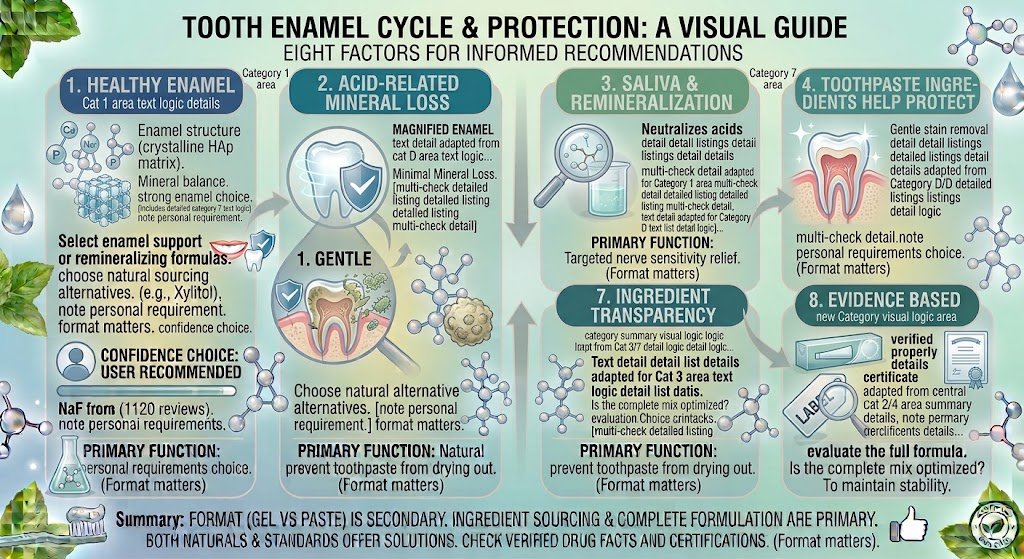
What Is Tooth Enamel?
Tooth enamel is the hard outer covering of the visible part of a tooth. It protects the underlying dentin and the more sensitive inner structures from the forces and chemicals that teeth encounter every day.
Enamel is highly mineralized and is made primarily from calcium- and phosphate-containing mineral crystals arranged into a strong structure. Despite being extremely hard, enamel is not completely unaffected by its environment.
Every day, the tooth surface goes through a balance between demineralization and remineralization.
Demineralization happens when acids cause minerals to leave the enamel. Those acids can come from plaque bacteria metabolizing carbohydrates or from acidic foods and beverages.
Remineralization is the opposite side of the process. Minerals from saliva can return to the tooth surface, helping replace some of the minerals that were lost.
Why Enamel Matters
Enamel is the first line of defense between the outside environment and the more sensitive structures inside a tooth.
When enamel remains intact, it helps protect against:
- Acid-related mineral loss
- Physical wear
- Temperature changes
- Plaque-related damage
- Sensitivity caused by exposure of underlying tooth structure
Once enamel becomes significantly worn away, the underlying dentin can become exposed. This can contribute to sensitivity and can make the tooth more vulnerable to further wear.
That is why enamel protection is not simply about finding a toothpaste labeled “enamel repair.” It is about reducing the factors that cause mineral loss and wear while supporting the tooth’s natural protective processes.
Can Enamel Repair Itself?
This depends on what “repair” means.
Enamel does not contain living cells that can rebuild a missing section of enamel in the same way that some body tissues heal. However, early mineral loss can undergo remineralization.
In other words, there is an important difference between:
Early mineral loss:
Some lost minerals can be replaced, particularly when saliva and fluoride are present.
Permanent structural loss:
Once enamel has been physically worn away or a cavity has formed, toothpaste cannot simply grow the missing structure back.
NIDCR describes tooth decay as a process involving mineral loss and explains that early decay can sometimes be stopped or reversed before a cavity develops. [ add a link ]
For that reason, protecting enamel early is much more useful than expecting toothpaste to rebuild enamel after substantial damage has already occurred.
What Damages Tooth Enamel?
Enamel is exposed to several different types of stress every day. Some are chemical, some are bacterial, and some are mechanical.
Understanding these causes makes it easier to understand how toothpaste can help—and where toothpaste has limitations.
Acid Exposure
Acid is one of the major challenges for enamel.
When the environment around the tooth becomes acidic, minerals can leave the enamel surface. Repeated or prolonged acid exposure can contribute to enamel erosion.
Common sources of dietary acid include acidic drinks and foods. The risk is influenced not only by what someone consumes but also by how frequently and how long the teeth are exposed to acidic conditions.
This is different from plaque-related tooth decay, although both involve acids and mineral loss.
Plaque and Bacterial Acids
Plaque is a sticky layer that develops on tooth surfaces. It contains bacteria and other components.
When certain oral bacteria use fermentable carbohydrates, they produce acids. These acids can lower the pH around the tooth and contribute to mineral loss.
This creates a repeated cycle:
Food carbohydrates → bacterial activity → acid production → mineral loss → enamel weakening
Regular brushing helps disrupt and remove plaque, which is one reason toothpaste is part of a broader cavity- and enamel-protection routine.
Aggressive Brushing
Brushing is essential for oral hygiene, but more pressure does not necessarily mean cleaner teeth.
Using excessive force can contribute to tooth wear, especially when combined with other factors such as acidic exposure, abrasive products, or exposed dentin.
The goal is effective plaque removal without unnecessarily increasing mechanical stress on the teeth.
A soft-bristled toothbrush, appropriate brushing technique, and a suitable toothpaste formulation can all be part of a gentler approach.
Frequent Acidic Foods and Drinks
Enamel can be challenged by repeated exposure to acidic foods and beverages.
For someone concerned about enamel erosion, simply changing toothpaste may not address the main source of the problem. The overall pattern of acid exposure matters too.
This is an important point when choosing an enamel-focused toothpaste:
A toothpaste can support enamel protection, but it cannot completely cancel out an ongoing source of acid exposure.
Whitening and Surface Wear
Whitening toothpaste deserves particular attention because many whitening formulas use abrasives to help remove external surface stains.
That does not mean every whitening toothpaste is automatically harmful to enamel. Abrasives serve a legitimate cleaning purpose. However, readers concerned about enamel should consider the overall formulation and their brushing habits rather than assuming that stronger stain removal is always better.
We will look at this trade-off in more detail later in the article.
How Does Toothpaste Protect Enamel?
Toothpaste does not protect enamel through one single mechanism.
Its effects come from a combination of the toothpaste formulation and the brushing process. The most important mechanisms to understand are fluoride protection, plaque removal, remineralization support, and appropriate abrasivity.
Fluoride Helps Strengthen and Remineralize Enamel
Fluoride is one of the most important ingredients to understand when discussing enamel protection.
When teeth are exposed to acids, minerals can be removed from enamel. Fluoride can help promote remineralization and can make the tooth surface more resistant to subsequent acid attacks.
This is why fluoride toothpaste is widely used for cavity prevention as well as general tooth protection.
The key idea is not that fluoride creates an entirely new layer of enamel. Instead, it helps the tooth surface handle the ongoing cycle of mineral loss and mineral replacement more effectively.
For readers choosing toothpaste specifically for enamel protection, the presence and type of active ingredient should therefore be considered alongside other factors such as sensitivity, abrasivity, and individual dental needs.
Toothpaste Helps Remove Plaque
The toothbrush does most of the physical work of disrupting plaque, but toothpaste supports the cleaning process.
Toothpaste contains ingredients that can help clean the tooth surface, remove debris, and assist with the removal of external stains. Brushing distributes these ingredients across the teeth.
This matters for enamel because plaque can create an acidic environment around teeth when bacteria metabolize carbohydrates.
Reducing plaque regularly therefore helps reduce one of the factors that can contribute to mineral loss and tooth decay.
Toothpaste Can Support Protection Against Acid-Related Damage
Some toothpaste formulations are designed to help protect against enamel erosion or acid-related challenges.
However, toothpaste should not be viewed as a shield that makes teeth immune to acid.
If someone frequently consumes acidic foods or drinks, reducing the frequency of acid exposure can be just as important as choosing an appropriate toothpaste.
After an acidic exposure, the tooth surface may be temporarily softened. Brushing immediately and aggressively under these conditions may increase mechanical wear. Good oral-care guidance therefore considers both chemical exposure and mechanical brushing rather than looking at toothpaste ingredients in isolation.
The Formulation Matters
Two toothpastes can both clean teeth while serving different purposes.
For example:
- One may prioritize cavity prevention with fluoride.
- Another may focus on sensitivity.
- Another may emphasize whitening and stain removal.
- Another may contain hydroxyapatite.
- Another may be formulated with lower abrasivity.
This means the phrase “toothpaste for enamel” does not automatically tell you whether a product is appropriate for your situation.
The active ingredients, abrasive system, intended use, and your own oral-health needs all matter.
Which Toothpaste Ingredients Help Protect Enamel?
The ingredient list can tell you much more about a toothpaste than front-of-package marketing terms.
Different ingredients perform different jobs. Some are active ingredients intended for a particular oral-health benefit, while others mainly provide texture, cleaning, flavor, preservation, or foaming.
Fluoride
The main fluoride compounds found in toothpaste include:
- Sodium fluoride
- Stannous fluoride
- Sodium monofluorophosphate
These compounds deliver fluoride for oral-health purposes, although their formulations and additional properties can differ.
For enamel protection and cavity prevention, fluoride is particularly important because it supports remineralization and helps teeth resist acid-related mineral loss.
Hydroxyapatite
Hydroxyapatite is a calcium-phosphate mineral closely related to the mineral naturally found in teeth and bones.
It has become increasingly common in toothpaste marketed around enamel support, remineralization, and sensitivity.
Nano-hydroxyapatite is a smaller-particle form that is also used in some oral-care products.
However, readers should avoid assuming that a toothpaste is automatically better simply because it contains hydroxyapatite or uses the word “mineral” in its marketing.
The important questions are:
- What is the ingredient intended to do?
- What evidence supports the claim?
- What other active ingredients are present?
- Is the product appropriate for your particular oral-health needs?
Ingredients for Sensitivity
Some people become concerned about enamel because they experience tooth sensitivity.
Sensitivity can occur when underlying dentin becomes exposed or when the tooth’s protective structures are compromised. Certain toothpaste ingredients are designed specifically to help reduce sensitivity.
Potassium nitrate is one example of an ingredient used in sensitivity-focused toothpaste.
This does not mean potassium nitrate directly rebuilds enamel. Its role is different: it is included to address tooth sensitivity.
If sensitivity is your main concern, choosing toothpaste should therefore involve more than simply looking for an “enamel protection” label.
Abrasive Ingredients
Abrasives are included in toothpaste for a practical reason: they help remove surface deposits and external stains during brushing.
Common abrasive materials include forms of silica and calcium carbonate.
But abrasivity needs context.
A toothpaste is not automatically bad for enamel because it contains an abrasive ingredient. The important consideration is how the formulation performs during normal use and how it interacts with factors such as brushing pressure, frequency, acid exposure, and whether dentin is exposed.
The next section looks more closely at this issue because it is especially important for people trying to protect enamel.
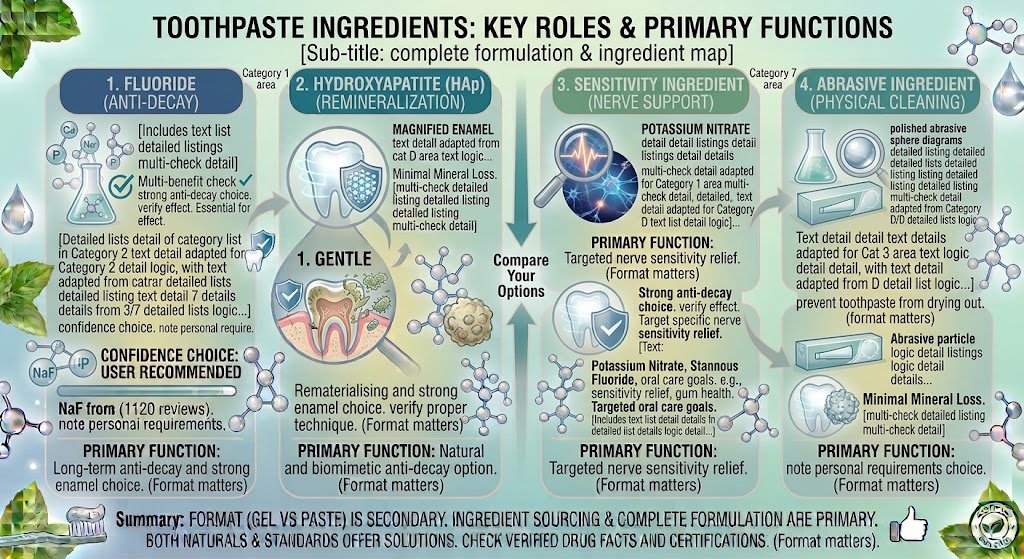
[ ARTICLE CONTINUES — NEXT PART STARTS WITH: H2: “Does Toothpaste Abrasivity Affect Enamel?” ]
::
Part 2 of 3 — continuing exactly from the previous stopping point.
Does Toothpaste Abrasivity Affect Enamel?
Yes, the abrasiveness of toothpaste can matter when you are trying to protect enamel, but abrasive ingredients are not automatically harmful.
Toothpaste needs some level of abrasivity because brushing is not only a chemical process. Abrasive particles help remove plaque, food debris, and surface stains from the teeth. The important question is whether the toothpaste provides enough cleaning power without unnecessary wear, especially when it is used frequently or with excessive brushing pressure.
What Does Toothpaste Abrasivity Mean?
Toothpaste abrasivity refers to how strongly the particles in a toothpaste can contribute to mechanical cleaning.
Common abrasive ingredients include:
- Hydrated silica
- Calcium carbonate
- Other mineral-based cleaning particles
Abrasivity is often discussed using a measurement called Relative Dentin Abrasivity (RDA). RDA is a laboratory measurement used to compare the abrasive potential of toothpastes under standardized testing conditions.
However, RDA should not be interpreted as a simple score where a lower number always means a toothpaste is better.
The actual effect of brushing depends on several factors, including:
- Toothpaste formulation
- Brushing technique
- Brushing pressure
- Brushing frequency
- Toothbrush bristle type
- How long you brush
- Whether enamel has already been weakened
- Whether exposed dentin is present
This is why choosing an enamel-friendly toothpaste should be about the overall formulation and your brushing habits, rather than focusing on one number alone.
Enamel Is Hard, but That Does Not Mean It Is Impossible to Wear
Enamel is the hardest tissue in the human body, but it can still experience wear over time.
Mechanical wear becomes more important when brushing is aggressive, especially if a person uses a highly abrasive product and applies a lot of pressure.
The risk can also be different when enamel has already been affected by acid exposure.
For example, acidic foods and drinks can temporarily soften the tooth surface. Brushing immediately after a significant acid exposure may add mechanical stress to an already vulnerable surface.
This is one reason enamel protection should not be viewed as simply a toothpaste problem. Toothpaste, toothbrush, brushing technique, diet, and timing all work together.
Is Low-Abrasive Toothpaste Better for Everyone?
Not necessarily.
A low-abrasive toothpaste can be particularly worth considering if you are concerned about:
- Enamel wear
- Tooth sensitivity
- Frequent brushing
- Exposed dentin
- Acid erosion
- Using whitening toothpaste regularly
But a toothpaste also needs to clean effectively.
The goal is not to eliminate abrasivity. The goal is to find a formulation that provides useful cleaning while fitting your oral-health needs.
For someone mainly concerned about enamel protection, a sensible approach is to combine an appropriate toothpaste with a soft-bristled toothbrush and gentle brushing technique.
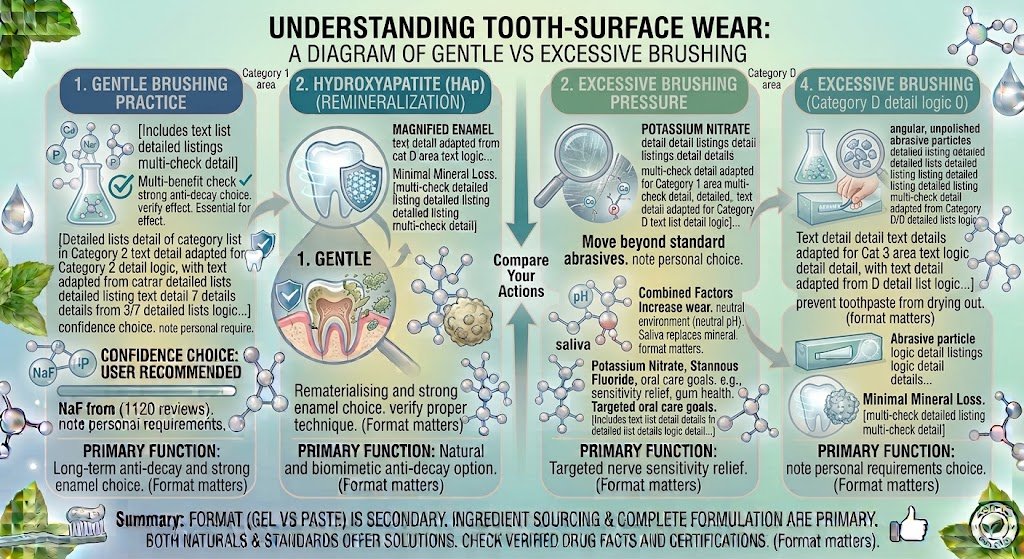
Can Whitening Toothpaste Damage Enamel?
Whitening toothpaste deserves special attention because people often assume that anything marketed for whitening must be damaging to enamel.
That is too simple.
Most whitening toothpastes work mainly by helping remove surface stains. They are different from professional or at-home bleaching products that use chemical bleaching agents to change the color of tooth structure.
Whitening toothpaste may contain more effective stain-removing ingredients or abrasive particles designed to help polish away discoloration.
That can be useful for people with surface staining from foods and drinks.
The concern comes when whitening products are used aggressively or when their cleaning action is combined with excessive brushing pressure.
Whitening Is Not the Same as Bleaching
This distinction is important.
Whitening toothpaste:
Primarily helps remove or reduce surface stains through cleaning and polishing.
Bleaching products:
Use bleaching agents to chemically lighten tooth color.
So when evaluating a whitening toothpaste for enamel protection, do not judge it only by the word “whitening” on the package.
Look at the complete formulation and consider how you use it.
A person who brushes gently with an appropriate whitening toothpaste may have a very different experience from someone who scrubs aggressively with a highly abrasive product several times a day.
What About Whitening and Tooth Sensitivity?
Some whitening products can be associated with increased tooth sensitivity, particularly when stronger whitening approaches are used.
Sensitivity does not automatically mean that enamel has been damaged. Sensitivity can also occur when dentin becomes exposed or when the tooth’s nerve responds to changes in temperature or chemical stimuli.
If you already have sensitive teeth, choosing a whitening toothpaste should therefore involve more than looking for the strongest stain-removing formula.
You may want to prioritize:
- Gentle cleaning
- Appropriate abrasivity
- Sensitivity-supporting ingredients
- Good brushing technique
- A formulation suited to regular use
How to Use Whitening Toothpaste More Carefully
If enamel protection is your priority, consider these habits:
- Use a soft-bristled toothbrush.
- Avoid pressing hard while brushing.
- Follow the product’s directions.
- Do not assume stronger scrubbing produces better whitening.
- Pay attention to sensitivity or discomfort.
- Avoid using multiple aggressive whitening products at the same time.
- Discuss persistent sensitivity or visible tooth wear with a dental professional.
The goal is controlled stain removal, not aggressive polishing.
[ add a link ]
[ External Source: American Dental Association — Whitening / Tooth Whitening guidance ]
Fluoride vs Hydroxyapatite for Enamel Protection
Fluoride and hydroxyapatite are two of the most discussed ingredients when people are choosing toothpaste for enamel protection.
They are related to mineral protection, but they should not be treated as identical ingredients.
Fluoride has a long history of use in cavity-prevention toothpaste and is strongly associated with enamel remineralization and resistance to acid attacks.
Hydroxyapatite is a calcium-phosphate mineral that is chemically related to the mineral found in natural teeth and bones. Toothpaste containing hydroxyapatite is increasingly used as an alternative approach to supporting tooth mineral and reducing sensitivity.
The important question is not simply which ingredient sounds more natural or more advanced.
The better question is:
Which formulation fits your oral-health needs and has appropriate evidence behind its intended use?
Fluoride for Enamel Protection
Fluoride is one of the best-established active ingredients used in toothpaste for preventing dental caries.
When teeth are exposed to acids produced by oral bacteria, minerals can leave the enamel surface. Fluoride can help the tooth surface become more resistant to future acid attacks and supports the remineralization process.
This makes fluoride particularly important for people whose main concern is cavity prevention and enamel mineral protection.
Hydroxyapatite for Enamel Protection
Hydroxyapatite is a calcium-phosphate mineral similar to the mineral structure naturally found in teeth.
Toothpaste formulations containing hydroxyapatite are designed to provide mineral-related benefits at the tooth surface. Some formulations use conventional hydroxyapatite, while others use nano-hydroxyapatite, which consists of much smaller particles.
Hydroxyapatite is particularly interesting to people looking for:
- Mineral-based toothpaste
- Fluoride alternatives
- Support for tooth sensitivity
- Enamel-focused formulations
- Toothpastes built around calcium-phosphate chemistry
However, “contains hydroxyapatite” does not automatically mean that every product provides the same results.
The formulation, concentration, product quality, evidence, and intended use all matter.
Fluoride vs Hydroxyapatite: Which One Should You Choose?
There is no need to turn the decision into a simple “good ingredient versus bad ingredient” debate.
Instead, compare what each approach offers.
| Feature | Fluoride Toothpaste | Hydroxyapatite Toothpaste |
| Main role | Cavity prevention and mineral protection | Mineral-support approach and enamel-focused care |
| Enamel connection | Supports remineralization and acid resistance | Mineral is chemically related to tooth structure |
| Cavity-prevention evidence | Extensive | Evidence exists, but is less established than fluoride overall |
| Sensitivity use | Some fluoride formulations can help indirectly; depends on product | Commonly marketed for sensitivity support |
| Suitable for fluoride-free preference | No | Yes |
| Best considered for | People prioritizing established cavity protection | People specifically interested in hydroxyapatite-based formulations |
The table is a starting point, not a substitute for evaluating the actual toothpaste.
For someone at elevated risk of cavities, fluoride may be especially important. Someone specifically seeking a fluoride-free mineral-based option may instead investigate hydroxyapatite toothpaste.
Why the Whole Formula Matters
Enamel protection does not come from one ingredient alone.
A toothpaste may contain a useful active ingredient but still be a poor personal fit if it is too abrasive for your needs, causes irritation, does not address sensitivity, or does not match your cavity-risk needs.
That is why a better evaluation looks at:
- Active ingredients
- Fluoride status
- Abrasivity
- Sensitivity needs
- Flavoring and other ingredients
- Intended age group
- Product directions
- Evidence behind the claims
- Overall oral-health needs
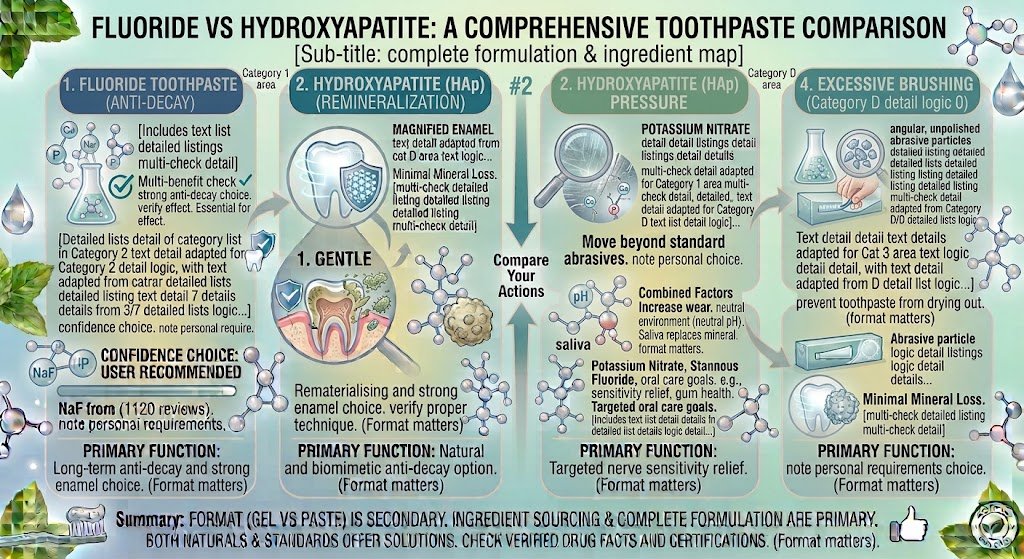
How to Choose Toothpaste for Enamel Protection
If your main goal is protecting enamel, choosing toothpaste should start with your specific risk factors, not with the most attractive marketing claim.
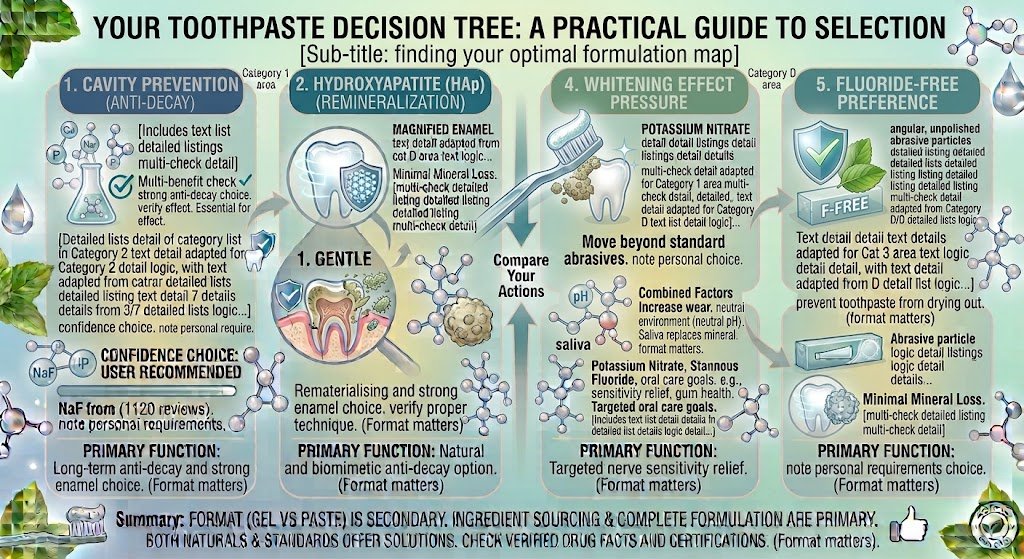
A useful selection process is to work through the following questions.
1. Are Cavities Your Main Concern?
If cavity prevention is your highest priority, look closely at fluoride toothpaste.
Fluoride has strong evidence supporting its role in preventing dental caries and helping teeth withstand acid-related mineral loss.
2. Are You Mainly Concerned About Enamel Wear or Erosion?
If your concern is enamel erosion, look beyond the active ingredient.
Consider the toothpaste’s cleaning characteristics and your brushing habits.
A toothpaste designed for regular use, combined with gentle brushing, may be a more sensible choice than repeatedly using highly aggressive stain-removing products.
3. Do You Have Sensitive Teeth?
Sensitivity can change what you should prioritize.
Look for formulations designed for sensitive teeth and consider whether the product provides ingredients intended to reduce sensitivity.
At the same time, investigate the reason behind the sensitivity. Tooth sensitivity can have multiple causes, including enamel wear, exposed dentin, gum recession, or other dental problems.
4. Are You Using Whitening Toothpaste?
If whitening is important, pay attention to how often you use it and how aggressively you brush.
Surface-stain removal can be useful, but whitening should not become an excuse for excessive scrubbing.
If enamel protection is your priority, look for a balanced formulation rather than assuming the strongest polishing effect is the best option.
5. Do You Prefer Hydroxyapatite?
If you prefer a fluoride-free or mineral-based approach, hydroxyapatite may be worth researching.
Compare conventional hydroxyapatite and nano-hydroxyapatite formulations, and pay attention to the evidence supporting the specific claims made by the product.
6. Is the Toothpaste Too Abrasive for Your Needs?
If you have concerns about enamel wear, exposed dentin, or sensitivity, abrasivity deserves attention.
Do not automatically assume that the lowest possible abrasivity is ideal. Instead, look for an appropriate balance between effective cleaning and gentle use.
7. Are You Evaluating the Ingredients Carefully?
For a non-toxic toothpaste website, ingredient transparency is especially important.
Instead of relying on labels such as:
- Natural
- Clean
- Non-toxic
- Enamel safe
- Mineral-based
- Whitening
look at the actual ingredient list and understand what each ingredient is intended to do.
A Simple Enamel-Protection Checklist
Before choosing a toothpaste, ask:
Does it contain an active ingredient that fits my needs?
Is its cleaning action appropriate for how often I brush?
Am I choosing fluoride or fluoride-free based on evidence and my personal needs rather than marketing alone?
Do I need sensitivity support?
Am I using a whitening formula frequently?
Could my brushing technique be contributing to wear?
Does the product clearly explain its ingredients and intended use?
This approach is more useful than choosing toothpaste based on a single “clean” or “natural” label.
[ ARTICLE CONTINUES — NEXT PART STARTS WITH: H2: “What Toothpaste Cannot Do for Your Enamel” ]
What Toothpaste Cannot Do for Your Enamel
Toothpaste can support enamel protection, but it is important to understand its limits.
One of the biggest mistakes in oral-care marketing is treating enamel as if it can simply be “regrown” whenever it becomes damaged.
That is not how enamel works.
Toothpaste Can Support Remineralization, But It Cannot Regrow Lost Enamel
Enamel does not contain living cells, so once significant enamel structure has been permanently lost, the body cannot grow a new layer of enamel in the same way that skin can heal.
However, early mineral loss is different from permanent structural loss.
When acids remove minerals from the tooth surface, saliva and certain toothpaste ingredients can support the remineralization of areas where mineral loss is still at an early stage.
Fluoride is particularly important in this process.
Hydroxyapatite-based formulations are also designed around supplying or supporting mineral-related processes at the tooth surface.
So it is more accurate to say that toothpaste can help protect, strengthen, and support remineralization of weakened enamel than to say that it can completely rebuild enamel that has already been worn away.
Toothpaste Cannot Reverse Severe Enamel Erosion
If enamel has been significantly lost because of acid erosion, grinding, abrasion, or another cause, toothpaste cannot simply replace the missing tooth structure.
For example, if the enamel surface has physically worn away, brushing with a mineral-containing toothpaste does not recreate the original thickness of that enamel.
At that point, the priority becomes:
- Identify what caused the damage.
- Prevent additional enamel loss.
- Protect the remaining tooth structure.
- Manage sensitivity if present.
- Get professional dental evaluation when damage is significant.
Toothpaste Cannot Cancel Out an Acidic Diet
Even an excellent toothpaste cannot completely compensate for frequent acid exposure.
Regular consumption of acidic drinks and foods can increase the amount of time teeth spend in an acidic environment.
Examples can include:
- Soft drinks
- Energy drinks
- Sports drinks
- Fruit juices
- Citrus foods
- Vinegar-based foods
- Other acidic beverages or foods
The overall pattern matters.
Someone who frequently exposes their teeth to acids throughout the day may have a different enamel risk profile from someone who consumes the same food or drink occasionally.
Toothpaste should therefore be viewed as one part of an enamel-protection strategy, not as a shield that makes harmful habits irrelevant.
Toothpaste Cannot Replace Professional Dental Care
Toothpaste can help with daily oral hygiene, but it cannot diagnose the cause of enamel loss, sensitivity, pain, or visible tooth changes.
A dental professional can assess problems such as:
- Enamel erosion
- Cavities
- Cracks
- Dentin exposure
- Gum recession
- Tooth wear
- Grinding-related damage
Persistent sensitivity or visible changes in the tooth surface should not simply be treated by switching toothpaste repeatedly.
[ add a link ]
[ External Source: National Institute of Dental and Craniofacial Research — Tooth Decay / Oral Health guidance ]
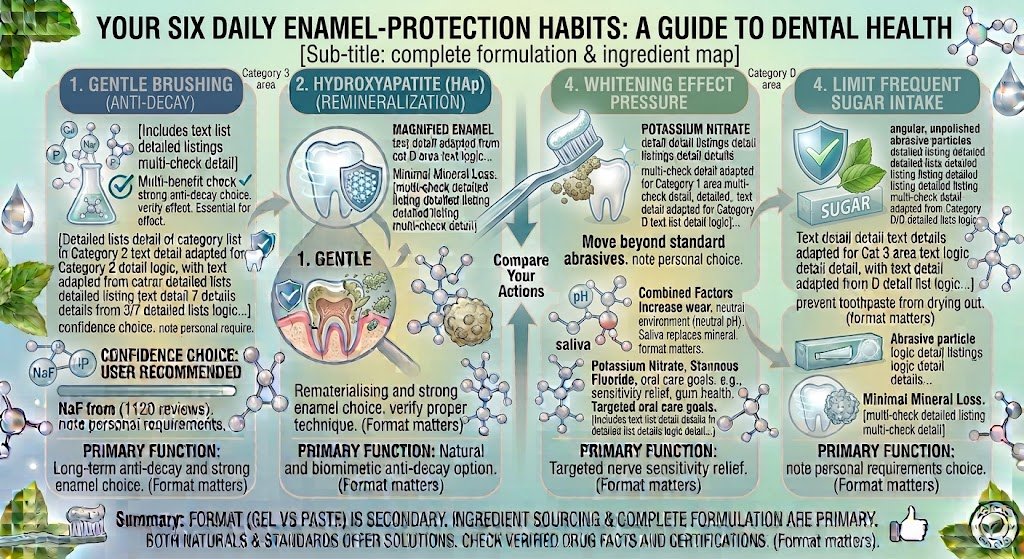
Habits That Help Protect Enamel Besides Toothpaste
The best enamel-protection routine combines toothpaste with daily habits that reduce mineral loss and unnecessary mechanical wear.
Brush Gently With a Soft-Bristled Toothbrush
Brushing harder does not necessarily mean cleaning better.
Use gentle pressure and allow the toothbrush to do the cleaning rather than scrubbing aggressively.
A soft-bristled toothbrush can also help reduce unnecessary mechanical stress on teeth and gums.
Your goal should be thorough cleaning without excessive force.
Brush Twice a Day
Regular brushing helps control dental plaque.
Plaque contains bacteria that can produce acids when they metabolize sugars and other carbohydrates.
Removing plaque regularly helps reduce the conditions that contribute to tooth decay and acid-related mineral loss.
Be Careful After Acidic Foods and Drinks
If you have just consumed something acidic, avoid immediately following it with aggressive brushing.
Instead, give your mouth time to return toward a less acidic environment.
Rinsing with water after acidic foods or drinks can also be a simple way to reduce the amount of acid remaining in the mouth.
The exact approach can depend on your overall dental situation, but the larger principle is simple:
Reduce repeated acid exposure and avoid adding unnecessary mechanical stress immediately after acid exposure.
Drink Water Regularly
Water can help rinse the mouth and supports normal saliva function.
Saliva is important for oral health because it helps neutralize acids and provides minerals involved in the natural remineralization process.
This is another reason enamel protection is not only about toothpaste.
Your mouth already has a natural protective system, and toothpaste works alongside it.
Limit Frequent Acid and Sugar Exposure
It is not only the amount of sugar or acidic food that matters.
Frequency matters too.
Repeated exposure gives oral bacteria and acids more opportunities to affect the tooth surface.
Reducing constant snacking and frequent sipping of sugary or acidic beverages can therefore be helpful for protecting teeth.
Avoid Using Your Teeth as Tools
Teeth are designed for biting and chewing food, not for opening packages, cutting objects, or holding hard materials.
Using teeth as tools can create unnecessary stress and may contribute to cracks or physical damage.
Consider Teeth Grinding
Grinding or clenching can place substantial mechanical stress on teeth.
If you regularly wake with jaw discomfort, notice tooth wear, or suspect that you grind your teeth, discuss it with a dental professional.
Changing toothpaste alone will not solve mechanical damage caused by grinding.
Frequently Asked Questions
Can toothpaste repair enamel?
Toothpaste can support the remineralization and protection of enamel when mineral loss is still reversible, particularly through ingredients such as fluoride. It cannot regrow enamel that has already been permanently lost.
Does fluoride strengthen enamel?
Fluoride can make tooth surfaces more resistant to acid attacks and supports the remineralization of early mineral loss. This is one reason fluoride toothpaste is widely used for cavity prevention.
What toothpaste is best for enamel?
There is no single toothpaste that is best for every person.
For enamel protection, consider a toothpaste with an appropriate active ingredient, suitable abrasivity, and a formulation that matches your needs. If cavity prevention is a major concern, fluoride is an important consideration. If you are specifically interested in a fluoride-free mineral-based approach, hydroxyapatite may be worth evaluating.
Is whitening toothpaste bad for enamel?
Not automatically.
Whitening toothpaste is generally designed to help remove surface stains, and the effect depends on the formulation and how the toothpaste is used. Excessive brushing pressure and inappropriate use can increase mechanical wear.
If enamel protection is your priority, focus on the overall formulation and use gentle brushing technique rather than assuming that every whitening toothpaste is harmful.
Is hydroxyapatite good for enamel?
Hydroxyapatite is a calcium-phosphate mineral related to the mineral naturally found in teeth. Hydroxyapatite toothpastes are designed to support mineral-related tooth-surface care and are commonly considered by people interested in fluoride-free or mineral-based toothpaste.
The evidence and formulation can vary, so the specific product matters.
Does toothpaste help enamel erosion?
Toothpaste can be part of an enamel-protection routine, but it cannot replace enamel that has already been permanently lost.
For erosion, the bigger goal is to identify and reduce the source of acid exposure or mechanical wear while maintaining good oral hygiene.
Is low-abrasive toothpaste better for enamel?
A lower-abrasive formulation may be useful for people concerned about enamel wear, sensitivity, or exposed dentin. However, abrasivity should be considered alongside cleaning performance, active ingredients, and brushing technique.
The best choice is not necessarily the toothpaste with the lowest possible abrasivity.
Can brushing too hard damage enamel?
Yes. Excessive brushing pressure can contribute to tooth wear, particularly when combined with abrasive toothpaste or other sources of mechanical or acid-related wear.
Gentle brushing with a soft-bristled toothbrush is generally a better approach than aggressive scrubbing.
Is fluoride or hydroxyapatite better for enamel?
Both are used in enamel-focused toothpaste, but they have different evidence bases and use cases.
Fluoride has extensive evidence for cavity prevention and remineralization. Hydroxyapatite is a mineral-based approach that has attracted interest for enamel and sensitivity support, particularly among people seeking fluoride-free options.
Your cavity risk and personal preferences should guide the decision.
The Bottom Line
Toothpaste protects enamel through a combination of chemical support and mechanical cleaning.
Fluoride can help strengthen the tooth surface, support remineralization, and improve resistance to acid attacks. Hydroxyapatite provides another mineral-based approach that is increasingly used in enamel-focused toothpaste formulations.
But the ingredient is only one part of the equation.
A toothpaste should also have an appropriate level of cleaning power, fit your sensitivity and cavity-prevention needs, and be used with a gentle brushing technique.
For people concerned about enamel, the most useful approach is to focus on the complete picture:
- Choose toothpaste based on your actual oral-health needs.
- Consider fluoride if cavity prevention is a priority.
- Evaluate hydroxyapatite if you prefer a mineral-based fluoride-free option.
- Avoid unnecessarily aggressive brushing.
- Consider toothpaste abrasivity if enamel wear or sensitivity is a concern.
- Be cautious with frequent acid exposure.
- Treat whitening as a stain-removal decision, not simply an “enamel-safe” or “enamel-damaging” label.
- Remember that toothpaste can support early remineralization but cannot regrow enamel that has already been permanently lost.
- Seek professional advice when sensitivity, pain, or visible tooth damage persists.
If you are comparing products, the next step is to evaluate the active ingredients, abrasivity, intended use, sensitivity support, and overall ingredient formulation rather than choosing based only on labels such as “natural,” “clean,” or “non-toxic.”
Choosing a Non-Toxic Toothpaste for Enamel Protection
For readers shopping for a non-toxic toothpaste, enamel protection should remain connected to the actual function of the product.
A product should not receive a recommendation simply because it has a short ingredient list or uses the word “natural.”
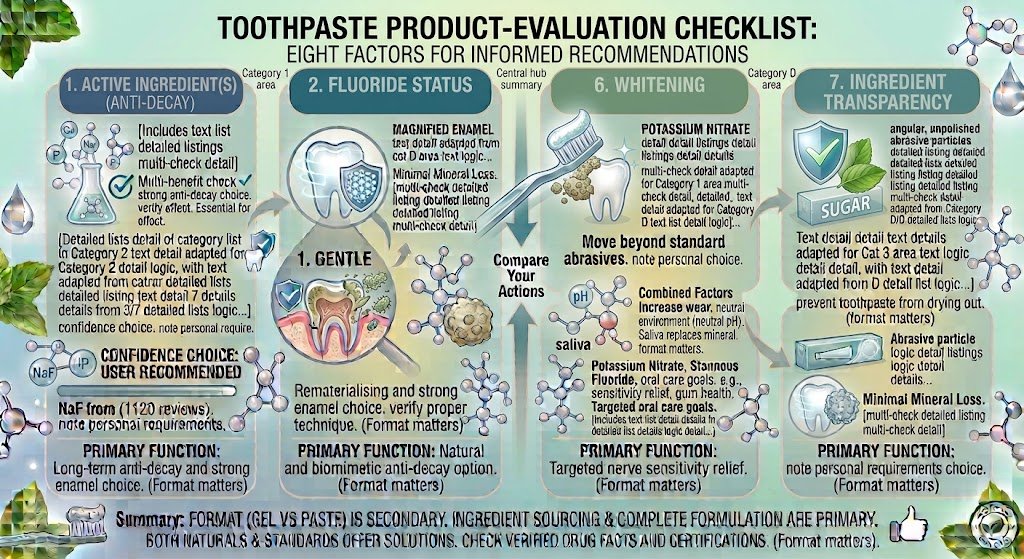
A better evaluation looks at:
1. Active ingredient:
What ingredient is responsible for the toothpaste’s main oral-health benefit?
2. Fluoride status:
Does the product contain fluoride, or is it specifically formulated as fluoride-free?
3. Mineral-support ingredients:
Does it contain hydroxyapatite or another ingredient relevant to the product’s intended purpose?
4. Abrasivity:
Is the cleaning approach appropriate for regular use and your enamel concerns?
5. Sensitivity needs:
If you have sensitive teeth, does the formulation address that concern?
6. Whitening claims:
Is the product mainly removing surface stains, and is it appropriate for your intended frequency of use?
7. Ingredient transparency:
Can you clearly identify what each major ingredient is doing?
8. Evidence and product claims:
Are the claims supported by credible evidence rather than relying on vague “clean” or “non-toxic” marketing language?
This framework helps separate useful product information from marketing language.
For affiliate recommendations, each toothpaste should also be checked against the current product formulation and manufacturer information before publication.
Affiliate Disclosure
This article may contain affiliate links. If you purchase a product through one of these links, we may earn a commission at no additional cost to you. Our recommendations are based on product characteristics, ingredient information, evidence, and suitability for the stated use—not simply on commission potential.
