Choosing toothpaste for a child is not just about finding a tube with a fun flavor or cartoon on the package. Parents also need to consider the child’s age, fluoride, how much toothpaste to use, whether the child can spit, and the child’s risk of cavities.
For most children, dental organizations recommend fluoride toothpaste in an age-appropriate amount, with an adult helping or supervising young children while they brush. The American Dental Association (ADA) recommends a rice-sized smear from the first tooth through age 3, then a pea-sized amount from ages 3 to 6. ADA
This guide explains what to look for in toothpaste for children, how fluoride fits into the decision, how much to use, which ingredients matter, and how to compare products before buying.
What Should You Look for in Toothpaste for Children?
A good children’s toothpaste should fit the child’s age, dental needs, brushing ability, and family preferences.
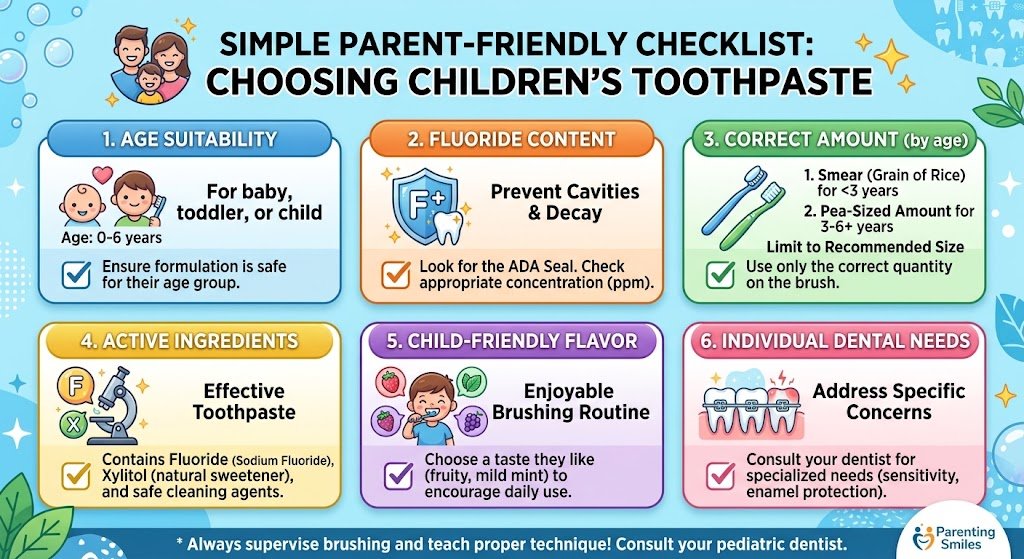
Before looking at brands, check these factors:
- Age suitability: Follow the manufacturer’s age guidance and your child’s dental professional’s advice.
- Fluoride: For most children, fluoride toothpaste is an important part of cavity prevention.
- Active ingredient: Check the active ingredient rather than relying only on marketing terms such as “natural” or “clean.”
- Amount needed: Younger children need only a very small amount.
- Flavor: A child who dislikes the taste may resist brushing.
- Ingredients: Parents may have preferences about SLS, dyes, flavoring agents, or sweeteners, but unfamiliar ingredients are not automatically harmful.
- Evidence and quality signals: Where available, an ADA Seal of Acceptance can provide an additional signal that a product has met the program’s requirements.
- Individual dental needs: A child with frequent cavities, sensitivity, enamel concerns, or another dental issue may need a recommendation tailored by a dentist.
The most important point is that the “best” toothpaste is not necessarily the one with the most natural-sounding label or the highest price. It is the one that fits the child’s needs and can be used correctly and consistently.
Should Children Use Fluoride Toothpaste?
For most children, yes. The ADA recommends brushing twice a day with fluoride toothpaste, including for young children once their first teeth erupt. The amount should be adjusted according to age. ADA
Fluoride is important because it helps protect teeth against dental caries (cavities). Toothpaste also helps physically remove plaque from the teeth, while fluoride provides additional protection against tooth decay. ADA
Why Fluoride Matters for Children’s Teeth
Children’s teeth can develop cavities just like adult teeth. Primary teeth are also important for a child’s ability to eat comfortably and maintain normal oral development.
Fluoride works mainly through topical contact with the teeth. Regular brushing with fluoride toothpaste helps maintain fluoride around the tooth surfaces and supports the prevention of tooth decay.
The important thing for parents is not simply asking, “Does this toothpaste contain fluoride?” The practical question is:
Is the toothpaste appropriate for my child’s age, and am I using the correct amount?
How Much Fluoride Toothpaste Should a Child Use?
The ADA’s guidance is straightforward:
| Child’s age | Recommended amount |
| First tooth to under 3 years | No more than a rice-sized smear |
| 3 to 6 years | No more than a pea-sized amount |
| Older children | Follow appropriate brushing guidance and the child’s dental needs |
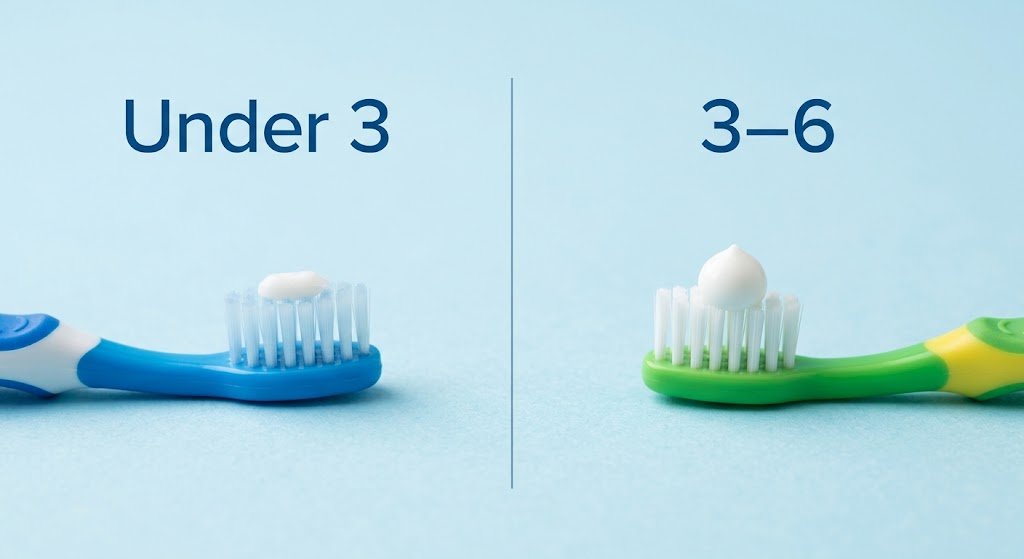
For children under 3, the ADA recommends starting fluoride toothpaste when the first tooth erupts and using no more than a smear about the size of a grain of rice. From ages 3 to 6, the recommended amount is no more than a pea-sized portion. ADA
What If a Child Swallows Toothpaste?
Young children may swallow some toothpaste while learning to brush. That is one reason the amount of toothpaste matters.
Parents and caregivers should supervise young children and encourage them to spit out excess toothpaste rather than swallowing it. ADA
Using a very small amount does not mean parents should avoid fluoride toothpaste altogether. Instead, follow the age-appropriate amount and your child’s dental professional’s advice.
For more detailed information about accidental swallowing:
How Much Toothpaste Should Children Use?
The amount of toothpaste on the toothbrush is one of the easiest things for parents to control.
For a child younger than 3, think grain of rice, not a full strip of toothpaste.
For a child between 3 and 6, think pea-sized, not a large blob covering the toothbrush.
The ADA specifically recommends these amounts because young children can swallow toothpaste, and using more than necessary increases their fluoride exposure from swallowed toothpaste. ADA
Parents should also supervise brushing, especially when children are still developing the ability to brush thoroughly and spit reliably.
Children’s Toothpaste by Age
Age is one of the easiest ways to narrow down your choices.
Toothpaste for Babies and First Teeth
Once a baby’s first tooth appears, it needs regular cleaning. The ADA recommends beginning brushing with fluoride toothpaste at that point, using no more than a rice-sized smear for children younger than 3. ADA
The toothbrush should be appropriately sized for a baby’s mouth, with soft bristles.
Parents should not wait until a child has a complete set of teeth before starting an oral-care routine.
Toothpaste for Toddlers
Toddlers are often learning to hold a toothbrush, copy adults, and spit. That makes parental assistance and supervision particularly important.
Use no more than a rice-sized smear of fluoride toothpaste until age 3. Once the child reaches age 3, the recommended amount changes to a pea-sized portion. ADA
For toddlers, flavor can also matter. A toothpaste that a child strongly dislikes may make twice-daily brushing more difficult, so taste and texture can be practical selection factors.
Toothpaste for Young Children
From ages 3 to 6, the ADA recommends no more than a pea-sized amount of fluoride toothpaste and continued adult assistance or supervision with brushing. ADA
At this stage, parents can gradually encourage children to take more responsibility for brushing while still checking that teeth are actually being cleaned.
Older Children
Older children can generally become more independent with brushing as their coordination improves.
However, independence does not automatically mean that parents should stop paying attention to oral hygiene. Children may still rush, miss areas, use too much toothpaste, or develop habits that need correction.
The ADA recommends brushing twice daily with fluoride toothpaste, while individual recommendations can vary according to a child’s dental risk and professional advice. ADA
Which Ingredients Matter in Children’s Toothpaste?
You do not need to memorize every ingredient on a toothpaste label.
Instead, focus on the ingredients that have a meaningful relationship to the toothpaste’s purpose and your child’s needs.
Fluoride
Fluoride is the most important active ingredient to understand when evaluating everyday cavity-prevention toothpaste for children.
Common fluoride compounds found in toothpaste include:
- sodium fluoride
- stannous fluoride
- sodium monofluorophosphate
The exact formulation matters less than simply recognizing that different fluoride compounds can serve a preventive role and that the product should be appropriate for the intended user.
Abrasives
Toothpaste needs cleaning ingredients to help remove plaque and surface debris.
The formulation should balance cleaning performance with an appropriate level of abrasivity. Parents do not need to automatically reject a toothpaste simply because it contains an abrasive ingredient; what matters is the overall formulation and intended use.
Flavoring
Flavor is often underestimated.
A child may have no problem brushing with one toothpaste but refuse another because it tastes too strong, too minty, or otherwise unpleasant.
For that reason, child acceptance is a legitimate practical consideration. A toothpaste that sits unused in the bathroom is not helping anyone.
Sweeteners
Some toothpastes contain sweetening ingredients to make the product more pleasant to use.
Parents should not assume that the presence of a sweetener automatically makes a toothpaste unsafe. Look at the complete formulation rather than judging one ingredient in isolation.
SLS, Dyes and Other Ingredients
Some parents prefer children’s toothpaste without SLS, artificial dyes, or certain flavoring ingredients. Those preferences can be reasonable, particularly when a child has a known sensitivity or simply tolerates another formulation better.
But there is an important distinction between:
“I prefer this formulation for my child”
and:
“Every toothpaste containing this ingredient is dangerous.”
The second statement requires much stronger evidence.
For a broader explanation of how to interpret labels:
Fluoride vs Fluoride-Free Toothpaste for Children
This is one of the biggest areas of confusion for parents.
A fluoride-free toothpaste may appeal to parents who are specifically looking for a particular ingredient profile. But fluoride-free does not automatically mean better or safer for every child.
For children at risk of cavities, fluoride toothpaste has an important role in cavity prevention. The ADA and AAPD recommend fluoride toothpaste for young children in appropriate amounts. ADA
That means parents should not make the decision based solely on the words “natural,” “clean,” or “fluoride-free.”
Instead, consider:
- the child’s age
- cavity history
- fluoride exposure from other sources
- the child’s ability to spit
- the toothpaste’s active ingredients
- advice from the child’s dentist
A child who has frequent cavities may have very different needs from a child with a low cavity risk. That’s one reason personalized dental guidance can be useful.
How to Choose the Right Children’s Toothpaste
Once you understand the basics, choosing a product becomes much easier.
Use this decision process.
1. Start With Age
First check the child’s age and the product’s stated age suitability.
Do not assume that a product marketed as “kids toothpaste” is appropriate for every child.
2. Consider Fluoride
For most children, fluoride toothpaste is an important part of cavity prevention.
If you’re unsure whether your child should use fluoride toothpaste, discuss the decision with their dentist rather than relying on a marketing claim.
3. Check the Active Ingredient
Look beyond the front of the package.
Check the ingredient information and identify the active ingredient and its intended dental function.
4. Think About Your Child’s Dental Risk
A child with previous cavities, orthodontic appliances, or other oral-health concerns may need a more individualized approach. The AAPD notes that fluoride benefit and preventive strategies should be considered in the context of a child’s individual caries risk. AAPD
5. Consider Flavor and Texture
A toothpaste that your child willingly uses twice a day may be more practical than one they repeatedly refuse.
6. Look at Ingredients Based on Your Actual Concerns
If you prefer SLS-free, dye-free, or another formulation, compare products based on the full ingredient list.
Do not assume that one “clean” marketing claim tells you everything about the formulation.
7. Consider Quality Signals
An ADA Seal of Acceptance can be useful when available. The ADA explains that products submitted for the Seal are evaluated against specific safety and effectiveness criteria. ADA News
8. Compare Value, Not Just Price
A cheaper tube is not necessarily better value if the child refuses to use it. Likewise, a more expensive toothpaste is not automatically more effective.
Compare:
- price
- amount in the tube
- frequency of use
- formulation
- age suitability
- features that actually matter to your child
What We Look For in Children’s Toothpaste
When comparing products for this article, the goal should not be to find a product with the most impressive marketing language.
A useful evaluation should consider:
- Age suitability
- Active ingredient
- Fluoride status
- Cavity-prevention purpose
- Ingredient transparency
- Flavor and child acceptance
- Evidence or recognized quality signals
- Price and value
- Manufacturer information
- Potential fit for a particular use case
This approach also makes it easier to explain why one product may suit one family while another product may be better for a different child.
Recommended Toothpaste for Children
The right product depends on what you want to prioritize.
Rather than declaring one toothpaste universally best for every child, a better approach is to compare products by use case.
What to Compare Before Buying
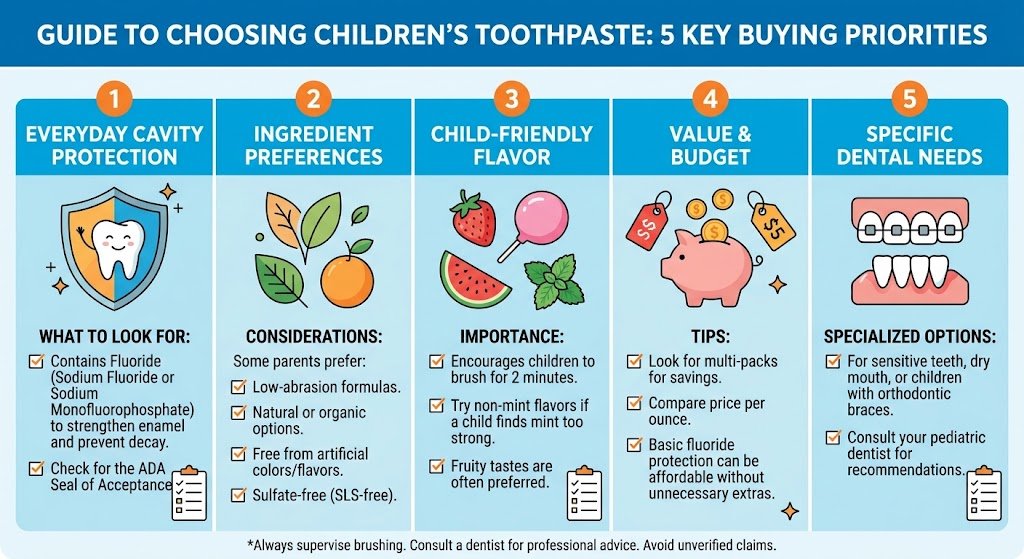
| Product category | What matters most |
| Everyday fluoride toothpaste | Age suitability and cavity protection |
| Ingredient-conscious toothpaste | Clear ingredient list and desired formulation |
| Toothpaste for picky children | Flavor and texture acceptance |
| Value-focused toothpaste | Appropriate formulation and cost per use |
| Toothpaste for a specific dental concern | Child’s individual needs and professional guidance |
Best Everyday Option
For a child who needs an everyday toothpaste, prioritize age suitability and fluoride-based cavity protection rather than packaging or marketing language.
The product should be easy for the parent to dispense in the appropriate amount and acceptable enough that the child will use it consistently.
Best for Ingredient-Conscious Parents
If your family prefers a particular ingredient profile, compare the complete ingredient lists rather than relying on words such as “clean” or “natural.”
A fluoride-free formulation may meet a parent’s preference, but parents should understand the trade-off if cavity prevention is a concern.
Best for Picky Kids
For children who resist brushing because of taste, flavor and texture become practical selection factors.
A mild, acceptable flavor may make it easier to maintain a consistent brushing routine.
Best Value
Look at the price relative to the amount of toothpaste and how well the product fits your child’s needs.
A low-priced toothpaste that isn’t used consistently is poor value.
Products to Avoid Choosing on Marketing Alone
Be cautious about selecting toothpaste simply because the packaging says:
- natural
- organic
- clean
- non-toxic
- chemical-free
- dentist approved
These terms can mean different things and do not replace looking at the active ingredient, age suitability, evidence, and full formulation.
For the actual Amazon product shortlist, verify current product labeling, age recommendations, active ingredients, ADA status where applicable, ingredient lists, and current availability before publication.
Children’s Toothpaste Buying Checklist
Before buying toothpaste for your child, run through this quick checklist:
- Is it appropriate for my child’s age?
- Does it contain an active ingredient appropriate for the child’s needs?
- If using fluoride toothpaste, am I using the correct amount?
- Can my child tolerate the flavor?
- Is the ingredient list clearly available?
- Does the formulation match my family’s preferences?
- Does my child have a dental condition that requires individualized advice?
- Is the price reasonable for regular use?
- Am I choosing based on evidence and function rather than packaging?
The goal isn’t to find the toothpaste with the longest ingredient list or the most impressive marketing claims.
It’s to find one your child can use correctly, consistently, and appropriately for their dental needs.
When Should You Ask a Dentist?
Most toothpaste decisions are straightforward, but some children need more individualized guidance.
Talk with your child’s dentist if your child:
- develops cavities frequently
- has significant tooth sensitivity
- has enamel concerns
- has difficulty brushing effectively
- has a dental condition requiring special care
- regularly swallows substantial amounts of toothpaste
- has unusual reactions to oral-care products
- has a history that makes fluoride exposure difficult to assess
The ADA recommends establishing a dental home early in childhood, with the first dental visit by age 1. ADA
For children with higher cavity risk, the appropriate preventive strategy may differ from the general guidance, so this is one area where a child’s own dentist can provide more useful advice than a generic product list.
Frequently Asked Questions
What toothpaste is best for children?
The best choice depends on the child’s age, dental risk, fluoride needs, ability to spit, and personal preferences such as flavor. For most children, fluoride toothpaste used in the appropriate amount is an important part of cavity prevention. A dentist can provide individualized guidance when a child has particular dental concerns.
Should children use fluoride toothpaste?
The ADA recommends fluoride toothpaste for children from the time the first tooth erupts, using an age-appropriate amount. Children under 3 should use no more than a rice-sized smear, while children ages 3 to 6 should use no more than a pea-sized amount. ADA
How much toothpaste should a child use?
Children under 3 should use no more than a smear about the size of a grain of rice. Children ages 3 to 6 should use no more than a pea-sized amount. Young children should be supervised while brushing. ADA
What happens if a child swallows toothpaste?
Small amounts may be swallowed while a young child is learning to brush, which is why the recommended amount is very small and supervision is important. If a child swallows a substantial amount or you are concerned about an ingestion, contact a medical or poison-control professional for situation-specific advice.
Is fluoride-free toothpaste better for children?
Not automatically. Fluoride-free toothpaste may fit some families’ preferences, but fluoride toothpaste has an established role in cavity prevention. Parents should consider the child’s cavity risk and discuss individual decisions with their dentist.
Can children use regular adult toothpaste?
The important factors are the toothpaste’s formulation, active ingredient, age suitability, and the amount used—not simply whether the package says “children” or “adult.” For young children, parents should follow age-appropriate toothpaste amounts and supervision guidance.
What ingredients should parents look for in children’s toothpaste?
Focus first on the active ingredient and the product’s suitability for your child’s age and dental needs. Other ingredients affect texture, cleaning, flavor, and formulation. Parents with specific ingredient preferences can compare complete ingredient lists rather than relying on marketing terms.
Should parents supervise children while brushing?
Yes, young children should be assisted or supervised so they use the correct amount of toothpaste and learn to spit out excess toothpaste. The ADA specifically recommends supervision for young children. ADA
Conclusion
Choosing toothpaste for children doesn’t need to be complicated.
Start with the child’s age, then consider fluoride, the appropriate amount, active ingredients, cavity risk, flavor, and the child’s ability to brush and spit properly. For most children, fluoride toothpaste is an important part of cavity prevention when used in the recommended amount. ADA
Don’t let labels such as “natural,” “clean,” or “non-toxic” make the decision for you. Look at what the toothpaste actually does, who it is designed for, and whether your child will use it consistently.
If your child has frequent cavities, sensitivity, enamel problems, or another dental concern, use a dentist’s guidance to personalize the choice.
When you’re ready to compare products, focus on age suitability, active ingredients, formulation, child acceptance, evidence, and value rather than simply choosing the product with the strongest marketing.
