As people get older, their toothpaste needs may change—not necessarily because they need a special “senior toothpaste,” but because problems such as dry mouth, sensitive teeth, gum recession, exposed roots, and cavities can become more important.
For most older adults with natural teeth, fluoride toothpaste remains an important part of daily cavity prevention. The better approach is to choose a formula based on the person’s actual oral-health needs rather than age alone.
This guide explains what to look for in toothpaste for older adults, including fluoride, sensitivity, dry mouth, exposed roots, gum health, dentures, and ease of use. It also provides a simple way to decide which type of toothpaste makes sense for different situations.
Do Older Adults Need Special Toothpaste?
No—not simply because they are older.
An older adult who has healthy natural teeth and no particular oral-health problem may be able to use the same type of fluoride toothpaste they have used for years. What changes is that certain dental concerns can become more common with age, making some toothpaste features more useful than others.
The important question is therefore not:
“What toothpaste is made for seniors?”
It is:
“What does this older adult’s mouth need from their toothpaste?”
Age Alone Does Not Determine the Best Toothpaste
Two people of the same age can have very different oral-health needs.
One person may have all of their natural teeth, no sensitivity, and a low history of cavities. Another may have gum recession, exposed roots, dry mouth, several fillings, and recurring cavities.
Those two people may benefit from very different toothpaste choices.
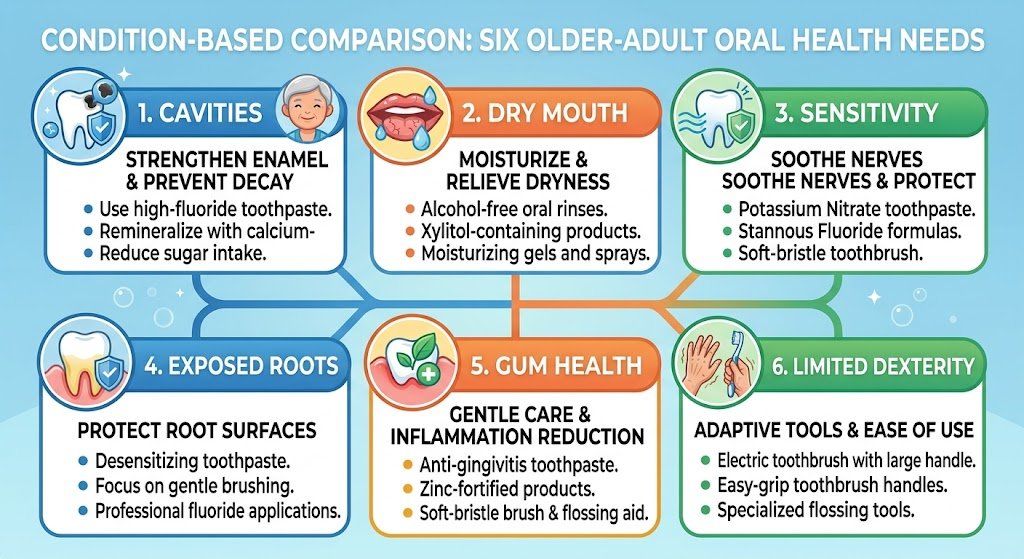
A practical starting point is to identify the person’s biggest concern:
| Main concern | What to prioritize |
| Cavity prevention | Fluoride toothpaste |
| Dry mouth | Fluoride toothpaste plus dry-mouth care |
| Sensitive teeth | Desensitizing toothpaste |
| Gum recession/exposed roots | Cavity protection and sensitivity support |
| Frequent cavities | Strong focus on fluoride and professional guidance |
| Strong taste sensitivity | Mild, comfortable flavor |
| Difficulty brushing | Easy-to-use toothpaste plus an appropriate toothbrush |
| Dentures | Separate denture-cleaning routine |
This condition-based approach is more useful than choosing a product simply because its packaging says “for seniors.”
Why Toothpaste Needs Can Change With Age
Several changes can affect oral care as people get older.
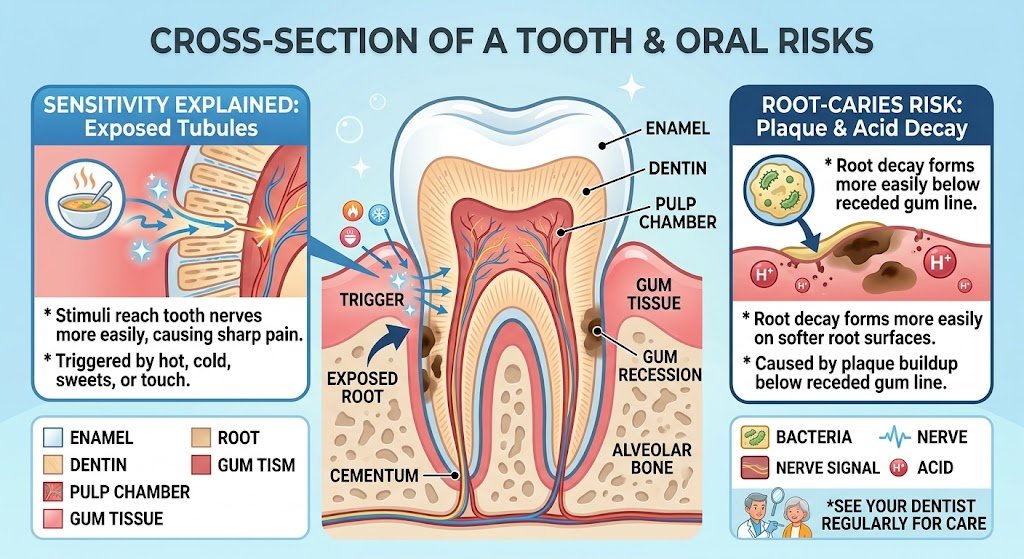
Gum recession can expose parts of the tooth that were previously protected by gum tissue. These root surfaces are different from the crown of the tooth and can be more vulnerable to decay and sensitivity.
Tooth sensitivity may also become noticeable when roots become exposed or when teeth have experienced wear or other changes.
So the toothpaste is only one part of the decision. The best oral-care routine is one the person can perform comfortably and consistently.
What Should Older Adults Look for in Toothpaste?
Once the main oral-health concern is clear, evaluating toothpaste becomes much easier.
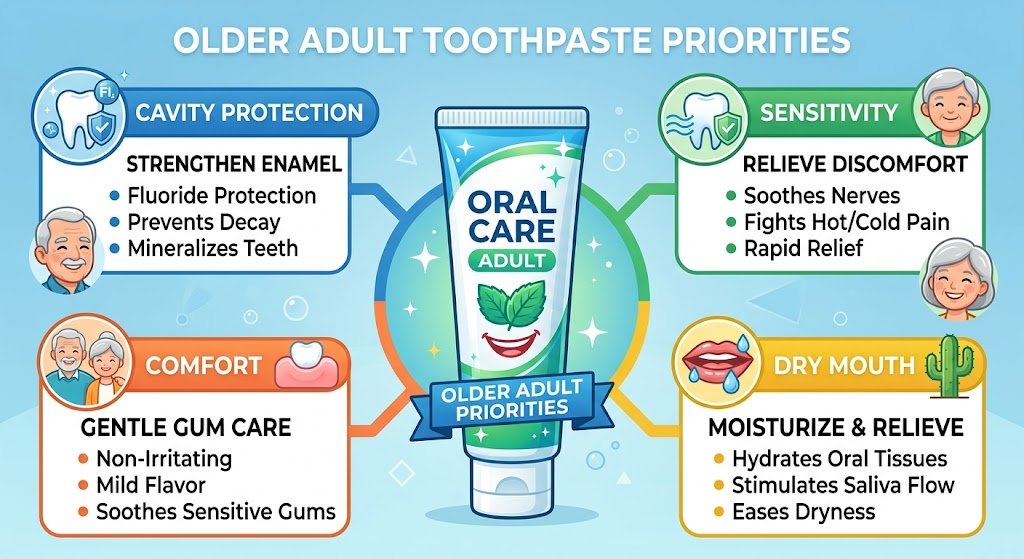
For most people with natural teeth, start with cavity protection, then consider sensitivity, dry mouth, flavor, texture, and other personal preferences.
Fluoride for Cavity Protection
Fluoride is one of the most important ingredients to consider when choosing toothpaste for an older adult with natural teeth.
This matters because older adults may have several factors that increase their risk of decay, including dry mouth and exposed root surfaces.
That does not mean every older adult needs a special or prescription fluoride toothpaste. The appropriate product depends on individual cavity risk and dental history.
If an older adult has frequent cavities, extensive dental work, or a dentist has identified a high risk of decay, professional guidance is more useful than simply choosing the toothpaste with the strongest marketing claim.
Ingredients for Sensitive Teeth
If an older adult experiences sharp discomfort from cold drinks, hot foods, sweet foods, or brushing, sensitivity may become an important toothpaste-selection factor.
Some toothpaste formulas contain ingredients designed to help reduce dentin hypersensitivity. Depending on the formulation, these may include stannous fluoride, potassium-based ingredients, or arginine.
The important point is to choose a product based on the actual problem rather than assuming every “gentle” or “natural” toothpaste is suitable for sensitive teeth.
Persistent sensitivity should also be evaluated by a dentist. Toothpaste can help manage sensitivity, but it cannot diagnose or treat every cause of tooth pain.
A Comfortable Flavor and Texture
Comfort matters more than it may seem.
An older adult may dislike an extremely strong mint flavor, intense aftertaste, excessive foam, or a particular texture. Changes in taste or dry mouth can also affect how comfortable oral-care products feel.
If a person consistently avoids brushing because the toothpaste is unpleasant, a more comfortable formula may be the better practical choice.
Look for a flavor and texture that the person can tolerate without making the brushing routine unnecessarily difficult.
Consider Abrasiveness
Older adults should also think about how a toothpaste feels during brushing, particularly if they have sensitive teeth, exposed roots, enamel wear, or gum recession.
A toothpaste should not be selected simply because it promises aggressive whitening or a powerful “deep cleaning” sensation.
The goal of daily toothpaste use is not to make the teeth feel aggressively scrubbed. The goal is effective, comfortable oral hygiene that supports the person’s dental needs.
For someone with significant sensitivity, enamel concerns, or exposed roots, it is reasonable to ask a dentist whether a particular toothpaste is appropriate.
[ARTICLE CONTINUES — NEXT PART STARTS WITH: H2: “Best Toothpaste for Older Adults Based on Their Needs” ]
Best Toothpaste for Older Adults Based on Their Needs
There is no single toothpaste that is right for every older adult. The better choice depends on the person’s teeth, gums, saliva levels, cavity history, and ability to maintain their daily routine.
Instead of choosing based on age alone, match the toothpaste to the main problem.
Best for Everyday Cavity Prevention
For an older adult with natural teeth who mainly wants everyday cavity protection, fluoride toothpaste is the most straightforward starting point.
Fluoride helps protect teeth against decay, and the National Institute on Aging recommends fluoride toothpaste as part of regular oral care for older adults. [ add a link — Anchor Text: “fluoride toothpaste for older adults” — Destination: “NIA oral-health guidance” ]
When comparing fluoride products, check the active ingredient rather than relying on claims such as “advanced,” “professional,” or “maximum protection.”
Common fluoride compounds include:
- Sodium fluoride
- Stannous fluoride
- Sodium monofluorophosphate
The exact fluoride compound is only one part of the decision. The person’s dental needs, sensitivity, and dentist’s recommendations also matter.
Amazon opportunity: This is the most natural place to introduce a small selection of fluoride toothpaste products after explaining the criteria.
A useful recommendation format would be:
Best for: Everyday cavity prevention
Look for: Fluoride active ingredient, comfortable flavor, appropriate formula
Consider instead: A sensitivity-focused formula if the person has exposed roots or tooth sensitivity
Best for Dry Mouth
Dry mouth, also called xerostomia, deserves special attention because saliva plays an important role in keeping the mouth comfortable and protecting oral tissues.
Older adults may experience dry mouth for different reasons, including medications and health conditions. [ add a link — Anchor Text: “dry mouth and oral health” — Destination: “ADA xerostomia guidance” ]
For someone with dry mouth, toothpaste selection should focus on more than whether the product feels “moisturizing.”
A practical choice should still support cavity prevention while being comfortable enough to use regularly.
Consider:
- Fluoride for cavity protection
- A flavor that does not irritate or overwhelm the mouth
- A texture the person can tolerate
- Avoiding a formula that causes noticeable discomfort
- The person’s overall dry-mouth routine
It is important not to treat toothpaste as a complete solution for xerostomia. If dry mouth is persistent, the underlying cause should be discussed with a dentist or healthcare professional.
Amazon opportunity: A dry-mouth-focused toothpaste can be introduced here, but explain that it is an option for comfort and oral-care support—not a cure for the underlying cause of dry mouth.
Best for Sensitive Teeth
If an older adult experiences discomfort from cold drinks, hot foods, sweets, or brushing, a sensitivity toothpaste may be more appropriate than a standard formula.
Sensitivity can be related to exposed dentin, gum recession, enamel wear, or other dental problems.
Some desensitizing toothpastes use ingredients such as stannous fluoride, potassium compounds, or arginine.
The right product depends on the person’s specific situation, so don’t choose solely because the package uses words such as “gentle” or “soothing.”
Amazon opportunity: This is a strong product-comparison point because readers can understand why a sensitivity-specific formula may be more useful than a general toothpaste.
Best for Exposed Roots or Gum Recession
Gum recession can expose parts of the tooth root. Unlike the visible crown of a tooth, the root does not have the same enamel covering.
That creates two related concerns:
Sensitivity: exposed surfaces can become more sensitive.
Root caries: exposed roots can also be vulnerable to decay.
This is why an older adult with receding gums should not simply search for “the strongest toothpaste.”
A more useful approach is to prioritize cavity protection while also considering sensitivity.
For someone with significant gum recession or a history of root cavities, a dentist can determine whether additional preventive measures are appropriate.
Best for Gum Health
Toothpaste can be part of a good gum-care routine, but it should not be treated as a standalone treatment for gum disease.
The basics still matter:
- Brush gently and thoroughly
- Clean along the gumline
- Clean between the teeth
- Use fluoride toothpaste for natural teeth
- Attend regular dental visits
- Address persistent bleeding or swelling
If an older adult has ongoing gum bleeding, loose teeth, painful gums, or other concerning changes, professional evaluation is more important than switching between toothpaste brands.
Best for Older Adults With Limited Dexterity
Sometimes the biggest oral-care problem is not the toothpaste itself.
An older adult may have difficulty squeezing a tube, holding a toothbrush, or making the small movements needed for thorough brushing.
In this situation, an electric or battery-powered toothbrush may be worth considering alongside an appropriate toothpaste. The NIA specifically notes that powered toothbrushes or toothbrushes with larger handles can help people who have difficulty with hand movement. [ add a link — Anchor Text: “toothbrush options for limited hand movement” — Destination: “National Institute on Aging oral-health guidance” ]
The toothpaste still needs to match the person’s oral-health needs. The toothbrush simply makes the routine easier to perform.
Amazon opportunity: This is a secondary product category where a caregiver may reasonably consider an easy-grip or powered toothbrush after choosing the appropriate toothpaste.
Fluoride vs. Fluoride-Free Toothpaste for Older Adults
The fluoride question becomes especially important when shopping for toothpaste marketed as natural, clean, or non-toxic.
For older adults with natural teeth, there is no general reason to assume that fluoride should be avoided simply because of age.
Fluoride toothpaste has an established role in cavity prevention, and professional dental guidance recommends fluoride toothpaste for adults, including older adults. [ add a link — Anchor Text: “fluoride toothpaste” — Destination: “ADA toothpaste guidance” ]
Why Fluoride Is Commonly Recommended
Older adults can have increased cavity concerns for several reasons.
Dry mouth can reduce the protective effects of saliva. Gum recession can expose root surfaces. Existing dental work and a history of cavities can also affect an individual’s risk.
In those situations, removing fluoride from the toothpaste can mean giving up an established cavity-prevention ingredient without addressing the reason for doing so.
That does not mean fluoride-free toothpaste is automatically inappropriate. It means the decision should be based on the person’s needs rather than fear-based marketing.
When Someone Might Prefer Fluoride-Free
Some people prefer fluoride-free toothpaste because of personal ingredient preferences or because they are interested in alternatives such as hydroxyapatite.
If someone chooses a fluoride-free product, they should understand what they are choosing and consider their cavity risk.
For an older adult with frequent cavities, dry mouth, exposed roots, or a history of root decay, it is particularly reasonable to discuss the decision with a dentist.
What If You Are Interested in Hydroxyapatite?
Hydroxyapatite is another toothpaste ingredient that has attracted interest among people looking for fluoride-free options.
It can be relevant to a non-toxic toothpaste buying decision, but it should not be presented as proof that fluoride is unsafe or unnecessary.
The useful comparison is:
What does the person need from their toothpaste, and which formulation best fits that need?
For an older adult at elevated risk of decay, professional dental advice should carry more weight than a general ingredient preference.
Toothpaste for Older Adults With Dry Mouth
Dry mouth deserves a closer look because simply buying a different toothpaste may not solve the problem.
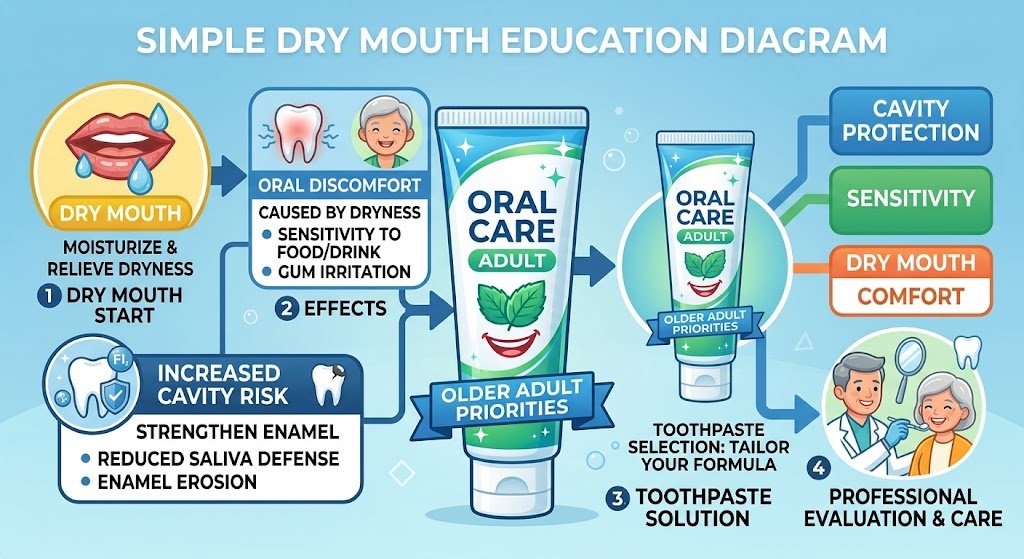
Saliva helps lubricate the mouth and contributes to its natural protective environment. When saliva production is reduced, an older adult may notice dryness, sticky saliva, difficulty eating or swallowing, changes in taste, or increased dental problems.
Certain medications are among the possible causes of dry mouth, which is why persistent symptoms deserve professional attention. [ add a link — Anchor Text: “dry mouth causes and oral-care advice” — Destination: “HRSA or ADA dry-mouth guidance” ]
What to Look for in Toothpaste
For an older adult with dry mouth, prioritize:
- Cavity protection — particularly fluoride when appropriate.
- Comfort — a formula that does not make the mouth feel worse.
- Tolerable flavor — strong flavors may be unpleasant for some people.
- A manageable texture — the product should be comfortable to use twice daily.
There is no need to assume that every toothpaste marketed for dry mouth is automatically superior.
Read the active ingredients and product purpose, then consider how the formula fits the person’s overall oral-care routine.
What Toothpaste Cannot Fix
If dry mouth is caused by medication, dehydration, a medical condition, or another underlying issue, changing toothpaste will not necessarily solve it.
An older adult should talk with a dentist or healthcare professional if dry mouth is persistent or causing difficulty with eating, speaking, sleeping, or oral hygiene.
The goal is to address both comfort and the reason the mouth is dry, when that cause can be identified.
When to Ask a Dentist About High-Fluoride Options
Some people at elevated risk of tooth decay may need additional fluoride strategies.
However, stronger or prescription fluoride products should not be selected simply because someone is older.
If an older adult has repeated cavities, root decay, significant dry mouth, or another high-risk situation, the dentist can determine whether additional fluoride is appropriate and which product or concentration should be used.
Toothpaste for Sensitive Teeth and Exposed Roots
Sensitivity and gum recession often overlap in older adults.
When gum tissue recedes, previously covered areas can become exposed. If those surfaces respond painfully to cold, heat, sweets, or touch, sensitivity-focused toothpaste may be useful.
A sensitivity formula can be a reasonable first product change when the symptoms are mild and already understood.
However, new or persistent sensitivity should not automatically be blamed on age.
A cavity, cracked tooth, worn restoration, gum recession, enamel loss, or another dental problem can produce similar symptoms.
What to Look For
A toothpaste for sensitive teeth may contain a desensitizing ingredient such as:
- Stannous fluoride
- Potassium-based compounds
- Arginine
The exact formulation varies by product.
Look at the active ingredient rather than choosing only according to words such as “natural,” “gentle,” or “premium.”
When Toothpaste Is Not Enough
An older adult should consider a dental evaluation if sensitivity:
- Appears suddenly
- Affects only one tooth
- Becomes severe
- Continues despite using sensitivity toothpaste
- Comes with pain or swelling
- Makes eating difficult
Toothpaste can support symptom management, but it cannot identify the underlying dental cause.
Toothpaste and Dentures: What Changes?
An older adult who wears dentures needs to distinguish natural-tooth care from denture care.
If the person still has natural teeth, those teeth still need regular brushing with an appropriate toothpaste.
Dentures, however, require their own cleaning routine. The NIA recommends cleaning dentures daily using appropriate denture-care practices. [ add a link — Anchor Text: “denture care for older adults” — Destination: “National Institute on Aging denture-care guidance” ]
Do not assume that ordinary toothpaste is the best choice for cleaning dentures. A denture-cleaning product may be more appropriate depending on the type of denture and the manufacturer’s instructions.
Older adults with partial dentures also need to care for their remaining natural teeth and gums.
For people with implants, crowns, bridges, or other dental restorations, the dentist’s instructions should take priority because the appropriate cleaning method can depend on the restoration.
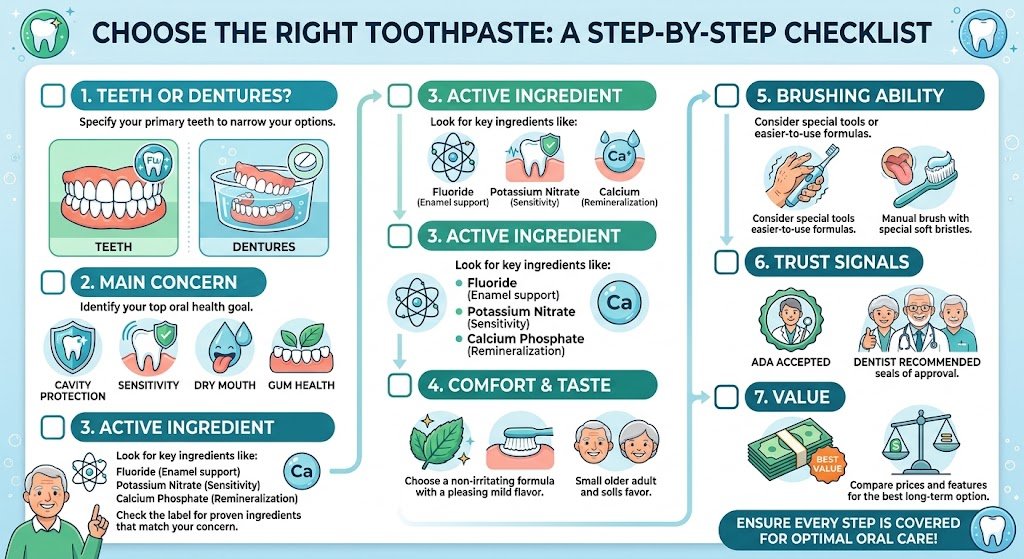
How to Choose Toothpaste for an Older Adult
If you are buying toothpaste for yourself, a parent, or another older family member, use this simple process.
Step 1: Identify What They Have
First determine whether the person has:
- Mostly natural teeth
- Partial dentures
- Full dentures
- Implants
- Crowns or bridges
- A combination of these
This determines what oral-care products are actually needed.
Step 2: Identify the Biggest Problem
Ask what the person is trying to solve.
Is it:
- Cavities?
- Dry mouth?
- Sensitivity?
- Exposed roots?
- Gum problems?
- Difficulty brushing?
- Taste or flavor discomfort?
The answer should guide the toothpaste category.
Step 3: Check the Active Ingredient
For natural teeth, look for the active ingredient and determine whether fluoride is part of the formula.
Do not rely solely on front-label phrases such as “advanced,” “natural,” “clean,” or “maximum.”
Step 4: Consider Comfort
The toothpaste should be pleasant enough to use consistently.
Check the flavor, texture, foam, and aftertaste.
Step 5: Consider the Person’s Ability to Brush
If hand strength or coordination is limited, toothpaste alone will not solve the problem.
An easy-grip or powered toothbrush may make the routine more manageable.
Step 6: Look for Trust Signals
The ADA Seal of Acceptance can be one useful signal when comparing dental products, although it should not replace consideration of the person’s individual needs.
Step 7: Compare Value, Not Just Price
A more expensive toothpaste is not automatically better.
Compare the product’s purpose, active ingredients, amount, tolerability, and suitability for the person’s specific problem.
[ARTICLE CONTINUES — NEXT PART STARTS WITH: H2: “What About the ADA Seal of Acceptance?” ]
What About the ADA Seal of Acceptance?
The ADA Seal of Acceptance can be a useful trust signal when comparing toothpaste, but it should not be the only factor you consider.
The American Dental Association evaluates products submitted to its Seal program against specific requirements related to safety and effectiveness. [ add a link — Anchor Text: “ADA Seal of Acceptance” — Destination: “American Dental Association Seal of Acceptance” ]
For an older adult, however, a toothpaste still needs to match the person’s individual needs.
For example, a toothpaste may have an ADA Seal and still not be the most comfortable choice for someone with a strong flavor sensitivity or a particular oral-health concern.
What the ADA Seal Can Tell You
When available, the Seal can provide additional confidence that a product has met the ADA’s applicable evaluation requirements.
It can be especially useful when comparing several similar products and you want another quality signal beyond packaging claims.
However, the Seal does not mean that a product is the “best toothpaste” for every older adult.
What the ADA Seal Does Not Decide
The Seal does not tell you which toothpaste is best for:
- Your specific level of tooth sensitivity
- Your personal flavor preference
- Your dry-mouth symptoms
- Your individual cavity risk
- Your dentist’s treatment recommendations
- Your ability to comfortably use the product
Think of the Seal as one part of the selection process, not the entire decision.
Common Mistakes When Buying Toothpaste for Older Adults
Choosing toothpaste for an older adult can become unnecessarily complicated when marketing claims are given more importance than actual dental needs.
Here are some common mistakes to avoid.
Choosing Toothpaste Just Because It Says “For Seniors”
Age-specific packaging can be convenient, but the words “senior,” “mature,” or “for older adults” do not automatically make a toothpaste better.
A 70-year-old with healthy natural teeth may need a very different formula from another 70-year-old with dry mouth, exposed roots, and recurring cavities.
Choose according to the person’s oral-health situation.
Avoiding Fluoride Without Considering Cavity Risk
Some shoppers assume that fluoride-free automatically means safer or more natural.
That is not a reliable way to make the decision.
Fluoride has an established role in cavity prevention. For an older adult with natural teeth, particularly someone with elevated cavity risk, removing fluoride should be a deliberate choice rather than a response to marketing language.
Choosing the Strongest Whitening Formula
A very strong whitening sensation is not the same thing as better oral care.
If an older adult has sensitivity, gum recession, exposed roots, or enamel concerns, an aggressive-feeling whitening toothpaste may be uncomfortable.
Whitening should be considered separately from the person’s primary oral-health needs.
Ignoring Dry Mouth
Dry mouth can be easy to overlook because it may initially seem like a comfort issue.
But reduced saliva can contribute to a higher risk of dental problems.
If an older adult regularly complains of a dry or sticky mouth, difficulty swallowing, or unusual oral discomfort, toothpaste selection should be considered alongside broader dry-mouth management.
Buying Based Only on “Natural” or “Non-Toxic” Claims
Terms such as “natural,” “clean,” and “non-toxic” can mean different things depending on the product and the brand.
Instead of assuming a marketing label tells you everything, read the active ingredients and ingredient list.
The important question is whether the formula is appropriate for the person’s needs and comfortable enough to use consistently.
Forgetting About Ease of Use
A toothpaste can be a good formulation on paper and still be a poor practical choice if the person struggles to open the tube or use it comfortably.
For older adults with limited hand movement, consider the entire brushing setup, including the toothpaste tube, toothbrush handle, and storage.
When Should an Older Adult See a Dentist?
Toothpaste can support daily oral hygiene, but it cannot replace a dental examination.
Older adults should seek professional dental advice when they notice a new or persistent oral problem.
Examples include:
- Tooth pain that does not go away
- New or worsening sensitivity
- Swollen or painful gums
- Persistent bleeding
- Loose adult teeth
- Difficulty chewing
- A sore or mouth lesion that does not heal
- A broken or damaged tooth
- Repeated cavities
- Increasing problems with dry mouth
- Dentures that no longer fit comfortably
A dentist can determine whether the problem is related to decay, gum disease, exposed roots, a damaged restoration, dry mouth, or another condition.
This is especially important when an older adult has several risk factors at the same time.
For example, dry mouth + gum recession + exposed roots + previous cavities may require a more personalized prevention plan than simply switching toothpaste.
Frequently Asked Questions
What is the best toothpaste for older adults?
There is no single best toothpaste for every older adult. For someone with natural teeth, fluoride toothpaste is generally an important starting point for cavity prevention. The final choice should also consider sensitivity, dry mouth, exposed roots, gum health, flavor, texture, and individual dental needs.
Should older adults use fluoride toothpaste?
For most older adults with natural teeth, fluoride toothpaste is an important part of cavity prevention. The appropriate product can depend on the person’s cavity risk and dental history. People with frequent cavities or other high-risk factors should ask their dentist whether additional fluoride treatment is appropriate.
Is fluoride-free toothpaste better for older adults?
Not simply because someone is older. Fluoride-free toothpaste may appeal to people who prefer alternative formulations, but choosing it means giving up fluoride’s established cavity-prevention benefit. Older adults with high cavity risk should discuss the decision with a dentist.
What toothpaste is best for older adults with dry mouth?
Look for a comfortable formula that supports cavity prevention, particularly fluoride toothpaste when appropriate. Flavor and texture also matter because dry mouth can make oral products feel uncomfortable. Persistent dry mouth should be discussed with a dentist or healthcare professional.
What toothpaste is best for sensitive teeth in older adults?
A sensitivity toothpaste containing an appropriate desensitizing ingredient may help manage sensitivity. Common examples include stannous fluoride, potassium-based ingredients, and arginine. If sensitivity is new, severe, persistent, or limited to one tooth, a dental examination is important.
Is hydroxyapatite toothpaste good for older adults?
Hydroxyapatite toothpaste can be an option for people interested in this ingredient, particularly those considering fluoride-free products. However, the right choice depends on cavity risk and individual dental needs. It should not be assumed that hydroxyapatite automatically makes a toothpaste better or safer for every older adult.
Can older adults use regular toothpaste?
Yes. Older adults do not automatically need a special toothpaste simply because of their age. A regular adult toothpaste can be appropriate when it meets the person’s oral-health needs.
What toothpaste is best for receding gums?
Gum recession itself does not automatically require a special toothpaste. If recession has exposed tooth roots, the person may need both cavity protection and sensitivity support. A dentist can also determine whether the recession needs additional treatment.
Do older adults need special toothpaste for dentures?
Dentures and natural teeth have different care requirements. An older adult with dentures should follow appropriate denture-cleaning instructions while continuing to care for any remaining natural teeth. Do not assume ordinary toothpaste is the correct product for cleaning dentures.
Does toothpaste help with gum disease?
Toothpaste can support daily oral hygiene, but it is not a substitute for professional treatment of gum disease. Persistent bleeding, swelling, pain, or loose teeth should be evaluated by a dental professional.
Is whitening toothpaste a good choice for older adults?
It depends on the person’s needs. Whitening may be a secondary goal, but an older adult with sensitivity, gum recession, or exposed roots may prefer a more comfortable formula focused on everyday oral care rather than an aggressive whitening sensation.
Conclusion
The best toothpaste for an older adult is not necessarily the one with “senior” on the label. It is the toothpaste that fits the person’s actual oral-health needs and daily routine.
For most older adults with natural teeth, fluoride remains an important consideration for cavity prevention. From there, the choice can become more specific:
- Cavities: prioritize fluoride and consider the person’s overall cavity risk.
- Dry mouth: choose a comfortable formula while addressing the underlying dry-mouth problem.
- Sensitive teeth: consider a toothpaste with an appropriate desensitizing ingredient.
- Exposed roots or gum recession: consider both sensitivity and root-cavity protection.
- Gum concerns: maintain thorough daily cleaning and seek professional care for persistent symptoms.
- Limited dexterity: make the entire brushing routine easier with an appropriate toothbrush and accessible toothpaste packaging.
- Dentures: keep denture care separate from natural-tooth care.
The most useful approach is to start with the person’s biggest concern, check the toothpaste’s active ingredients, consider comfort and usability, and then compare products based on those criteria.
If you are still unsure which formula fits the situation, a dentist can help identify the person’s cavity and gum-health risks and recommend the most appropriate type of toothpaste.
