Toothpaste is a dental-cleaning product used with a toothbrush to clean teeth and deliver ingredients that can support specific oral-health goals.
It is available mainly as a paste or gel, with some formulations available as powders. Modern toothpaste can contain several different types of ingredients, and each one has a particular job.
Some ingredients help with physical cleaning. Others deliver active compounds such as fluoride, while additional ingredients can support goals such as reducing tooth sensitivity, controlling tartar, or improving the appearance of surface stains.
Understanding what toothpaste is—and what its ingredients actually do—makes it easier to choose a formulation based on your oral-health needs rather than simply choosing whatever product has the most appealing label.
What Is Toothpaste?
Toothpaste, also called dentifrice, is a formulation designed to be applied to the teeth during brushing.
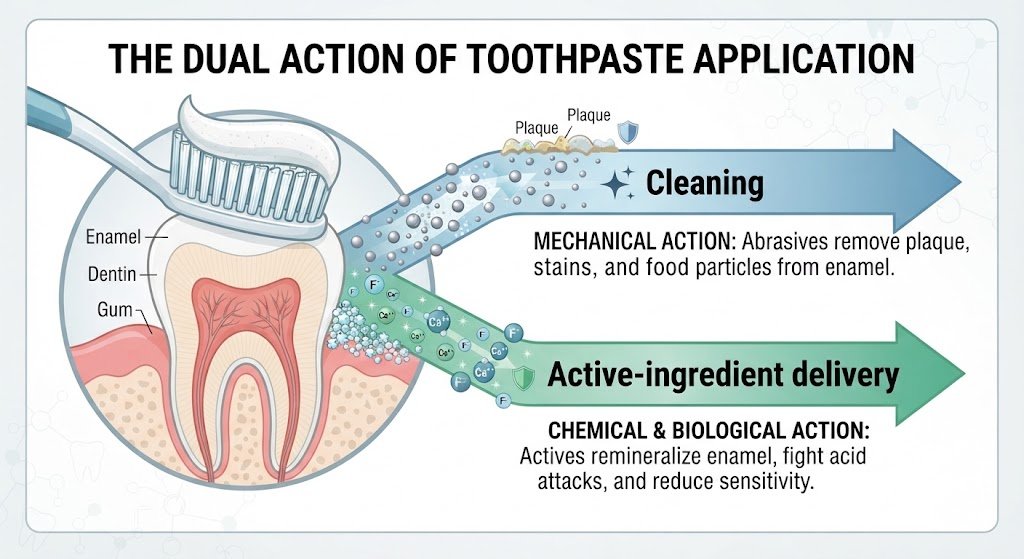
The American Dental Association summarizes the U.S. Food and Drug Administration’s framework as defining dentifrice as an abrasive-containing dosage form used to deliver an anticaries drug to the teeth. In practical terms, that means toothpaste can serve both a cleaning function and a delivery system for active ingredients.
For everyday brushing, toothpaste works together with the toothbrush. The toothbrush provides the mechanical action that helps disturb and remove plaque and debris, while the toothpaste contributes ingredients that can assist cleaning and provide additional oral-health benefits.
This distinction is important: toothpaste is not simply a substance that makes brushing feel fresh. Its formulation determines what it can contribute to the brushing process.
What Does Toothpaste Do?
Toothpaste can perform several different functions during brushing. The exact benefits depend on the formulation and its active ingredients.
Helps clean teeth
Toothpaste commonly contains abrasive ingredients that help remove material from the tooth surface during brushing. Examples include silica and calcium carbonate.
The abrasive component works together with the mechanical action of the toothbrush. It can help remove deposits and surface stains, contributing to the clean feeling people associate with brushing.
However, toothpaste should not be thought of as a substitute for brushing technique. The toothbrush still provides the physical movement needed to clean the surfaces of the teeth.
Delivers active ingredients
One of toothpaste’s most important functions is delivering active ingredients to the teeth.
Fluoride is the most important example for cavity prevention. Common fluoride compounds used in U.S. toothpastes include sodium fluoride, sodium monofluorophosphate, and stannous fluoride.
Other formulations may contain ingredients intended for specific concerns, such as dentin sensitivity or surface staining.
This is why two toothpastes can look and feel similar but serve somewhat different purposes. The differences may be found in their active ingredients rather than in the basic paste itself.
Supports everyday oral hygiene
Regular toothbrushing with an appropriate toothpaste can be part of a broader oral-hygiene routine.
For most people, the American Dental Association recommends brushing twice a day with fluoride toothpaste. Toothpaste therefore contributes more than flavor or foam: the formulation can provide an evidence-supported active ingredient while brushing mechanically cleans the teeth.
What Is Toothpaste Made Of?
There is no single formula used for every toothpaste. Instead, toothpaste is generally made from a combination of ingredients that perform different technical or oral-health functions.
The exact ingredients vary according to the product’s purpose.
Common categories include:
- Active ingredients — provide a specific oral-health benefit, such as anticaries protection.
- Abrasives — help with physical cleaning and removal of surface deposits.
- Surfactants or detergents — help disperse the formulation and can create foam.
- Humectants — help keep the toothpaste from drying out.
- Thickeners and binders — help maintain the desired consistency and stability.
- Flavoring and sweeteners — improve taste and the sensory experience of brushing.
- Other functional ingredients — may target concerns such as sensitivity, tartar, gingivitis, or whitening.
The ingredients are therefore not interchangeable. Each component is included for a reason, whether that reason is therapeutic, functional, sensory, or related to the physical stability of the product.
Main toothpaste ingredient categories
| Ingredient category | Main role |
| Fluoride compounds | Help prevent tooth decay and support enamel remineralization |
| Abrasives | Help remove deposits and surface stains during brushing |
| Surfactants | Help disperse the formulation and produce foam |
| Humectants | Help retain moisture |
| Thickeners/binders | Help control consistency and stabilize the formulation |
| Flavoring | Provides taste and freshness |
| Sweeteners | Improve taste without serving as a primary therapeutic ingredient |
| Desensitizing ingredients | Used in formulations intended for sensitive teeth |
| Whitening ingredients | May help address surface staining or contribute to whitening |
The presence of an ingredient does not automatically mean that more of it—or a longer ingredient list—is better. What matters is the ingredient’s purpose, concentration where relevant, evidence for the intended use, and whether the formulation suits the individual using it.
How Do the Main Toothpaste Ingredients Work?
Understanding ingredient roles is more useful than simply memorizing ingredient names.
Fluoride
Fluoride is an active ingredient used to help prevent dental caries. It supports the tooth’s ability to resist acid-related mineral loss and promotes remineralization of early enamel changes.
Common fluoride ingredients in U.S. toothpaste include:
- Sodium fluoride
- Sodium monofluorophosphate
- Stannous fluoride
Most over-the-counter fluoride toothpastes in the United States contain roughly 1,000–1,500 ppm fluoride.
Abrasives
Abrasives help toothpaste perform its cleaning function.
Examples include modified silica, calcium carbonate, hydrated aluminum oxides, phosphate salts, and silicates.
During brushing, these particles contribute to the physical removal of material from tooth surfaces. Some formulations use abrasive systems that also help remove surface stains, which can make teeth appear cleaner or brighter.
Abrasiveness needs to be considered as part of the overall formulation rather than treated as a simple “more is better” feature.
Surfactants
Surfactants, sometimes called detergents, help toothpaste spread and interact with water and other components during brushing.
Sodium lauryl sulfate (SLS) is one familiar example.
Surfactants can also contribute to foaming. The foam is largely a sensory and formulation characteristic; more foam does not necessarily mean that a toothpaste cleans better.
Humectants
Humectants help retain moisture within the toothpaste.
Common examples include glycerol, propylene glycol, and sorbitol. Without ingredients that help control moisture, a toothpaste formulation could become less usable as it loses water.
Thickeners and binders
These ingredients help give toothpaste its familiar consistency and help keep different components appropriately dispersed.
Natural gums, synthetic cellulose compounds, mineral or seaweed-derived colloids, and other thickening systems may be used.
Their primary job is formulation stability and texture rather than providing the main therapeutic effect.
Flavoring and sweeteners
Flavoring ingredients make toothpaste more pleasant to use, while non-caloric sweeteners can improve taste.
These ingredients can have an important practical role because a toothpaste that is unpleasant to use may be harder for someone to incorporate consistently into their routine.
However, flavoring is not the same thing as therapeutic effectiveness.
Why Is Fluoride in Toothpaste?
Fluoride is included in many toothpastes because it provides an evidence-supported way to help prevent tooth decay.
When fluoride is present in the mouth, it can interact with dental plaque and enamel and support remineralization. It also helps make tooth surfaces more resistant to acid-related mineral loss.
The ADA identifies fluoride-containing toothpaste as the most commonly used form of self-applied topical fluoride worldwide. In the United States, over-the-counter fluoride toothpastes generally contain 1,000–1,500 ppm fluoride.
The specific fluoride compound can vary. Sodium fluoride, sodium monofluorophosphate, and stannous fluoride are used in U.S. toothpaste formulations.
This does not mean every person should select toothpaste solely by looking at the fluoride compound. Other factors—such as sensitivity, flavor tolerance, ingredients that an individual wishes to avoid, or a specific dental concern—can also influence the appropriate choice.
For people at unusually high risk of tooth decay, a dentist may recommend a higher-strength fluoride product or another preventive approach. Those products should not be treated as interchangeable with ordinary over-the-counter toothpaste.
Are All Toothpastes the Same?
No. Toothpastes share some basic formulation principles, but they can be designed for different purposes.
A conventional fluoride toothpaste may primarily focus on everyday cleaning and cavity prevention. Another formulation may add ingredients intended for sensitive teeth. Others may emphasize whitening, tartar control, gingival health, or particular ingredient preferences.
This creates several broad toothpaste categories, including:
- Fluoride toothpaste for routine cavity prevention.
- Sensitive-teeth toothpaste containing ingredients intended to reduce dentin hypersensitivity.
- Whitening toothpaste designed primarily to address surface staining and improve the appearance of teeth.
- SLS-free toothpaste formulated without sodium lauryl sulfate.
- Hydroxyapatite toothpaste using hydroxyapatite as an alternative active ingredient in some formulations.
- Tartar-control toothpaste containing ingredients intended to help control calculus formation.
- Children’s toothpaste formulated and labeled for younger users, with appropriate guidance about amount and supervision.
These categories can overlap. A toothpaste may be both fluoride-containing and designed for sensitivity, for example.
The important point is that the category should follow the need—not the other way around.
How to Choose a Toothpaste
Once you understand what toothpaste does, choosing one becomes less about finding a universally “best” formula and more about matching the formulation to your needs.
Start with your primary oral-health goal
Ask what you actually want the toothpaste to do.
For many people, cavity prevention is the primary consideration. For others, sensitivity, surface staining, ingredient tolerability, or another specific concern may be more important.
If cavity prevention is your main concern, fluoride toothpaste is the most established starting point for routine use.
Look at the active ingredients
The front of the package is often designed to emphasize flavor, whitening, freshness, or other marketing messages.
The active-ingredient information can tell you more about what the toothpaste is actually designed to do.
Look for the active ingredient and the oral-health claim associated with it rather than assuming that a product’s branding tells you its most important function.
Consider tolerability
A toothpaste can be theoretically well suited to your needs but still be a poor personal fit if you find its flavor, foaming, or other ingredients irritating.
Toothpaste can contain ingredients that occasionally cause irritation or allergic reactions in susceptible people. Flavoring compounds and certain other ingredients have been reported as possible causes of oral irritation or contact reactions.
If a toothpaste consistently causes burning, peeling, swelling, sores, or another unusual reaction, changing products may be reasonable, but persistent or significant symptoms should be evaluated by a dental or medical professional.
Don’t assume “natural” means better
A toothpaste marketed as natural, clean, simple, or free from particular ingredients is not automatically more effective or safer for every person.
The useful question is more specific:
Does the formulation contain ingredients appropriate for the oral-health goal, and is it tolerable enough to use consistently?
This approach helps separate meaningful formulation differences from marketing language.
Consider professional advice when your needs are specific
People with frequent cavities, significant tooth sensitivity, enamel concerns, gum disease, dry mouth, or other oral-health problems may need more individualized guidance.
A dentist can help determine whether an ordinary over-the-counter toothpaste is appropriate or whether a different active ingredient, concentration, or treatment is warranted.
For a broader product-selection framework, see the [ add a link — Anchor Text: “toothpaste buying guide” — Destination: “C40: Toothpaste Buying Guide” ].
Does Toothpaste Actually Matter?
Yes—but toothpaste is only one part of effective oral hygiene.
The toothbrush’s mechanical action is important for disturbing and removing plaque. Toothpaste adds ingredients that can make the brushing process more effective for specific goals, particularly when it contains an evidence-supported active ingredient such as fluoride.
The ADA recommends brushing twice daily with fluoride toothpaste, and its home-oral-care guidance emphasizes that the evidence for this recommendation concerns brushing with fluoride toothpaste rather than brushing alone.
That distinction explains why toothpaste matters without overstating what toothpaste can accomplish.
Toothpaste cannot replace the rest of oral care. It does not make someone immune to cavities or gum disease, and choosing an expensive or highly specialized formula cannot compensate for poor brushing habits or neglected dental care.
The practical takeaway is simple:
Choose toothpaste for the job you need it to perform, then use it consistently as part of an effective oral-hygiene routine.
Frequently Asked Questions
What is toothpaste made of?
Toothpaste is generally made from a combination of active ingredients and functional ingredients. Common categories include fluoride compounds, abrasives, surfactants, humectants, thickeners or binders, flavoring agents, and sweeteners. Some formulations also contain ingredients intended for sensitivity, whitening, tartar control, or other specific purposes.
What does toothpaste do?
Toothpaste helps clean teeth during brushing and can deliver active ingredients that support specific oral-health goals. Abrasives assist physical cleaning, while active ingredients such as fluoride can help prevent tooth decay.
Why is fluoride added to toothpaste?
Fluoride is added because it helps prevent dental caries and supports remineralization of enamel. It can also make tooth surfaces more resistant to acid-related mineral loss.
Why does toothpaste foam?
Foam is mainly produced by surfactants or detergents such as sodium lauryl sulfate. These ingredients help disperse the toothpaste and can contribute to foaming during brushing. More foam does not necessarily mean better cleaning.
Are all toothpastes the same?
No. Toothpastes can differ in their active ingredients, abrasives, surfactants, flavors, and other formulation components. Some are designed for general cavity prevention, while others target concerns such as sensitivity, whitening, tartar control, or particular ingredient preferences.
Is toothpaste necessary for brushing?
Toothbrushing itself provides important mechanical cleaning, but toothpaste can add useful benefits through ingredients such as fluoride. For most people, the ADA recommends brushing twice a day with fluoride toothpaste.
How do I choose the right toothpaste?
Start with your primary oral-health goal. Consider whether you need routine cavity protection, sensitivity support, whitening, or another specific feature. Then check the active ingredients and consider whether the formulation is comfortable for you to use consistently. If you have a significant dental concern, ask your dentist for individualized advice.
Conclusion
Toothpaste is more than a flavored paste used to make brushing feel fresh. It is a formulated dentifrice that combines cleaning ingredients with active and functional ingredients designed to support different oral-health purposes.
Abrasives help with physical cleaning, surfactants help disperse the formulation and create foam, humectants retain moisture, and other ingredients control texture and flavor. Most importantly for routine cavity prevention, fluoride-containing toothpaste delivers fluoride to the teeth during brushing.
Once you understand these roles, toothpaste selection becomes much simpler. Instead of asking which toothpaste is universally best, start by asking what you need your toothpaste to do.
That approach gives you a more useful way to evaluate fluoride, sensitivity, whitening, SLS-free, hydroxyapatite, and other toothpaste categories—and helps keep product selection grounded in oral-health needs rather than marketing alone.
