If you have ever looked at the back of a toothpaste tube, you may have wondered why the ingredient list contains so many unfamiliar names. What are all those ingredients actually doing?
Toothpaste is not made from one main substance. It is a carefully formulated mixture of ingredients that work together to clean teeth, deliver active ingredients, control moisture and texture, improve taste, and support specific oral-health needs.
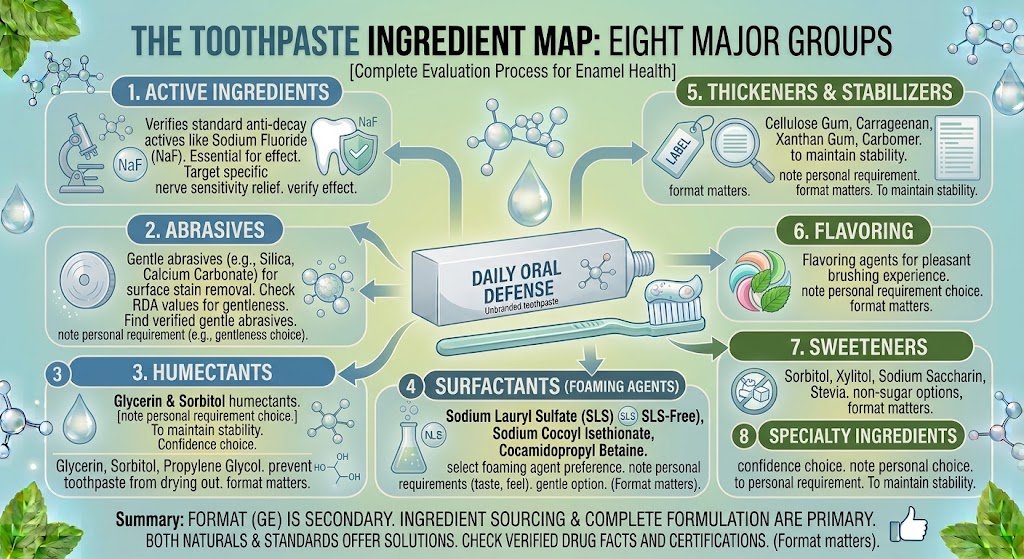
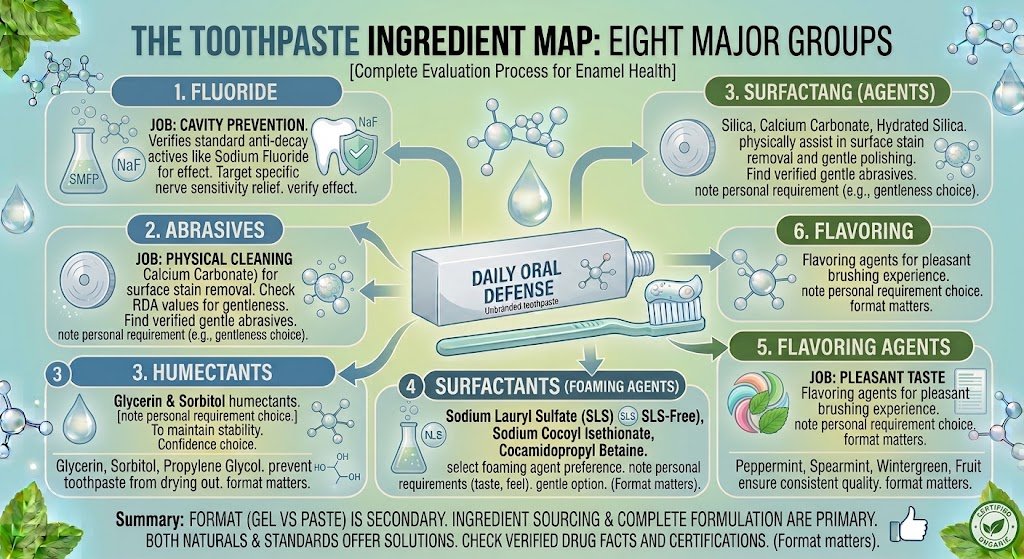
Depending on the formula, toothpaste may contain fluoride, abrasives, humectants, detergents, thickeners, flavoring agents, sweeteners, water, and specialty ingredients.
The exact formula varies between products. A toothpaste designed for cavity prevention may use a different active ingredient from one designed for sensitivity or whitening.
This guide explains what the main toothpaste ingredients do, why they are included, and what you should pay attention to when choosing a toothpaste.
What Is Toothpaste Made Of?
Toothpaste is generally made from several different groups of ingredients, with each group serving a particular purpose.
A typical toothpaste formula may contain:
- Active ingredients — provide a specific oral-health benefit.
- Abrasives — help physically clean teeth and remove surface deposits and stains.
- Humectants — help keep the toothpaste moist.
- Detergents or surfactants — help the toothpaste spread and may create foam.
- Thickeners and binders — give toothpaste its texture and help keep ingredients mixed.
- Flavoring agents — give toothpaste its taste.
- Sweeteners — improve flavor without relying on ordinary sugar.
- Water and other formulation ingredients — help create the desired consistency.
- Specialty ingredients — may be included for concerns such as sensitivity, whitening, tartar control, or other oral-health needs.
The American Dental Association describes toothpaste, also called dentifrice, as a product used with a toothbrush to clean teeth and deliver active ingredients. It identifies ingredient groups such as abrasives, detergents, humectants, thickeners, flavoring agents, and sweeteners in toothpaste formulations. [ add a link ]
Not every toothpaste contains all of these ingredients. The formula depends on what the product is designed to do.
The Main Types of Ingredients in Toothpaste
Active Ingredients
Active ingredients are included because they perform a specific function related to the product’s intended oral-health benefit.
Fluoride is one of the most familiar examples.
Common fluoride compounds used in toothpaste include:
- Sodium fluoride
- Stannous fluoride
- Sodium monofluorophosphate
Fluoride helps prevent tooth decay and supports the strength of tooth enamel. It is one of the main reasons many conventional toothpastes are formulated with a fluoride active ingredient.
Other toothpastes may contain ingredients designed for particular concerns. For example, some formulations contain ingredients intended to help with tooth sensitivity, while others are formulated for whitening or tartar control.
This means the most useful question is not simply:
“How many ingredients does this toothpaste have?”
Instead, ask:
“What is each ingredient doing in this particular formula?”
That distinction becomes especially important when comparing conventional, natural, fluoride-free, hydroxyapatite, or non-toxic toothpaste.
Abrasives
Abrasives are ingredients that help with the physical cleaning action of toothpaste.
Common examples include forms of:
- Silica
- Calcium carbonate
When you brush, abrasive ingredients help remove plaque, food debris, and some surface stains from the teeth.
However, more abrasive does not automatically mean better.
A toothpaste needs to provide useful cleaning while remaining appropriate for the teeth and gums. The overall formulation and brushing technique matter as well.
The American Dental Association identifies abrasives as an important toothpaste ingredient group because they help clean teeth and remove surface stains. [ add a link ]
If you are specifically comparing toothpaste based on abrasiveness, that deserves a closer look than simply identifying whether “silica” or another abrasive appears on the label.
Humectants
Humectants help toothpaste retain moisture.
Common examples include:
- Glycerin
- Sorbitol
- Propylene glycol
Their role is largely related to the physical properties of the toothpaste.
Without moisture-controlling ingredients, toothpaste could dry out and become much harder to use. Humectants help the formula maintain the consistency people expect when they squeeze toothpaste onto a toothbrush.
So when you see glycerin on an ingredient label, it does not necessarily mean the ingredient is there to provide a direct dental treatment. It can simply be performing an important formulation function.
Detergents and Surfactants
Some toothpaste formulas contain detergents or surfactants.
One familiar example is sodium lauryl sulfate, usually shortened to SLS.
SLS can help toothpaste spread through the mouth and contributes to the foaming action that many people associate with brushing.
But foam itself is not what makes toothpaste effective.
A toothpaste can produce a lot of foam without necessarily providing better cleaning than a lower-foaming formula.
Some people also prefer SLS-free toothpaste because of personal preferences or because certain formulations may cause irritation for them.
The ADA notes that some toothpaste ingredients, including SLS and certain flavoring components, can act as potential irritants for susceptible individuals. [ add a link ]
Thickeners and Binders
Toothpaste needs to have the right consistency.
Thickeners and binders help create that consistency and help keep the different ingredients distributed throughout the formula.
Depending on the product, these may include cellulose-based ingredients, gums, or other thickening materials.
Their primary purpose is not necessarily to provide a direct oral-health benefit. Instead, they help determine how the toothpaste feels, spreads, and stays together.
Without appropriate formulation ingredients, a toothpaste could become too runny, separate, or otherwise lose the consistency expected from the product.
Flavoring and Sweeteners
Toothpaste is usually flavored because taste and mouthfeel affect the brushing experience.
Mint is one of the most familiar toothpaste flavors, but different formulas can use different flavoring ingredients.
Toothpaste may also contain sweeteners to make the product taste more pleasant.
This does not mean that toothpaste needs ordinary sugar.
In fact, sugar is not desirable in a toothpaste intended to support cavity prevention. Toothpaste formulations can instead use suitable sweetening agents that improve taste without functioning like ordinary dietary sugar.
The ADA notes that toothpaste accepted under its program cannot contain sugar or another cariogenic ingredient as a flavoring agent. [ add a link ]
Flavoring can also be relevant if you have experienced irritation or sensitivity from a particular toothpaste.
If one toothpaste repeatedly causes burning, peeling, redness, swelling, or another unusual reaction, it may be worth discussing the ingredients with a dental or medical professional rather than simply assuming the toothpaste is “too strong.”
What Does Fluoride Do in Toothpaste?
Fluoride is one of the most important toothpaste ingredients to understand, particularly if cavity prevention is one of your main concerns.
Fluoride is a naturally occurring mineral that helps prevent tooth decay. It strengthens enamel and can help reverse the early stages of tooth damage before a cavity becomes established.
[ add a link ]
In the United States, common over-the-counter fluoride toothpastes generally contain fluoride concentrations in the range of about 1,000 to 1,500 ppm, depending on the formulation. Common fluoride compounds include sodium fluoride, sodium monofluorophosphate, and stannous fluoride. [ add a link ]
This makes the active ingredient an important part of comparing toothpaste products.
For example, if two toothpastes have similar packaging and claims but use different active ingredients, you should understand what those active ingredients are intended to do before deciding which product better fits your needs.
For most people looking for everyday cavity protection, fluoride is an important consideration.
That does not mean every person has exactly the same toothpaste needs. People may have different dental conditions, sensitivities, preferences, or recommendations from their dentist.
Why Does Toothpaste Contain SLS?
Sodium lauryl sulfate, or SLS, is one of the ingredients that frequently gets attention from ingredient-conscious toothpaste shoppers.
Its main role is related to its detergent or surfactant properties. It can help toothpaste spread across the teeth and mouth and can contribute to the foam produced during brushing.
However, SLS is not responsible for all of the toothpaste’s cleaning action.
The cleaning process also involves:
- The physical action of brushing
- Abrasive ingredients
- The active ingredients in the formula
- The overall toothpaste formulation
Some people prefer SLS-free toothpaste because they want a formula without this surfactant or because they believe a particular SLS-containing toothpaste contributes to irritation.
That does not mean SLS is automatically harmful for everyone.
If you are comparing SLS-containing and SLS-free products, the better approach is to consider your own experience and the rest of the formula rather than treating SLS as a universal “good” or “bad” ingredient.
Why Are Sweeteners and Flavoring Added to Toothpaste?
Toothpaste needs to be pleasant enough that people are willing to use it regularly.
Flavoring gives toothpaste its characteristic taste and sensation, while sweeteners can help make that flavor more acceptable.
This is why toothpaste can taste sweet even though it is not a food.
The distinction between sweetness and sugar is important. A toothpaste may use a sweetening ingredient without containing ordinary sugar.
Flavoring can also be relevant to people who have ingredient sensitivities. Certain flavoring ingredients and essential oils can cause irritation or allergic reactions in some individuals.
If you notice repeated irritation after switching to a particular toothpaste, pay attention to the complete ingredient list rather than assuming that one category of ingredient is automatically responsible.
Are All Toothpaste Ingredients Necessary?
Not every ingredient in toothpaste performs the same kind of job.
Some ingredients are directly connected to an oral-health benefit. Others make the product easier to use, more stable, more pleasant, or more consistent.
| Ingredient group | Main function |
| Active ingredients | Provide a specific oral-health benefit |
| Abrasives | Help physically clean teeth and remove surface deposits |
| Humectants | Help retain moisture |
| Detergents/surfactants | Help spread the formula and may create foam |
| Thickeners/binders | Control consistency and help stabilize the formula |
| Flavoring | Provides taste and mouthfeel |
| Sweeteners | Improve taste |
| Specialty ingredients | Address specific product purposes or consumer needs |
This is why ingredient counting is a poor way to judge toothpaste.
A toothpaste with a short ingredient list is not automatically better.
A toothpaste with a long ingredient list is not automatically worse.
The more useful approach is to understand the function of the ingredients and whether the overall formula matches your needs.
For example, a toothpaste designed for cavity prevention may contain ingredients that are unnecessary in a very simple formulation, while a toothpaste designed for sensitivity or whitening may need additional ingredients for its specific purpose.
How to Read a Toothpaste Ingredient List
Once you understand the main ingredient groups, a toothpaste label becomes much easier to interpret.
You do not need to memorize every chemical name.
Instead, use a simple process.
1. Identify the Active Ingredient
Start by asking:
What is this toothpaste designed to do?
For a cavity-prevention toothpaste, identify the anticaries active ingredient listed on the package.
For a sensitivity, whitening, or other specialty toothpaste, look at the ingredients associated with that particular purpose.
The active ingredient gives you an important clue about what the product is intended to accomplish.
2. Look at the Toothpaste’s Main Purpose
Next, look beyond the ingredient names and identify the product’s intended use.
Is it designed for:
- Cavity prevention?
- Tooth sensitivity?
- Whitening?
- Tartar control?
- Gum care?
- General cleaning?
- Ingredient-conscious consumers?
The purpose gives context to the ingredient list.
An ingredient that makes sense in a whitening formula may not be particularly important in a toothpaste designed primarily for sensitivity.
3. Look at the Cleaning Ingredients
Abrasives contribute to the physical cleaning process.
When evaluating them, don’t assume that an ingredient sounds “natural” or “chemical” tells you whether it is effective.
What matters is the role it plays in the overall formulation and whether the product is appropriate for your needs.
4. Consider Surfactants and Flavoring
If you have experienced sensitivity or irritation with toothpaste, pay closer attention to:
- SLS
- Flavoring agents
- Essential oils
- Other ingredients you already know cause problems for you
This does not mean these ingredients are universally unsuitable.
It simply means your personal response can be an important part of choosing a toothpaste.
5. Look at Specialty Ingredients
Some toothpastes include additional ingredients because they are designed for a specific purpose.
For example, a toothpaste aimed at sensitive teeth may contain ingredients that are not necessary in a basic toothpaste.
Likewise, a whitening toothpaste may use a different combination of ingredients intended to address surface stains.
6. Match the Formula to Your Needs
The most important question is:
Does this toothpaste’s formula make sense for my oral-health needs and ingredient preferences?
If you want a deeper step-by-step method for evaluating labels, the next useful resource is:
[ ARTICLE CONTINUES — NEXT PART STARTS WITH: H2: “Which Toothpaste Ingredients Should You Look For?” ]
Part 2 — Continuing the article
Which Toothpaste Ingredients Should You Look For?
There is no single ingredient that makes a toothpaste right for everyone. The best formula depends on your oral-health needs, whether you want fluoride or fluoride-free toothpaste, how sensitive your teeth are, and which ingredients you prefer to avoid.
Instead of looking for a long list of ingredients that sound “clean,” focus on what each ingredient does and whether it fits your needs.
Fluoride
If your main goal is cavity prevention, fluoride is one of the most important ingredients to understand.
Common fluoride ingredients include:
- Sodium fluoride
- Stannous fluoride
- Sodium monofluorophosphate
Fluoride helps strengthen teeth and supports the remineralization process that can repair early mineral loss. For people who are at risk of cavities, a fluoride toothpaste may be an important part of daily oral care.
Hydroxyapatite
Hydroxyapatite is a calcium-phosphate mineral that is closely related to the mineral naturally found in tooth enamel.
It is used in some toothpaste formulas as an alternative active ingredient to fluoride, particularly in products marketed around enamel support, remineralization, and sensitivity.
Nano-hydroxyapatite is a smaller-particle form that is also used in some modern toothpaste formulas.
Potassium Nitrate
Potassium nitrate is commonly used in toothpaste designed for sensitive teeth.
Tooth sensitivity can happen when areas of the tooth become more exposed or vulnerable to temperature, touch, or other triggers. A sensitivity toothpaste may use ingredients such as potassium nitrate to help manage sensitivity.
If sensitivity is your main concern, do not choose a toothpaste only because it has a “natural” label. Look at the active ingredients and consider whether the formula is designed for sensitivity.
Xylitol
Xylitol is a sugar alcohol used as a sweetener in some oral-care products.
Unlike ordinary sugar, xylitol does not function as a fermentable sugar in the same way. It can also improve the taste of toothpaste without adding traditional sugar.
However, seeing xylitol on an ingredient list does not automatically make a toothpaste superior. It should be considered alongside the toothpaste’s active ingredients, cleaning ability, and overall formula.
Mild Abrasives
Abrasives are included to help clean the teeth and remove surface debris and stains.
Common examples include:
- Calcium carbonate
- Hydrated silica
- Other mineral-based cleaning agents
The important point is that more abrasive does not necessarily mean better cleaning. A toothpaste should provide effective cleaning without being unnecessarily harsh for your particular needs.
People concerned about enamel wear or sensitivity may want to pay closer attention to the overall formula and its abrasiveness.
Ingredients You May Want to Avoid
Some people intentionally look for formulas without certain ingredients, particularly if they have experienced irritation or simply prefer a specific formulation.
Common examples include:
- SLS
- Artificial dyes
- Certain strong flavoring agents
- Ingredients that personally trigger irritation or sensitivity
This does not mean that every ingredient on an “avoid” list is harmful for every person. The better approach is to understand why an ingredient is included, what evidence says about it, and whether it causes a problem for you.
Does “Natural” Mean Better or Safer?
The word “natural” can make a toothpaste sound appealing, especially if you are trying to reduce exposure to ingredients you do not recognize.
But natural does not automatically mean better or safer.
A toothpaste can contain plant-derived oils, minerals, natural flavors, or other ingredients and still not be the best choice for your particular oral-health needs. On the other hand, a conventional toothpaste can contain carefully selected ingredients that serve important functions.
The more useful question is:
What does each ingredient do, and is the overall formula appropriate for me?
Natural Toothpaste vs. Conventional Toothpaste
Natural and conventional toothpastes can differ in their:
- Active ingredients
- Sweeteners
- Flavoring agents
- Surfactants
- Preservatives
- Abrasives
- Texture
- Use of fluoride or fluoride alternatives
For example, one natural toothpaste may use hydroxyapatite instead of fluoride, while another may still contain fluoride but use fewer synthetic flavoring or coloring ingredients.
That means “natural” is not a single formula. It is a broad category.
Focus on Function, Not Just Ingredient Names
Ingredient names can be confusing when you first start reading toothpaste labels.
Instead of asking only:
“Does this toothpaste contain chemicals?”
remember that almost every toothpaste contains chemical substances because everything in the formula is made of chemical compounds.
A better set of questions is:
- What is the active ingredient?
- What is its purpose?
- What ingredients help clean the teeth?
- What ingredients control texture and moisture?
- Does the formula contain ingredients I personally want to avoid?
- Does the toothpaste address my main oral-health concern?
This approach gives you much more useful information than simply counting how many ingredients appear on the label.
How to Choose a Toothpaste Based on Its Ingredients
Choosing toothpaste becomes easier when you start with your oral-health goal rather than the marketing on the front of the package.
If Your Main Goal Is Cavity Prevention
Look closely at the active ingredient.
For many people, fluoride toothpaste is an important choice for cavity prevention. Common fluoride forms include sodium fluoride, stannous fluoride, and sodium monofluorophosphate.
If you are comparing fluoride toothpastes, check the active ingredient rather than relying only on words such as “clean,” “natural,” or “premium.”
If You Have Sensitive Teeth
Look for a formula specifically designed for sensitivity.
Ingredients such as potassium nitrate may be used in sensitivity toothpastes. You may also want to consider whether the toothpaste is unnecessarily abrasive or contains flavoring ingredients that irritate your mouth.
If You Want to Support Enamel
Pay attention to ingredients associated with enamel protection and remineralization.
Fluoride is widely used for this purpose, while hydroxyapatite is another ingredient used in some toothpaste formulas.
Your choice should depend on your oral-health needs and the type of toothpaste you are comfortable using.
If You Want an SLS-Free Toothpaste
Look through the ingredient list for sodium lauryl sulfate, commonly abbreviated as SLS.
SLS is a surfactant that can help toothpaste spread and create foam. Some people prefer SLS-free formulas because they find certain toothpaste formulas irritating.
If you want to avoid SLS, do not rely only on the words “natural” or “clean.” Check the actual ingredient list.
If You Want Hydroxyapatite
Check whether hydroxyapatite appears as an active ingredient.
You may also come across nano-hydroxyapatite. These products are often marketed toward people interested in enamel support, sensitivity, or fluoride alternatives.
If you are comparing products, look at the complete formula rather than choosing solely because the package says “hydroxyapatite.”
If You Want a “Non-Toxic” Toothpaste
Start by defining what “non-toxic” means for your own selection criteria.
You might prioritize:
- Clear ingredient labeling
- A suitable active ingredient
- No ingredients you personally want to avoid
- A formula appropriate for your oral-health needs
- A reasonable level of cleaning abrasiveness
- A toothpaste from a manufacturer that provides useful product information
Rather than judging a toothpaste from one ingredient alone, evaluate the formula as a whole.
Frequently Asked Questions
What is toothpaste mainly made of?
Toothpaste is generally made from a combination of active ingredients and supporting ingredients. These can include fluoride or another active ingredient, abrasives, humectants, surfactants, thickeners, flavoring agents, and sweeteners.
The exact formula varies by product and its intended purpose.
What is the most important ingredient in toothpaste?
There is no single most important ingredient for every person.
For cavity prevention, fluoride is an important active ingredient in many toothpastes. For sensitivity, a toothpaste may contain a sensitivity-focused active ingredient. Other formulas use hydroxyapatite or different active ingredients.
The right ingredient depends on your oral-health goal.
Is fluoride a natural ingredient?
Fluoride is a naturally occurring mineral, but toothpaste manufacturers use specific fluoride compounds in controlled formulations.
The important point is not simply whether an ingredient is natural. Its concentration, purpose, formulation, and appropriate use all matter.
Why does toothpaste contain glycerin?
Glycerin is a humectant. It helps toothpaste retain moisture and contributes to the texture of the product.
Without ingredients that help control moisture, toothpaste would not maintain the same consistency during storage and use.
Why does toothpaste contain SLS?
SLS is a surfactant that can help toothpaste spread across the teeth and produce foam while brushing.
Some people prefer to avoid SLS because of personal sensitivity or irritation concerns, so SLS-free toothpastes are also available.
Is SLS in toothpaste bad?
SLS is not automatically “bad” simply because it is a synthetic ingredient.
It has a functional purpose in toothpaste, but some people may prefer SLS-free formulas because they experience irritation or simply want to avoid it.
If SLS is a concern for you, check the ingredient list and choose a suitable SLS-free formula.
Is toothpaste made with sugar?
Most toothpaste is not made with ordinary sugar as a main sweetener because sugar is not desirable for a product designed for oral care.
Toothpaste may instead use sweeteners such as sorbitol, xylitol, or other ingredients to improve taste.
Are toothpaste ingredients safe?
Toothpaste ingredients are selected for specific functions and are used in regulated formulations. However, individual tolerance can differ.
A person may experience irritation or sensitivity to an ingredient even when that ingredient is acceptable for general use.
If a toothpaste repeatedly causes discomfort, consider switching formulas and discussing persistent symptoms with a dental professional.
Is natural toothpaste better than regular toothpaste?
Not necessarily.
“Natural” describes a broad category rather than guaranteeing a particular level of effectiveness or safety. Compare the active ingredients, cleaning ingredients, and overall formulation instead.
How can I tell what ingredients are in my toothpaste?
Read the ingredient panel on the toothpaste package.
Start by identifying the active ingredient, then examine the supporting ingredients such as abrasives, humectants, surfactants, flavoring agents, and sweeteners.
If an ingredient is unfamiliar, research its specific function instead of assuming that an unfamiliar name means it is harmful.
The Bottom Line
So, what is toothpaste made of?
Most toothpaste formulas combine active ingredients with supporting ingredients that help the product clean, protect, taste good, stay moist, and maintain its texture.
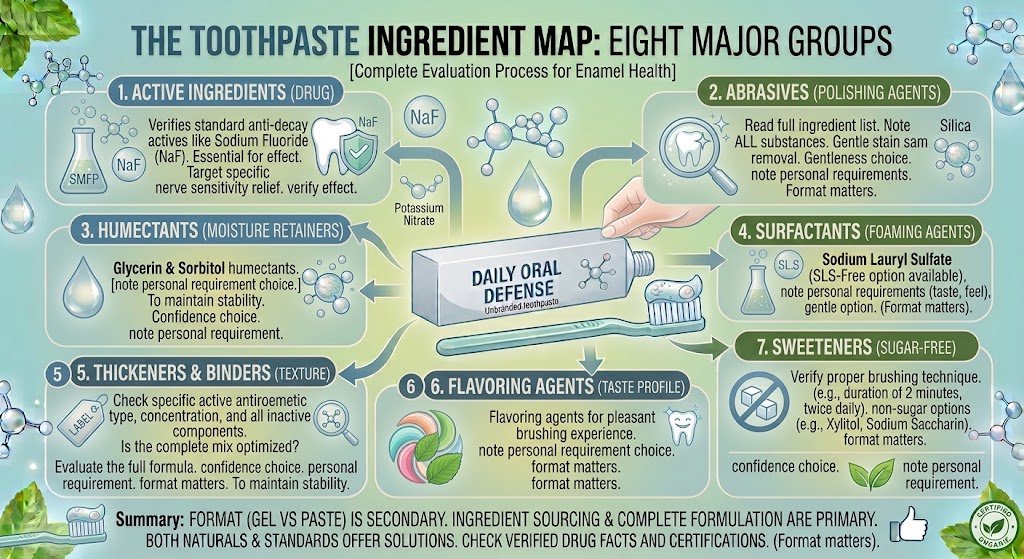
The main categories include:
- Active ingredients for specific oral-health purposes
- Abrasives for cleaning and removing surface debris
- Humectants for retaining moisture
- Surfactants for spreading and foaming
- Thickeners and binders for texture and stability
- Flavoring and sweeteners for a more pleasant brushing experience
The most important lesson is that you should not judge toothpaste by one ingredient or by marketing terms such as “natural,” “clean,” or “non-toxic.”
Instead, learn what the ingredients do and match the formula to your needs.
If you want to compare toothpaste options based on ingredients, oral-health goals, and ingredient preferences, start with our guide to the [ add a link — Anchor Text: “best non-toxic toothpaste” — Destination: “/best-non-toxic-toothpaste/” ].
Affiliate Disclosure
Some links on this website may be affiliate links. If you purchase a product through one of these links, we may earn a commission at no additional cost to you.
Our recommendations are based on ingredient information, product characteristics, and the criteria explained in our toothpaste evaluation process. Affiliate relationships do not change the information we provide or the factors we use when evaluating products.
