If you’re comparing hydroxyapatite and nano-hydroxyapatite toothpaste, the main difference is particle size and characteristics, not that they are two completely unrelated ingredients. Nano-hydroxyapatite (nano-HAp) uses hydroxyapatite particles at the nanoscale, which can change their surface behavior and interaction with tooth surfaces.
But that does not automatically make nano-hydroxyapatite the better choice.
The right option depends on what you want from a toothpaste—such as enamel care, sensitivity support, fluoride avoidance, or general remineralization—and on the complete formulation rather than the word “nano” on the label.
In this guide, we’ll compare hydroxyapatite vs nano-hydroxyapatite, look at what the research actually supports, explain the differences that matter when buying toothpaste, and show you how to decide between them.
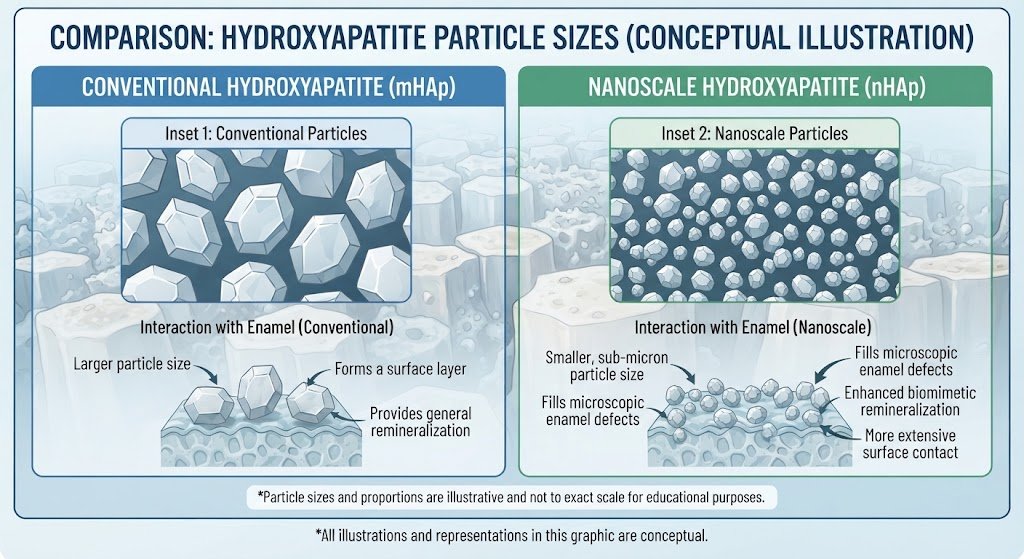
Hydroxyapatite vs Nano-Hydroxyapatite at a Glance
Both hydroxyapatite and nano-hydroxyapatite are calcium-phosphate materials used in oral-care research and toothpaste formulations. The most important distinction is the size and characteristics of the particles.
| Feature | Hydroxyapatite | Nano-Hydroxyapatite |
| Basic material | Hydroxyapatite, a calcium-phosphate mineral | Hydroxyapatite formulated as nanoscale particles |
| Main distinction | Particle size can vary by formulation | Specifically designed around nanoscale particles |
| Used in toothpaste | Yes | Yes |
| Research areas | Enamel, remineralization, sensitivity, caries | Enamel, remineralization, sensitivity, caries |
| Surface behavior | Depends on particle characteristics | Smaller particles can provide different surface properties |
| Automatically better? | No | No |
| Best way to compare | Look at the complete formulation and evidence | Look at the complete formulation and evidence |
The important takeaway is simple: nano-hydroxyapatite is not a completely different mineral from hydroxyapatite. It is a nanoscale form of the same basic material.
Research has found promising results for hydroxyapatite-based oral-care products, including nano-HAp formulations, but reviews also point to differences in study quality, formulations, follow-up periods, and the amount of clinical evidence available. [ add a link — Anchor Text: “research on hydroxyapatite toothpaste” — Destination: “authoritative systematic review or PubMed research” ]
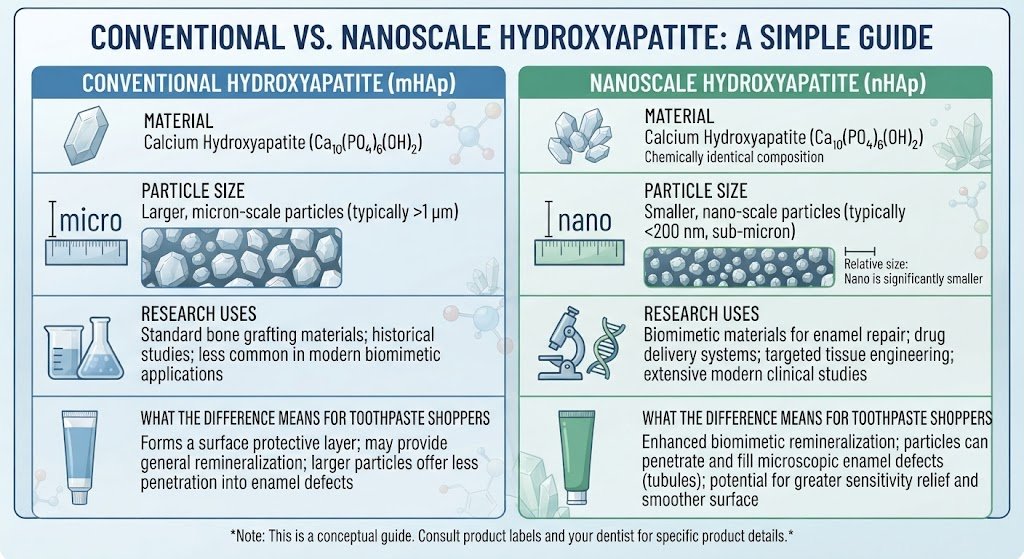
What Is Hydroxyapatite?
Hydroxyapatite is a calcium-phosphate mineral that is closely related to the mineral component of human teeth and bones.
In oral care, researchers have studied hydroxyapatite because it can interact with tooth surfaces and may help support the mineral content of enamel and dentin. This is one reason it is often described as a biomimetic ingredient—meaning it is designed to resemble a naturally occurring mineral found in tooth structure.
Hydroxyapatite toothpaste is therefore different from a toothpaste that relies only on abrasive cleaning. The ingredient itself is being investigated for functions related to mineral support, enamel remineralization, and dentin sensitivity.
If you want the basic science behind the ingredient before comparing its different forms, this article should point readers to the dedicated hydroxyapatite guide:
However, there is an important distinction between hydroxyapatite as a material and a particular hydroxyapatite toothpaste.
Two toothpastes can both contain hydroxyapatite but behave differently because of differences in:
- particle characteristics
- concentration
- formulation
- other active ingredients
- abrasivity
- manufacturing methods
- intended use
That is why simply seeing “hydroxyapatite” on a toothpaste label does not tell you everything about how the product will perform.
What Is Nano-Hydroxyapatite?
Nano-hydroxyapatite, commonly abbreviated as nano-HAp or nHAp, is hydroxyapatite produced or formulated with particles in the nanoscale range.
The smaller particle size can change characteristics such as surface area and how the material interacts with surrounding surfaces. This is one reason nano-hydroxyapatite has attracted interest in dental research.
But the word nano should be understood correctly.
It does not mean:
- automatically more effective
- automatically safer
- automatically better for everyone
- automatically capable of repairing damaged teeth
Those conclusions require evidence for the specific formulation and intended use.
The underlying mechanism and research can be explored further in your dedicated article:
For shoppers, the practical lesson is that particle size is one product attribute—not the entire product.
A toothpaste containing nano-HAp still needs to be evaluated as a complete formulation.
The Main Difference Between Hydroxyapatite and Nano-Hydroxyapatite
The easiest way to understand the difference is to focus on what changes when hydroxyapatite is produced at a much smaller particle size.
Particle Size
The defining distinction is particle size.
Hydroxyapatite used in oral-care products can exist in different particle forms and sizes. Nano-hydroxyapatite specifically refers to particles engineered or characterized at the nanoscale.
Reducing particle size can increase the material’s surface-area-to-volume ratio. That can influence how particles interact with surfaces and other ingredients in a formulation.
However, a smaller particle does not automatically produce a better clinical outcome.
This is an important distinction because product marketing can make “nano” sound like a performance guarantee. It isn’t.
Surface Area
Smaller particles can have a greater amount of surface area relative to their volume.
That property is one reason researchers are interested in nano-HAp. More available surface area can influence interactions between the particles and tooth surfaces.
But again, what happens in a laboratory does not automatically translate into a clinically meaningful difference for every toothpaste user.
The formulation, concentration, particle shape, and other ingredients can all influence performance.
Interaction With Tooth Surfaces
Hydroxyapatite is relevant to oral care because tooth enamel contains a mineral phase that is closely related to calcium-phosphate structures.
Researchers have investigated whether hydroxyapatite particles can deposit on or interact with tooth surfaces and contribute to mineral-supporting effects.
Nano-HAp is particularly interesting because its small particle size may allow different surface interactions compared with larger particles.
That is a reason to study it—not proof that every nano-HAp toothpaste will outperform every conventional hydroxyapatite toothpaste.
Why Particle Morphology Matters
Particle size is only one part of the picture.
Morphology refers to the shape and physical structure of particles. Two materials can both be described as nano-hydroxyapatite while having differences in particle characteristics.
For toothpaste shoppers, this means that the label alone may not reveal every factor that affects performance.
This is one reason a responsible comparison should avoid saying:
“Nano-HAp is better because the particles are smaller.”
A better conclusion is:
Nano-HAp has physical characteristics that may offer useful advantages, but the real-world value depends on the formulation and evidence supporting the specific use.
Is Nano-Hydroxyapatite More Effective?
This is where the comparison becomes more complicated.
Research on nano-hydroxyapatite has produced promising findings in areas such as enamel remineralization and white spot lesions. However, the available evidence does not justify treating every nano-HAp product as automatically superior.
Some studies are laboratory-based, while others involve human participants. These types of evidence answer different questions.
What Research Shows
Research has investigated hydroxyapatite and nano-hydroxyapatite for several oral-health applications, including:
- remineralization
- enamel mineral loss
- early caries-related lesions
- dentin hypersensitivity
- dental biofilm
- caries prevention
Systematic reviews have reported promising findings for nano-HAp, particularly in remineralization-related outcomes, while also noting limitations in the available evidence. [ add a link — Anchor Text: “systematic review of nano-hydroxyapatite research” — Destination: “Peer-reviewed systematic review/PubMed source” ]
What Research Does Not Yet Prove
Research does not give you a simple rule that says:
nano-HAp toothpaste = better than all conventional HAp toothpaste.
There are several reasons.
Different studies can use different:
- concentrations
- particle sizes
- particle shapes
- toothpaste bases
- brushing protocols
- study durations
- outcome measurements
So even if one nano-HAp formulation performs well in a study, that result should not automatically be transferred to every product carrying the same ingredient name.
Why “Nano” Does Not Automatically Mean Better
Think about it this way:
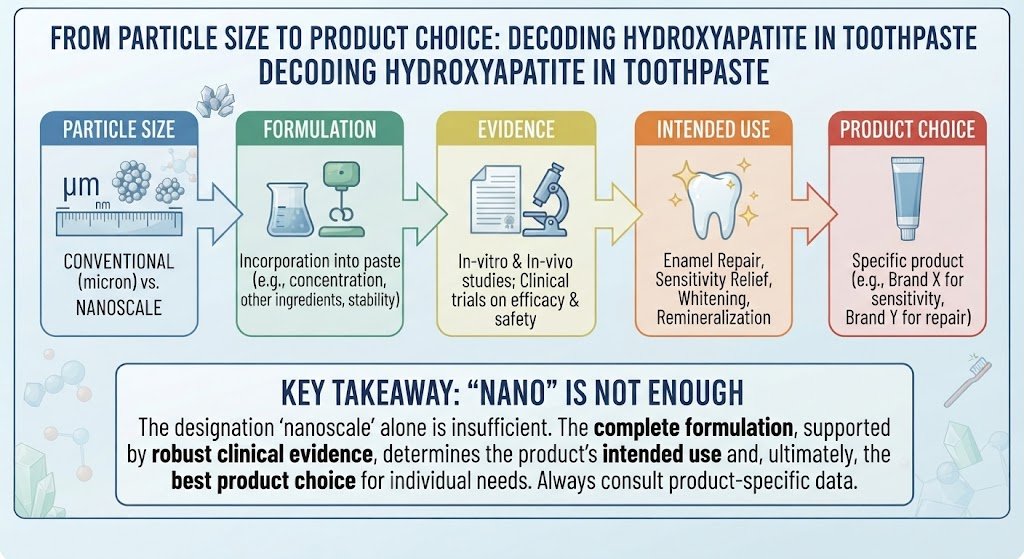
Ingredient category → particle characteristics → formulation → clinical evidence → individual use case
All of these steps matter.
The word “nano” tells you something important about the material, but it does not answer the bigger question:
Is this particular toothpaste a good choice for me?
That question requires looking at the whole formulation.
Hydroxyapatite vs Nano-Hydroxyapatite for Enamel
Enamel is one of the most important reasons people become interested in hydroxyapatite toothpaste.
Enamel is the hard outer layer of a tooth, and its mineral content can be affected by acids produced by oral bacteria and acids from foods and drinks. Mineral loss and mineral recovery are therefore important concepts when discussing toothpaste.
Hydroxyapatite has been studied for its potential role in supporting enamel remineralization.
Nano-HAp has received particular research attention because its smaller particles may interact with enamel surfaces in useful ways.
But it is important to keep the claim proportional to the evidence.
A toothpaste should not be described as literally rebuilding an entire damaged tooth. Remineralization is a specific biological and mineral process, and it is not the same thing as reversing every type of structural tooth damage.
For a deeper explanation of the relationship between hydroxyapatite and enamel:
If the reader is ready to compare actual toothpaste options for enamel care, the relevant commercial page is:
What This Means for Shoppers
If enamel care is your priority, don’t choose a toothpaste solely because it says “nano.”
Instead, consider:
- Which active ingredient it contains.
- Whether the formulation clearly identifies the ingredient.
- What evidence exists for the intended use.
- Whether you also need cavity protection or sensitivity support.
- Whether the product’s abrasivity is appropriate for your needs.
That gives you a much stronger basis for choosing a toothpaste than the word “nano” alone.
Which Is Better for Sensitive Teeth?
Tooth sensitivity is another area where hydroxyapatite-based toothpaste can become relevant.
Dentin hypersensitivity can occur when exposed dentin allows external stimuli to affect the nerves inside the tooth. One approach researchers have studied is the use of materials that can help reduce sensitivity by interacting with exposed dentin and its tubules.
Hydroxyapatite has been investigated for this purpose, including nano-HAp formulations.
But if sensitivity is your main concern, don’t assume nano-HAp automatically wins.
The complete toothpaste formulation matters.
For example, a product may contain hydroxyapatite alongside another ingredient specifically used for sensitivity. That could make the overall formulation more relevant to a person with sensitive teeth than particle size alone.
If sensitivity is your main concern, see:
You can also explore:
A Practical Rule
If two products are otherwise similar, nano-HAp may be an interesting formulation feature to consider.
But if one product has a more appropriate overall formulation for sensitivity, the complete formulation can matter more than whether its hydroxyapatite is labeled nano.
That is a much more useful purchasing rule.
Hydroxyapatite vs Nano-Hydroxyapatite for Cavity Prevention
Cavity prevention needs especially careful treatment because not all toothpaste choices carry the same level of evidence or are appropriate for every person.
Hydroxyapatite has been studied as a potential anticaries and remineralizing ingredient, and clinical research has continued to grow.
Recent systematic-review evidence suggests hydroxyapatite is promising for caries prevention, but the strength and consistency of evidence should still be considered when making individual recommendations. [ add a link — Anchor Text: “clinical evidence for hydroxyapatite and caries prevention” — Destination: “Peer-reviewed systematic review/PubMed source” ]
Where Fluoride Fits
Fluoride remains an important reference point when discussing cavity-prevention toothpaste.
That does not mean hydroxyapatite has no value. It means readers should distinguish between:
- an ingredient with growing evidence
- an ingredient with an established role in conventional cavity-prevention toothpaste
- the individual’s actual caries risk
Someone with a high risk of cavities should not make a major change to their oral-care routine based solely on a marketing claim about “nano.”
For readers comparing these approaches:
And for readers specifically looking for cavity-focused products:
The Practical Decision
If your priority is cavity prevention, consider your personal risk first.
If you have frequent cavities, active dental problems, or have been advised by your dentist to use a particular fluoride toothpaste, don’t replace that recommendation simply because a product contains nano-HAp.
For someone specifically seeking a fluoride-free option, hydroxyapatite may be worth researching—but the decision should be based on evidence and individual circumstances rather than the word “nano.”
Is Nano-Hydroxyapatite Safe?
Safety is one of the biggest questions people have when they see the word “nano.”
That concern is understandable, but the answer should not be reduced to either:
“All nanoparticles are dangerous.”
or:
“Nano-hydroxyapatite is completely risk-free.”
Neither statement is a responsible way to evaluate a dental ingredient.
Research and safety assessments have considered characteristics such as the particle’s size, shape, composition, and behavior. Nano-HAp should therefore be evaluated based on the specific material and its intended use rather than the word “nano” alone. [ add a link — Anchor Text: “nano-hydroxyapatite safety research” — Destination: “Peer-reviewed safety research/PubMed source” ]
What Current Research Suggests
Hydroxyapatite is a mineral closely related to tooth structure, and nano-HAp has been investigated for oral-care applications.
Available research is encouraging, but that does not mean every possible formulation has been studied equally.
The evidence can vary according to:
- particle characteristics
- concentration
- formulation
- exposure conditions
- study design
- duration of use
This is why a trustworthy article should avoid absolute safety statements.
Why Particle Characteristics Matter
“Nanoscale” describes a size range; it does not completely describe a material.
Two nano-HAp materials can differ in their characteristics.
That is particularly relevant when evaluating scientific studies or safety assessments.
For consumers, the practical message is straightforward:
Don’t judge a toothpaste as safe or unsafe solely because it contains the word “nano.”
Look at the complete formulation and the evidence supporting its intended use.
For a deeper discussion of the ingredient itself:
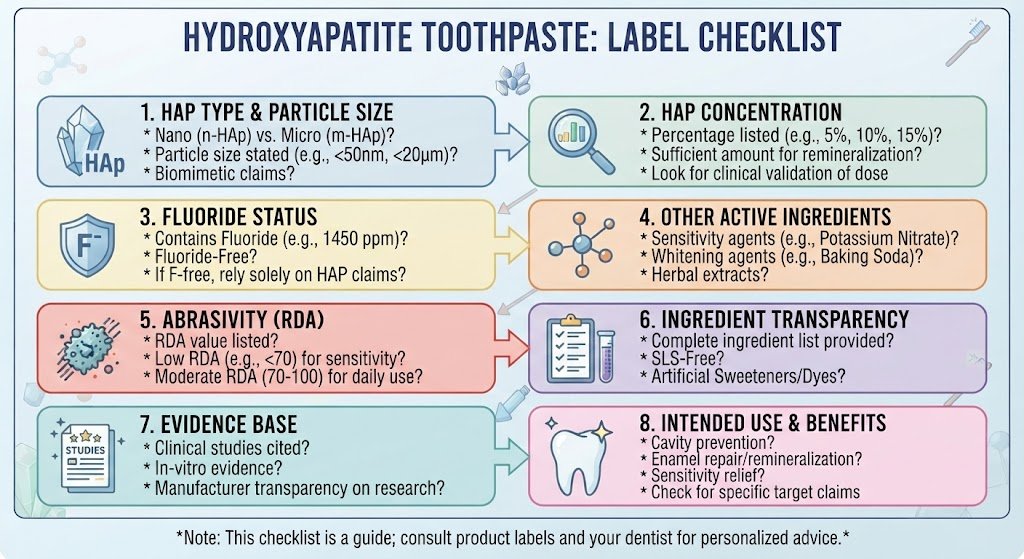
How to Choose a Hydroxyapatite Toothpaste
Once you understand the difference between hydroxyapatite and nano-HAp, the next question is more practical:
What should I actually look for when buying toothpaste?
The answer is broader than particle size.
1. Check the Hydroxyapatite Type
See whether the manufacturer identifies:
- hydroxyapatite
- nano-hydroxyapatite
- nano-HAp
- another specific form
Don’t assume that every product uses exactly the same material.
2. Look for Concentration Information
If the product clearly discloses its active concentration, that can make comparison easier.
However, don’t assume that a higher number automatically means a better toothpaste. The formulation and evidence still matter.
3. Check Fluoride Status
If you specifically want fluoride-free toothpaste, verify that rather than assuming hydroxyapatite automatically means fluoride-free.
Some formulations may contain both hydroxyapatite and fluoride.
4. Look at the Other Active Ingredients
The rest of the formula can be important.
Depending on your needs, you may care about ingredients related to:
- sensitivity
- cavity protection
- cleaning
- flavor
- foaming
- enamel care
5. Consider Abrasivity
A toothpaste can contain an interesting active ingredient and still not be the right choice for your situation if the overall formulation is not appropriate.
Abrasivity can matter when considering long-term tooth cleaning and enamel/dentin exposure.
6. Look for Transparent Labeling
A good product page should make it reasonably easy to understand:
- active ingredients
- ingredient list
- intended use
- product size
- relevant formulation information
7. Evaluate the Evidence
Don’t stop at:
“Contains nano-hydroxyapatite.”
Ask:
What evidence supports the ingredient and the intended use?
That is a much stronger shopping habit.
8. Compare the Whole Product
This is the most important point.
When comparing two toothpastes, consider:
ingredient → concentration → formulation → intended use → evidence → price
rather than:
nano = better
For readers who want a broader framework:
And for product-specific comparisons:
Hydroxyapatite vs Nano-Hydroxyapatite: Which One Should You Choose?
There isn’t a universal winner.
The better choice depends on why you’re buying the toothpaste in the first place.
Consider Conventional Hydroxyapatite If…
You want a hydroxyapatite-based toothpaste and don’t have a specific reason to prioritize a nano formulation.
You don’t need to assume that a conventional HAp product is inferior simply because it isn’t labeled “nano.”
Consider Nano-Hydroxyapatite If…
You specifically want a toothpaste formulated with nano-HAp and prefer the research surrounding nanoscale hydroxyapatite.
Just make sure you’re evaluating the entire formulation rather than treating the particle size as a guarantee of better results.
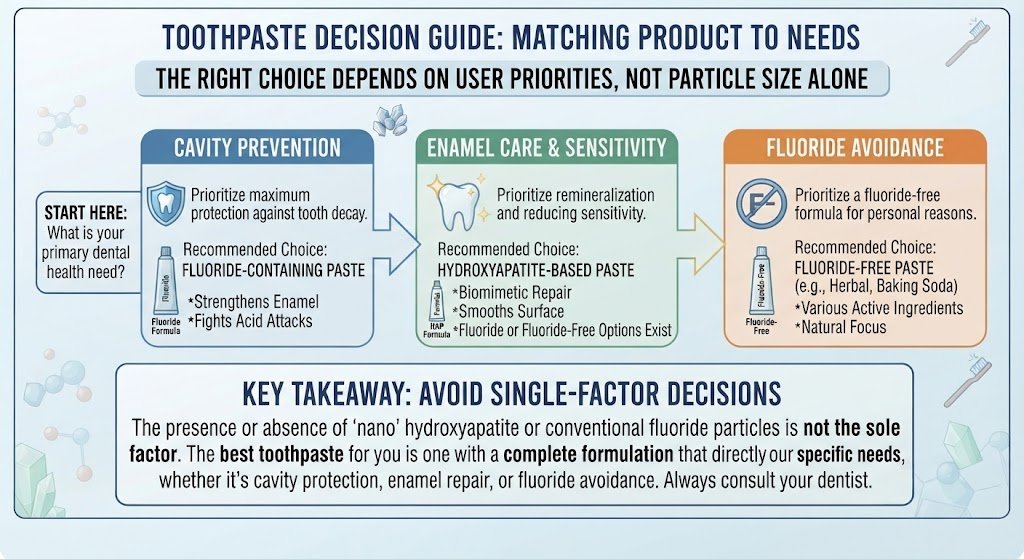
Consider Fluoride Toothpaste If…
Your main priority is established cavity protection, particularly if you have elevated caries risk or your dental professional has recommended fluoride toothpaste.
This is an important reason not to frame the HAp-versus-nano-HAp decision in isolation.
If Sensitive Teeth Are Your Main Concern
Look beyond the HAp label.
Compare:
- sensitivity-focused ingredients
- HAp type
- formulation
- evidence
- your individual cause of sensitivity
And remember that persistent or severe sensitivity deserves professional evaluation.
The Simplest Decision Framework
If you want fluoride-free mineral-based toothpaste:
Hydroxyapatite or nano-HAp may both be worth considering.
If you’re specifically interested in nano-HAp:
Choose a transparent formulation supported by appropriate evidence rather than simply choosing the word “nano.”
If cavity risk is your biggest concern:
Consider fluoride evidence and your individual risk before switching.
If enamel or sensitivity is your priority:
Compare the entire formulation and the evidence for that specific use.
If you’re unsure:
A dentist can help you choose based on your actual oral-health needs.
Hydroxyapatite vs Nano-Hydroxyapatite Toothpaste: What Should You Buy?
Once you’ve narrowed down your preferred type, the next step is comparing actual products.
Rather than choosing based on packaging claims, compare:
- hydroxyapatite type
- disclosed concentration
- fluoride status
- sensitivity ingredients
- other active ingredients
- abrasivity information
- ingredient transparency
- price per tube
- evidence relevant to the product’s formulation
For a dedicated comparison of hydroxyapatite products:
For nano-HAp-specific options:
Amazon Buying Tip
If you’re shopping on Amazon, don’t rely only on the product title.
Open the product details and ingredient information where available. Check whether the product clearly explains the hydroxyapatite type and formulation, and compare that information across products.
Product selection should come after understanding the ingredient—not before.
Frequently Asked Questions
Is nano-hydroxyapatite the same as hydroxyapatite?
Nano-hydroxyapatite is a nanoscale form of hydroxyapatite. The basic material is closely related, but the smaller particle size gives the nano form different physical characteristics. That difference can affect surface behavior and how the material interacts with tooth surfaces. However, nano-HAp should not automatically be treated as a completely different or universally superior ingredient.
Is nano-hydroxyapatite better than regular hydroxyapatite?
Not necessarily. Nano-HAp has properties that make it interesting for oral-care research, and some studies have reported promising results. But “smaller particles” does not automatically mean better clinical performance. The complete toothpaste formulation, concentration, particle characteristics, evidence, and intended use all matter.
Does nano-hydroxyapatite remineralize enamel?
Research suggests that nano-HAp can support remineralization-related processes, and systematic reviews have reported promising findings. However, research quality and study conditions vary. Laboratory results should not automatically be interpreted as proof that every nano-HAp toothpaste will produce the same result in everyday use.
Is nano-hydroxyapatite safe in toothpaste?
Current research on nano-HAp in oral care is generally encouraging, but absolute statements such as “completely risk-free” are not appropriate. Safety depends on the characteristics of the material and its formulation. When evaluating a specific toothpaste, look for transparent ingredient information and evidence relevant to the product and intended use.
Can hydroxyapatite replace fluoride toothpaste?
Hydroxyapatite is a promising ingredient for fluoride-free oral-care products, but that does not mean everyone should replace fluoride toothpaste with it. Fluoride has an established role in cavity prevention, and people with higher caries risk may have different needs. If you’re considering switching, especially because of recurrent cavities, discuss the choice with your dentist.
Which is better for sensitive teeth: hydroxyapatite or nano-hydroxyapatite?
There is no simple universal winner. Both forms have been studied in relation to dentin sensitivity, but the overall formulation can matter more than the word “nano.” Look at the other active ingredients, the product’s intended use, and the evidence supporting its formulation.
What should I look for when buying hydroxyapatite toothpaste?
Start with the hydroxyapatite type and any disclosed concentration. Then check whether the toothpaste contains fluoride, what other active ingredients are included, whether the formulation is transparent, and whether there is evidence relevant to your goal. Also consider abrasivity, price, and whether the toothpaste is specifically designed for sensitivity, enamel care, or another need.
Should I choose nano-hydroxyapatite toothpaste just because it says “nano”?
No. “Nano” describes a physical characteristic of the hydroxyapatite; it is not a guarantee of superior clinical performance. Use it as one comparison factor, then evaluate the complete formulation and the evidence behind the product.
Conclusion
Hydroxyapatite and nano-hydroxyapatite are closely related materials, with particle size and characteristics being the key distinction.
Nano-hydroxyapatite has attracted significant interest because its smaller particles can have different surface properties, and research has found promising applications in areas such as enamel remineralization and sensitivity. But the current evidence does not support a simple rule that every nano-HAp toothpaste is better than every conventional hydroxyapatite toothpaste.
For most shoppers, the smarter approach is to compare the whole formulation:
hydroxyapatite type → concentration → other active ingredients → fluoride status → intended use → evidence → price
If you’re choosing between specific products, start with the dedicated:
and:
The goal isn’t simply to find the toothpaste with the most impressive ingredient name. It’s to find the formulation that best matches your oral-health needs and the evidence available for that use.
