Choosing between fluoride and hydroxyapatite toothpaste can be confusing. Both are used in toothpaste designed to support tooth health, but they are not the same ingredient and they do not have the same evidence history.
Fluoride toothpaste has a long-established role in cavity prevention, while hydroxyapatite is a researched alternative that is increasingly used in fluoride-free toothpaste. Some people prefer hydroxyapatite because they specifically want to avoid fluoride, while others prioritize fluoride because of its established evidence and dental guidance.
So which one should you choose?
The answer depends on your cavity risk, dental needs, ingredient preferences, and the complete toothpaste formula. This guide compares fluoride and hydroxyapatite, explains what the research can and cannot tell us, and shows what to look for before buying either type.
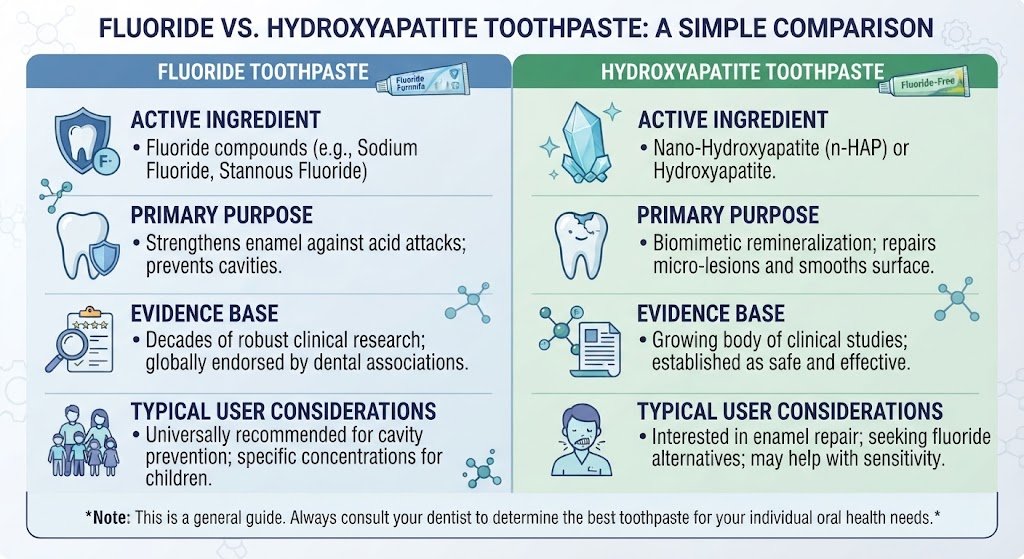
Fluoride vs. Hydroxyapatite Toothpaste at a Glance
| Factor | Fluoride Toothpaste | Hydroxyapatite Toothpaste |
| Main active ingredient | Fluoride compound | Hydroxyapatite |
| Common examples | Sodium fluoride, sodium monofluorophosphate, stannous fluoride | Hydroxyapatite, including some nano-hydroxyapatite formulas |
| Main oral-health focus | Established cavity prevention | Tooth-mineral and enamel-focused care; studied for cavity prevention |
| Evidence base | Extensive and long-established | Growing clinical evidence |
| Usually fluoride-free? | No | Yes, when used as the alternative active ingredient |
| Best fit | People prioritizing established anticaries protection | People specifically seeking a hydroxyapatite or fluoride-free option |
| Main buying consideration | Fluoride type and complete formula | Hydroxyapatite formulation and complete formula |
The American Dental Association identifies sodium fluoride, sodium monofluorophosphate, and stannous fluoride among fluoride compounds used in toothpaste. [ add a link ]
The key point is that “fluoride-free” and “hydroxyapatite” are not interchangeable terms. Fluoride-free simply means fluoride is not present as the active ingredient. A fluoride-free toothpaste may use hydroxyapatite or another approach.
What Is Fluoride Toothpaste?
Fluoride toothpaste is toothpaste that contains a fluoride compound as an active ingredient. Fluoride is widely used in toothpaste because it helps protect teeth against dental caries, commonly called cavities.
To understand why fluoride matters, it helps to understand what happens to enamel during everyday eating and drinking.
How Fluoride Helps Protect Teeth
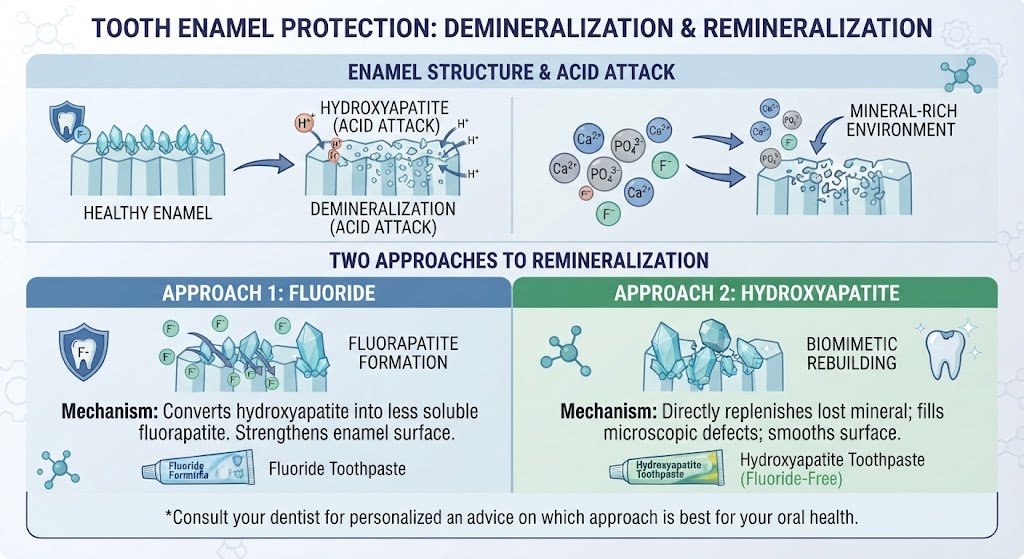
Your teeth are constantly exposed to acids produced when bacteria in dental plaque metabolize carbohydrates. These acids can cause minerals to leave the enamel surface, a process called demineralization.
Your mouth also has natural processes that put minerals back into tooth surfaces. This is called remineralization.
Fluoride supports the balance between these processes and helps make teeth more resistant to acid-related damage. This is one reason fluoride toothpaste has become a standard part of cavity-prevention guidance.
The ADA recommends brushing twice daily with fluoride toothpaste for general home oral care. [ add a link ]
Fluoride does not mean that a person can eat without limits or ignore brushing, flossing, dental visits, or other oral-health habits. Tooth decay is influenced by multiple factors, including plaque, diet, saliva, oral hygiene, and individual cavity risk.
Common Fluoride Ingredients
Not all fluoride toothpaste uses exactly the same fluoride compound.
Common fluoride ingredients include:
- Sodium fluoride
- Sodium monofluorophosphate
- Stannous fluoride
These ingredients are not simply different names for the same chemical. They are different fluoride compounds used in toothpaste formulations.
For example, stannous fluoride can be used in formulas that make additional oral-health claims, while sodium fluoride is widely used in anticaries toothpaste.
The FDA also has a regulatory framework for over-the-counter anticaries drug products, including recognized fluoride active ingredients used in toothpaste. [ add a link ]
How Much Fluoride Is in Toothpaste?
U.S. fluoride toothpaste commonly contains fluoride within established anticaries concentrations. The exact amount and labeling depend on the product and active ingredient.
Rather than choosing toothpaste based only on the number printed on the package, consider the product’s intended use and follow the directions on the label.
If you have an unusually high risk of cavities or have been given specific fluoride instructions by your dentist, your personal recommendation may differ from general consumer guidance.
What Is Hydroxyapatite Toothpaste?
Hydroxyapatite is a calcium-phosphate mineral closely related to the mineral structure found in teeth and bones.
In toothpaste, hydroxyapatite is used as an active ingredient in some formulas, particularly products marketed as fluoride-free alternatives.
The idea behind hydroxyapatite toothpaste is different from simply removing fluoride from a formula. Instead, the toothpaste uses a mineral-based ingredient that has been studied for its interaction with tooth surfaces and its potential role in remineralization and caries prevention.
That distinction matters.
A toothpaste labeled fluoride-free does not automatically contain hydroxyapatite. If hydroxyapatite is the reason you are considering a fluoride-free toothpaste, check the ingredient information rather than relying on the front of the package.
What Is Nano-Hydroxyapatite?
You may also see the term nano-hydroxyapatite, sometimes abbreviated as n-HAp.
“Hydroxyapatite” describes the material, while “nano” refers to the scale of the particles used in the formulation.
Nano-hydroxyapatite has received particular attention in oral-care research because researchers have investigated how small hydroxyapatite particles interact with tooth surfaces.
However, seeing the word “nano” on a toothpaste package does not automatically mean that the product is better than every conventional hydroxyapatite toothpaste.
The complete formulation, amount used, intended purpose, evidence, and quality of the product still matter.
How Is Hydroxyapatite Intended to Work?
Hydroxyapatite is chemically related to the mineral that makes up much of tooth enamel. Research has investigated whether hydroxyapatite-containing toothpaste can contribute to mineral deposition, enamel surface protection, and prevention of early caries-related changes.
The research is promising, but it is important to keep the language precise.
Hydroxyapatite should not be presented as a miracle ingredient that can rebuild a severely damaged tooth or reverse an established cavity.
Early enamel mineral loss and an established cavity are not the same thing. Once significant structural tooth damage has occurred, toothpaste cannot simply restore the tooth to its original condition.
Fluoride vs. Hydroxyapatite: How Do They Actually Compare?
The biggest mistake in this comparison is asking:
“Which ingredient is better?”
without first asking:
“Better for what?”
If your main concern is established cavity prevention, fluoride has the advantage of a much longer and broader evidence history.
If your priority is finding a fluoride-free toothpaste containing hydroxyapatite, then the question becomes whether the particular hydroxyapatite formula provides the characteristics you want and whether its evidence fits your expectations.
Cavity Prevention
Fluoride has a well-established role in preventing dental caries and is incorporated into mainstream dental guidance.
Hydroxyapatite has also been studied for anticaries effects. Recent reviews have found growing evidence supporting its potential, including research directly comparing hydroxyapatite and fluoride formulations. [ add a link ]
However, “has evidence” and “has the same depth of evidence” are not automatically the same statement.
Fluoride has been studied extensively over many years and is deeply established in dental practice and public-health guidance. Hydroxyapatite is a newer alternative in mainstream toothpaste discussions, so its research base is different.
Remineralization and Enamel
Both fluoride and hydroxyapatite are associated with the mineral side of tooth protection, but they should not be described as identical mechanisms.
Fluoride can help teeth resist acid-related mineral loss and support remineralization.
Hydroxyapatite is a calcium-phosphate mineral that has been investigated for its ability to interact with tooth surfaces and contribute to mineral-related protection.
This is why hydroxyapatite toothpaste is often marketed around terms such as:
- remineralization
- enamel care
- mineral repair
- enamel strengthening
But consumers should be careful with the word “repair.”
A toothpaste may support the management of early mineral loss, but that does not mean it can repair a large cavity, cracked tooth, or other structural dental problem.
Evidence
This is where the comparison becomes more nuanced.
Research on hydroxyapatite has expanded considerably, and systematic reviews have evaluated its potential for caries prevention and comparison with fluoride toothpaste. [ add a link ]
At the same time, the existence of hydroxyapatite research does not erase the extensive evidence supporting fluoride.
A responsible comparison therefore should not say either:
“Hydroxyapatite does nothing.”
or:
“Hydroxyapatite has completely replaced fluoride.”
Both statements go beyond what the evidence supports.
Fluoride-Free Preference
Some consumers simply prefer not to use fluoride.
That preference can be based on personal beliefs, ingredient preferences, previous experiences, or interest in alternative oral-care products.
If that describes you, hydroxyapatite may be worth investigating because it provides a specific active-ingredient approach rather than simply removing fluoride.
But the decision should still be based on the actual formula and your oral-health needs.
Personal Dental Risk
This may be the most important part of the comparison.
Someone who rarely develops cavities and someone who repeatedly needs fillings may have very different reasons for choosing toothpaste.
If you have a history of frequent cavities, dry mouth, extensive dental work, or another factor that increases your cavity risk, it is sensible to discuss a fluoride-free switch with your dentist rather than making the decision based only on online product claims.
Is Hydroxyapatite as Effective as Fluoride?
This is one of the most common questions surrounding hydroxyapatite toothpaste, and the answer requires more nuance than a simple yes or no.
Clinical research has investigated hydroxyapatite toothpaste for caries prevention and compared it with fluoride-containing toothpaste in different settings.
A recent systematic review and meta-analysis examined hydroxyapatite and fluoride toothpaste and found that the available evidence did not show a significant difference for the specific caries outcomes evaluated. However, the review included a relatively small number of eligible in-situ randomized trials, which means the findings should not be interpreted as proof that every hydroxyapatite toothpaste is equivalent to every fluoride toothpaste. [ add a link ]
Other reviews have also reported growing evidence for hydroxyapatite’s potential in caries prevention while emphasizing differences in study design and the need for further high-quality research. [ add a link ]
That distinction is important.
What We Can Say With More Confidence
We can reasonably say that:
- Hydroxyapatite is a researched oral-care ingredient.
- It has been investigated for remineralization and caries-related outcomes.
- Some clinical research compares it directly with fluoride toothpaste.
- It can be used in fluoride-free toothpaste.
- The evidence base is growing.
But we should be more cautious about saying:
- Every hydroxyapatite toothpaste works as well as every fluoride toothpaste.
- Nano-hydroxyapatite is automatically superior.
- Hydroxyapatite is universally safer.
- Fluoride is unnecessary for everyone.
- One ingredient is the universal winner.
The product itself matters.
A toothpaste is not just one ingredient in a tube. It is a formulation containing an active ingredient plus abrasives, flavoring agents, humectants, detergents, binders, and other components.
That means two products containing hydroxyapatite can still be quite different.
Likewise, two fluoride toothpastes can differ in fluoride compound, additional active ingredients, abrasivity, flavoring, and other formulation characteristics.
For consumers, this leads to a better question:
Which formulation fits my dental needs and ingredient preferences?
rather than simply:
Which ingredient wins?
[ARTICLE CONTINUES — NEXT PART STARTS WITH: H2: “Which Is Better for Cavities?”]
Continuing from the exact stopping point, without repeating the previous sections.
Which Is Better for Cavities?
When comparing fluoride and hydroxyapatite toothpaste, cavity prevention is one of the most important factors to consider.
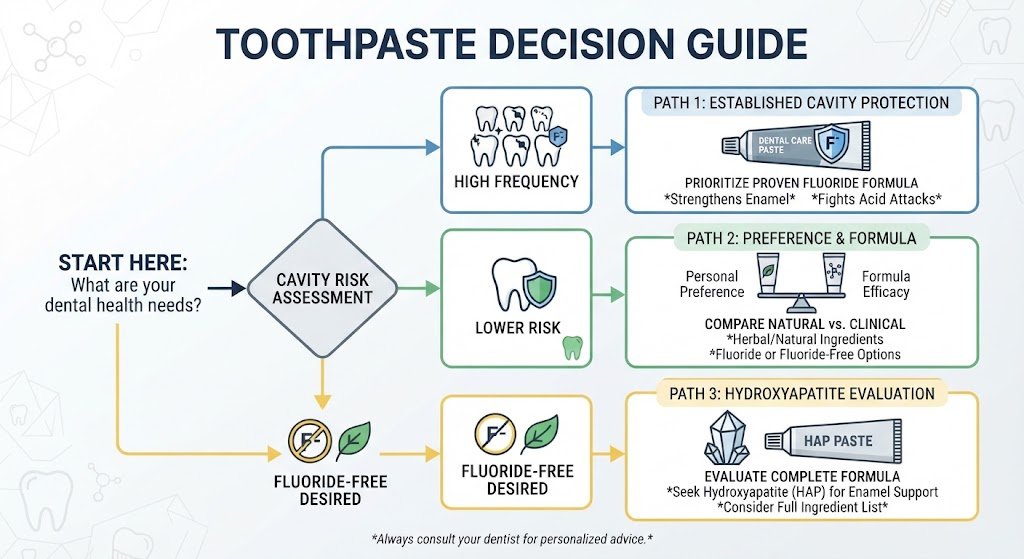
The better choice depends on your cavity risk, your oral-health needs, and whether you want fluoride in your toothpaste. It is also important to look at the complete toothpaste formula, rather than assuming that one ingredient automatically makes a product better.
If You Frequently Get Cavities
If you frequently develop cavities, have a history of dental decay, or have been told by your dentist that you are at higher risk for cavities, fluoride toothpaste has a particularly well-established role in cavity prevention.
The American Dental Association recommends brushing twice daily with fluoride toothpaste. In the United States, commonly used fluoride toothpaste contains active fluoride ingredients such as sodium fluoride, sodium monofluorophosphate, or stannous fluoride.
Fluoride helps teeth resist acid-related mineral loss and supports remineralization. This makes fluoride an important consideration for people who need reliable cavity protection.
That does not mean hydroxyapatite toothpaste has no value. Hydroxyapatite has been studied for remineralization and caries-related outcomes, and research on hydroxyapatite toothpaste continues to develop. However, the evidence base and professional recommendations for fluoride toothpaste remain more established.
If cavity prevention is your highest priority, especially if you have a higher-than-average cavity risk, it is reasonable to give greater weight to fluoride’s established evidence and guidance.
If You Have a Lower Cavity Risk
Someone with a lower cavity risk may approach the decision differently.
For example, you may have good brushing habits, regular dental checkups, a relatively low history of cavities, and a diet that does not frequently expose your teeth to fermentable carbohydrates. In that situation, you may be more interested in other toothpaste characteristics, such as:
- whether you want fluoride or fluoride-free toothpaste
- sensitivity support
- ingredient preferences
- taste and texture
- abrasiveness
- whether the formula contains ingredients you personally prefer to avoid
- whether the product fits your daily brushing routine
Hydroxyapatite can be an option for people who specifically want a fluoride-free toothpaste and are interested in a mineral-based active ingredient.
However, low cavity risk does not mean cavity risk is zero. Your risk can change with age, medications, dry mouth, diet, oral hygiene, gum health, and other factors.
The important point is to choose based on your actual oral-health situation rather than simply choosing the toothpaste marketed as the most “natural” or “clean.”
If You Specifically Want Fluoride-Free Toothpaste
If avoiding fluoride is important to you, hydroxyapatite toothpaste is one category worth investigating.
But fluoride-free does not automatically mean hydroxyapatite.
A fluoride-free toothpaste can use different active or functional ingredients, and not every fluoride-free product has the same evidence behind it. If you are specifically looking for hydroxyapatite toothpaste, check the ingredient list to confirm that hydroxyapatite is actually included and identify whether the formula uses conventional hydroxyapatite or nano-hydroxyapatite.
You should also look beyond the active ingredient.
A toothpaste can contain hydroxyapatite but still differ from another hydroxyapatite toothpaste in abrasives, flavoring agents, detergents, humectants, sweeteners, and other formulation details.
For a fluoride-free option, the question should therefore be:
What does the complete formula contain, and is it appropriate for my oral-health needs?
That is a much more useful question than simply asking whether a toothpaste is “non-toxic,” “natural,” or “clean.”
Which Is Better for Sensitive Teeth?
Sensitivity can make the fluoride-versus-hydroxyapatite decision more complicated because sensitivity is not caused by one single factor.
Tooth sensitivity can occur when dentin becomes exposed or when enamel and gum conditions allow stimuli such as cold, heat, sweetness, or touch to affect the underlying tooth structures.
Both fluoride and hydroxyapatite toothpaste may appear in products marketed toward people with sensitivity, but the specific formula matters.
Some sensitivity toothpastes use ingredients specifically intended to reduce sensitivity, while others focus more broadly on enamel protection or remineralization.
Fluoride Toothpaste for Sensitive Teeth
Fluoride can support enamel and help protect teeth from mineral loss. Some fluoride toothpaste formulations also contain other ingredients designed specifically for sensitivity.
This means that choosing a fluoride toothpaste does not necessarily mean choosing between cavity protection and sensitivity support. A single formula may address multiple needs.
When shopping for sensitivity toothpaste, check the active ingredients and the product’s stated purpose rather than relying only on words such as “natural,” “gentle,” or “clean.”
Hydroxyapatite Toothpaste for Sensitive Teeth
Hydroxyapatite is also used in toothpaste formulations intended to support enamel and reduce sensitivity.
Because hydroxyapatite is chemically related to the mineral found in teeth, researchers have investigated its potential role in supporting the tooth surface and reducing sensitivity.
However, not every hydroxyapatite toothpaste is formulated specifically for sensitive teeth.
If sensitivity is your main concern, look for a product that clearly explains what it is intended to do and examine the rest of the formula.
You should also consider why your teeth are sensitive. Persistent or worsening sensitivity can sometimes be associated with issues such as tooth decay, gum recession, enamel wear, cracks, or other dental problems.
Toothpaste can support daily oral care, but it should not be used as a substitute for a dental evaluation when sensitivity is persistent, severe, or associated with other symptoms.
What Should You Look for When Buying Hydroxyapatite Toothpaste?
If you decide that hydroxyapatite toothpaste fits your preferences, do not stop at the words “hydroxyapatite toothpaste” on the front of the package.
A better approach is to evaluate the complete product.
1. Check the Active Ingredient
Start by checking whether hydroxyapatite is actually listed in the ingredients.
If the product specifically promotes nano-hydroxyapatite, check whether the ingredient list identifies the type of hydroxyapatite used.
Marketing language alone is not enough to tell you how much of an ingredient is present or how the complete formula performs.
2. Understand Whether It Uses Nano-Hydroxyapatite
Nano-hydroxyapatite consists of very small hydroxyapatite particles.
It has attracted attention because particle size can affect how a material interacts with tooth surfaces. However, “nano” should not automatically be interpreted as “better.”
The relevant questions are:
- What form of hydroxyapatite is used?
- What does the available research show?
- What concentration or formulation is being used?
- What is the product actually intended to help with?
- Is the evidence relevant to this type of formulation?
A responsible comparison looks at the evidence rather than treating the word “nano” as a quality guarantee.
3. Look at the Complete Formula
The active ingredient is important, but it is not the entire toothpaste.
Toothpaste can also contain:
- abrasives
- detergents
- humectants
- thickeners
- flavoring ingredients
- sweeteners
- preservatives
- other active ingredients
If your goal is a gentler or “cleaner” toothpaste, examine the whole ingredient list.
For example, you may personally prefer to avoid certain detergents, strong flavoring ingredients, dyes, or other ingredients. That is different from claiming that every person needs to avoid those ingredients.
4. Consider Abrasiveness
A toothpaste can contain an ingredient you like while still being unsuitable for your particular needs if the overall formula is too abrasive for you.
Abrasives help remove surface deposits and stains, but excessive or inappropriate abrasion can be a concern for people with certain forms of enamel wear, exposed dentin, or gum recession.
If you are specifically looking for a gentler toothpaste, abrasiveness should be part of your comparison.
5. Consider Your Main Dental Goal
Ask yourself what you actually want the toothpaste to help you with.
Your priorities might be:
- cavity prevention
- sensitive teeth
- enamel protection
- fluoride-free oral care
- remineralization
- gum health
- whitening
- bad breath
- avoiding specific ingredients
The best toothpaste for one goal may not be the best choice for another.
This is why comparing fluoride and hydroxyapatite in isolation can be misleading. A toothpaste is a complete formulation designed around one or more oral-health purposes.
6. Look for Clear Product Information
A good toothpaste listing should make it reasonably easy to understand:
- the active ingredients
- the purpose of the toothpaste
- important formulation details
- directions for use
- relevant warnings
- manufacturer information
Be cautious when a product relies heavily on broad claims such as “toxin-free,” “chemical-free,” “100% safe,” or “better than fluoride” without explaining the evidence behind those claims.
7. Consider Third-Party or Professional Evaluation
If a toothpaste has a recognized professional evaluation or seal, understand exactly what that evaluation means.
For example, the ADA Seal of Acceptance is not simply a ranking of which toothpaste is “best.” It indicates that a product has been evaluated for safety and effectiveness for specific claims.
That distinction matters.
A seal or certification should be interpreted according to what was actually evaluated, rather than treated as proof that a product is universally better than every alternative.
8. Compare Value, Not Just Price
Price can vary significantly between fluoride and hydroxyapatite toothpaste.
Instead of comparing the sticker price alone, consider:
- tube size
- recommended amount per use
- frequency of use
- ingredients
- active ingredient
- product purpose
- evidence supporting the intended benefit
- whether you actually need the additional features
A more expensive toothpaste is not automatically more effective.
Fluoride vs. Hydroxyapatite: Which One Should You Choose?
There is no single answer that applies to every person.
The most useful way to decide is to start with your oral-health risk and personal priorities.
Choose Fluoride Toothpaste If:
Fluoride may be the more straightforward choice if:
- cavity prevention is your highest priority
- you frequently develop cavities
- your dentist has identified you as being at higher risk for dental caries
- you want the benefit of fluoride’s long-established evidence base
- you want a toothpaste that aligns with mainstream U.S. dental guidance for cavity prevention
If you are unsure which fluoride formula fits your needs, focus on the active fluoride ingredient, the product’s purpose, and other formulation characteristics.
Consider Hydroxyapatite Toothpaste If:
Hydroxyapatite may be worth considering if:
- you specifically prefer fluoride-free toothpaste
- you are interested in a mineral-based active ingredient
- you want to explore hydroxyapatite’s growing research base
- you are comparing toothpaste based on enamel or remineralization considerations
- you have a lower cavity risk and want to evaluate alternatives based on your personal preferences
This does not mean hydroxyapatite is automatically the right choice for everyone.
If you have a high cavity risk, discuss fluoride-free options with your dentist before changing your routine.
If You Want the “Cleanest” Toothpaste
Be careful with the word “clean.”
There is no universal scientific definition that makes one toothpaste “clean” and another “unclean.”
Instead of relying on a marketing label, look at the actual formula.
Ask:
- What is the active ingredient?
- What is the toothpaste designed to help with?
- Does it contain fluoride or hydroxyapatite?
- If it contains hydroxyapatite, what type?
- What other ingredients are included?
- Is the formula appropriate for my dental needs?
- What evidence supports the product’s main claims?
- Does the product have any relevant professional evaluation or seal?
- Is the price reasonable for what I am getting?
This approach gives you a more reliable way to compare products than simply searching for a toothpaste labeled “natural” or “non-toxic.”
If you want a broader comparison of toothpaste categories and products, you can use our guide to:
Frequently Asked Questions
Is hydroxyapatite toothpaste as effective as fluoride toothpaste?
Research has directly investigated hydroxyapatite and fluoride toothpaste, including studies examining caries-related outcomes. Some recent reviews have found promising results, including no significant difference for certain outcomes in the studies analyzed.
However, the evidence base is not identical to fluoride’s much longer-established evidence and professional guidance. Results can also depend on the specific formulation, study design, population, and outcome being measured.
So it is more accurate to say that hydroxyapatite is a researched alternative than to claim that every hydroxyapatite toothpaste is universally equal to every fluoride toothpaste.
Can hydroxyapatite toothpaste prevent cavities?
Hydroxyapatite toothpaste has been studied for its potential role in preventing or managing dental caries and supporting remineralization.
The evidence is encouraging, but product formulation and individual cavity risk matter. People with a high risk of cavities should discuss fluoride-free toothpaste with their dentist before replacing a fluoride toothpaste.
Is hydroxyapatite toothpaste safe?
Hydroxyapatite has been studied as an ingredient in oral-care products, including toothpaste.
However, safety should be considered in the context of the complete product, how it is used, and the specific formulation. Avoid assuming that an ingredient is automatically risk-free simply because it is marketed as “natural” or “mineral-based.”
Is nano-hydroxyapatite better than regular hydroxyapatite?
Not necessarily.
Nano-hydroxyapatite has properties related to its very small particle size and has been studied for oral-care applications. But the word “nano” alone does not prove that one toothpaste will perform better than another.
Compare the actual formulation and evidence rather than choosing a product based solely on the presence of “nano” in its marketing.
Can I replace fluoride toothpaste with hydroxyapatite toothpaste?
Some people choose hydroxyapatite toothpaste because they specifically want a fluoride-free option.
Whether that change makes sense depends on your individual cavity risk and oral-health needs. If you are prone to cavities or have been advised to use fluoride toothpaste, speak with your dentist before making the switch.
Which is better for sensitive teeth: fluoride or hydroxyapatite?
Neither ingredient should automatically be considered the winner for every sensitive-tooth situation.
The specific formula matters because some toothpastes contain ingredients specifically intended for sensitivity. Your underlying cause of sensitivity also matters.
If sensitivity continues, becomes severe, or is accompanied by pain or other symptoms, a dental examination is more important than simply switching toothpaste.
How do I choose a good hydroxyapatite toothpaste?
Start by checking whether hydroxyapatite is actually included in the ingredient list. Then consider whether it is conventional or nano-hydroxyapatite, the rest of the formula, abrasiveness, product purpose, evidence, directions, and your personal oral-health needs.
Do not choose based solely on claims such as “natural,” “non-toxic,” or “chemical-free.”
Should I choose fluoride or hydroxyapatite toothpaste?
For many people, the decision comes down to cavity risk and personal preference.
Fluoride has a long-established role in cavity prevention and is recommended in mainstream U.S. dental guidance. Hydroxyapatite is a researched alternative that may appeal to people specifically seeking fluoride-free toothpaste.
If you have a higher cavity risk, fluoride deserves serious consideration. If fluoride-free toothpaste is important to you, hydroxyapatite may be a category worth researching carefully.
Final Verdict: Fluoride vs. Hydroxyapatite Toothpaste
Fluoride and hydroxyapatite are not simply two marketing labels competing for the same customer.
They are different active ingredients with different evidence histories, and the best choice depends on your individual oral-health needs.
Fluoride toothpaste remains the more established choice for cavity prevention, particularly for people who are at higher risk of dental caries. Its role in cavity prevention is supported by extensive research and professional dental guidance.
Hydroxyapatite toothpaste is a researched fluoride-free alternative that has gained attention for its potential role in remineralization, enamel support, and caries-related outcomes. The evidence is growing, but it should be interpreted carefully rather than through exaggerated “better than fluoride” claims.
If you are choosing between the two, start with three questions:
- How high is my cavity risk?
- Do I specifically want fluoride-free toothpaste?
- What does the complete toothpaste formula contain?
From there, compare the active ingredient, evidence, formulation, abrasiveness, product purpose, and value.
The goal is not to find the toothpaste with the most impressive marketing claim. The goal is to find a toothpaste that makes sense for your teeth, your oral-health needs, and your daily routine.
