Choosing toothpaste should be simple, but the number of options available today can make it surprisingly difficult. You may see toothpaste for cavities, sensitive teeth, whitening, gum care, fresh breath, fluoride-free formulas, hydroxyapatite, SLS-free formulas, and products marketed as natural or non-toxic.
So which one should you actually buy?
The answer depends on what you want your toothpaste to do.
A good toothpaste buying decision starts with your dental needs, then considers the active ingredients, complete formula, product claims, price, and overall value. This guide will help you compare those factors so you can choose a toothpaste that fits your needs instead of simply choosing the product with the most impressive packaging.
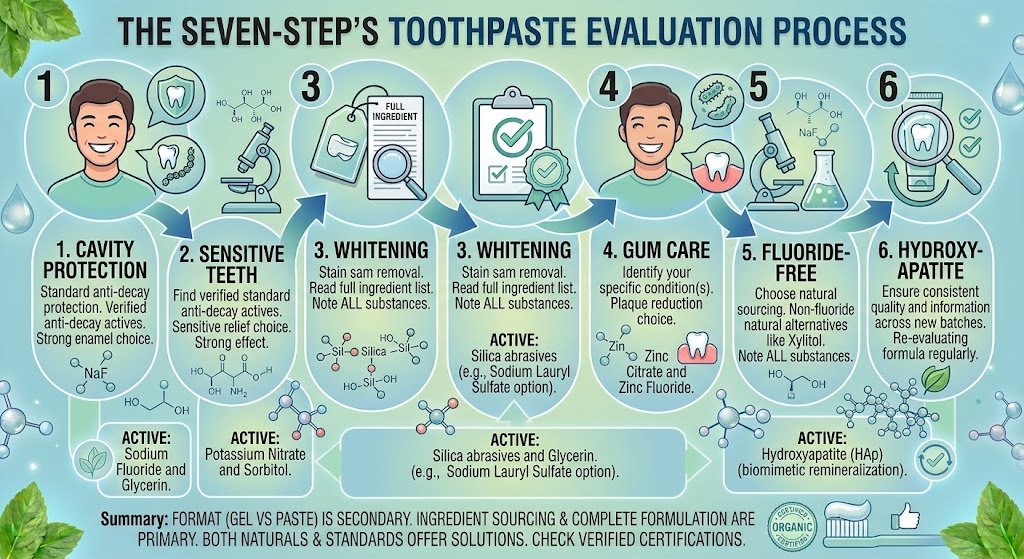
How to Choose the Right Toothpaste
Before comparing brands, narrow down what you actually need from your toothpaste.
A simple five-step approach is:
- Identify your main dental goal.
- Check the active ingredient.
- Read the complete ingredient list.
- Consider your personal preferences and limitations.
- Compare price, size, and overall value.
This approach is more useful than choosing a toothpaste simply because it says “natural,” “advanced,” “clean,” or “whitening” on the front of the package.
For example, someone mainly concerned about cavities may have different priorities from someone looking for an SLS-free formula. Someone with sensitive teeth may need to focus on a different set of ingredients than someone who simply wants a fresher flavor.
The goal is not to find one toothpaste that is universally best. The goal is to find the right type of toothpaste for your situation.
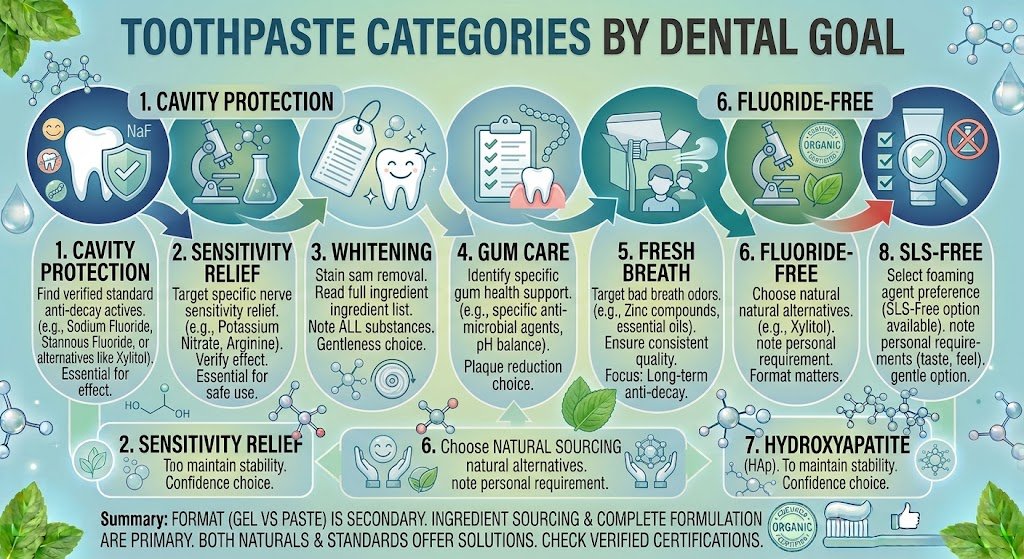
First, Identify What You Want Your Toothpaste to Do
The easiest way to narrow down toothpaste choices is to start with the problem or goal you are trying to address.
Cavity Protection
If your main goal is helping prevent cavities, the active ingredient should be one of the first things you examine.
Fluoride toothpaste has an established role in cavity prevention, and the American Dental Association recommends brushing with fluoride toothpaste as part of regular home oral care.
U.S. toothpaste products may use fluoride compounds such as:
- Sodium fluoride
- Stannous fluoride
- Sodium monofluorophosphate
These ingredients are not simply interchangeable marketing terms. When comparing products, check the actual active ingredient and the directions provided with the specific toothpaste.
If preventing cavities is your highest priority, do not let secondary features such as flavor, packaging, or “natural” marketing distract you from evaluating the product’s cavity-protection purpose.
[ add a link ]
Sensitive Teeth
If your teeth hurt when you drink something cold, eat something hot, or consume sweet or acidic foods, look for toothpaste specifically formulated for sensitive teeth.
Some sensitivity-focused toothpastes contain active ingredients intended to help reduce sensitivity. The important thing is to look at the actual active ingredient and the benefit the product is designed to provide.
Also remember that persistent sensitivity can have different causes. Toothpaste may help with symptoms, but it does not necessarily address the underlying dental problem.
If sensitivity is new, severe, or persistent, professional dental advice is more appropriate than simply trying one toothpaste after another.
Whitening
Whitening toothpaste is another common category, but it is important to understand what these products are designed to do.
Many whitening toothpastes focus on removing or reducing surface stains. That is different from assuming that every whitening toothpaste will dramatically change the natural color of your teeth.
When comparing whitening formulas, consider:
- What type of whitening benefit is being claimed?
- Is the product primarily focused on surface stain removal?
- Could the formula be unsuitable if you already experience sensitivity?
- What does the complete ingredient list tell you?
A toothpaste with a “whitening” label is not automatically the best choice for everyone.
Gum Health
If gum health is your main concern, toothpaste is only one part of your oral-care routine.
Look for a formula that fits your general oral-health needs, but do not rely on toothpaste alone if you regularly experience bleeding, swelling, pain, or other gum problems.
Those symptoms can require professional evaluation.
A useful buying guide should therefore distinguish between choosing a suitable toothpaste and treating an underlying dental condition.
Fresh Breath
Some toothpastes are marketed primarily around fresh breath.
Flavoring can make your mouth feel fresher after brushing, but persistent bad breath may have a cause that toothpaste alone does not solve.
If bad breath continues despite regular brushing and good oral hygiene, consider discussing it with a dental professional rather than simply switching between stronger flavors.
Ingredient-Focused Preferences
Some shoppers start their search from the ingredient side rather than a dental condition.
They may want:
- Fluoride-free toothpaste
- SLS-free toothpaste
- Hydroxyapatite toothpaste
- Natural toothpaste
- Non-toxic toothpaste
- Products without certain flavors, dyes, or other ingredients
These preferences can be important to the shopper, but they should be considered separately from evidence about dental effectiveness.
In other words, “I prefer to avoid this ingredient” and “this ingredient makes toothpaste ineffective” are two different claims.
If your main priority is a cleaner or non-toxic formulation, you can explore our [ add a link — Anchor Text: “best non-toxic toothpaste” — Destination: “/best-non-toxic-toothpaste/” ] guide.
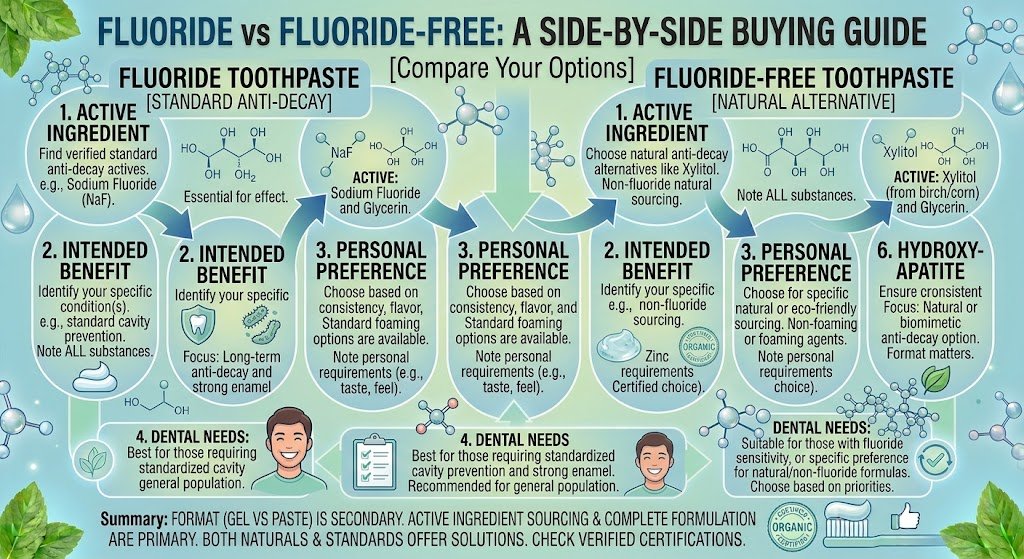
Fluoride vs. Fluoride-Free Toothpaste
One of the most important decisions for many toothpaste shoppers is whether to choose fluoride toothpaste or a fluoride-free formula.
Fluoride has a well-established role in helping prevent tooth decay. The ADA recommends fluoride toothpaste for general home oral care, while the FDA regulates certain OTC anticaries toothpaste ingredients and labeling.
[ add a link ]
That does not mean every consumer will automatically choose fluoride toothpaste. Some people specifically prefer fluoride-free products because of personal preferences or concerns about ingredients.
If you are considering a fluoride-free toothpaste, look beyond the front of the package.
Ask:
- What is the product’s active ingredient?
- What benefit is that ingredient intended to provide?
- Why am I choosing fluoride-free toothpaste?
- Am I at increased risk of cavities?
- Have I discussed the choice with my dentist if I have concerns?
The important point is to make an informed decision rather than assuming that either category is automatically right for everyone.
If you already know that you want fluoride toothpaste, our [ add a link — Anchor Text: “best fluoride toothpaste” — Destination: “/best-fluoride-toothpaste/” ] guide can help you explore that category.
If you specifically want fluoride-free options, see our [ add a link — Anchor Text: “best fluoride-free toothpaste” — Destination: “/best-fluoride-free-toothpaste/” ] guide.
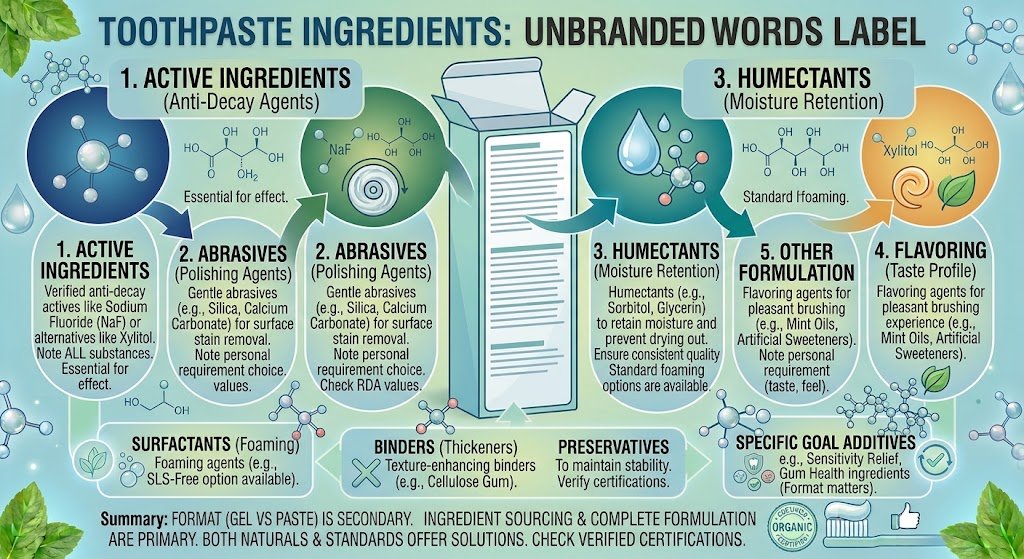
Which Toothpaste Ingredients Matter Most?
You do not need to memorize every ingredient printed on a toothpaste tube.
Instead, focus first on ingredients that have a meaningful relationship to the toothpaste’s purpose.
Fluoride
Fluoride is primarily important because of its role in cavity prevention.
Common fluoride active ingredients in U.S. toothpaste include sodium fluoride, stannous fluoride, and sodium monofluorophosphate.
When comparing fluoride toothpastes, look at the actual active ingredient and product directions rather than simply choosing a package with the largest “fluoride” claim.
Hydroxyapatite
Hydroxyapatite is another ingredient that has become increasingly relevant to shoppers looking for alternatives or products marketed around enamel and remineralization.
If you are considering hydroxyapatite toothpaste, compare the complete formulation and the product’s intended purpose rather than assuming that all products containing hydroxyapatite are equivalent.
Potassium Nitrate
Potassium nitrate is commonly associated with toothpaste formulated for sensitive teeth.
If sensitivity is your primary reason for buying a new toothpaste, check whether the product is specifically formulated for that purpose and examine its active ingredient rather than relying only on the word “sensitive” on the package.
SLS
Sodium lauryl sulfate, commonly abbreviated as SLS, is a surfactant used in many toothpaste formulas.
Some shoppers prefer SLS-free toothpaste because of personal preferences or concerns about irritation.
However, avoiding SLS by itself does not prove that a toothpaste is better overall. You should still consider its active ingredients, dental purpose, full formulation, and suitability for your needs.
Abrasives
Toothpaste also contains ingredients that help clean the teeth and remove surface deposits as you brush.
Examples can include hydrated silica and calcium carbonate.
The important point is that toothpaste is a complete formulation. One ingredient should not automatically determine whether a product is good or bad.
When comparing formulas, consider the intended cleaning benefit along with your personal needs and preferences.
Flavoring and Other Ingredients
Toothpaste can contain many other ingredients that help provide flavor, texture, moisture, sweetness, preservation, or other formulation characteristics.
These ingredients may include:
- Flavoring agents
- Glycerin
- Sweeteners
- Thickeners
- Humectants
- Preservatives
- Coloring agents
If a particular ingredient matters to you, read the complete ingredient list instead of relying only on the front label.
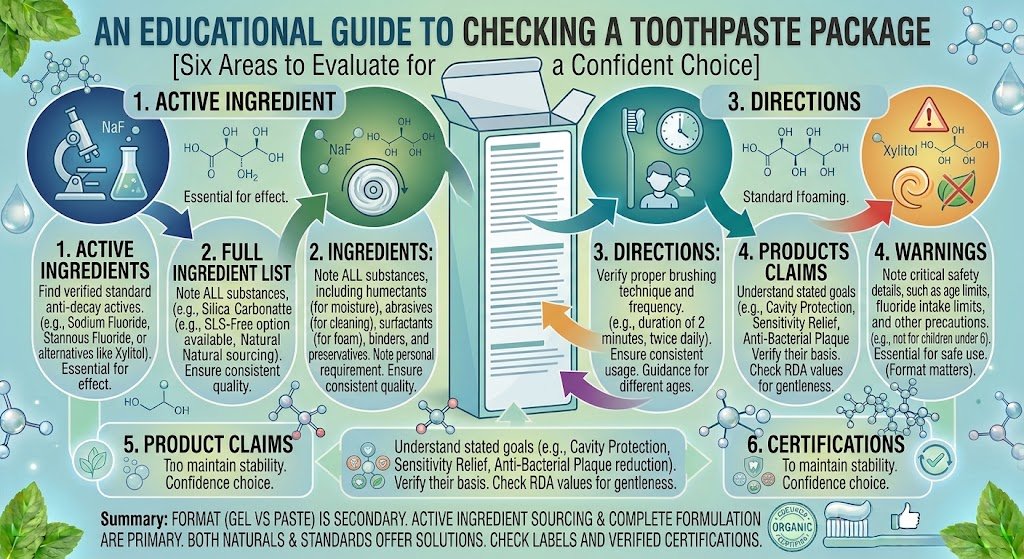
How to Read a Toothpaste Label
Once you know what you need from toothpaste, the next step is learning how to evaluate the product itself.
1. Check the Active Ingredient
Start with the active ingredient.
This tells you what the product is formulated to provide from a therapeutic perspective and helps you compare products serving the same purpose.
2. Read the Complete Ingredient List
Do not stop after seeing one ingredient advertised on the front.
Read the complete list and look for ingredients that matter to your preferences.
This is particularly important if you are trying to avoid a specific ingredient.
3. Check the Directions
Read the product directions instead of assuming that every toothpaste should be used exactly the same way.
Directions are particularly important when products are intended for different age groups or specific dental purposes.
4. Read the Warnings
Warnings can provide important information about appropriate use.
Do not ignore product-specific warnings simply because another toothpaste contains a similar ingredient.
5. Evaluate the Claims
Words such as “natural,” “clean,” “non-toxic,” “whitening,” and “remineralizing” should prompt you to look at the supporting product information.
A marketing claim is not automatically proof that the product is superior.
6. Check Certifications Carefully
If a toothpaste displays a professional seal or certification, find out what that certification actually evaluates.
A certification can provide useful information without answering every question about a product.
For more detail on our evaluation approach, see [ add a link — Anchor Text: “how we evaluate toothpaste” — Destination: “/how-we-evaluate-toothpaste/” ].
[ARTICLE CONTINUES — NEXT PART STARTS WITH: H2: “How to Compare Toothpaste for Different Needs”]
Part 1 complete. Continue karne par main “How to Compare Toothpaste for Different Needs” se exactly continue karunga—previous content repeat nahi hoga.
How to Compare Toothpaste for Different Needs
Once you know what you want your toothpaste to do, the next step is comparing products based on the same criteria. A toothpaste that works well for cavity prevention may not be the best choice for someone primarily concerned with sensitivity or whitening.
Use your main dental goal as the starting point, then compare the active ingredient, fluoride status, full ingredient list, texture, flavor, and price.
| Your Main Goal | What to Look For | What to Compare |
| Cavity protection | Fluoride or another evidence-supported approach | Active ingredient, fluoride concentration, directions |
| Sensitive teeth | A toothpaste formulated for sensitivity | Potassium nitrate or another appropriate active ingredient |
| Whitening | Whitening formula with appropriate stain-removal ingredients | Abrasives, whitening claims, sensitivity considerations |
| Gum health | Formula suitable for regular oral care | Active ingredients, flavoring, irritation potential |
| Fresh breath | Breath-freshening formula | Flavoring, ingredients, how long freshness lasts |
| Fluoride-free | Fluoride-free formula | Alternative active ingredients and your cavity risk |
| Hydroxyapatite | Hydroxyapatite formula | Ingredient type, concentration if disclosed, overall formula |
| SLS-free | Formula without sodium lauryl sulfate | Full ingredient list rather than front-label claims |
If Cavity Protection Is Your Priority
Start by checking the active ingredient. For many adults, fluoride toothpaste is an important part of routine cavity prevention.
Do not choose based only on a product’s front label. Check the active ingredient section and directions on the package.
If you have a history of cavities or other factors that increase your risk, your dentist can help you determine which toothpaste is appropriate.
If You Have Sensitive Teeth
Look for toothpaste specifically formulated for sensitivity and check which active ingredient it uses.
You should also consider what is causing your sensitivity. Tooth sensitivity can have different causes, including exposed tooth surfaces, wear, cavities, or other dental problems. A toothpaste may help manage sensitivity, but it does not replace an evaluation when the problem is persistent or severe.
If You Want Whiter Teeth
First decide whether you want to remove surface stains or change the underlying color of your teeth.
Many whitening toothpastes are designed primarily to help remove surface stains through their formulation. That is different from professional whitening treatments that change tooth color more substantially.
If you already experience sensitivity, compare whitening products carefully rather than assuming a stronger-feeling formula will produce better results.
If You Prefer Fluoride-Free Toothpaste
Do not stop at the words “fluoride-free.”
Compare the alternative active ingredients, understand what the product is intended to do, and consider your personal cavity risk. A fluoride-free toothpaste may fit some people’s preferences, but the right choice depends on your individual oral-health needs.
If You Want Hydroxyapatite Toothpaste
Check that hydroxyapatite is actually listed in the formula rather than choosing a product simply because it uses words such as “mineral” or “natural.”
Also look at the rest of the formula. Hydroxyapatite is one ingredient, while the overall toothpaste still includes other ingredients that affect flavor, texture, cleaning, and user experience.
If You Want SLS-Free Toothpaste
Check the complete ingredient list.
Sodium lauryl sulfate, commonly called SLS, is used in many personal-care products as a cleansing and foaming ingredient. If you prefer to avoid it, do not rely only on a “clean” or “natural” claim. Look for the actual ingredient name in the formula.
What About “Natural,” “Clean,” and “Non-Toxic” Toothpaste?
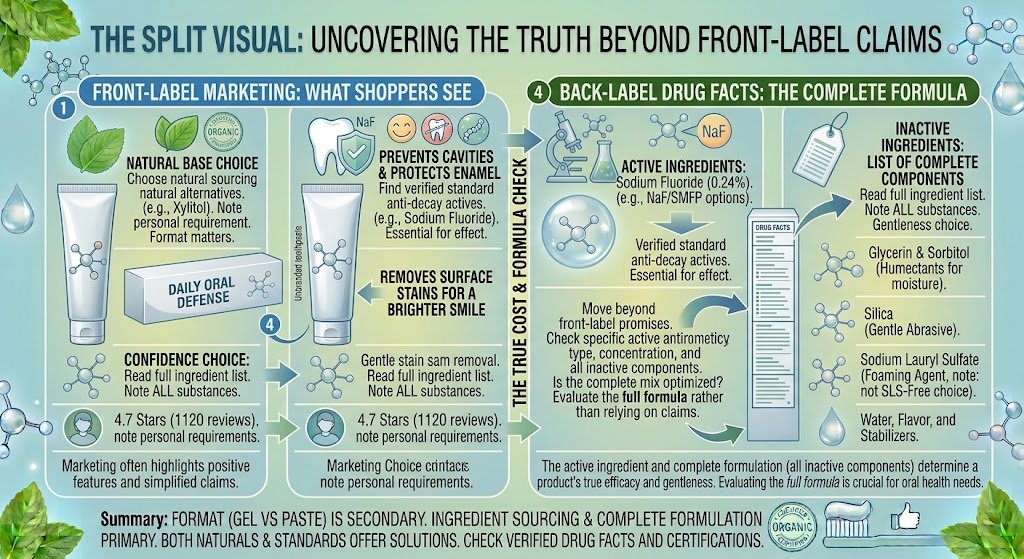
Terms such as “natural,” “clean,” and “non-toxic” can be useful when they describe a shopper’s preferences, but they should not be treated as automatic proof that a toothpaste is better.
These terms can be used differently from one brand to another. The more useful approach is to look past the marketing language and evaluate the actual formula.
Look at the Ingredients
Instead of asking only, “Is this toothpaste natural?” ask:
- What is the active ingredient?
- Does it contain fluoride?
- Does it contain hydroxyapatite?
- Does it contain SLS?
- What abrasives are used?
- What ingredients provide flavor?
- Are there ingredients you personally want to avoid?
- Are the product claims clear and specific?
This gives you more useful information than a single marketing label.
Natural Does Not Automatically Mean Better
A naturally derived ingredient can still cause irritation or an allergic reaction in some people. Likewise, a synthetic ingredient is not automatically harmful simply because it was produced synthetically.
Your goal should be to understand the formula and decide whether it fits your needs.
Focus on Transparency
A toothpaste brand should make it reasonably easy for you to understand what is in the product and what its active ingredients are intended to do.
For a deeper look at ingredients, use a complete ingredient-checking approach rather than judging the product from its front label.
How Much Should You Spend on Toothpaste?
The most expensive toothpaste is not automatically the best toothpaste for you.
Price can vary because of ingredients, formulation, packaging, brand positioning, package size, specialty features, and where the product is sold.
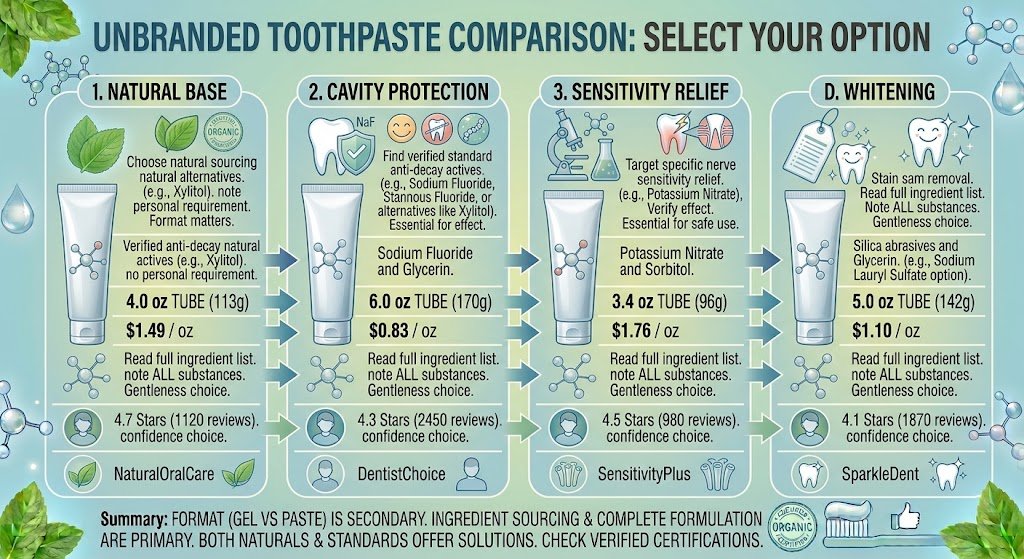
Instead of comparing only the sticker price, compare the cost per ounce when package sizes differ.
For example, a larger tube may have a higher total price but a lower cost per ounce. On the other hand, a premium toothpaste may cost more because it uses a specialized formula that matches a particular preference or dental need.
A Simple Value Check
Before paying more, ask:
- Does this toothpaste solve the problem I actually have?
- Does its active ingredient make sense for my goal?
- Does the formula fit my ingredient preferences?
- Is the package size reasonable for the price?
- Would a less expensive toothpaste provide the same features I need?
This prevents you from paying extra simply because a product uses premium packaging or marketing language.
How to Compare Toothpaste on Amazon
Amazon can make toothpaste shopping convenient, but it can also make comparison difficult because many products use similar claims.
Instead of choosing the product with the highest rating or most reviews, create a short comparison list.
1. Check the Product Type
Make sure you are comparing similar products.
Do not compare a specialty sensitivity toothpaste with a children’s toothpaste or a toothpaste powder and assume the cheapest option is the best value.
2. Check the Active Ingredient
Look at the product details and packaging images for the active ingredient.
If the listing does not make the ingredient information clear, consider checking the manufacturer’s product information before purchasing.
3. Check the Full Ingredient List
Look beyond the headline claims.
A product described as “natural,” “clean,” “gentle,” or “non-toxic” still needs to be evaluated based on its actual formula.
4. Compare Package Size
Two toothpaste listings can have very different prices while containing different amounts.
Calculate or compare the cost per ounce rather than looking only at the total price.
5. Read Recent Reviews Carefully
Reviews can help you understand practical details such as:
- Taste
- Texture
- Foaming
- Packaging
- Tube size
- Shipping or delivery issues
- Whether users found the product comfortable to use
But reviews should not replace ingredient and product evaluation. Individual experiences are not proof that a toothpaste will work the same way for everyone.
6. Check the Seller and Product Details
Before purchasing, verify the product name, size, flavor, package count, and seller information. This can help prevent ordering a different variation from the one you intended to buy.
Common Toothpaste-Buying Mistakes
Choosing toothpaste can seem simple, but several common mistakes can lead shoppers toward products that do not match their actual needs.
Choosing Based Only on the Front Label
Words such as “natural,” “clean,” “whitening,” or “fresh” tell you something about how a product is marketed, but they do not provide the complete picture.
Always check the active ingredient and full ingredient list.
Assuming More Expensive Means Better
A higher price does not automatically mean better cavity protection, better cleaning, or better overall value.
Choose based on your dental needs and the features that actually matter to you.
Ignoring Your Main Dental Problem
A toothpaste selected because of its flavor or packaging may not address the reason you are shopping.
If sensitivity is your main concern, start there. If cavity prevention is the priority, start with that. Your dental goal should guide the rest of the comparison.
Choosing Fluoride-Free Without Considering Cavity Risk
Fluoride preference is personal, but cavity risk also matters.
If you are considering switching away from fluoride, especially if you have frequent cavities or other risk factors, discuss the decision with your dentist.
Assuming Whitening Means Bleaching
Whitening toothpaste and professional whitening are not necessarily doing the same thing.
Understand what the product claims to accomplish before expecting a major change in tooth color.
Comparing Products Without Checking Size
A $5 tube and a $9 tube cannot be compared fairly if they contain very different amounts.
Check the package size and cost per ounce.
Buying From Claims Instead of Evidence
A product can sound impressive without giving you enough information to evaluate it.
The better approach is simple: identify your goal, check the active ingredient, read the full formula, compare the important attributes, and then consider price and convenience.
:::દાવાદ
When Should You Ask Your Dentist?
A toothpaste buying guide can help you compare products, but it cannot determine what is causing a dental problem.
Consider talking with your dentist if you have:
- Frequent or recurring cavities
- Persistent tooth sensitivity
- Tooth pain that does not go away
- Bleeding or swollen gums
- Signs of gum disease
- Significant tooth wear
- A damaged or broken tooth
- Ongoing bad breath despite regular oral care
- Questions about whether fluoride-free toothpaste is appropriate for you
Your dentist can consider your dental history, cavity risk, gum health, existing restorations, medications, and other factors when recommending an oral-care routine.
If you are choosing between fluoride and fluoride-free toothpaste because of a specific dental concern, professional advice can be especially useful.
FAQs
What should I look for when buying toothpaste?
Start with your main dental goal. Then check the active ingredient, fluoride status, full ingredient list, and any features that matter to you, such as sensitivity support, whitening, SLS-free formulation, or hydroxyapatite.
After that, compare package size, cost per ounce, flavor, texture, and other personal preferences.
Is fluoride toothpaste better for cavity protection?
Fluoride toothpaste is widely used for cavity prevention because fluoride helps strengthen teeth and supports the remineralization process.
However, the right toothpaste for an individual depends on their oral-health needs and preferences. If you have a high risk of cavities or are considering avoiding fluoride, discuss your options with a dentist.
What toothpaste is best for sensitive teeth?
Look for a toothpaste specifically formulated for sensitivity and check its active ingredient.
Sensitivity can have different causes, so toothpaste should not be viewed as a complete solution for persistent or severe sensitivity. If sensitivity continues, a dental examination can help identify the underlying cause.
Is fluoride-free toothpaste a good choice?
It can be a reasonable preference for some people, but it should be considered alongside your cavity risk and overall oral-health needs.
If you frequently develop cavities, ask your dentist before switching away from fluoride toothpaste.
Is hydroxyapatite toothpaste better than fluoride toothpaste?
There is no universal answer that makes one option best for everyone.
Hydroxyapatite and fluoride are different active ingredients with different evidence and mechanisms. Your decision should consider your dental needs, personal preferences, and professional dental advice where appropriate.
Is SLS bad in toothpaste?
SLS is commonly used as a foaming and cleansing ingredient. Some people prefer to avoid it because they find certain formulas irritating or simply prefer SLS-free products.
Whether you should avoid SLS depends on your individual experience and preferences. If a toothpaste causes irritation, switching formulas may be worth considering.
Is expensive toothpaste worth it?
Not necessarily.
A more expensive toothpaste may offer a specialized formula, particular ingredients, or features that matter to you, but price alone does not prove that it is a better choice.
Compare the active ingredient, formula, package size, cost per ounce, and suitability for your dental goal.
How do I choose toothpaste on Amazon?
Start by identifying your dental goal and then compare products using the same criteria.
Check the active ingredient, full ingredient list, fluoride status, package size, cost per ounce, product variation, seller information, and recent reviews.
Do not choose only because a product has a high star rating or a large number of reviews.
Your Toothpaste Buying Checklist
Before buying a toothpaste, run through this quick checklist:
Dental Need
- What is my main goal?
- Do I need cavity protection?
- Do I have sensitive teeth?
- Am I looking for whitening?
- Do I want support for gum health or fresh breath?
Active Ingredient
- What is the active ingredient?
- Does it match my main dental goal?
- Is it fluoride or fluoride-free?
- Does the product use hydroxyapatite or another active ingredient?
Full Formula
- Have I checked the complete ingredient list?
- Does it contain ingredients I want to avoid?
- Does the flavoring suit me?
- Do I prefer an SLS-free formula?
- Is the formula comfortable for regular use?
Value
- How much toothpaste is in the package?
- What is the approximate cost per ounce?
- Am I paying for a feature I actually want?
- Is there a comparable option at a lower price?
Shopping
- Am I buying the correct product variation?
- Have I checked the seller?
- Have I reviewed recent customer feedback?
- Does the product information clearly match what I am looking for?
Personal Dental Needs
- Do I have a dental condition that needs professional advice?
- Do I have frequent cavities or persistent sensitivity?
- Am I making a major change to my oral-care routine?
If you can answer these questions, you can usually narrow a large toothpaste selection down to a much smaller group of products that actually fit your needs.
Final Thoughts
The best toothpaste is not simply the one with the most attractive packaging, the highest price, or the strongest marketing claims.
The better approach is to start with your dental goal.
From there, check the active ingredient, understand the fluoride status, read the full ingredient list, compare the formula with your preferences, and consider the price and package size.
If you prefer natural, clean, non-toxic, fluoride-free, hydroxyapatite, or SLS-free toothpaste, use those preferences as part of your decision rather than relying only on the label.
For Amazon shoppers, the same process works well: compare products using the same criteria instead of choosing based only on star ratings, reviews, or price.
And if you have persistent pain, sensitivity, gum problems, frequent cavities, or uncertainty about which type of toothpaste is appropriate for you, a dentist can provide advice based on your specific oral-health needs.
A good toothpaste choice should be appropriate for your dental needs, clear about its ingredients, comfortable enough to use consistently, and reasonable for your budget.
