Choosing toothpaste can be confusing when products are marketed as natural, clean, non-toxic, or free from unwanted ingredients. These labels may reflect different preferences, but they do not automatically prove that a toothpaste is safer or more effective.
Our evaluation approach looks beyond the front of the package. We consider active ingredients, ingredient transparency, evidence for dental benefits, product labeling, relevant certifications, and value. We also distinguish between verified information and claims that cannot be independently confirmed.
The goal is to help you compare toothpaste options using clear criteria, understand their limitations, and choose a product that fits your oral-care needs.
What “Non-Toxic Toothpaste” Means to Us
We use non-toxic toothpaste as a consumer search term for products people want to evaluate for ingredient concerns and everyday oral care. We do not treat it as a universal scientific category or assume that a toothpaste is harmless simply because its packaging uses the term.
We evaluate three related but different questions:
- Ingredient preferences: Does the formula match the ingredients or formulation characteristics a shopper wants?
- Safety: What reliable information is available about the ingredients and finished product when used as directed?
- Effectiveness: Is there evidence supporting the dental benefits the product claims to provide?
A toothpaste can match someone’s ingredient preferences without having evidence for every advertised benefit. Likewise, an unfamiliar ingredient name does not automatically mean that the ingredient is harmful.
We avoid describing any toothpaste as completely toxin-free, universally safe, or guaranteed to deliver a particular result without adequate evidence. Instead, we look at the product’s intended use, formulation, directions, warnings, and available supporting information.
Our Toothpaste Evaluation Criteria
We assess products across several areas rather than judging them by one ingredient or marketing claim.
| Evaluation criterion | What we examine | Why it matters |
| Active ingredients | Ingredients associated with the product’s stated dental purpose | Helps readers understand what the formula is intended to do |
| Ingredient transparency | Full ingredient lists and accessible product information | Makes meaningful comparison possible |
| Safety information | Relevant evidence, directions, warnings, and limitations | Helps readers assess suitability without fear-based claims |
| Dental effectiveness | Evidence supporting the specific benefit advertised | Separates supported benefits from general marketing language |
| Certifications | Relevant programs and the scope of their evaluation | Helps readers verify specific product claims |
| Formula suitability | Intended use, flavoring, foaming, and potential sensitivities | Accounts for individual needs and preferences |
| Value and availability | Package size, price, and current product details | Supports practical purchasing decisions |
These criteria guide our comparisons, but they do not mean that every product receives identical treatment. A toothpaste marketed for sensitivity should be assessed in relation to that purpose, while a toothpaste promoted for cavity prevention requires attention to its active ingredients and relevant evidence.
We also distinguish between information that can be verified and information that remains uncertain. If an important detail is unavailable, we should identify that limitation instead of filling the gap with an assumption.
1. We Review Active Ingredients and Dental Benefits
We begin by asking what a toothpaste is designed to do and whether its active ingredients and available evidence support that purpose.
Toothpaste may be marketed for cavity prevention, sensitivity relief, whitening, enamel care, or other oral-care needs. Each claim requires its own evaluation.
Cavity protection
Fluoride is an established ingredient for helping prevent tooth decay. Common fluoride compounds in toothpaste include sodium fluoride, stannous fluoride, and sodium monofluorophosphate.
We check whether active ingredients are clearly identified and whether the product’s claims align with authoritative dental guidance. The American Dental Association provides information about toothpaste ingredients and its Seal of Acceptance program.
addalink—AnchorText:”ADAguidanceontoothpastes”—Destination:”AmericanDentalAssociationtoothpasteguidance”add a link — Anchor Text: “ADA guidance on toothpastes” — Destination: “American Dental Association toothpaste guidance”
A fluoride-free label does not, by itself, demonstrate that a product is safer or equally effective for cavity prevention. People who are prone to cavities or have particular dental concerns should discuss suitable options with a dental professional.
Sensitivity and other specific benefits
Some toothpastes contain ingredients intended to help reduce tooth sensitivity. Others are designed to remove surface stains or address different oral-care needs.
We evaluate products according to their stated purpose. For example, removing surface stains is not the same as changing the underlying color of teeth. Similarly, the presence of a particular ingredient does not prove that every formula containing it will deliver the same result.
We do not rank products by the number of benefits printed on their packaging. Relevant evidence, clear labeling, and suitability matter more than the number of claims.
addalink—AnchorText:”besttoothpasteforsensitiveteeth”—Destination:”/best−toothpaste−for−sensitive−teeth/”add a link — Anchor Text: “best toothpaste for sensitive teeth” — Destination: “/best-toothpaste-for-sensitive-teeth/”
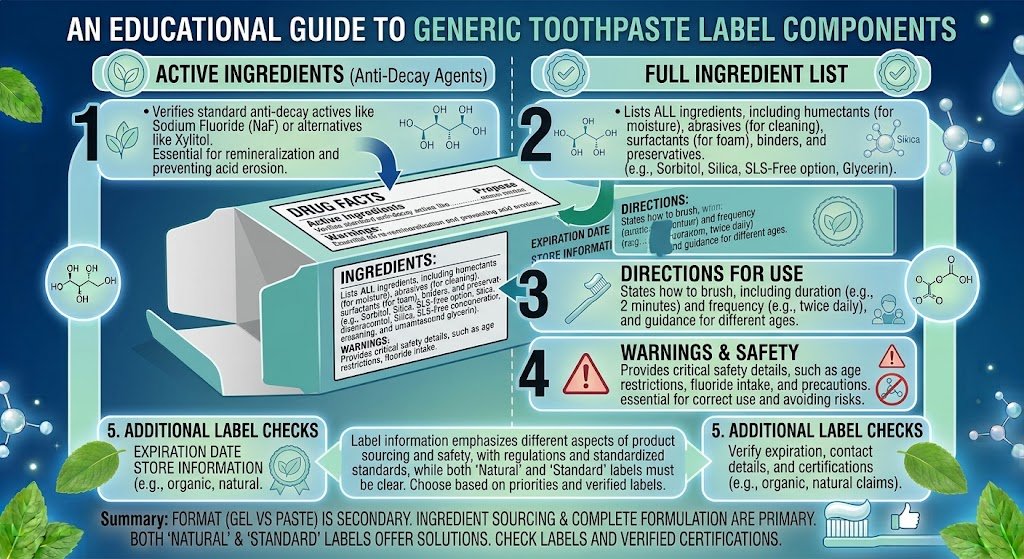
2. We Examine Ingredient Transparency
We review the ingredient information available on product packaging, manufacturer websites, and other reliable product documentation.
Our review may consider:
- Whether a complete ingredient list is available.
- Whether active ingredients are identified where applicable.
- Whether the product explains its intended use and directions.
- Whether warnings and age-related instructions are accessible.
- Whether the manufacturer provides useful information about specific claims.
- Whether an online listing appears to match the product being evaluated.
We also consider ingredients that shoppers commonly ask about, including sodium lauryl sulfate (SLS), flavoring ingredients, abrasives, sweeteners, glycerin, and hydroxyapatite.
However, we do not automatically classify an ingredient as harmful because it has a chemical-sounding name or is synthetically produced. We consider its role in the formula and the available evidence relevant to the concern being discussed.
If a reader wants to avoid an ingredient because of a known sensitivity or personal preference, that may be a valid reason to choose a different formula. It should still be distinguished from a broader claim that the ingredient is dangerous for everyone.
addalink—AnchorText:”howtoreadatoothpasteingredientlist”—Destination:”/how−to−read−toothpaste−ingredients/”add a link — Anchor Text: “how to read a toothpaste ingredient list” — Destination: “/how-to-read-toothpaste-ingredients/”
3. We Review Safety Evidence and Product Warnings
A toothpaste can look “clean” or “natural” and still require a closer look. Our evaluation does not assume that an ingredient is safe simply because it comes from a plant, nor do we assume that a synthetic ingredient is automatically harmful.
We look at the available evidence, the ingredient’s purpose, how it is used in toothpaste, and any relevant warnings or usage instructions.
We also consider whether the product clearly explains important information on its packaging or product page. A transparent product should make it reasonably easy for consumers to understand what they are buying and how it should be used.
Natural or Clean Does Not Automatically Mean Safer
Terms such as “natural,” “clean,” “green,” and “non-toxic” can describe a brand’s positioning, but they do not by themselves prove that a toothpaste is safer or more effective.
For example, a toothpaste may contain natural flavoring or essential oils but still cause irritation for some people. Likewise, a toothpaste containing a conventional ingredient is not automatically unsafe simply because the ingredient sounds unfamiliar.
That is why we separate marketing claims from evidence.
When evaluating an ingredient, we consider:
- What purpose does the ingredient serve?
- Is there credible evidence supporting its use?
- Are there known concerns relevant to normal toothpaste use?
- Does the product provide appropriate directions or warnings?
- Could the ingredient be particularly relevant for people with allergies, sensitivity, or irritation concerns?
For readers who want a deeper explanation of specific ingredients, our [ add a link — Anchor Text: “toothpaste ingredient safety guide” — Destination: “/toothpaste-ingredient-safety/” ] provides additional context.
What If the Evidence Is Incomplete?
Not every toothpaste ingredient has the same amount of research behind it.
When evidence is limited, we do not treat the ingredient as proven harmful simply because research is incomplete. At the same time, we avoid presenting uncertain claims as established facts.
This distinction is important because a responsible evaluation should be able to say “the evidence is limited” when that is the most accurate conclusion.
We also avoid making medical claims that go beyond the available evidence. Our goal is to help readers compare products and understand trade-offs, not to diagnose dental conditions or replace advice from a dentist.
4. We Check Certifications and Independent Evidence
Certifications and third-party verification can provide useful information, but we look at what the certification actually means rather than treating every certification as proof that a product is superior.
For example, the American Dental Association’s [ add a link — Anchor Text: “ADA Seal of Acceptance” — Destination: “American Dental Association Seal of Acceptance” ] is relevant because the program evaluates products against specific requirements. However, having or not having a particular seal should be considered in context.
A certification may address a specific characteristic, such as safety, manufacturing standards, ingredients, or environmental criteria. It may not answer every question a shopper has about a toothpaste.
So when we see a certification or testing claim, we ask:
- Who issued it?
- What standards does it use?
- What exactly was evaluated?
- Does the certification apply to the specific product?
- Is the certification current?
- Does it support the particular claim being made?
This helps prevent a common mistake in product reviews: treating a certification logo as if it proves everything about a product.
We also distinguish between regulatory requirements, professional recommendations, voluntary certifications, and marketing badges. These are different types of evidence and should not be presented as interchangeable.
5. We Compare Product Information, Price, and Value
A toothpaste evaluation should not focus only on ingredients.
Two products may contain similar active ingredients but differ significantly in price, tube size, availability, flavor options, or suitability for a particular need.
When comparing products, we therefore look at practical information such as:
- Product size
- Price
- Approximate cost per ounce when reliable pricing is available
- Active ingredients
- Intended dental benefit
- Ingredient transparency
- Directions and warnings
- Availability
- Product variations
- Whether the product appears suitable for the intended user
Price is especially important for affiliate recommendations because an expensive toothpaste is not automatically a better toothpaste.
A product should earn a recommendation because its overall combination of evidence, ingredients, intended benefit, transparency, and value makes sense for the reader.
Prices can also change over time. For that reason, we avoid presenting a temporary price as a permanent characteristic of a product.
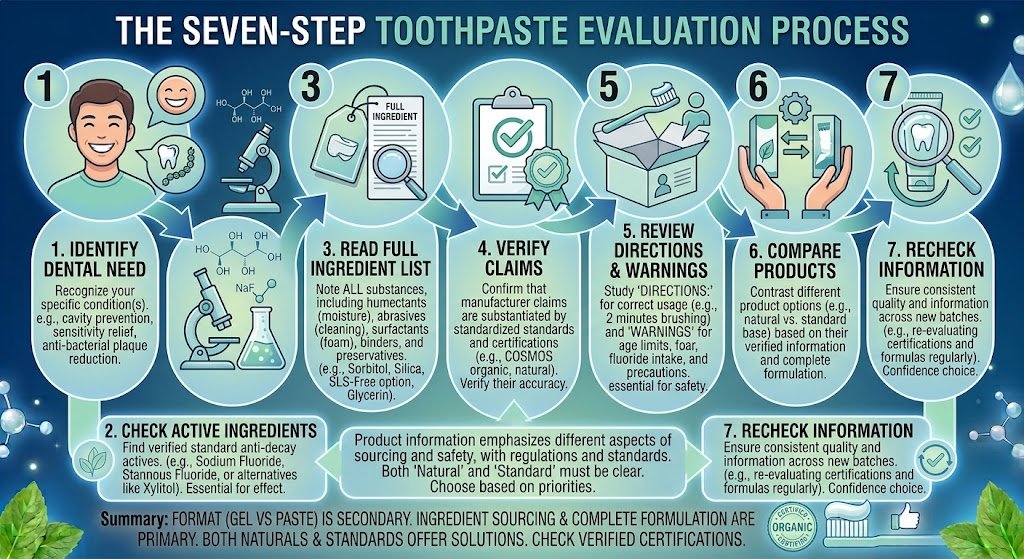
How We Research and Compare Toothpaste
Our evaluation process is designed to reduce guesswork and keep product comparisons consistent.
Step 1: Identify the Reader’s Main Goal
First, we determine what the reader is actually trying to accomplish.
The right toothpaste for cavity protection may not be the same choice as the right toothpaste for someone primarily concerned with sensitivity or avoiding SLS.
We therefore start with the search intent and dental need rather than choosing a product first.
Step 2: Review the Product’s Active Ingredients
Next, we examine the active ingredients and their stated purpose.
For cavity-protection products, fluoride is an important consideration because fluoride toothpaste has strong support for helping prevent tooth decay.
Depending on the product, we may encounter ingredients such as sodium fluoride, stannous fluoride, or sodium monofluorophosphate.
For products marketed around other benefits, we examine the ingredients associated with those claims and consider whether the available evidence supports the intended use.
Step 3: Read the Full Ingredient List
We then examine the complete ingredient list rather than focusing only on one highlighted ingredient.
This can reveal ingredients used for:
- Cleaning
- Texture
- Moisture retention
- Flavor
- Foaming
- Sweetening
- Preservation
- Appearance
Readers who want to perform this step themselves can use our [ add a link — Anchor Text: “guide to reading toothpaste ingredients” — Destination: “/how-to-read-toothpaste-ingredients/” ].
Step 4: Check Claims Against Evidence
Marketing language is reviewed separately from evidence.
If a product says it is “natural,” “non-toxic,” “clean,” “whitening,” “remineralizing,” or designed for sensitivity, we ask what information actually supports that claim.
We do not automatically treat a bold front-of-package statement as scientific evidence.
Step 5: Review Directions and Warnings
Usage instructions matter.
A toothpaste can contain appropriate ingredients but still need specific directions or warnings. We therefore consider information such as recommended brushing frequency, age-related instructions, warnings about swallowing, and other product-specific directions.
This is particularly important when evaluating toothpaste intended for children or people with specific dental concerns.
Step 6: Compare Products on the Same Criteria
Whenever possible, products within the same comparison are judged using the same basic framework.
For example, if we compare several toothpaste options for a particular dental need, we look at comparable factors instead of praising one product for an ingredient while ignoring that same factor in another product.
This creates a more balanced comparison.
Step 7: Recheck Important Information
Product formulas, packaging, certifications, prices, and availability can change.
Important product information should therefore be checked again when an article is updated. If a manufacturer changes a formula, a product is discontinued, or evidence changes, the evaluation may need to change as well.
For broader purchasing considerations, readers can also use our [ add a link — Anchor Text: “toothpaste buying guide” — Destination: “/toothpaste-buying-guide/” ].
What We Do Not Automatically Reward or Penalize
A fair toothpaste review should not start with the assumption that one ingredient category is always good and another is always bad.
We therefore do not automatically reward or penalize a product simply because it contains or avoids a particular ingredient.
For example, avoiding SLS may be an important preference for some shoppers, especially those who experience irritation or want an SLS-free formula. However, the absence of SLS alone does not prove that a toothpaste is more effective or safer overall.
The same principle applies to fluoride, essential oils, artificial sweeteners, flavoring agents, and other ingredients.
Instead, we consider the ingredient in context:
- Why is it included?
- What does the evidence say?
- What benefit does it provide?
- Are there relevant concerns?
- Does the product meet the reader’s specific needs?
- Are there reasonable alternatives?
This approach helps us avoid simplistic “good ingredient vs. bad ingredient” lists.
How We Handle Product Recommendations and Affiliate Links
Some of our toothpaste recommendations may contain affiliate links. This means we may earn a commission if a reader purchases through one of our links, at no additional cost to the reader.
However, an affiliate relationship should not determine the evaluation criteria.
Our process starts with the product and the reader’s needs—not the commission.
We aim to recommend products based on factors such as:
- Ingredient transparency
- Active ingredients
- Dental purpose
- Available evidence
- Product information
- Relevant certifications or verification
- Value
- Suitability for the intended user
A product should not receive a better evaluation simply because it has a higher commission, and a product should not be recommended solely because it is popular.
Affiliate links also do not replace the need for independent research. Product formulas and availability can change, so readers should check the current product information before purchasing.
Where appropriate, we encourage readers to compare several products rather than assuming that our first recommendation is automatically the best choice for everyone.
What Our Evaluation Can and Cannot Tell You
Our evaluation is designed to make toothpaste research easier, but it has limits.
What We Can Help You Understand
Our reviews can help you understand:
- What ingredients a toothpaste contains
- What its active ingredients are intended to do
- Which dental needs the product may be designed for
- How ingredient claims compare with available evidence
- Whether important product information is clearly provided
- How products differ in price, ingredients, and features
- Which factors may matter when comparing similar toothpastes
This information can make it easier to narrow down your options.
What We Cannot Determine for Every Person
A product review cannot determine exactly which toothpaste is medically appropriate for every individual.
Your dental history, cavity risk, gum health, allergies, sensitivity, medications, age, and other factors may influence which toothpaste is appropriate.
If you have recurring dental problems, significant sensitivity, gum disease, frequent cavities, or another ongoing concern, a dentist can provide advice based on your individual situation.
In other words, our evaluation helps with product research and comparison. It is not a substitute for personalized dental care.
How to Use Our Toothpaste Reviews
The best way to use our reviews is to start with your own priorities.
If Cavity Protection Is Your Main Goal
Start by looking at the active ingredient and the evidence supporting cavity prevention.
You can then compare products using our [ add a link — Anchor Text: “best toothpaste for cavities” — Destination: “/best-toothpaste-for-cavities/” ] guide.
If You Prefer Fluoride Toothpaste
Look for products that provide fluoride in an appropriate formulation and compare their other ingredients, features, and value.
If You Prefer Fluoride-Free Toothpaste
Understand why you are choosing fluoride-free toothpaste and consider what the product uses instead.
If You Want Hydroxyapatite
Look at the type of hydroxyapatite used, the product’s overall formulation, and the evidence supporting the intended benefit.
If Avoiding SLS Is Important to You
Check the complete ingredient list rather than relying only on a front-label claim.
If You Have Sensitive Teeth
Sensitivity can have different causes, so the toothpaste’s intended benefit and active ingredients matter.
Frequently Asked Questions
How do you evaluate non-toxic toothpaste?
We evaluate toothpaste by looking at active ingredients, dental benefits, ingredient transparency, available evidence, product warnings, certifications, price, value, and suitability for the intended use. We also distinguish between marketing claims and evidence.
Do you personally test every toothpaste?
A transparent review should clearly distinguish between hands-on product testing and research-based evaluation.
Where a product has not been personally tested, we should not imply that it has been. Research-based evaluations rely on available product information, ingredient lists, manufacturer information, professional guidance, and other relevant evidence.
This distinction helps readers understand exactly what type of review they are reading.
Does “natural” mean a toothpaste is safer?
Not necessarily.
“Natural” describes a product characteristic or marketing position; it does not automatically establish that a toothpaste is safer, more effective, or better suited to every person.
We evaluate the actual ingredients, evidence, intended use, and product information instead of relying on the word “natural” alone.
Is fluoride toothpaste better than fluoride-free toothpaste?
There is no single answer for every individual, but fluoride has strong evidence for helping prevent tooth decay.
People considering fluoride-free toothpaste should understand what benefit they are seeking and discuss their options with a dental professional if they are at increased risk of cavities.
Does a toothpaste need the ADA Seal of Acceptance?
Not necessarily.
The ADA Seal can provide useful information because it indicates that a product has met the requirements of the ADA’s voluntary Seal program. However, the absence of a seal does not automatically mean that a toothpaste is unsafe or ineffective.
The important point is to understand what the seal evaluates rather than treating it as the only measure of product quality.
Do affiliate links affect your recommendations?
Affiliate links may generate a commission when readers purchase through them, but the presence of an affiliate relationship should not change the evaluation criteria.
Products should be compared using consistent factors such as ingredients, evidence, intended benefits, transparency, and value.
How often should toothpaste reviews be updated?
Reviews should be revisited when important information changes, such as product formulas, ingredient lists, certifications, availability, pricing, or relevant evidence.
The exact update schedule can vary by product and topic. A review that contains outdated product information should be treated cautiously, which is why maintaining current information is an important part of responsible product publishing.
Our Commitment to Transparent Toothpaste Recommendations
Choosing a “non-toxic” toothpaste can be confusing because the market combines dental science, ingredient preferences, natural-product marketing, and strong consumer opinions.
Our goal is to make that process easier without pretending that every question has a simple yes-or-no answer.
We look beyond the front of the package.
We consider the active ingredients, the complete ingredient list, the intended dental benefit, available evidence, product warnings, certifications, price, value, and the needs of the person using the toothpaste.
Most importantly, we try to separate what is known, what is supported by evidence, what is a personal preference, and what remains uncertain.
That distinction is at the center of our evaluation process.
A toothpaste does not become a better choice simply because it says “natural” or “non-toxic” on the package. Likewise, avoiding one ingredient does not automatically make a product superior.
The better approach is to understand the formulation, identify your own priorities, consider the evidence, and compare products using the same reasonable standards.
That is how we aim to create toothpaste recommendations that are useful, transparent, and genuinely reader-first.
