If you’re looking for a toothpaste with simpler ingredients, you’ve probably come across labels such as natural, organic, clean, and plant-based. They may sound similar, but they don’t necessarily mean the same thing.
Natural toothpaste is generally marketed around its ingredients or formulation, while organic toothpaste may use ingredients that meet specific organic standards. However, neither label automatically tells you whether a toothpaste is the right choice for your teeth.
Before buying one, it’s worth checking three things: what the ingredients do, whether the product has credible certification behind its claims, and whether its formulation matches your dental needs.
This guide explains the differences, what to look for on toothpaste labels, and how to compare products without paying extra for marketing claims alone.
Natural vs Organic Toothpaste: The Quick Answer
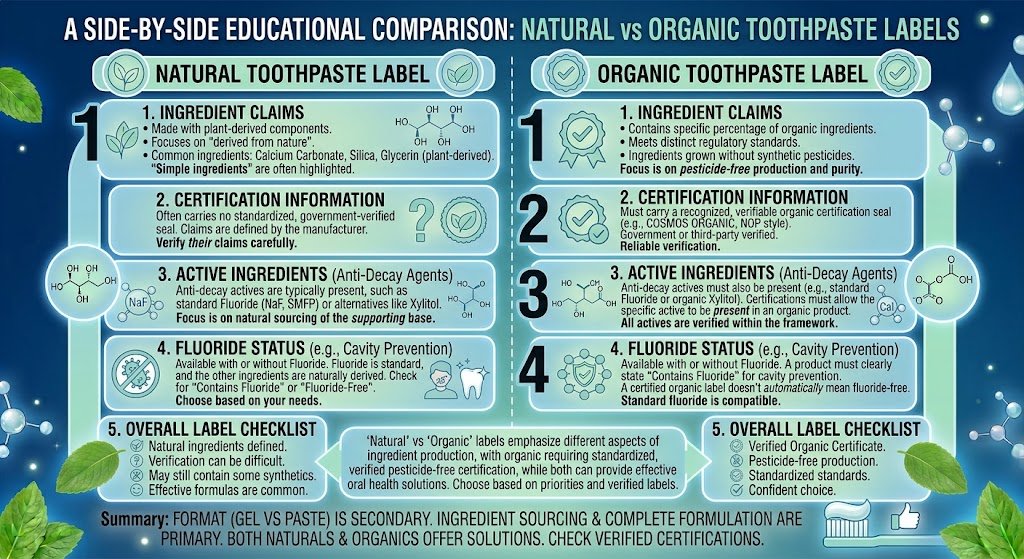
Natural and organic toothpaste differ mainly in how their ingredients and product claims are described or verified.
- Natural toothpaste: Usually marketed around naturally derived ingredients, minerals, botanical extracts, or a particular ingredient philosophy. The term alone does not establish that the product is certified.
- Organic toothpaste: May contain ingredients produced under recognized organic standards. Whether a product can make a particular organic claim depends on the applicable requirements and certification.
- Dental effectiveness: Depends on the formulation and its intended purpose, not simply on whether the package says natural or organic.
In the United States, the USDA explains that the FDA does not define or regulate the term organic for cosmetics and personal-care products. Certain products containing qualifying agricultural ingredients may nevertheless be eligible for USDA organic certification when applicable requirements are met. addalinkadd a link
For oral-care products, NSF/ANSI 305 is another relevant standard. It covers personal-care products containing organic ingredients, including oral-care products, and establishes requirements for qualifying organic-content claims. addalinkadd a link
The practical takeaway is simple: a natural label is not the same as organic certification, and organic certification is not proof that a toothpaste is best for every dental concern.
What Is Natural Toothpaste?
Natural toothpaste is generally marketed toward people who prefer ingredients described as naturally derived, mineral-based, botanical, or more aligned with a particular ingredient philosophy.
Depending on the formulation, the ingredient list may include:
- Xylitol or other sweeteners
- Calcium carbonate or silica
- Glycerin
- Plant extracts
- Essential oils
- Mineral ingredients
- Flavoring ingredients
- Fluoride or non-fluoride active ingredients
These ingredients do not all serve the same purpose. Some help clean teeth, some provide texture or moisture, some contribute flavor, and others may be included for a specific oral-care function.
That is why looking only at the front of the package can be misleading. A product marketed as natural may contain ingredients you prefer, but you need to read its full ingredient list to know what is actually included.
Does Natural Toothpaste Have a Standard Meaning?
You should not assume that every brand uses the word natural in exactly the same way.
One company may emphasize plant-derived ingredients. Another may focus on avoiding certain additives. A third may use the term as part of its broader brand positioning.
The word alone does not tell you:
- Whether the toothpaste is independently certified
- Whether all ingredients are naturally derived
- Whether it contains fluoride
- Whether it is suitable for sensitive teeth
- Whether it provides the dental benefit you want
Look for specific, verifiable claims instead of treating the word natural as a complete description of the product.
Does Natural Toothpaste Contain Fluoride?
It can.
Natural and fluoride-free are two different characteristics. Some natural-positioned toothpastes contain fluoride, while others are formulated without it.
If cavity prevention is important to you, check the active ingredients and product label. Do not assume that a natural toothpaste automatically lacks fluoride—or that a fluoride-free product is automatically better.
The American Dental Association identifies fluoride compounds such as sodium fluoride, sodium monofluorophosphate, and stannous fluoride as anticaries ingredients used in toothpaste. addalinkadd a link
If you’re specifically comparing products for cavity protection, see our guide to addalink—AnchorText:”bestfluoridetoothpaste”—Destination:”/best−fluoride−toothpaste/”add a link — Anchor Text: “best fluoride toothpaste” — Destination: “/best-fluoride-toothpaste/”.
Does Natural Mean Safer?
Not automatically.
An ingredient’s natural origin does not, by itself, establish how suitable it is for every person or every use. Naturally derived substances can still cause irritation or allergic reactions in some individuals.
For example, certain essential oils or strong flavoring ingredients may not suit everyone. Someone who prefers botanical ingredients may enjoy a particular formula, while another person may find it uncomfortable.
Rather than asking only whether an ingredient is natural, consider:
- What is the ingredient used for?
- Is the product intended for your dental needs?
- Do you have a known sensitivity to any listed ingredient?
- Are the manufacturer’s claims clear and specific?
- Is there credible support for the product’s intended benefit?
A more natural ingredient philosophy may be a valid personal preference. It simply should not replace evaluating the complete formulation.
What Is Organic Toothpaste?
Organic toothpaste is a toothpaste that contains organic ingredients and may qualify for an applicable organic standard or certification.
The important detail is that organic claims for personal-care products need to be understood in their specific regulatory and certification context. The rules that apply to organic agricultural ingredients and food products do not automatically mean every toothpaste labeled organic has the same certification status.
The USDA explains that personal-care products containing qualifying agricultural ingredients may be eligible for certification under its National Organic Program when the relevant requirements are met. addalinkadd a link
For oral-care products, NSF/ANSI 305 is particularly relevant because it addresses personal-care products containing organic ingredients, including oral-care products. Under the standard, qualifying products can use the “contains organic ingredients” designation when they meet its requirements, including the applicable minimum organic-content threshold. addalinkadd a link
This is why it is worth checking the actual certification rather than relying solely on a package’s wording.
Why Organic Certification Matters
Certification can help you verify a particular claim against a defined set of requirements.
For example, a product’s packaging might emphasize organic ingredients, but that statement alone may not tell you:
- Which ingredients are organic
- What proportion of the product qualifies
- Which standard is being followed
- Whether an independent organization has verified compliance
When organic sourcing matters to you, look for the name of the standard or certifying organization and check what the certification actually covers.
Do not assume that every organic claim refers to the same standard. Different certification frameworks may have different requirements and permitted claims.
Does Organic Mean the Whole Toothpaste Is Organic?
Not necessarily.
Toothpaste is a formulated product that may contain ingredients serving different functions. Some may be agricultural ingredients that can qualify as organic, while others may be minerals or other components that do not fall into the same category.
A certification or organic-content claim should therefore be interpreted according to the standard behind it—not as a blanket statement that every component is organic.
The most useful questions are:
- Which certification or standard applies?
- What does it permit the manufacturer to claim?
- Which ingredients are covered?
- Does the complete formulation still meet your dental needs?
Is Organic Toothpaste Automatically Better for Your Teeth?
No.
Organic certification and dental effectiveness address different questions.
Certification can provide information about qualifying ingredients and compliance with a particular standard. It does not, on its own, establish that the toothpaste is the best option for cavities, tooth sensitivity, whitening, or another specific oral-health concern.
For example, if cavity prevention is your priority, the active ingredients and evidence supporting the product’s intended use matter more than the organic label alone.
Likewise, if you want to avoid a particular ingredient, read the full ingredient list even when a toothpaste carries an organic claim.
Organic sourcing may matter to your purchasing preferences, but it should not be used as a substitute for evaluating dental purpose and formulation.
Natural vs Organic Toothpaste: Key Differences
The easiest way to compare natural and organic toothpaste is to separate ingredient preferences, certification, and dental performance.
| Comparison factor | Natural toothpaste | Organic toothpaste |
| Main positioning | Often emphasizes naturally derived ingredients or a particular formulation philosophy | Emphasizes organic ingredients or an applicable organic standard |
| Certification | Not necessarily certified | May have certification under a relevant standard |
| Ingredient sourcing | Depends on the individual product | Qualifying organic ingredients must meet the applicable requirements |
| Fluoride | May contain fluoride or be fluoride-free | May contain fluoride or be fluoride-free |
| Cavity protection | Depends on the active ingredients and formulation | Depends on the active ingredients and formulation |
| Ingredient transparency | Must be assessed from the label and manufacturer information | Must be assessed from the label, certification, and manufacturer information |
| Price | Varies by product | Varies by product; certification and sourcing may affect cost |
| Best way to evaluate | Read the ingredients and verify specific claims | Check the organic standard, certification, ingredients, and dental purpose |
The table highlights an important point: natural and organic are not opposite ends of a simple quality scale.
A natural-positioned toothpaste may suit someone who wants a particular ingredient profile but does not require organic certification. An appropriately certified organic product may suit someone who specifically values organic ingredient sourcing.
Either way, you still need to assess the formulation.
Ab main article ko bilkul wahin se continue kar raha hoon jahan Part 1 khatam hua tha. Pehle wale sections repeat nahi honge.
Is Organic Toothpaste Better Than Natural Toothpaste?
Is Organic Toothpaste Better Than Natural Toothpaste?
Organic toothpaste is not automatically better than natural toothpaste. The better choice depends on the ingredients, active ingredients, your dental needs, and whether the product has credible evidence supporting its claims.
For example, a natural toothpaste containing an appropriate fluoride ingredient may be a suitable everyday option for someone who wants to maintain cavity protection while choosing a formula marketed around naturally derived ingredients.
An organic toothpaste may appeal to someone who prioritizes certified organic ingredients. However, organic certification alone does not establish how well a toothpaste prevents cavities, protects enamel, or manages tooth sensitivity.
When Natural Toothpaste May Be the Better Choice
Natural toothpaste may be a practical option if you want to:
- Compare formulas based on specific ingredients rather than marketing claims.
- Find a toothpaste that contains fluoride.
- Avoid a particular ingredient that irritates your mouth.
- Choose a formula with a texture, flavor, or foaming level you prefer.
- Evaluate hydroxyapatite or other ingredients based on your dental needs.
The word natural is only a starting point. Check the full ingredient list and identify the active ingredients before deciding whether a product meets your needs.
When Organic Toothpaste May Be the Better Choice
Organic toothpaste may be worth considering if certified organic ingredients are important to you.
Before purchasing, check:
- Which ingredients are certified organic.
- Whether the certification applies to individual ingredients or the finished product.
- Whether the product clearly identifies its active ingredients.
- Whether it contains fluoride or is fluoride-free.
- Whether its intended benefits match your dental needs.
A product with organic ingredients can still contain other ingredients that are not organic. The product’s certification and labeling should explain what the organic claim actually covers.
What Matters More Than the Label?
For everyday toothpaste, the most important question is whether the formula is appropriate for your oral health needs.
Consider these factors in order:
- Cavity protection: Does the toothpaste contain an active ingredient suitable for your cavity-prevention needs?
- Dental concerns: Do you need help with sensitivity, surface stains, enamel care, or another specific concern?
- Ingredient suitability: Does the formula contain anything you know you cannot tolerate?
- Evidence and labeling: Are the product’s claims clear and supported?
- Personal preferences: Do you like the flavor, texture, and price enough to use it consistently?
Natural and organic labels can help you narrow your options, but neither replaces an evaluation of the actual formula.
What About Fluoride in Natural and Organic Toothpaste?
Fluoride is one of the most important factors to consider when comparing natural and organic toothpaste because the terms natural and organic do not tell you whether a product contains fluoride.
Some products marketed as natural contain fluoride. Others are fluoride-free. Organic positioning does not, by itself, determine a toothpaste’s fluoride status.
Why Fluoride Matters
Fluoride helps protect teeth against cavities by supporting the remineralization of enamel and making teeth more resistant to acid attacks.
Dental plaque bacteria produce acids when they break down sugars and other fermentable carbohydrates. These acids can remove minerals from tooth enamel. Fluoride helps the teeth recover minerals and can reduce the risk of tooth decay.
For many people, brushing twice daily with fluoride toothpaste is a standard part of cavity prevention. Individual needs may vary depending on age, cavity history, dental conditions, and professional advice.
Can Organic Toothpaste Contain Fluoride?
The answer depends on the product’s formulation and the applicable organic certification or labeling rules.
Do not assume that a toothpaste is fluoride-free simply because its packaging says organic. Equally, do not assume that a toothpaste contains fluoride because it is marketed as natural.
Check the active ingredients section of the label. Look for the specific fluoride compound, if present, and follow the product’s directions.
For additional guidance on fluoride-containing products, consult the American Dental Association’s toothpaste guidance.
addalink—AnchorText:”bestfluoridetoothpaste”—Destination:”/best−fluoride−toothpaste/”add a link — Anchor Text: “best fluoride toothpaste” — Destination: “/best-fluoride-toothpaste/”
Is Fluoride-Free Toothpaste Better?
Not necessarily. Fluoride-free toothpaste may appeal to shoppers who prefer a formula without fluoride, but removing fluoride does not automatically make a toothpaste safer or more effective.
The trade-off is especially important for people who are prone to cavities. A fluoride-free product may not offer the same established cavity-prevention benefits as a suitable fluoride toothpaste.
If you are considering a fluoride-free option, evaluate its active ingredients and evidence for the specific benefit you want. Hydroxyapatite is one ingredient used in some fluoride-free formulas, but you should not assume that every hydroxyapatite toothpaste performs identically or provides the same level of protection as every fluoride toothpaste.
People with a history of frequent cavities, children, and anyone with specific dental concerns should discuss suitable toothpaste options with a dental professional.
addalink—AnchorText:”bestfluoride−freetoothpaste”—Destination:”/best−fluoride−free−toothpaste/”add a link — Anchor Text: “best fluoride-free toothpaste” — Destination: “/best-fluoride-free-toothpaste/”
Natural and Organic Toothpaste Ingredients to Know
The ingredient list can tell you more about a toothpaste than the words natural or organic on the front of the package.
Different ingredients serve different purposes. Some help prevent cavities, some remove surface stains, and others control texture, moisture, flavor, or foaming.
Here are several ingredients worth understanding when comparing natural and organic toothpaste.
1. Fluoride Compounds
Common fluoride ingredients in toothpaste include sodium fluoride, stannous fluoride, and sodium monofluorophosphate.
These ingredients are used to help prevent tooth decay. Their presence is more relevant to cavity protection than whether the product is described as natural or organic.
When comparing fluoride toothpastes, check the active ingredient, labeled concentration where provided, and product directions. Do not judge the formula solely by the number of ingredients or by whether the names sound familiar.
2. Hydroxyapatite
Hydroxyapatite is a calcium phosphate mineral related to the mineral structure of teeth. It is used in some toothpaste formulas, including products marketed as fluoride-free or designed to support enamel care.
However, the presence of hydroxyapatite does not automatically establish that a product is the best choice for every person. Formulation, concentration, available evidence, and your individual dental needs all matter.
If you are comparing hydroxyapatite products, review the actual formula rather than relying on broad claims such as tooth enamel repair or natural remineralization.
addalink—AnchorText:”besthydroxyapatitetoothpaste”—Destination:”/best−hydroxyapatite−toothpaste/”add a link — Anchor Text: “best hydroxyapatite toothpaste” — Destination: “/best-hydroxyapatite-toothpaste/”
3. Xylitol
Xylitol is a sugar alcohol used as a sweetener in some oral-care products. It can help provide sweetness without using ordinary sugar.
However, seeing xylitol on the ingredient list does not prove that a toothpaste prevents cavities on its own. Consider the full formulation and the evidence behind any specific product claims.
Also, keep products containing xylitol away from dogs, as xylitol can be highly toxic to them.
4. Silica and Calcium Carbonate
Hydrated silica and calcium carbonate are used in many toothpastes as polishing or cleaning ingredients.
They help remove surface deposits during brushing. Their suitability depends on the formulation, including the product’s abrasiveness and intended use.
A toothpaste described as natural may still contain these ingredients. Their presence does not automatically make a product undesirable, nor does a naturally derived origin guarantee that the formula is gentle.
If you have concerns about enamel wear, exposed roots, or sensitivity, ask your dentist which type of toothpaste is appropriate.
5. Glycerin
Glycerin helps retain moisture and contributes to toothpaste texture. It can help keep the product from drying out and support a smooth consistency.
Glycerin can be obtained from different sources, so its presence does not automatically establish whether a toothpaste is natural, plant-derived, or organic. If the source matters to you, look for clear information from the manufacturer.
6. Sodium Lauryl Sulfate (SLS)
Sodium lauryl sulfate, commonly called SLS, is a foaming agent used in some toothpaste formulas.
Some shoppers prefer SLS-free toothpaste because they experience irritation or want to avoid this ingredient. Others tolerate it without a problem.
A toothpaste that foams less is not necessarily less effective, and a toothpaste that foams more is not automatically better at cleaning teeth. Foaming is only one characteristic of the formula.
If you experience recurring mouth irritation, discuss possible causes with a dental professional instead of assuming SLS is always responsible.
addalink—AnchorText:”toothpastewithoutSLS”—Destination:”/toothpaste−without−sls/”add a link — Anchor Text: “toothpaste without SLS” — Destination: “/toothpaste-without-sls/”
7. Essential Oils and Flavoring Ingredients
Some natural toothpaste formulas use essential oils or other flavoring ingredients to create a fresh taste.
Natural origin does not guarantee that an ingredient will be suitable for everyone. Certain flavoring ingredients can cause irritation or allergic reactions in sensitive individuals.
If a toothpaste causes burning, swelling, sores, or persistent discomfort, stop using it and seek appropriate professional advice, particularly if symptoms are severe or do not resolve.
8. Preservatives, Colorants, and Other Supporting Ingredients
Depending on the formula, toothpaste may contain ingredients that help maintain stability, appearance, taste, or shelf life.
Do not automatically treat every unfamiliar ingredient as harmful. Instead, identify its purpose, check the manufacturer’s explanation where available, and look for credible evidence concerning any specific safety concern.
The goal is not to find a toothpaste with the shortest possible ingredient list. The goal is to choose a formula that is suitable, clearly labeled, and effective for your needs.
addalink—AnchorText:”toothpasteingredientstoavoid”—Destination:”/toothpaste−ingredients−to−avoid/”add a link — Anchor Text: “toothpaste ingredients to avoid” — Destination: “/toothpaste-ingredients-to-avoid/”
How to Read a Natural or Organic Toothpaste Label
A toothpaste package may use several attractive claims at once: natural, organic, clean, plant-based, non-toxic, whitening, or enamel-supporting. These words do not all mean the same thing.
Use the following checklist to compare products more carefully.
Step 1: Read the Active Ingredients
Start with the active ingredients section, if one is provided.
Identify whether the toothpaste contains fluoride or another ingredient promoted for a specific dental benefit. Then consider whether that ingredient suits your needs and whether the product provides clear instructions.
Do not rely only on the front of the package. Important details may appear in the active ingredients panel or elsewhere on the label.
Step 2: Check the Full Ingredient List
Read the complete ingredient list, not just the highlighted ingredients on the front.
Look for ingredients you specifically want to avoid because of a known sensitivity, allergy, or personal preference. If an ingredient’s purpose or source is unclear, check the manufacturer’s product information.
Remember that an unfamiliar chemical name is not, by itself, proof that an ingredient is dangerous.
Step 3: Verify Organic Claims
If organic ingredients are a priority, check whether the product identifies a recognized certification or standard.
In the United States, USDA organic rules concern qualifying agricultural products and ingredients. Toothpaste is a formulated personal-care product, so you should not assume that every toothpaste can be evaluated in exactly the same way as an organic food.
Some personal-care products may refer to other standards, such as NSF/ANSI 305, which addresses personal-care products containing organic ingredients. Read the specific standard and certification details rather than treating every organic claim as interchangeable.
A logo or the word organic should prompt you to verify what is actually certified.
Step 4: Look for Evidence Behind Dental Claims
Claims such as whitens teeth, supports enamel, helps prevent cavities, and reduces sensitivity refer to different outcomes.
Ask what the product is designed to do and whether the manufacturer provides appropriate evidence for that claim.
If cavity protection is your main concern, guidance from the American Dental Association and its Seal of Acceptance program can be useful when evaluating eligible products. Certification or recognition should be checked for the specific product, not assumed from a brand’s reputation.
Step 5: Check Who Should Use the Product
Some toothpastes are designed for adults, while others are formulated or labeled for children or particular dental concerns.
Follow age-related directions, quantity guidance, and warnings on the packaging. For young children, ask a dentist or pediatric dental professional about the appropriate toothpaste and amount to use.
Step 6: Compare Price With Practical Value
A higher price does not automatically mean a toothpaste has better ingredients or provides better dental protection.
Compare the amount of product, recommended usage, active ingredients, certification details, and the benefits you actually need. A more affordable toothpaste that suits your needs may be a better value than a premium product with vague claims.
For a broader buying framework, see:
addalink—AnchorText:”toothpastebuyingguide”—Destination:”/toothpaste−buying−guide/”add a link — Anchor Text: “toothpaste buying guide” — Destination: “/toothpaste-buying-guide/”
Natural vs. Organic vs. Clean vs. Non-Toxic Toothpaste
These terms are often used together on toothpaste packaging, but they should not be treated as synonyms.
| Label term | What it generally communicates | What it does not automatically prove |
| Natural | A marketing description often emphasizing ingredients perceived as natural or naturally derived | That every ingredient is natural, that the product is certified, or that it is more effective |
| Organic | A claim about qualifying organic ingredients or production practices, depending on the applicable standard | That the entire formula is organic or that it prevents cavities better |
| Clean | A broad marketing term often associated with selected ingredient preferences | That the product meets one universal definition or certification |
| Non-toxic | A safety-oriented marketing claim that needs context | That the product is harmless in every amount or circumstance |
| Fluoride-free | Indicates that fluoride is not included in the formula, when the claim is accurate | That the product is safer or provides equivalent cavity protection |
| SLS-free | Indicates that the formula does not contain sodium lauryl sulfate, when the claim is accurate | That the toothpaste is automatically gentler or more effective |
Why These Differences Matter
A toothpaste can be natural and fluoride-containing. Another can be natural and fluoride-free. A product may include certified organic ingredients without every ingredient meeting an organic standard.
Likewise, clean and non-toxic can reflect a brand’s ingredient philosophy rather than a single, universally accepted toothpaste certification.
Instead of choosing a product because it displays several reassuring words, determine what each claim means and verify the information that matters most to you.
For help evaluating safety-related ingredient claims, review:
addalink—AnchorText:”toothpasteingredientsafety”—Destination:”/toothpaste−ingredient−safety/”add a link — Anchor Text: “toothpaste ingredient safety” — Destination: “/toothpaste-ingredient-safety/”
What Should You Avoid Assuming About Natural Toothpaste?
A careful comparison means looking beyond both positive and negative marketing claims.
Do not assume natural means chemical-free. Toothpaste is made from chemical substances, including water and mineral ingredients. The more useful question is whether the ingredients and finished formula are suitable for their intended use.
Do not assume organic means more effective. Organic certification and dental performance are separate considerations. A certification may provide information about ingredient sourcing or production, but it does not automatically demonstrate superior cavity prevention.
Do not assume fluoride-free means safer. Safety and suitability depend on the ingredient, amount, use, and person. Fluoride also has established benefits for cavity prevention when used appropriately.
Do not assume every synthetic ingredient is harmful. An ingredient’s name or origin alone does not determine its safety. Consider evidence, concentration, intended use, and individual tolerance.
Do not assume a short ingredient list is always better. Toothpaste ingredients serve different functions, and a simple formula is not automatically more effective or suitable.
Do not assume all natural toothpastes work the same way. Formulas differ in active ingredients, cleaning agents, flavorings, and intended benefits.
The most reliable approach is to evaluate the product as a whole rather than relying on one label claim.
How to Choose Between Natural and Organic Toothpaste for Your Needs
How to Choose Between Natural and Organic Toothpaste for Your Needs
The right toothpaste depends on what you want it to do. Instead of choosing based only on a natural or organic label, start with your main dental concern and compare products that address it.
If Your Main Goal Is Cavity Prevention
Look for a toothpaste with an appropriate cavity-protection ingredient. For many people, fluoride toothpaste is a well-established choice for everyday cavity prevention.
If you prefer a natural formula, check whether it contains fluoride rather than assuming all natural toothpastes are fluoride-free. If you are considering a fluoride-free product, discuss the options with your dentist, especially if you have a history of cavities.
addalink—AnchorText:”besttoothpasteforcavities”—Destination:”/best−toothpaste−for−cavities/”add a link — Anchor Text: “best toothpaste for cavities” — Destination: “/best-toothpaste-for-cavities/”
If You Have Sensitive Teeth
Tooth sensitivity can have several causes, including enamel wear, gum recession, cavities, and exposed tooth roots. A toothpaste marketed as natural or organic does not necessarily address these problems.
Look for a formula intended for sensitive teeth and check its active ingredients. Avoid assuming that a product is suitable simply because it has a gentle-sounding label.
If sensitivity is new, persistent, severe, or limited to one tooth, arrange a dental examination to identify the cause.
addalink—AnchorText:”besttoothpasteforsensitiveteeth”—Destination:”/best−toothpaste−for−sensitive−teeth/”add a link — Anchor Text: “best toothpaste for sensitive teeth” — Destination: “/best-toothpaste-for-sensitive-teeth/”
If You Want Whiter Teeth
Natural and organic toothpastes may contain polishing ingredients designed to help remove surface stains. However, removing surface stains is not the same as changing the natural color of teeth.
Compare the product’s whitening claims, cleaning ingredients, and directions. Avoid assuming that charcoal, strong flavoring, or a rough texture means a toothpaste whitens better.
If you have sensitive teeth or concerns about enamel wear, ask your dentist which whitening approach is appropriate.
If You Want to Avoid SLS
An SLS-free toothpaste may be worth trying if you prefer less foaming or suspect that a particular toothpaste irritates your mouth.
However, SLS-free does not automatically mean natural, organic, or more effective. Check the complete ingredient list and compare the product’s active ingredients as well.
addalink—AnchorText:”isSLSintoothpastebad?”—Destination:”/ingredient−safety/is−sls−in−toothpaste−bad/”add a link — Anchor Text: “is SLS in toothpaste bad?” — Destination: “/ingredient-safety/is-sls-in-toothpaste-bad/”
If Certified Organic Ingredients Are Your Priority
Choose a product that clearly explains its certification or the standard behind its organic claim.
Check which ingredients qualify, what portion of the formula is covered, and whether the toothpaste also meets your oral-care needs. Do not pay extra solely because the word organic appears prominently on the package.
If You Want a Simple Everyday Toothpaste
You may not need a product that makes every possible claim. A straightforward formula with clearly identified ingredients, appropriate cavity protection, and a flavor you can comfortably use twice daily may be the more practical option.
Consistency matters: the best option for your routine is one you can use correctly and regularly.
Natural vs. Organic Toothpaste: What to Compare Before Buying
If you are comparing products online, use the following checklist to make a more informed decision.
- Active ingredients: Does the product contain fluoride or another ingredient relevant to your goal?
- Dental purpose: Is it intended for everyday cleaning, sensitivity, whitening, or another specific concern?
- Ingredient list: Can you review the complete list rather than relying only on front-label claims?
- Certification: If organic ingredients matter to you, can you verify the applicable standard or certification?
- Personal tolerance: Does the formula avoid ingredients you know cause problems for you?
- Evidence: Are the dental claims clearly explained and supported?
- Directions: Are the age guidance, usage instructions, and warnings appropriate for you?
- Value: Does the price make sense for the amount, formulation, and benefits you need?
For online shoppers, these checks are more useful than choosing the product with the most appealing packaging or the longest list of marketing claims.
Toothpaste Categories Worth Comparing
Rather than treating all natural or organic products as one group, compare formulas within the category that matches your priorities.
Natural toothpaste: Compare the full ingredient list, active ingredients, and the meaning of the manufacturer’s natural claim.
Organic toothpaste: Verify the certification details and identify which ingredients or production practices the certification covers.
Fluoride toothpaste: Compare products intended for everyday cavity prevention and review the labeled active ingredients.
Fluoride-free toothpaste: Check the alternative active ingredients and discuss cavity-prevention needs with a dental professional.
Hydroxyapatite toothpaste: Compare formulations and the evidence behind claims about enamel care or sensitivity.
SLS-free toothpaste: Review the complete formula, especially if you are choosing it because of irritation or personal preference.
A Note About Amazon Toothpaste Shopping
Amazon can be useful for comparing ingredient lists, package sizes, prices, and customer feedback. However, product listings may use similar marketing terms to describe products that have very different formulas.
Before buying, review the current product label and the manufacturer’s information. Confirm that the listing matches the product you intend to purchase, especially when comparing different flavors, sizes, or formulations.
Customer reviews can reveal practical issues such as taste, texture, or packaging, but they cannot independently establish that a toothpaste is clinically effective or safer than competing products.
If you use affiliate links, disclose the commercial relationship clearly and close to the relevant recommendations. Product selection should be based on suitability and evidence, not simply on commission rates.
Frequently Asked Questions
Is organic toothpaste better than natural toothpaste?
Not automatically. Organic toothpaste may be preferable if certified organic ingredients are important to you, while natural toothpaste may offer a formula that better matches your dental needs or ingredient preferences. Compare active ingredients, certification details, and evidence rather than relying on the label alone.
What does natural toothpaste mean?
Natural toothpaste is generally marketed as a formula that uses ingredients perceived as natural or naturally derived. However, the term does not automatically establish that every ingredient is natural or that the product has a recognized certification. Check the manufacturer’s ingredient information and the complete label.
Does organic toothpaste contain fluoride?
It may or may not. Organic claims do not tell you whether a toothpaste contains fluoride. Read the active ingredients section and confirm the product’s fluoride status before buying.
Is fluoride-free toothpaste better for you?
Not necessarily. Fluoride helps prevent cavities, and fluoride toothpaste is a well-established choice for many people. A fluoride-free product may suit some shoppers’ preferences, but it should not automatically be considered safer or equally effective for cavity prevention. Ask your dentist if you are unsure which option is right for you.
Is natural toothpaste safer than regular toothpaste?
The word natural alone does not establish safety. Safety depends on the ingredients, their amounts, the finished formula, how the product is used, and individual sensitivities. Both naturally derived and synthetic ingredients need to be evaluated in context.
How can I tell whether organic toothpaste is certified?
Look for the name of the certification or standard and verify what it covers. Do not assume that a product is certified simply because its package says organic. The certification may apply to certain ingredients or a defined portion of the formulation rather than the entire product.
Is organic toothpaste worth the extra money?
It depends on your priorities. If verified organic ingredients are important to you, the additional cost may be worthwhile. If your main priority is cavity prevention or sensitivity relief, compare the active ingredients, evidence, and suitability before paying more for an organic label.
Can natural toothpaste whiten teeth?
Some natural toothpastes can help remove surface stains through polishing ingredients. However, natural origin does not guarantee whitening performance, and surface-stain removal is different from changing the underlying color of teeth. Check the product’s specific claims and avoid assuming that more abrasive formulas are better.
Is SLS-free toothpaste always natural or organic?
No. SLS-free means that the product does not contain sodium lauryl sulfate, assuming the claim is accurate. It does not automatically mean the toothpaste is natural, organic, or certified. Check the remaining ingredients and any relevant certification separately.
What should I look for in the best natural or organic toothpaste?
Start with your main dental goal. Review the active ingredients, complete ingredient list, any certification, and the product’s evidence-supported claims. Also consider taste, texture, price, and whether the product is suitable for your age and dental needs.
Final Verdict: Natural vs. Organic Toothpaste
Natural and organic toothpaste are not competing categories with one universal winner. The difference is mainly about how ingredients are described, sourced, or certified—not a guarantee of better dental performance.
Natural toothpaste may suit shoppers who want to compare ingredient choices or find a particular formulation. Organic toothpaste may appeal to people who specifically value verified organic ingredients and sourcing standards.
For either option, look beyond the front of the package. Check the active ingredients, confirm whether fluoride is included, investigate certification claims, and consider the dental concern you want to address.
For many people, the practical starting point is a toothpaste with appropriate cavity protection, clear labeling, and a formula they can use consistently. If you have frequent cavities, ongoing sensitivity, gum problems, or other specific concerns, ask a dental professional for personalized advice.
The bottom line: Choose toothpaste based on its ingredients, evidence, and suitability for your oral health—not simply because it says natural, organic, clean, or non-toxic.
Affiliate disclosure: This article may contain affiliate links. If you purchase through these links, the publisher may earn a commission at no additional cost to you. Recommendations should be based on product suitability and available evidence.
