Yes. Toothpaste can expire, and if the tube is past its expiration date, replacing it is the sensible choice—especially when it is a fluoride toothpaste that you rely on for cavity protection.
An expired tube may not suddenly become dangerous the day after its date. The bigger concern is that the product may no longer be within the period for which its manufacturer has established its intended stability, quality, and effectiveness. FDA explains that expiration dating for applicable drug products is tied to maintaining strength, quality, and purity through the labeled shelf life. (U.S. Food and Drug Administration)
If you’re wondering whether the old tube in your bathroom is still worth using, this guide explains how to find the expiration date, what happens after toothpaste expires, whether unopened toothpaste is different, and when it’s better to throw a tube away.
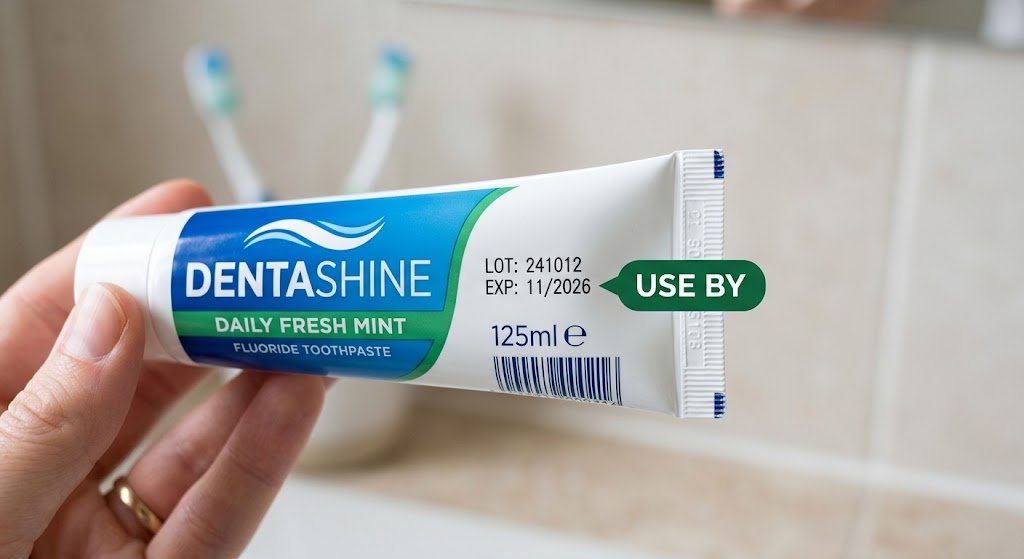
Does Toothpaste Really Expire?
Yes. Toothpaste is a formulated product with active and inactive ingredients, and manufacturers establish a shelf life for their products.
This matters particularly for fluoride toothpaste. Fluoride is the active ingredient responsible for the cavity-prevention benefit of fluoride toothpaste, and the ADA recommends brushing twice daily with fluoride toothpaste for most people. (American Dental Association)
An expiration date therefore isn’t simply a suggestion about whether the toothpaste still looks fresh. It indicates the period for which the manufacturer has established the product’s expected stability under specified storage conditions.
FDA describes an expiration date as the point through which a drug product is expected to retain its strength, quality, and purity when stored according to its labeled conditions. (U.S. Food and Drug Administration)
For everyday use, the practical rule is simple:
If your toothpaste is past its labeled expiration date, replace it with a fresh tube rather than relying on it for your regular oral-care routine.
This is especially important if you are using toothpaste specifically for cavity protection, sensitivity, or another dental need.
How Long Does Toothpaste Last?
The exact shelf life depends on the specific product and manufacturer, so there isn’t one universal expiration period that applies to every toothpaste.
The best source is the expiration date printed on the tube or packaging.
Some factors that can affect how a formulated product holds up over time include:
- The formulation and active ingredients
- Packaging
- Storage conditions
- Exposure to heat
- Exposure to moisture
- How long the product has been stored
- Whether the product has been opened and repeatedly exposed to the environment
For products regulated as drugs, FDA explains that expiration dates are supported by stability testing and are intended to indicate how long the product is expected to meet applicable standards when stored under the labeled conditions. (U.S. Food and Drug Administration)
That means you shouldn’t assume that every tube of toothpaste remains equally effective for an arbitrary number of years.
Does unopened toothpaste expire?
Yes.
An unopened tube can still reach its manufacturer’s expiration date. Keeping it sealed may help protect the formulation from contamination or environmental exposure, but it doesn’t eliminate the product’s stated shelf life.
If you find an unopened tube at the back of a cabinet and its expiration date has passed, replacing it is preferable to treating it as indefinitely usable.
Does opened toothpaste expire faster?
Opening a tube introduces additional exposure to air, moisture, and the surrounding environment.
However, you shouldn’t replace toothpaste based solely on how long ago you opened it if the manufacturer provides a specific expiration date. Instead, use the labeled date together with the product’s condition and storage instructions.
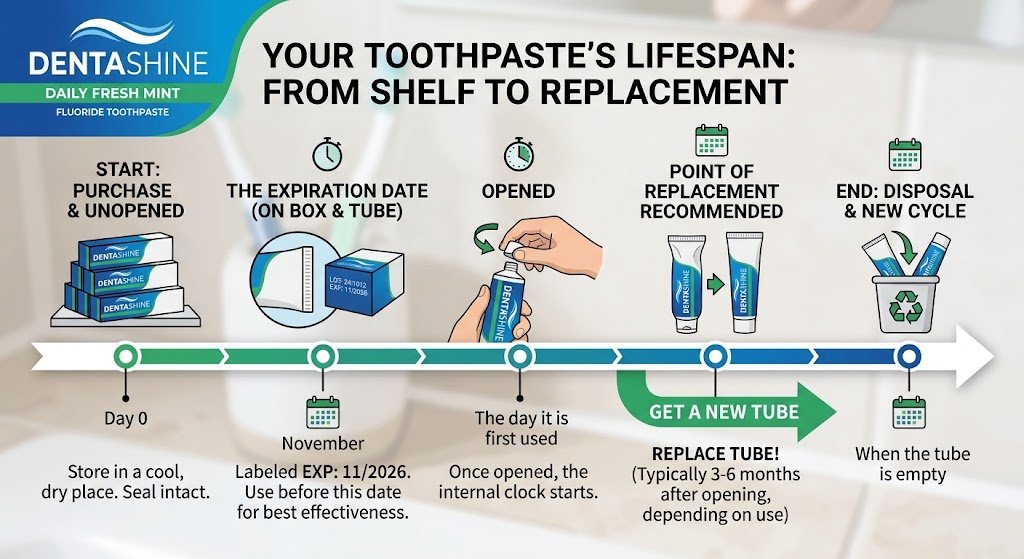
How Do You Find the Expiration Date on Toothpaste?
Look carefully around the toothpaste tube and its packaging.
The date may appear:
- On the crimped end of the tube
- Near the bottom or back of the tube
- On the box
- Along another printed area of the packaging
The exact placement varies by product.
You may see wording such as:
- EXP
- Expiration
- Expires
- A month and year
- A date printed directly on the package
If you can’t identify the date, check the manufacturer’s packaging information or contact the manufacturer rather than guessing.
What if you only see a lot number?
A lot or batch number is not necessarily an expiration date.
Manufacturers use lot codes for product identification and production tracking. Don’t automatically interpret an unfamiliar alphanumeric code as a date.
If the expiration information isn’t obvious, the safest approach is to look for official product information or ask the manufacturer.
What Happens If You Use Expired Toothpaste?
Using toothpaste shortly after its expiration date doesn’t necessarily mean you will immediately experience a harmful reaction.
The more important issue is reliability.
Over time, a formulation can change, and the manufacturer may no longer guarantee that the product meets its intended specifications beyond the labeled shelf life. FDA’s explanation of expiration dating emphasizes maintaining strength, quality, and purity through the established shelf life. (U.S. Food and Drug Administration)
With toothpaste, this can matter because you’re not simply looking for something that makes your mouth feel clean. You’re using a product for a specific oral-care function.
For example, fluoride toothpaste is intended to provide fluoride while brushing. The ADA identifies fluoride as the active ingredient required for toothpaste making a cavity-protection claim under its Seal program. (American Dental Association)
So if a tube is expired, there’s little advantage to taking the chance when replacing it with a fresh tube is inexpensive and straightforward.
Is expired toothpaste dangerous?
Not necessarily, but it is not something you should deliberately continue using.
The exact risk depends on the product, how far past its date it is, and how it has been stored. An old tube that has been sitting in a cool, dry cabinet is not necessarily equivalent to one that has been exposed to high temperatures and moisture.
Still, once the labeled expiration date has passed, the product is outside the manufacturer’s established shelf-life period.
For routine oral care, replacing it is the better choice.
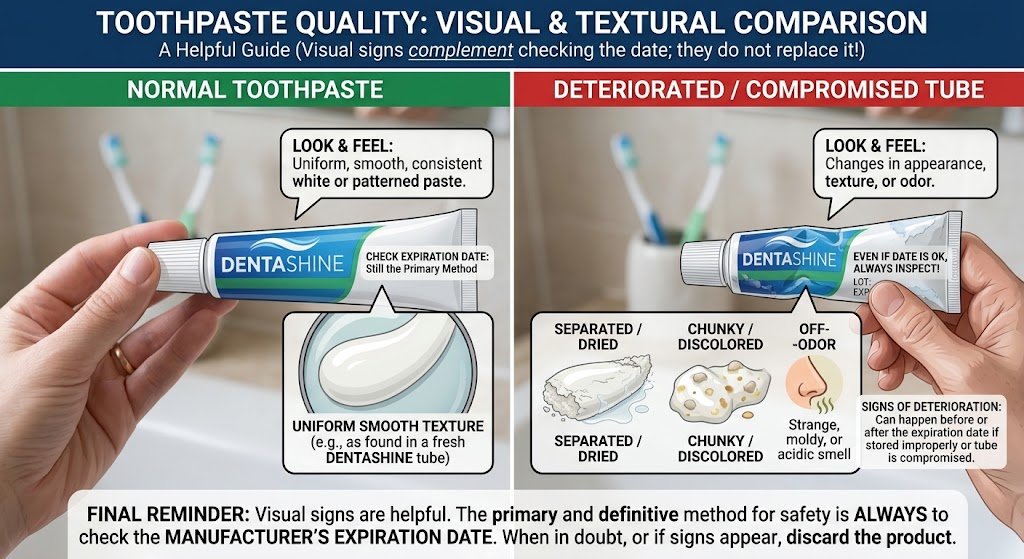
How Can You Tell If Toothpaste Has Gone Bad?
The expiration date should be your primary reference, but the physical condition of the toothpaste can also tell you that something has changed.
Consider replacing a tube if you notice:
- A significant change in texture
- Separation of the formulation
- Unusual drying or hardening
- A noticeable change in smell
- An unusual change in color
- Liquid separating from the paste
- Damaged or compromised packaging
- Evidence that the tube has been contaminated
These signs don’t give you a precise new expiration date. They simply indicate that the product may no longer be in its intended condition.
If the toothpaste looks or smells substantially different from when you normally use it, there’s little reason to keep using it.
Can You Use Toothpaste After the Expiration Date?
Technically, people may still have toothpaste left after the printed date, but that doesn’t make continued use the best choice.
Think about the expiration date as a boundary for the manufacturer’s established shelf life—not as a magical switch that makes the product unusable at midnight.
The important distinction is:
Expired does not automatically mean immediately dangerous.
But:
Expired does mean you’re outside the period for which the manufacturer established the product’s labeled shelf life.
If you’re choosing between an expired tube and a fresh tube, choose the fresh one.
This is particularly straightforward when toothpaste is inexpensive and you’re using it every day.
What About Toothpaste That Is Only Slightly Expired?
This is where people often want a specific number of days or months.
There isn’t a universal rule that says toothpaste is acceptable for exactly 30, 60, or 90 days after its expiration date.
Shelf life is product-specific. FDA explains that expiration dating is established using stability information rather than a universal post-expiration grace period. (U.S. Food and Drug Administration)
So instead of asking:
“How many months after expiration can I use toothpaste?”
a better question is:
“Is this product still within its labeled shelf life?”
If the answer is no, replace it.
If you’ve accidentally brushed once with toothpaste that recently expired, there’s generally no reason to panic. Simply switch to a current tube for your regular routine.
Does Expired Fluoride Toothpaste Still Protect Against Cavities?
This is one of the most important reasons not to rely on expired toothpaste.
The ADA recommends brushing twice daily with fluoride toothpaste for most people because fluoride toothpaste helps prevent tooth decay. (American Dental Association)
However, once a toothpaste has passed its expiration date, you should not assume that its active ingredient will continue to perform exactly as intended indefinitely.
The manufacturer has established the product’s shelf life based on its formulation and stability information. Beyond that date, you no longer have the same assurance that the product remains within its labeled specifications.
If cavity prevention is your priority, using a current, appropriately formulated fluoride toothpaste makes much more sense than trying to stretch an old tube.
Does Toothpaste Expire Faster in a Hot Bathroom?
Storage conditions matter.
Heat, moisture, and repeated environmental exposure can affect formulated products. FDA notes that storage conditions are part of the expiration-date framework for drug products, meaning the labeled shelf life assumes the product is stored according to its specified conditions. (U.S. Food and Drug Administration)
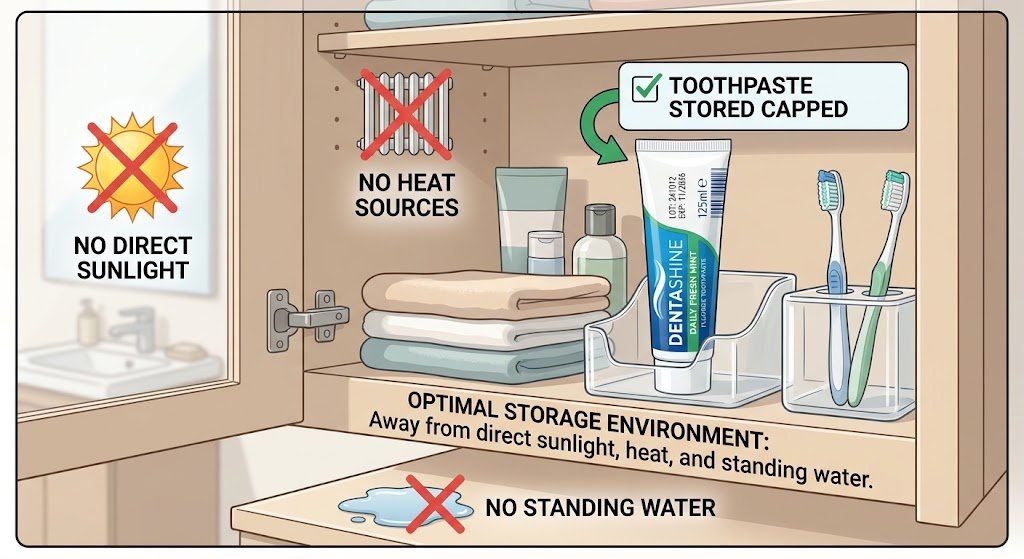
A bathroom isn’t automatically a bad place to keep toothpaste, but avoid unnecessary exposure to extreme heat or direct sunlight.
Practical storage habits include:
- Keep the cap closed.
- Store the tube according to the manufacturer’s instructions.
- Avoid leaving toothpaste in excessive heat.
- Don’t deliberately expose it to water.
- Keep the opening reasonably clean.
- Don’t share a tube in a way that contaminates the opening.
Good storage won’t make an expired tube usable forever. It simply helps you get the intended shelf life from a product that is still within date.
Should You Throw Away Toothpaste If It Looks Fine but Is Expired?
Yes, replacing it is still the better approach.
A toothpaste can look perfectly normal while being past its established shelf life. Appearance alone cannot tell you whether every component remains within its intended specifications.
This is especially relevant for products where an active ingredient matters.
For example, the ADA explains that toothpaste products can contain active ingredients for specific oral-health purposes, including fluoride for cavity prevention and ingredients intended to reduce sensitivity or other oral-health concerns. (American Dental Association)
So don’t use appearance as a substitute for the expiration date.
Date first; appearance second.
Is It Worth Buying Toothpaste in Bulk?
Buying multiple tubes can make sense if you regularly use a particular toothpaste, but don’t buy more than you can reasonably use within the products’ shelf life.
Bulk buying becomes less attractive when:
- You use toothpaste slowly.
- You are trying a new formulation.
- You have multiple partially used tubes.
- You frequently change products.
- You have limited storage space.
- The expiration dates are relatively close.
If you do buy several tubes, check the dates and use the oldest appropriate tube first.
This is particularly useful when shopping on Amazon, where multi-packs and larger quantities can make a product appear cheaper per tube.
The goal isn’t simply to find the lowest price per ounce. It’s to buy an amount you’re realistically going to use while the products are still within their intended shelf life.
What Should You Look For When Buying Toothpaste?
If you’re replacing an expired tube, don’t automatically buy the same product—or choose one based only on marketing language.
Start with your oral-health need.
For everyday cavity prevention
For most people, fluoride toothpaste is the conventional evidence-based starting point. The ADA recommends twice-daily brushing with fluoride toothpaste. (American Dental Association)
Look for:
- An appropriate fluoride formulation
- Clear ingredient labeling
- Directions for use
- A current expiration date
- Reputable manufacturing information
If you want an additional trust signal, you can look for products that have earned the ADA Seal of Acceptance. The ADA says Seal products are evaluated against requirements for safety and effectiveness for their specific claims. (American Dental Association)
If you have sensitive teeth
Sensitivity may call for a toothpaste formulated around desensitizing ingredients rather than simply choosing a generic “natural” or “clean” product.
Depending on the product, ingredients such as potassium-containing compounds or stannous fluoride may be relevant to sensitivity-focused formulations.
If sensitivity is persistent, severe, or associated with pain, don’t assume toothpaste alone is the solution. Dental problems such as decay, cracks, gum recession, or other conditions can also cause sensitivity.
If you’re looking for hydroxyapatite toothpaste
Hydroxyapatite is another toothpaste ingredient that attracts attention from consumers looking for fluoride alternatives or different remineralization-oriented formulations.
However, don’t choose it simply because the ingredient sounds more “natural.”
Compare the formulation, evidence, intended use, and your own oral-health needs.
If you’re trying to avoid SLS
If sodium lauryl sulfate is something you specifically want to avoid, read the ingredient list rather than relying only on labels such as “natural,” “clean,” or “non-toxic.”
Can You Buy Expired Toothpaste on Amazon?
You should avoid intentionally purchasing toothpaste that is close to or past its expiration date.
When shopping online, particularly for multipacks or less-common formulations, check:
- The product’s expiration information where available
- Seller information
- Product packaging
- Recent customer feedback as a secondary signal
- Whether the listing clearly identifies the product
- Whether the product is sold through a reputable seller
Customer reviews should not replace checking the actual product date. Reviews can also describe older batches than the one you receive.
For an affiliate recommendation, the more useful approach is to evaluate product suitability first and freshness second, rather than promoting whichever toothpaste happens to have the highest rating.
What Is the Best Way to Store Toothpaste?
You don’t need a complicated storage system.
For ordinary household use:
- Keep the cap closed when you’re finished brushing.
- Store the tube in a reasonably cool, dry location.
- Avoid unnecessary exposure to direct sunlight or extreme heat.
- Keep the opening clean.
- Follow any storage instructions printed on the package.
If your toothpaste is still within its expiration date and has been stored appropriately, there’s usually no reason to replace it simply because you’ve had the tube for a while.
Quick Decision: Should You Keep or Replace Your Toothpaste?
Use this simple checklist:
| Situation | What to do |
| Expiration date has not passed | Continue using it if the product is in normal condition |
| Expiration date has passed | Replace it |
| Date is unclear | Check manufacturer information before relying on it |
| Texture or smell has noticeably changed | Replace it |
| Tube is damaged or contaminated | Replace it |
| You accidentally used recently expired toothpaste once | Don’t panic; switch to a current tube |
| You need cavity protection | Use a current fluoride toothpaste unless your dental professional recommends otherwise |
| You have persistent dental symptoms | Seek dental advice rather than relying only on toothpaste |
The key point is that toothpaste isn’t something you need to stretch past its labeled shelf life to save money.
Frequently Asked Questions
Does toothpaste expire if unopened?
Yes. An unopened tube can still reach its manufacturer’s expiration date. Sealing helps protect the product during storage, but it doesn’t make the formulation indefinitely shelf-stable.
How long is toothpaste good after the expiration date?
There isn’t a universal grace period. The appropriate shelf life depends on the specific formulation and manufacturer. Once the labeled expiration date has passed, replacing the toothpaste is the better choice.
Can expired toothpaste make you sick?
Expired toothpaste isn’t automatically dangerous, but its quality and performance are no longer assured beyond the established shelf life. If the product has changed in appearance, texture, or smell, or the packaging is compromised, discard it.
Does toothpaste expire faster after opening?
Opening a tube exposes it to the surrounding environment, but the printed expiration date remains the primary reference. Proper storage and keeping the cap closed can help maintain the product in its intended condition.
Can you use toothpaste that expired a month ago?
A recently expired tube isn’t necessarily an immediate health emergency, but there is little reason to deliberately continue using it when a fresh tube is readily available. For routine oral care, replace it.
Does fluoride toothpaste expire?
Yes. Fluoride toothpaste has a labeled shelf life, and you should use it according to the manufacturer’s directions and expiration information. Fluoride toothpaste is recommended by the ADA for routine cavity prevention for most people. (American Dental Association)
Does natural toothpaste expire?
Yes. “Natural” does not mean a product is exempt from shelf-life considerations. Check the manufacturer’s expiration information and storage instructions.
Should I throw away toothpaste that has separated?
If the toothpaste has noticeably separated, changed texture, developed an unusual smell, or otherwise appears abnormal, replacing it is the prudent choice.
Can old toothpaste still clean your teeth?
Toothpaste can provide mechanical cleaning through brushing, but you shouldn’t rely on an expired formulation as though it were guaranteed to perform exactly as intended. If the tube is past its expiration date, replace it.
The Bottom Line
Yes, toothpaste can expire.
The expiration date represents the manufacturer’s established shelf life, and FDA explains that expiration dating for applicable drug products is based on maintaining expected strength, quality, and purity under specified storage conditions. (U.S. Food and Drug Administration)
You don’t need to panic if you accidentally used toothpaste that recently expired. But you also don’t gain much by deliberately keeping an old tube in your routine.
If your toothpaste is expired, visibly changed, damaged, or stored poorly, replace it with a fresh tube.
And if you’re buying a replacement, choose based on your actual oral-health needs—not just labels such as “natural,” “clean,” or “non-toxic.” For most people, the ADA recommends brushing twice daily with fluoride toothpaste, while specific dental needs may call for a different formulation or professional guidance. (American Dental Association)
Affiliate disclosure: If this article contains links to products sold through Amazon, the site may earn a commission from qualifying purchases at no additional cost to you. Product recommendations should be based on the reader’s needs and the criteria explained in the article.
