Charcoal toothpaste is marketed as a way to clean and whiten teeth, but the black color and “natural” positioning can make it seem more effective than ordinary toothpaste. The important question is whether the charcoal itself provides a meaningful benefit—and whether that benefit is worth the potential trade-offs.
The evidence so far does not establish charcoal toothpaste as a superior whitening option. Research on activated-charcoal toothpastes has produced mixed whitening results, while several studies and reviews have raised concerns about abrasive potential. [ add a link ]
That does not mean every charcoal toothpaste is identical or that every product should automatically be avoided. The rest of the formulation matters, including its fluoride status, abrasives, intended purpose, and other active ingredients.
This guide explains what charcoal toothpaste actually does, what the evidence says about whitening and safety, how fluoride fits into the decision, and what to look for if you’re considering buying one.
What Is Charcoal Toothpaste?
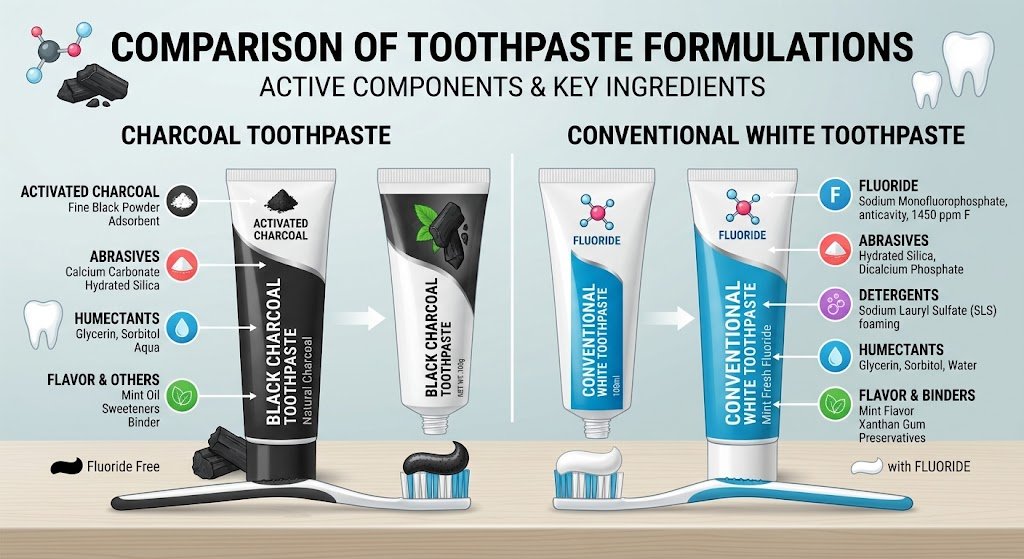
Charcoal toothpaste is a toothpaste formulation that contains activated charcoal, a processed form of carbon with a highly porous structure. Activated charcoal is commonly produced from carbon-rich materials and processed to increase its surface area.
The charcoal is responsible for the toothpaste’s characteristic dark or black appearance. But it is only one ingredient. Toothpaste is a complete formulation that can also contain active ingredients, abrasives, humectants, flavoring agents, sweeteners, detergents, thickeners, and other components.
That distinction is important when comparing products.
A toothpaste containing charcoal is not automatically:
- Fluoride-free
- Fluoride-containing
- More natural
- Less abrasive
- Better at whitening
- Safer
- More effective
Those characteristics depend on the specific formulation, not simply on whether the label says “charcoal.”
Why Is Charcoal Toothpaste Black?
The answer is straightforward: the charcoal particles are dark, and enough charcoal in the formulation can give the toothpaste its distinctive black or gray appearance.
The color itself does not demonstrate effectiveness.
In other words, a black toothpaste isn’t necessarily better at removing stains than a white toothpaste. Color is an ingredient characteristic, not an efficacy measurement.
What Else Is in Charcoal Toothpaste?
The rest of the ingredient list deserves at least as much attention as the charcoal.
Two charcoal toothpastes can differ substantially in whether they contain fluoride, which abrasive system they use, what other active ingredients they contain, and what claims the manufacturer makes.
For anyone comparing products, this leads to a useful rule:
Evaluate the whole toothpaste, not just the charcoal.
Does Charcoal Toothpaste Actually Whiten Teeth?
This is where the marketing around charcoal toothpaste needs some context.
The word “whitening” can describe several different things. Removing a stain from the outside of a tooth is not the same as changing the tooth’s underlying color through bleaching.
Surface Stains vs. Intrinsic Tooth Color
Teeth can become darker or look less white for different reasons.
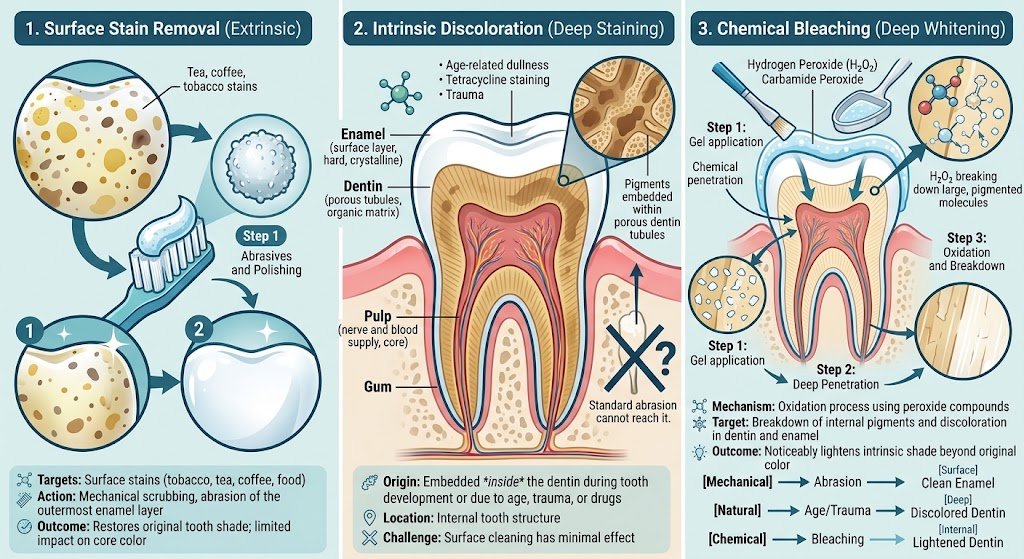
Coffee, tea, tobacco and some foods can contribute to extrinsic stains, which are discolorations on or near the tooth’s surface. Toothpaste can sometimes improve the appearance of these stains through mechanical cleaning.
By contrast, intrinsic discoloration involves the underlying tooth structure. Changing intrinsic tooth color is generally a different problem and may require a different whitening approach.
The American Dental Association explains that whitening toothpastes primarily rely on abrasives to mechanically remove extrinsic surface stains, while many whitening strips rely primarily on peroxide to bleach teeth.
So when someone asks whether charcoal toothpaste “whitens,” the first question should be:
Whiten in what sense?
How Is Charcoal Supposed to Whiten Teeth?
Activated charcoal has been promoted partly because of its ability to adsorb certain substances onto its surface. Charcoal-based toothpastes have also been proposed to produce whitening through mechanical action during brushing.
But a proposed mechanism is not the same thing as demonstrated clinical superiority.
A systematic review of activated-charcoal toothpastes found varied whitening results across the available studies and noted that most included studies reported greater abrasive potential.
Another clinical study comparing charcoal toothpaste with other whitening approaches found that charcoal toothpaste produced considerably less whitening than carbamide peroxide, while its whitening performance was closer to conventional fluoridated toothpaste.
The evidence therefore does not justify treating charcoal toothpaste as a proven superior whitening treatment.
What Does the Evidence Actually Show?
The current evidence does not establish charcoal as a special whitening ingredient that consistently outperforms established alternatives.
That does not mean a particular charcoal toothpaste can never make teeth look cleaner or remove some surface discoloration. It means that the presence of charcoal alone is not a reliable reason to expect better whitening.
A charcoal toothpaste may also contain conventional abrasives or other ingredients that contribute to stain removal. In that case, attributing the entire whitening effect to charcoal would be misleading.
Is Charcoal Toothpaste Safe?
Safety is more complicated than a simple yes-or-no answer.
The main concern discussed in the research is abrasivity.
Toothpaste needs some cleaning action, and abrasive ingredients can help remove plaque and surface stains. But excessive mechanical wear is a different matter.
The important questions are:
- How abrasive is the particular formulation?
- How frequently is it used?
- How hard does the person brush?
- What condition are the teeth already in?
- Does the person have sensitivity, exposed dentin, enamel wear, or restorations?
The charcoal ingredient by itself does not answer all of those questions.
Abrasivity and Tooth Surfaces
The ADA describes toothpaste as an abrasive-containing formulation and notes that abrasives can physically remove surface stains.
The concern with charcoal products is that some research has found relatively high abrasive potential.
This is why the statement “charcoal toothpaste damages enamel” is too broad as a blanket claim.
Different products have different formulations, and laboratory findings do not automatically tell us exactly what will happen to every person’s teeth during normal long-term use.
At the same time, it would be equally misleading to dismiss abrasivity as irrelevant.
If a product is highly abrasive and is used aggressively or frequently, mechanical wear becomes a legitimate consideration.
What About Enamel?
Enamel is the hard outer layer of the tooth. Unlike many tissues in the body, mature enamel does not simply grow back after it has been physically worn away.
That makes excessive abrasion worth taking seriously, particularly for someone who already has signs of enamel wear, exposed dentin, recession or sensitivity.
However, consumers should distinguish between:
“Charcoal products can raise abrasivity concerns”
and
“Every charcoal toothpaste will damage your enamel.”
The first statement reflects the evidence more responsibly.
The second goes beyond what can be concluded about every formulation.
Could Charcoal Toothpaste Increase Sensitivity?
Potentially, but the complete formulation and the person’s existing dental condition matter.
Sensitivity can be associated with exposed dentin, enamel wear, gum recession and other dental issues. A toothpaste that contributes excessive mechanical wear could be an especially poor choice for someone who is already sensitive.
If your teeth regularly hurt when exposed to cold, hot, sweet or acidic foods, the better question may not be:
“Which charcoal toothpaste should I buy?”
It may be:
“Why are my teeth sensitive, and which toothpaste is appropriate for that problem?”
What Remains Uncertain?
The evidence base for charcoal toothpaste is not as extensive as the evidence base for established fluoride toothpaste and mainstream whitening approaches.
Reviews of activated-charcoal toothpaste have identified limitations in the available studies, including relatively small evidence bases and concerns about study quality.
There is also laboratory research concerning charcoal-based dentifrices and dental restorative materials, but these studies should not be interpreted as direct proof of what will happen to every restoration in everyday use.
That distinction matters.
Laboratory evidence can identify a potential concern. It does not automatically predict a clinical outcome for every person.
Why Brushing Technique Matters
Even a well-formulated toothpaste can be used poorly.
Aggressive brushing, excessive pressure, very frequent brushing, or an unnecessarily abrasive product can increase mechanical wear.
So if you are evaluating charcoal toothpaste, don’t look only at the ingredient list. Consider the way you brush and your existing oral-health situation as well.
For someone with significant sensitivity, visible enamel wear, gum recession, or extensive dental restorations, discussing the choice with a dentist may be more useful than relying on the charcoal marketing claim.
Does Charcoal Toothpaste Contain Fluoride?
Yes—some charcoal toothpastes contain fluoride and some do not.
Charcoal itself does not determine whether a toothpaste contains fluoride. That is a property of the individual formulation, so you should check the product’s active ingredients rather than assuming that all charcoal toothpaste is fluoride-free.
The American Dental Association identifies sodium fluoride, stannous fluoride, and sodium monofluorophosphate among the fluoride compounds used in toothpastes for anticaries purposes.
Why Does Fluoride Matter?
Your teeth are constantly exposed to acids produced by bacteria in dental plaque and introduced through foods and drinks. Those acids can contribute to mineral loss from enamel.
Fluoride helps teeth resist this process and supports remineralization. That makes fluoride particularly relevant when your primary goal is cavity prevention, rather than simply making teeth look whiter.
This is one reason you should not evaluate a charcoal toothpaste solely by asking whether it contains charcoal.
A better set of questions is:
- Does it contain fluoride?
- Which fluoride compound does it use?
- What other active ingredients are present?
- What is the toothpaste intended to accomplish?
- Does its formulation fit your oral-health needs?
What If You Specifically Want Fluoride-Free Charcoal Toothpaste?
That is a legitimate product preference, but it should be treated as a deliberate choice rather than an automatic consequence of buying charcoal toothpaste.
If you are choosing fluoride-free toothpaste, understand the role conventional fluoride toothpaste plays in cavity prevention and consider your individual risk of dental caries.
Likewise, if cavity prevention is one of your main priorities, a fluoride-containing toothpaste may deserve closer consideration.
Is Charcoal Toothpaste Better With or Without Fluoride?
There is no universal answer based on charcoal alone.
The more useful question is:
What are you trying to accomplish with your toothpaste?
Someone primarily concerned about cavity prevention may place a high priority on fluoride. Someone specifically seeking a fluoride-free formulation may have a different set of criteria.
The important point is that charcoal and fluoride address different aspects of the formulation. One does not automatically replace the other.
What Should You Look for in a Charcoal Toothpaste?
If you have decided that you specifically want to try charcoal toothpaste, don’t choose one simply because the packaging makes the strongest whitening claim.
Instead, evaluate the product as you would any other toothpaste.
1. Check the Fluoride Status
Start with the active ingredients.
If cavity protection is important to you, determine whether the product contains fluoride and identify the fluoride compound listed on the packaging.
Don’t assume that a product is fluoride-free because it is marketed as “natural,” and don’t assume it contains fluoride merely because it is sold as toothpaste.
2. Look Beyond the Charcoal
“Activated charcoal” is only one attribute.
Pay attention to the rest of the formulation, including its active ingredients and abrasive system.
For example, two charcoal toothpastes could both contain activated charcoal but differ in whether they contain fluoride, what abrasives they use, and what other active ingredients they contain.
This is why a simple rule such as “more charcoal = better” doesn’t make sense.
3. Consider Abrasivity
A toothpaste needs enough cleaning ability to remove plaque and surface deposits, but more abrasion is not automatically better.
Abrasivity should be considered alongside:
- Your brushing technique
- How frequently you brush
- Existing tooth sensitivity
- Enamel wear
- Gum recession
- The type of stains you’re trying to remove
The ADA explains that relative dentin abrasivity, or RDA, is a standardized measure used to characterize dentifrice abrasivity. However, an RDA value should not be treated as a simple “safe versus unsafe” score.
4. Look at the Evidence Behind the Whitening Claim
Marketing language can make charcoal sound like a special whitening technology.
The actual evidence is more nuanced.
If the product claims to whiten teeth, ask what mechanism is actually responsible for that result.
Is the product primarily designed to:
- Remove surface stains mechanically?
- Use peroxide or another bleaching ingredient?
- Provide general cleaning?
- Create the appearance of a more dramatic whitening experience?
These are different claims.
The ADA notes that whitening toothpastes primarily work by removing surface stains rather than changing the intrinsic color of teeth.
5. Consider the ADA Seal When Applicable
The ADA Seal of Acceptance can be a useful trust signal when evaluating eligible oral-care products.
The ADA requires companies seeking the Seal to submit information supporting a product’s safety and efficacy and to meet its applicable requirements.
However, don’t turn the Seal into a universal quality ranking.
A product without the Seal is not automatically dangerous or ineffective, and a Seal does not mean that a product is necessarily the best match for your specific needs.
Instead, treat it as one piece of the evaluation process.
6. Match the Product to Your Actual Goal
This is perhaps the most important buying criterion.
| Your Main Goal | What to Prioritize |
| Cavity prevention | Appropriate fluoride formulation |
| Surface-stain removal | Proven stain-removal approach and reasonable abrasivity |
| Significant whitening | Evidence-supported whitening ingredients or treatments |
| Sensitive teeth | A formulation appropriate for sensitivity |
| Fluoride-free preference | Clearly labeled fluoride-free formulation |
| General oral care | Complete formulation rather than charcoal marketing alone |
Charcoal may be part of the product you choose, but it should not be the only reason you choose it.
Who Might Consider Charcoal Toothpaste?
Charcoal toothpaste can make sense for someone who is specifically interested in the category and understands what it can—and cannot—reasonably be expected to do.
You might consider it if:
- You like a particular charcoal formulation.
- You are interested in trying a charcoal-based toothpaste after reviewing its ingredients.
- Your primary concern is mild surface staining rather than major intrinsic discoloration.
- You have checked its fluoride status and other active ingredients.
- You understand that charcoal is not automatically a superior whitening ingredient.
The key is to approach charcoal as a formulation choice, not as a guarantee of whiter or healthier teeth.
If you are mainly interested in whitening, it is worth comparing charcoal toothpaste with products specifically designed and supported for that purpose.
Who Should Consider Another Option?
Charcoal toothpaste isn’t necessarily the best fit for every oral-care goal.
If Your Primary Goal Is Substantial Whitening
If you want a noticeable change in intrinsic tooth color, charcoal toothpaste may not be the most appropriate tool.
Surface-stain removal and bleaching are different processes, and charcoal should not be treated as a substitute for every evidence-supported whitening approach.
Depending on the situation, options may include whitening toothpaste, peroxide-based over-the-counter products, or dentist-supervised whitening.
If You Have Significant Tooth Sensitivity
If your teeth are already sensitive, choosing a toothpaste primarily because it contains charcoal may not address the underlying problem.
A toothpaste designed specifically around sensitivity may be more relevant.
If Cavity Prevention Is Your Top Priority
Don’t let the charcoal label distract you from the active ingredient that matters for your objective.
If you want conventional fluoride-based cavity protection, evaluate charcoal products accordingly—or consider a different toothpaste category.
If You Already Have Substantial Enamel Wear or Gum Recession
A dentist can help determine why the problem is occurring and whether your toothpaste and brushing technique are contributing to it.
The goal should not simply be to find the “least damaging charcoal toothpaste.” It may be more appropriate to address the underlying oral-health issue first.
If You Have Unexplained Tooth Discoloration
Not every dark or yellow-looking tooth is a surface stain.
A single discolored tooth, rapidly changing tooth color, or discoloration associated with pain or trauma can have a cause that toothpaste cannot correct.
In those situations, whitening experimentation can delay the more important step: finding out why the discoloration occurred.
Charcoal Toothpaste vs. Whitening Toothpaste
The two categories overlap, but they are not the same thing.
A charcoal toothpaste may be marketed for whitening, yet charcoal is not itself proof of superior whitening performance.
A whitening toothpaste, on the other hand, is generally positioned around removing or reducing visible tooth stains. Depending on the formulation, its whitening effect may come primarily from abrasives, chemical stain-removal ingredients, or a combination of approaches.
| Factor | Charcoal Toothpaste | Whitening Toothpaste |
| Main selling point | Charcoal-based formulation | Whitening or stain removal |
| Surface-stain removal | Depends on formulation | Common intended purpose |
| Bleaching intrinsic color | Not established as a charcoal-specific benefit | Depends on formulation |
| Fluoride | Product-dependent | Product-dependent |
| Abrasivity | Product-dependent | Product-dependent |
| Evidence for charcoal itself | Limited/mixed | Depends on the active formulation |
| Best reason to choose it | Preference for a specific formulation | Primary focus on stain removal/whitening |
The important takeaway is that “charcoal” and “whitening” describe different things.
Charcoal identifies an ingredient or formulation characteristic.
Whitening describes the intended cosmetic outcome.
A toothpaste can therefore be both charcoal-based and marketed as whitening without the charcoal itself being responsible for the entire whitening effect.
If whitening is your main objective, compare the actual whitening mechanism and evidence rather than simply choosing the darkest-colored toothpaste.
How to Choose Charcoal Toothpaste on Amazon
If you are shopping for charcoal toothpaste on Amazon, use the product page as a place to verify the formulation, not simply as a source of marketing claims.
The most useful comparison starts with the attributes that affect your actual decision.
1. Check the active ingredients
Look at the product label and manufacturer information.
Confirm whether the toothpaste contains fluoride and identify the active ingredients rather than relying only on the product title.
2. Check what the product claims to do
A toothpaste marketed for whitening is not necessarily designed for the same purpose as one marketed for sensitivity or cavity protection.
Match the stated purpose to your own goal.
3. Look for meaningful formulation information
Useful product information can include:
- Fluoride status
- Active ingredients
- Product size
- Intended use
- Manufacturer’s directions
- Relevant certifications or seals where applicable
- Ingredient information
Avoid treating vague claims such as “detoxifying,” “chemical-free,” or “maximum whitening” as evidence by themselves.
4. Compare value, not just price
A lower-priced tube isn’t necessarily better value if it doesn’t meet your needs.
Compare the amount of toothpaste, formulation, intended use, and relevant active ingredients.
5. Read customer reviews carefully
Reviews can help identify practical characteristics such as:
- Taste
- Texture
- Packaging
- Tube usability
- Whether the product matches its description
But customer reviews should not replace evidence about safety or clinical effectiveness.
A review saying “this made my teeth much whiter” is a personal experience, not controlled evidence of whitening efficacy.
A simple Amazon decision framework
Before clicking “Buy,” ask:
- Does this product meet my primary oral-health goal?
- Does it contain the active ingredients I want?
- Am I comfortable with its formulation and abrasivity considerations?
- Are its major claims supported by credible evidence?
- Would another toothpaste category better solve my problem?
If the answer to the final question is yes, buying charcoal toothpaste simply because it is popular defeats the purpose of careful product selection.
What Are Better Alternatives for Whiter Teeth?
If your main objective is whiter-looking teeth, you do not need to restrict yourself to charcoal toothpaste.
Whitening toothpaste
Whitening toothpastes can help remove extrinsic surface stains through their formulation, often using abrasives and other ingredients intended for stain control.
They may be useful when your goal is maintaining a cleaner-looking surface rather than dramatically changing intrinsic tooth color.
Peroxide-based whitening products
Peroxide-based whitening products work through a different mechanism from ordinary stain-removing toothpaste.
They may be more appropriate when the goal is actual bleaching rather than simply removing surface deposits.
The ADA recognizes peroxide-based whitening products as an established category of tooth-whitening treatment.
Whitening strips
Whitening strips are another over-the-counter option for people seeking more noticeable whitening than ordinary toothpaste may provide.
Their effectiveness and suitability depend on the product, concentration, application and the condition of the person’s teeth.
Professional whitening
For people seeking substantial whitening or dealing with complicated discoloration, dentist-supervised treatment can provide a more individualized approach.
This is particularly relevant when discoloration may have an underlying dental cause or when the person has restorations that may not respond to whitening in the same way as natural teeth.
The important lesson is that the best whitening method depends on what is causing the discoloration and how much change you actually want.
Frequently Asked Questions
Does charcoal toothpaste really whiten teeth?
Charcoal toothpaste may help remove some surface discoloration depending on its formulation, but current evidence does not establish charcoal itself as a superior whitening ingredient. Surface-stain removal is also different from bleaching the intrinsic color of a tooth.
If noticeable whitening is your main goal, compare the toothpaste’s actual whitening mechanism and evidence rather than choosing it simply because it contains activated charcoal.
Is charcoal toothpaste safe?
Safety depends on the complete formulation, how it is used, and the person’s oral-health condition. Abrasivity is an important consideration because excessive mechanical wear can be problematic.
Research on charcoal toothpaste has raised concerns about abrasive potential, but that does not mean every charcoal toothpaste will produce the same effect.
If you already have sensitivity, enamel wear, gum recession or other dental concerns, consider discussing your toothpaste choice with a dental professional.
Does charcoal toothpaste contain fluoride?
Some charcoal toothpastes contain fluoride and others are fluoride-free.
Charcoal does not determine the fluoride status of a product. Check the active ingredients on the individual package or manufacturer’s product information.
If cavity prevention is a major priority, fluoride status should be one of the first things you evaluate.
Can charcoal toothpaste damage enamel?
It is too broad to say that all charcoal toothpaste damages enamel.
The more accurate concern is that some charcoal toothpastes may have relatively high abrasive potential, and excessive mechanical abrasion can contribute to tooth-surface wear.
The formulation, brushing pressure, frequency of use and condition of the teeth all matter.
Is charcoal toothpaste good for sensitive teeth?
It may not be the most appropriate choice for someone whose primary concern is sensitivity, particularly if the formulation is relatively abrasive.
People with sensitive teeth may benefit more from choosing a toothpaste specifically formulated for sensitivity and from addressing the underlying cause of their sensitivity.
Is charcoal toothpaste better than whitening toothpaste?
Not necessarily.
Charcoal toothpaste is defined by its charcoal-containing formulation, while whitening toothpaste is designed around the goal of stain removal or whitening.
If whitening is your primary objective, compare the evidence and ingredients behind the whitening effect rather than assuming charcoal provides an advantage.
Can you use charcoal toothpaste every day?
There is no universal rule that makes every charcoal toothpaste appropriate—or inappropriate—for daily use.
The formulation, abrasivity, directions and your oral-health needs matter.
If you notice increasing sensitivity, discomfort or other changes after switching products, stop assuming that more brushing or continued use will produce better results and consider getting professional advice.
Should you buy charcoal toothpaste on Amazon?
You can, but evaluate the product rather than the marketing.
Check the active ingredients, fluoride status, formulation, intended use, available evidence and manufacturer information. Customer reviews can help with practical issues such as taste or texture, but they should not be treated as clinical evidence.
Bottom Line
Charcoal toothpaste is an interesting oral-care category, but charcoal itself is not a guarantee of better whitening, cleaner teeth or better oral health.
The evidence for charcoal-specific whitening remains limited and mixed, while abrasivity is an important consideration when evaluating these products.
If you are considering one, look beyond the black color and the word “charcoal.” Check the complete formulation, determine whether it contains fluoride, consider its abrasive characteristics, and match it to your actual oral-care goal.
If your priority is significant whitening, sensitivity management or cavity prevention, another toothpaste or whitening approach may be a better fit.
In short:
Choose the formulation that solves your oral-care problem—not simply the toothpaste with the most convincing charcoal marketing.
