Toothpaste tablets are a solid alternative to conventional toothpaste. Instead of squeezing paste from a tube, you chew a tablet, wet your toothbrush, and brush as usual.
They can be appealing if you want a travel-friendly format, less bulky packaging, or a toothpaste option without a conventional plastic tube. But the important question is not simply whether tablets are convenient. The formulation inside the tablet matters more than the tablet format itself.
Some toothpaste tablets contain fluoride; others are fluoride-free and may use ingredients such as hydroxyapatite instead. Because fluoride toothpaste has a well-established role in cavity prevention, you should compare the active ingredients and intended benefits before switching. The American Dental Association (ADA) says fluoride-containing toothpaste is the most commonly used form of self-applied fluoride and recommends fluoride toothpaste carrying the ADA Seal of Acceptance. (American Dental Association)
This guide explains how toothpaste tablets work, what to look for on the ingredient label, how they compare with conventional toothpaste, and when a tablet may—or may not—be a sensible choice.
Affiliate disclosure: If this article includes links to products, they may be affiliate links, meaning the site may earn a commission from qualifying purchases at no additional cost to you.
What Are Toothpaste Tablets?
Toothpaste tablets are concentrated, solid dentifrice products designed to replace traditional toothpaste paste. Rather than dispensing a ribbon of toothpaste onto a toothbrush, you use a pre-measured tablet.
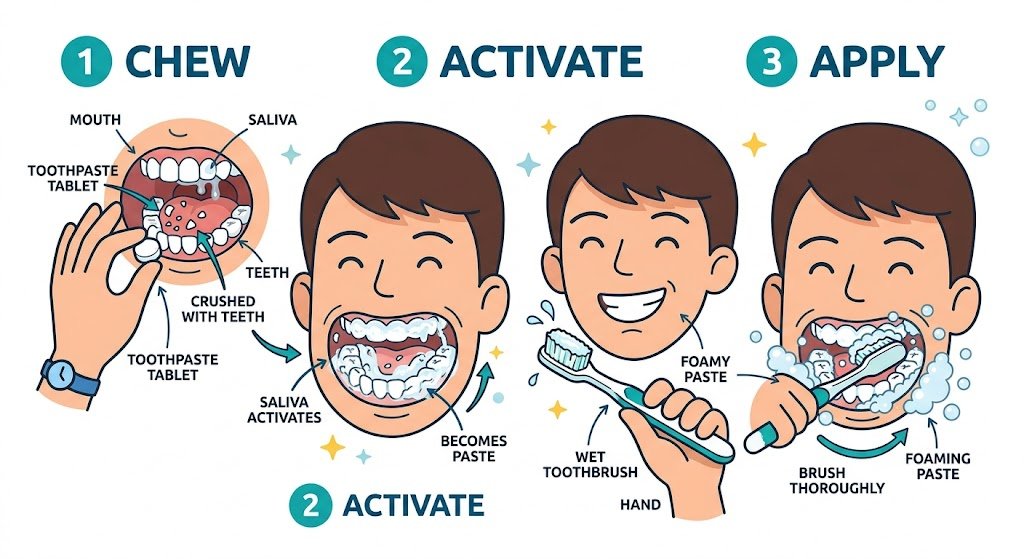
The basic process is simple:
- Place one tablet in your mouth.
- Chew or crush it according to the manufacturer’s directions.
- Wet your toothbrush.
- Brush with the resulting paste or foam.
- Spit and rinse according to the product’s instructions.
The exact experience varies between formulations. Some tablets are designed to break down quickly into a conventional-looking paste, while others produce more foam or a different texture.
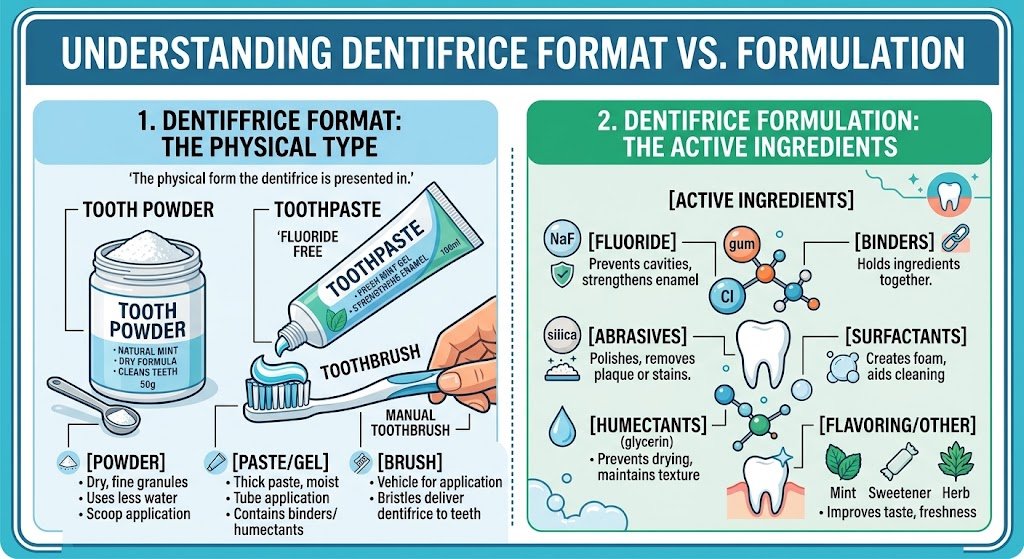
The distinction is important because “toothpaste tablet” describes a delivery format, not a particular level of effectiveness. Two products can both be called toothpaste tablets while having very different active ingredients, fluoride content, abrasivity, flavors, and intended uses.
Toothpaste tablets vs. fluoride tablets
There is also an important terminology issue.
Toothpaste tablets are not the same thing as fluoride supplements.
Fluoride tablets or lozenges are dietary fluoride supplements used in specific circumstances, particularly for children at elevated risk of tooth decay when drinking water contains insufficient fluoride. Their dosing is determined according to factors such as age and fluoride exposure and should not be confused with a toothpaste product. (American Dental Association)
When shopping for toothpaste tablets, make sure you are looking at a dentifrice intended for brushing, rather than an oral fluoride supplement.
How Do Toothpaste Tablets Work?
Toothpaste tablets work by turning a solid dose of toothpaste ingredients into a form that can be distributed across the teeth with a toothbrush.
Traditional toothpaste already contains a mixture of active and inactive ingredients. The active ingredients can address specific oral-health objectives, while other ingredients provide cleaning, texture, flavor, stability, or other formulation functions. The ADA identifies fluoride compounds such as sodium fluoride, sodium monofluorophosphate, and stannous fluoride as anticaries ingredients used in toothpaste. (American Dental Association)
A tablet essentially packages those ingredients into a measured solid form.
The tablet itself isn’t what protects your teeth
This is one of the most important points when evaluating toothpaste tablets.
The fact that a product comes in a tablet does not automatically make it better for cavities, enamel, sensitivity, or gum health.
Instead, evaluate:
- The active ingredient
- The concentration of the active ingredient
- Whether the product contains fluoride
- The cleaning and abrasive system
- Ingredients relevant to your specific oral-health concern
- Directions for use
- Evidence supporting the product’s claims
- Whether the product has an appropriate certification or professional acceptance
For example, the ADA states that toothpaste carrying its Seal of Acceptance for cavity-protection claims must contain fluoride. (American Dental Association)
That doesn’t mean every non-ADA product is ineffective. The ADA explains that products must apply and undergo its scientific review process to display the Seal, so the absence of a Seal is not by itself proof that a product does not work. (American Dental Association)
Why Are People Switching to Toothpaste Tablets?
The strongest reasons to consider toothpaste tablets are generally format and convenience, rather than assuming the tablet itself provides superior dental benefits.
1. Less bulky packaging
A tablet doesn’t require a tube containing a conventional toothpaste paste. Depending on the brand and packaging system, tablets may come in tins, jars, or refill pouches.
That can make them attractive to people trying to reduce the amount of packaging associated with their oral-care routine.
However, don’t assume that every tablet automatically has a lower environmental impact. Packaging materials, manufacturing, shipping, ingredients, refill systems, and how often you purchase the product can all affect the overall picture.
2. Convenient for travel
A solid tablet can be easier to pack than a tube of paste, particularly when you want to avoid liquid or gel products.
This is one of the clearest practical advantages of the format.
A small container of tablets can also be easier to keep in a work bag, toiletry kit, or travel case without worrying about a toothpaste tube being squeezed open.
3. Pre-measured portions
Each tablet provides a defined amount of product.
That creates a simple routine: one tablet, brush, repeat.
It can also make the product easier to portion when traveling or sharing a household supply.
4. Different ingredient preferences
Some toothpaste tablets are specifically formulated for people looking for:
- Fluoride-containing toothpaste
- Fluoride-free formulations
- Hydroxyapatite
- SLS-free formulations
- Fewer ingredients
- Particular flavors
- Plastic-free packaging
These preferences are legitimate product-selection criteria, but they should not be confused with proof that one formulation is universally better than another.
Are Toothpaste Tablets as Effective as Regular Toothpaste?
The answer depends on which tablet you are comparing and what you mean by effective.
A toothpaste tablet can deliver toothpaste ingredients in a solid format, but you should not judge effectiveness from the tablet format alone.
For cavity prevention in particular, the active ingredient deserves close attention. The ADA identifies fluoride as an anticaries ingredient and states that fluoride toothpaste helps prevent tooth decay. U.S. over-the-counter fluoride toothpastes generally contain 1,000–1,500 ppm fluoride. (American Dental Association)
So if your main objective is cavity prevention, a useful first question is not:
“Are tablets as good as toothpaste?”
It is:
“Does this particular tablet provide an appropriate cavity-preventive formulation for me?”
That distinction prevents a common shopping mistake: choosing a product because its packaging or format is appealing without checking what is actually in it.
Fluoride-containing tablets
If you want a toothpaste tablet while retaining fluoride as part of your oral-care routine, look for a product that clearly identifies its fluoride active ingredient and concentration.
The ADA lists sodium fluoride, sodium monofluorophosphate, and stannous fluoride among fluoride compounds used in toothpaste. (American Dental Association)
Fluoride-free tablets
Fluoride-free toothpaste tablets are also available. Some use hydroxyapatite or other active ingredients instead.
The evidence base for fluoride-free formulations is an evolving area. A 2026 systematic review identified clinical trials investigating fluoride-free active ingredients, including hydroxyapatite and arginine, but that does not mean every fluoride-free tablet on the market has equivalent evidence or should be assumed to provide the same cavity protection as a fluoride toothpaste. (PubMed)
If cavity prevention is a major concern, discuss a fluoride-free switch with your dentist rather than treating “fluoride-free” as automatically superior.
What Ingredients Should You Look for in Toothpaste Tablets?
The ingredient list is where your evaluation should begin.
A useful toothpaste-tablet comparison should consider active ingredients first, followed by formulation characteristics that affect how the product feels and functions.
Fluoride
For many people, fluoride is the most important ingredient to investigate because of its established role in preventing dental caries.
The ADA recognizes fluoride as safe and effective for preventing tooth decay when used appropriately and notes that fluoride toothpaste is the most common form of self-applied fluoride. (American Dental Association)
If you are buying a fluoride toothpaste tablet, check:
- Which fluoride compound it uses
- The fluoride concentration
- Whether the manufacturer clearly identifies the active ingredient
- Whether the product has appropriate professional certification or acceptance
- Whether the product is intended for your age group
Hydroxyapatite
Hydroxyapatite is another ingredient you may encounter, particularly in fluoride-free toothpaste tablets.
Hydroxyapatite is a calcium-phosphate mineral associated with the mineral component of teeth and bones. Some toothpaste formulations use hydroxyapatite as an active ingredient intended to support enamel-related goals.
However, don’t evaluate a product solely because the label says “hydroxyapatite.” The formulation, concentration, particle characteristics, evidence, and intended claim all matter.
Xylitol
Xylitol is a sugar alcohol commonly used as a sweetener in oral-care products.
It can be useful from a formulation standpoint because it provides sweetness without being ordinary fermentable sugar. But its presence doesn’t automatically mean that a toothpaste tablet is superior.
Look at the complete formula rather than treating one ingredient as a shortcut for judging the entire product.
Abrasives
Toothpaste needs some mechanism for cleaning and polishing the tooth surface.
Depending on the formulation, tablets may contain ingredients such as calcium carbonate, hydrated silica, or other polishing materials.
Abrasiveness matters because toothpaste is used repeatedly over long periods. But a product’s abrasive ingredient list alone doesn’t tell you exactly how it will perform clinically.
The ADA notes that relative dentin abrasivity (RDA) values can be useful in the context of toothpaste evaluation, but warns that RDA values below 250 should not be used quantitatively to rank toothpaste safety. ADA-Accepted dentifrices have an RDA of 250 or less. (American Dental Association)
Foaming and surfactants
Some people prefer a strong foaming sensation; others specifically look for SLS-free formulations.
Remember that foam is largely a sensory characteristic, not a simple measurement of cleaning ability.
A tablet can produce plenty of foam, little foam, or something in between depending on its formulation.
If you are avoiding SLS because you have experienced irritation with a particular toothpaste, examine the complete ingredient list rather than assuming every tablet is SLS-free.
How to Choose Toothpaste Tablets
If you are ready to compare products, use this decision process rather than choosing based on packaging alone.
Step 1: Decide whether you want fluoride
This is the first major fork in the decision.
If your priority is established cavity prevention, fluoride is an important consideration. The ADA recommends fluoride toothpaste for most people and notes that U.S. OTC fluoride toothpastes generally contain 1,000–1,500 ppm fluoride. (American Dental Association)
If you specifically want fluoride-free toothpaste, identify the alternative active ingredient and research the evidence behind that formulation.
Step 2: Match the formula to your oral-health needs
Your priorities might be:
| Your priority | What to investigate |
| Cavity prevention | Fluoride and its concentration |
| Fluoride-free routine | Active alternative such as hydroxyapatite |
| Tooth sensitivity | Desensitizing ingredients and overall formulation |
| Ingredient avoidance | Full ingredient list rather than marketing claims |
| Travel | Compact, leak-free packaging |
| Reduced packaging | Refillable or lower-packaging format |
| Taste/texture | Flavor, foam, and tablet consistency |
| Value | Cost per tablet or per brushing session |
Your needs should determine the product—not the other way around.
Step 3: Check the complete ingredient list
“Natural,” “clean,” “plastic-free,” or “eco-friendly” are not substitutes for reading the ingredients.
Look at:
- Active ingredients
- Fluoride status
- Sweeteners
- Abrasives
- Surfactants
- Flavoring agents
- Preservatives where applicable
- Ingredients you personally need to avoid
This is particularly important if you have previously experienced irritation or sensitivity from toothpaste ingredients.
Step 4: Look for evidence rather than marketing language
A product can make attractive claims about enamel, whitening, freshness, or “clean” ingredients.
Those claims should be evaluated individually.
For example, the ADA Seal is tied to specific product categories and claims. An ADA-Accepted fluoride toothpaste has undergone review against requirements for safety and efficacy related to its intended use. (American Dental Association)
The absence of an ADA Seal doesn’t automatically make a product bad. But where the Seal is relevant and available, it gives consumers another evidence-based screening criterion.
Step 5: Calculate the real cost
Toothpaste tablets can look inexpensive or expensive depending on how they are packaged and sold.
Instead of comparing sticker prices, calculate:
Cost per tablet × tablets used per day × number of days supplied
For example, if a product contains enough tablets for two daily brushing sessions, compare the cost of a 30-day supply with the cost of a conventional toothpaste tube expected to last the same period.
Subscription discounts can also make a product look cheaper than its standard price, so check the ongoing price rather than focusing only on an introductory offer.
Toothpaste Tablets vs. Regular Toothpaste
For most shoppers, the choice is primarily about format, formulation, convenience, and personal preferences.
| Factor | Toothpaste tablets | Conventional toothpaste |
| Packaging | Often available in tins, jars, or refill systems | Usually a tube |
| Travel | Compact and non-liquid format | Familiar but can be bulky or messy |
| Portioning | Pre-measured tablet | User dispenses paste |
| Fluoride availability | Depends on product | Widely available |
| Ingredient choice | Depends on formulation | Very broad range |
| Texture | Chew/crush before brushing | Ready-to-use paste or gel |
| Routine change | Requires adjustment | Familiar for most people |
| Environmental considerations | May reduce certain packaging types | Tube packaging is standard |
The table highlights an important point: there isn’t a single winner for every user.
If your priority is portability and avoiding conventional toothpaste tubes, tablets have an obvious practical advantage.
If your priority is finding a widely established fluoride formulation with extensive availability, conventional toothpaste may give you more straightforward choices.
If your priority is fluoride-free oral care, toothpaste tablets can provide another format to consider—but you should evaluate the active ingredient and supporting evidence carefully.
Best Toothpaste Tablets for Different Needs
There is no responsible way to name one toothpaste tablet as the universal “best” option. The better approach is to match the product category to the user’s priorities.
Best for fluoride-focused cavity prevention
Look for a toothpaste tablet that clearly identifies a fluoride active ingredient and its concentration.
For additional confidence, check whether the product has relevant professional acceptance or certification.
The ADA specifically identifies fluoride-containing toothpaste as an established cavity-prevention category. (American Dental Association)
Buying priority: fluoride formulation first, tablet format second.
Best for a fluoride-free routine
Look for a clearly identified active alternative, such as hydroxyapatite, and investigate the evidence supporting the specific formulation.
Don’t assume that every fluoride-free tablet provides identical protection simply because both products contain the word “hydroxyapatite.”
Buying priority: active ingredient + evidence + formulation transparency.
Best for travel
Almost any well-designed toothpaste tablet can be convenient for travel, but packaging matters.
Look for:
- A secure container
- Compact size
- Clearly labeled directions
- Moisture protection
- Enough tablets for the length of the trip
Buying priority: portability and packaging.
Best for ingredient-conscious shoppers
Read the complete ingredient list.
Don’t rely solely on phrases such as “clean,” “natural,” or “non-toxic.” Those descriptions can mean different things to different manufacturers and consumers.
Buying priority: ingredient transparency.
What Are the Downsides of Toothpaste Tablets?
Toothpaste tablets aren’t automatically a better choice.
You have to adapt to the texture
The first few uses can feel unfamiliar. Instead of immediately squeezing paste onto your toothbrush, you need to chew or crush a tablet first.
Some people adapt quickly; others prefer conventional toothpaste.
Not every formulation provides the same active ingredients
This is arguably the biggest consideration.
Two toothpaste tablets may have completely different approaches to cavity prevention and enamel care.
One might contain fluoride. Another might be fluoride-free and contain hydroxyapatite. Another may focus primarily on a particular ingredient profile.
The name “toothpaste tablet” doesn’t tell you enough.
Fluoride-free does not automatically mean better
Some consumers specifically want fluoride-free toothpaste, but that preference should not be confused with established evidence that fluoride is harmful when used appropriately.
The ADA recognizes fluoride as safe and effective for preventing dental decay in children and adults when appropriately used. (American Dental Association)
Availability can be narrower
Conventional toothpaste is sold almost everywhere. Tablet brands may have more limited retail distribution.
That can matter if you want to buy your usual product locally or replace it immediately while traveling.
Price needs to be compared per use
A container can look inexpensive until you calculate how many brushing sessions it actually provides.
Always compare products on a per-use basis, not just by package price.
Are Toothpaste Tablets Good for Travel?
Yes, travel is one of the strongest practical use cases for toothpaste tablets.
The solid format can make packing easier and eliminate the concern of a toothpaste tube leaking inside a toiletry bag.
They’re particularly useful for:
- Air travel
- Backpacking
- Camping
- Business trips
- Short vacations
- Gym bags
- Minimalist toiletry kits
But travel convenience shouldn’t cause you to ignore the formulation.
If you already have a toothpaste that works well for your oral-health needs, the ideal travel tablet is one that provides a formulation you are comfortable using—not simply the smallest package.

How to Use Toothpaste Tablets
Most products follow a simple routine, but always follow the specific manufacturer’s directions because formulations differ.
A common method is:
- Take one tablet.
- Chew or crush it until it breaks down.
- Wet your toothbrush.
- Brush thoroughly, following your normal brushing routine.
- Spit and rinse as directed.
Some products are specifically designed to foam after being crushed and brushed.
The important thing is not to assume that every tablet should be used identically. Check the packaging for the manufacturer’s instructions, particularly if the product has unusual ingredients or directions.
For general oral hygiene, the ADA recommends brushing twice a day with fluoride toothpaste for most people. (American Dental Association)
Are Toothpaste Tablets Safe?
For a specific product, safety depends on its ingredients, formulation, intended use, and how it is used.
A sensible evaluation should consider both the tablet format and the formula inside it.
If you have:
- Frequent cavities
- Significant tooth sensitivity
- Enamel erosion
- Gum disease
- Mouth irritation
- A history of reactions to toothpaste ingredients
- Special oral-health needs
it is reasonable to discuss a toothpaste change with your dentist or dental hygienist.
Children require particular care because toothpaste use needs to be appropriate for their age and swallowing behavior. The ADA provides specific guidance on fluoride toothpaste amounts for young children and recommends supervision. (American Dental Association)
Don’t assume an adult toothpaste tablet is automatically appropriate for a young child simply because it is marketed as “natural” or “safe.”
How to Evaluate a Toothpaste Tablet Before Buying
Use this quick checklist before clicking “Buy.”
Toothpaste Tablet Buying Checklist
1. What is the active ingredient?
Don’t stop at the front label. Check the full formula.
2. Does it contain fluoride?
If yes, identify the fluoride compound and concentration. If no, identify the alternative active ingredient.
3. What is your primary oral-health goal?
Cavity prevention, sensitivity, ingredient preferences, convenience, or something else?
4. Is the evidence appropriate for the claim?
A product’s marketing claim and the strength of the underlying evidence are not necessarily the same thing.
5. Is the ingredient list transparent?
You should be able to identify what you are actually putting in your mouth.
6. Does the format fit your routine?
If you dislike chewing the tablet or don’t like its texture, you may stop using it consistently.
7. What’s the cost per brushing?
Compare the actual amount of product you receive.
8. Is the product appropriate for your age and needs?
Children and people with specific dental conditions may need different guidance.
9. Are there relevant professional standards or certifications?
Where applicable, check the certifying organization’s own database rather than relying solely on a logo displayed by a retailer.
10. What happens if you don’t like it?
Check the manufacturer’s return policy, especially when buying a multi-month supply.
Should You Buy Toothpaste Tablets?
Toothpaste tablets make the most sense when their format solves a real problem for you.
They can be a good option if you value:
- Easy travel
- Compact storage
- Pre-measured portions
- A tube-free oral-care routine
- A particular ingredient formulation
- Refillable or alternative packaging systems
But the tablet format should not be the main reason you choose a toothpaste.
Before buying, decide whether you want fluoride or fluoride-free toothpaste, identify the active ingredients, consider your dental needs, and compare the cost per use.
For someone primarily concerned with cavity prevention, fluoride deserves serious consideration because it has an established role in preventing tooth decay. (American Dental Association)
For someone specifically looking for a fluoride-free product, compare the active alternative and the evidence behind it rather than assuming that every fluoride-free tablet is equivalent.
If you know which formulation you want, the next step is to compare individual toothpaste tablets using the criteria above rather than choosing solely on brand, packaging, or marketing claims.
Frequently Asked Questions
Are toothpaste tablets better than regular toothpaste?
Not automatically. Toothpaste tablets are primarily a different delivery format. The ingredients, active compounds, formulation, and evidence supporting the product’s claims matter more than whether the toothpaste is solid or paste.
Do toothpaste tablets contain fluoride?
Some do and some don’t. Always check the product’s active ingredients. Fluoride-containing toothpaste has an established role in cavity prevention, while fluoride-free tablets may use ingredients such as hydroxyapatite instead. (American Dental Association)
How do you use toothpaste tablets?
Typically, you chew or crush one tablet, wet your toothbrush, and brush with the resulting material. Exact instructions vary, so follow the product label.
Are toothpaste tablets good for travel?
They can be particularly convenient for travel because they are compact and don’t involve a conventional toothpaste tube. Packaging still matters, so choose a secure container that protects the tablets from moisture.
Are fluoride-free toothpaste tablets effective?
Some fluoride-free formulations have been studied, including formulations containing hydroxyapatite, but effectiveness should be assessed at the formulation level rather than assumed for every fluoride-free product. A 2026 systematic review identified clinical evidence for some fluoride-free active ingredients, while also noting that the evidence base consists of a limited number of clinical trials. (PubMed)
Can children use toothpaste tablets?
Don’t assume an adult toothpaste tablet is appropriate for a child. Children’s toothpaste use depends on age, fluoride exposure, swallowing behavior, and cavity risk. The ADA provides specific guidance for fluoride toothpaste use in young children. (American Dental Association)
Are toothpaste tablets environmentally friendly?
They can reduce or change certain types of packaging, but “tablet” does not automatically mean environmentally superior. Consider the entire packaging system, including the container, refills, shipping, and how frequently you reorder.
Are toothpaste tablets expensive?
It depends on the brand and how many brushing sessions each package provides. Compare the cost per tablet or brushing session rather than comparing package prices alone.
Conclusion
Toothpaste tablets are best understood as an alternative format, not a magic category of toothpaste.
The strongest reasons to choose them are convenience, portability, portion control, and the availability of formulations that match particular ingredient preferences. But the same fundamentals still apply: your oral-health needs, active ingredients, evidence, appropriate use, and consistency matter more than whether the toothpaste comes from a tube or a tablet.
If you are comparing products, start with the active ingredient. If cavity prevention is your priority, pay particular attention to fluoride. If you want a fluoride-free formulation, investigate the alternative active ingredient and the evidence behind the specific product.
Then consider secondary factors such as ingredients you prefer to avoid, taste, texture, packaging, travel convenience, and cost per use.
The best toothpaste tablet is ultimately the one whose formulation fits your oral-health needs and whose format you will actually use consistently.
