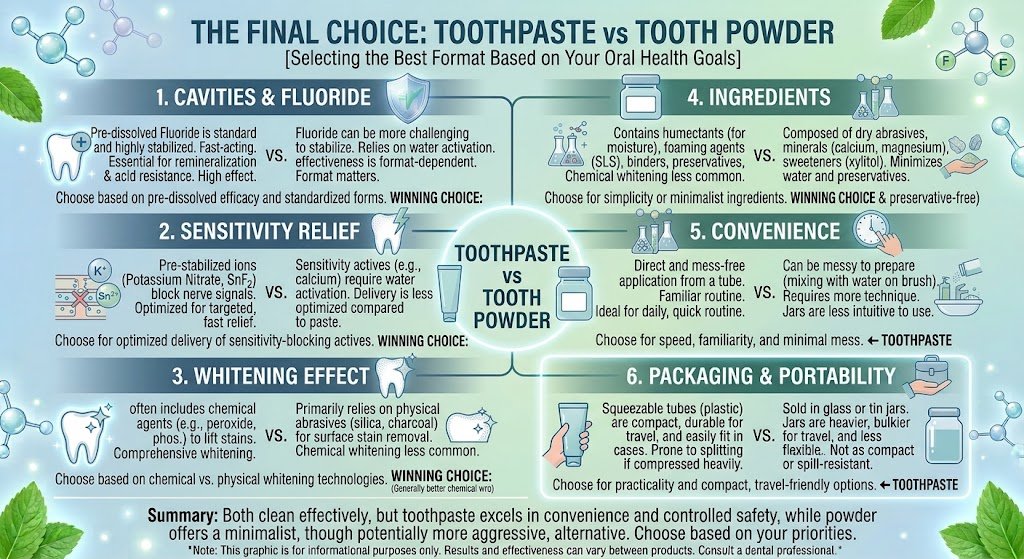
If you’re deciding between toothpaste vs tooth powder, the better choice is not determined by the format alone.
Toothpaste and tooth powder are both forms of dentifrice—the products used with a toothbrush to clean teeth and, when formulated with an anticaries active ingredient, deliver cavity protection. The FDA’s definition of dentifrice includes gel, paste, or powder forms.
The bigger question is what the product contains and what you need it to do.
A fluoride toothpaste may be a straightforward choice for someone focused on cavity prevention. A fluoride tooth powder may appeal to someone who prefers a powder format. A fluoride-free powder may fit a different set of ingredient preferences, but it should not automatically be treated as equivalent to a fluoride dentifrice for cavity protection.
In this guide, we’ll compare toothpaste and tooth powder for cavities, fluoride, sensitivity, abrasiveness, whitening, ingredients, convenience, packaging, and everyday use so you can make a more informed choice.
Toothpaste vs Tooth Powder: Quick Answer
| Feature | Toothpaste | Tooth Powder |
| Physical form | Paste or gel | Dry powder |
| Fluoride options | Widely available | Available in some products |
| Cavity protection | Available with fluoride formulations | Available with fluoride formulations |
| Abrasives | Common | Common |
| Sensitivity formulas | Widely available | More dependent on the individual product |
| Whitening formulas | Widely available | Available in some products |
| Ingredient choices | Very broad | Varies considerably |
| Ease of dispensing | Usually simple | Can require more care |
| Packaging | Usually tubes or pumps | Jars, tins, pouches, or other formats |
| Best reason to choose it | Broad range of established formulations | Preference for powder format or specific formulation |
The most important takeaway is:
Don’t choose between toothpaste and tooth powder simply because one sounds more natural, traditional, or convenient. Compare the actual formulation.
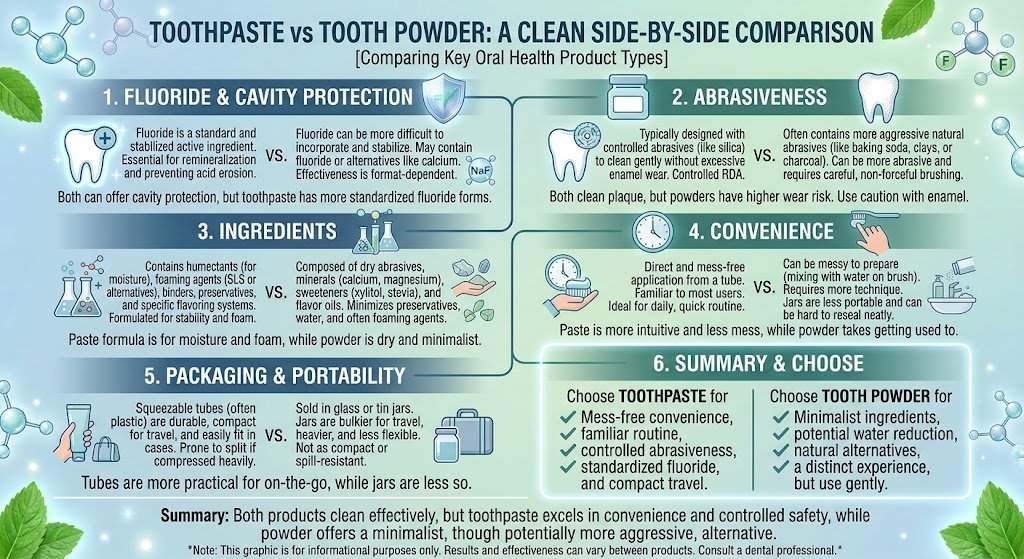
The American Dental Association explains that dentifrices can contain ingredients for cleaning, cavity prevention, sensitivity, gingivitis, tartar control, enamel erosion, whitening, and bad breath. It also notes that fluoride is used for cavity protection in accepted fluoride toothpastes.
That makes the active ingredients and overall formulation more important than the physical format by itself.
What Is Toothpaste?
Toothpaste is a dentifrice formulated as a paste or gel. It combines cleaning ingredients with active and inactive ingredients designed to make brushing more effective, practical, and pleasant.
Depending on the product, toothpaste can contain:
- Fluoride compounds
- Abrasive ingredients
- Humectants
- Flavoring agents
- Sweeteners
- Detergents
- Thickeners
- Ingredients aimed at sensitivity, whitening, or other oral-health concerns
The exact combination varies from one product to another.
How Toothpaste Works
When you brush, the toothbrush provides the main mechanical action while the dentifrice helps distribute ingredients across the teeth.
Abrasive ingredients can help remove plaque and surface deposits. Some toothpaste ingredients also provide specific oral-health functions.
Fluoride is especially important when cavity prevention is the goal. The ADA explains that fluoride is taken up by dental plaque and demineralized enamel and increases fluoride levels in saliva, helping support the teeth against decay.
This is why two toothpastes that look almost identical can have very different purposes.
One might focus primarily on cavity protection. Another may combine cavity protection with sensitivity relief. Another may focus on whitening or gum-related concerns.
The package format doesn’t tell you all of that. The ingredient list and active ingredients do.
What Toothpaste Usually Contains
Toothpaste formulations commonly use several ingredient groups.
Abrasives help with mechanical cleaning and removal of surface deposits. The ADA lists materials such as silica and calcium carbonate among examples used in dentifrices.
Humectants help keep toothpaste from drying out.
Flavoring ingredients provide the taste and sensation associated with brushing.
Detergents can help with foaming and distribution of the product.
Thickening agents help maintain the desired texture.
Active ingredients, such as fluoride, are included for specific oral-health purposes.
This variety is one reason toothpaste offers such a broad range of specialized products.
What Is Tooth Powder?
Tooth powder is a dry dentifrice that is used with a toothbrush instead of a paste or gel.
The basic concept is not completely different from toothpaste. You still use a toothbrush to mechanically clean the teeth, while the powder supplies whatever cleaning and active ingredients are included in its formulation.
The FDA’s anticaries monograph includes dentifrice dosage forms such as gels, pastes, and powders, so tooth powder is not simply a cosmetic product category outside the normal concept of dentifrice.
How Tooth Powder Works
A typical tooth powder is placed onto a toothbrush and then used for brushing according to the product’s directions.
The powder itself does not automatically make brushing more effective.
Its performance depends on factors such as:
- Which active ingredients it contains
- Whether it contains fluoride
- Which abrasive system it uses
- How the product is intended to be used
- How the user brushes
- Whether the product is appropriate for that person’s oral-health needs
This distinction matters because “tooth powder” describes the format, not the quality of the formulation.
Two tooth powders can have completely different ingredient profiles and intended uses.
What Tooth Powder Usually Contains
Depending on the product, tooth powder may contain ingredients such as:
- Calcium carbonate
- Silica or other abrasives
- Fluoride compounds
- Xylitol or other sweeteners
- Flavoring ingredients
- Herbal ingredients
- Essential oils
- Other active or inactive ingredients
Some tooth powders are marketed around natural or minimal ingredients, while others are designed around specific oral-health functions.
So don’t assume that every tooth powder is fluoride-free, and don’t assume that every tooth powder is fluoride-containing.
Read the actual product label.
Toothpaste vs Tooth Powder: Key Differences
The most useful way to compare these products is to look at the factors that can actually change your buying decision.
1. Cavity Protection
For someone concerned about cavities, the first question should be:
Does the product contain an appropriate anticaries active ingredient?
For fluoride dentifrices, fluoride is the key ingredient.
The ADA states that fluoride-containing toothpaste helps prevent tooth decay, and fluoride supports enamel and remineralization.
The U.S. FDA also establishes conditions for OTC anticaries products containing fluoride, including certain dentifrice formulations.
This means a fluoride toothpaste and a fluoride tooth powder can both belong to the cavity-protection category.
But that does not mean every tooth powder is equivalent to every toothpaste.
Consider this example:
Product A: fluoride toothpaste formulated for cavity protection.
Product B: fluoride-free tooth powder marketed mainly around natural ingredients.
If your primary goal is cavity prevention, you should not treat these as interchangeable simply because both are used to brush your teeth.
The relevant difference is the active formulation, not the fact that one is paste and one is powder.
2. Fluoride
Fluoride is one of the biggest decision points in this comparison.
Some tooth powders contain fluoride.
Some do not.
The same is true of broader dentifrice categories, which include a wide variety of formulations.
For U.S. consumers, the ADA says OTC fluoride toothpastes generally contain 1,000–1,500 ppm fluoride, while prescription-strength products can contain more. The ADA also identifies sodium fluoride, sodium monofluorophosphate, and stannous fluoride as active ingredients used in fluoride-containing toothpaste.
A useful rule is:
If cavity prevention is important to you, check the active ingredient rather than assuming the format tells you whether fluoride is present.
A review of commercially available dentifrices also found substantial variation in fluoride content across toothpaste, tooth powder, and tablet products, illustrating why consumers need to check individual formulations rather than making assumptions based on product category alone.
This is particularly important in the natural and low-waste oral-care market, where fluoride-free products are common.
Fluoride-free does not automatically mean unsafe, but it does mean you should evaluate the product based on its intended oral-health benefits and your own cavity risk rather than assuming it provides the same evidence base as a conventional fluoride dentifrice.
3. Abrasiveness
Abrasiveness is an important but frequently misunderstood part of the toothpaste-versus-powder comparison.
Abrasive ingredients help physically remove surface deposits during brushing. Both toothpastes and tooth powders can contain abrasives.
The question isn’t simply:
“Which one is more abrasive?”
The better questions are:
- What abrasive is being used?
- How abrasive is the finished formulation?
- How often will you use it?
- How hard do you brush?
- Do you have exposed dentin or gum recession?
- Are you trying to remove surface stains?
The ADA uses the Relative Dentin Abrasivity (RDA) system as a standardized way of measuring dentifrice abrasivity. The ADA states that dentifrices with an RDA of 250 or less meet its safety threshold for the ADA Seal, while also cautioning that RDA numbers should not be treated as a simple ranking system for clinical safety.
So don’t assume:
Powder = too abrasive
or:
Paste = gentle
Neither statement is automatically true.
The finished formulation and your brushing technique matter.
4. Sensitivity
If you have sensitive teeth, the physical format should not be your main deciding factor.
Instead, look at the formulation.
Some toothpastes are specifically designed for sensitivity and may contain active ingredients selected for that purpose. A generic tooth powder may not provide the same targeted approach.
Abrasiveness also matters because people with exposed dentin, enamel wear, or gum recession may need to be more careful about how aggressively they brush.
If your teeth regularly hurt with cold drinks, cold air, sweets, or brushing, don’t assume that changing from paste to powder will solve the underlying problem.
Persistent or worsening sensitivity is also a reason to speak with a dental professional, because sensitivity can have multiple causes.
5. Whitening
Both toothpaste and tooth powder can help remove surface stains through mechanical cleaning.
That is different from actually changing the intrinsic color of a tooth.
This distinction is important because a product described as “whitening” may be focused on removing external stains rather than bleaching the tooth.
If you’re comparing a whitening tooth powder with a whitening toothpaste, consider:
- The abrasive system
- Any whitening active ingredients
- The product’s intended use
- Sensitivity concerns
- Evidence supporting the whitening claim
Don’t assume that a powder whitens better just because it feels more abrasive.
More aggressive scrubbing is not the same thing as better whitening.
6. Ingredients
For a reader interested in non-toxic oral care, this may be one of the most important differences to investigate.
The word “natural” does not tell you enough.
Instead, look at the complete ingredient list.
For example, ask:
- Is fluoride included?
- Which fluoride compound is used?
- What abrasives are present?
- Are essential oils included?
- Are flavoring agents included?
- Are there sweeteners?
- Is the product designed for sensitivity?
- What is the purpose of each major active ingredient?
The same approach applies to toothpaste.
A simple-looking tube can contain a complex formulation, while a powder marketed as “clean” can also contain numerous active and inactive ingredients.
7. Convenience
Toothpaste usually wins when convenience is the priority.
You squeeze or dispense the product, brush, rinse, and put the tube away.
Tooth powder can require more care when dispensing because a dry powder is easier to spill or contaminate if the container is not designed well.
However, this is not necessarily a reason to avoid powder.
Some people genuinely prefer:
- The dry format
- The texture
- The packaging
- The ingredient profile
- The ability to store the product without a traditional toothpaste tube
The right choice depends on what fits your routine.
8. Packaging and Waste
Packaging is one reason some consumers investigate tooth powder in the first place.
Depending on the brand, powder may come in:
- Glass jars
- Metal tins
- Plastic containers
- Refill pouches
- Other packaging formats
But don’t assume that powder automatically means more sustainable.
To evaluate the environmental side, consider the entire packaging system:
- What material is the container made from?
- Is it recyclable?
- Is it reusable?
- Are refills available?
- How much packaging is used?
- How long does the product last?
- How is it shipped?
Environmental considerations are useful when choosing between products, but they should be evaluated separately from cavity protection and other oral-health factors.
Is Tooth Powder as Effective as Toothpaste?
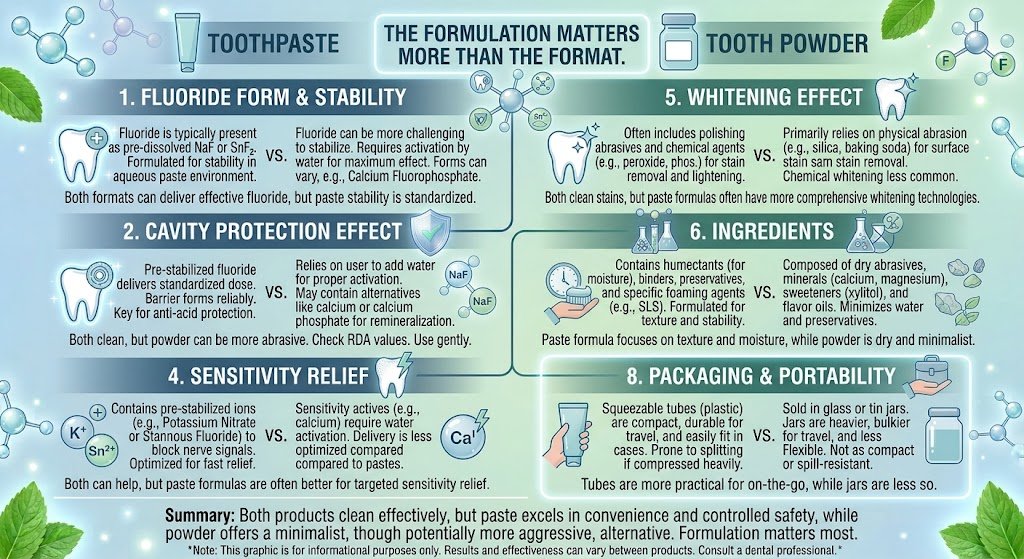
It can be, but the answer depends on the formulation and the goal.
It would be too simplistic to say that toothpaste is always more effective because it is a paste.
It would be equally misleading to say that tooth powder is better because it is more natural or traditional.
The evidence and formulation need to be considered.
For example, the ADA defines dentifrice broadly enough to include powder, paste, and gel forms, while the FDA’s anticaries framework also includes powder as a possible dentifrice dosage form.
So the physical format itself does not determine whether a product can deliver an anticaries ingredient.
The more important comparison is:
What does the product contain, and is it appropriate for the purpose you’re buying it for?
For Cavity Prevention
Check the fluoride status and active ingredient.
For Sensitivity
Check whether the formulation is specifically designed for sensitive teeth and consider abrasivity.
For Whitening
Check whether the product is designed to remove surface stains or contains ingredients intended for a whitening effect.
For Ingredient Preferences
Read the full ingredient list rather than relying on “natural” or “clean” marketing.
For Sustainability
Evaluate the actual packaging and refill system.
This is why there is no universal winner in the toothpaste-versus-tooth-powder debate.
Is Tooth Powder Better for Cavities?
Not automatically.
If cavity prevention is your primary goal, fluoride deserves serious consideration.
The ADA identifies fluoride-containing toothpaste as an important self-applied source of topical fluoride and recommends fluoride toothpaste for cavity protection.
That doesn’t mean every fluoride toothpaste is identical, and it doesn’t mean every tooth powder should be dismissed.
It means you should compare the actual active ingredient and formulation.
When evaluating a tooth powder for cavity protection, check:
- Does it contain fluoride?
- Which fluoride compound does it use?
- What fluoride concentration does the label provide?
- What is the product’s stated purpose?
- Is the product intended for routine use?
- Does the overall formulation fit your needs?
A fluoride tooth powder can therefore be a legitimate category to investigate.
A fluoride-free powder requires a different evaluation, particularly if you have a high risk of cavities.
There is growing research into fluoride-free active ingredients such as hydroxyapatite, but individual studies and reviews should not be treated as proof that every fluoride-free tooth powder is equivalent to an established fluoride dentifrice. Recent reviews have found promising evidence for some fluoride-free formulations while also highlighting the importance of the specific active ingredient and formulation.
Is Tooth Powder Better for Sensitive Teeth?
Not necessarily. If you have sensitive teeth, the formula matters more than whether the product is a paste or powder.
Tooth sensitivity can be affected by exposed dentin, enamel wear, gum recession, brushing technique, and other dental conditions. A highly abrasive product or aggressive brushing may make some sensitivity problems worse, so choosing a product based only on its “powder” or “paste” format is not enough.
When comparing a tooth powder with toothpaste for sensitive teeth, look at:
- The active ingredients used for sensitivity
- The type and level of abrasives
- Whether the product contains fluoride
- Whether the product is intended for daily use
- Whether its flavoring or other ingredients cause irritation
- How aggressively you brush
For someone specifically looking for sensitivity support, a toothpaste formulated for sensitive teeth may be easier to evaluate because you can identify the active ingredient and intended use on the label.
The important point is that tooth powder is not automatically gentler than toothpaste, and toothpaste is not automatically better. The complete formulation and your brushing habits matter.
Is Tooth Powder Better for Whitening?
Tooth powder can help with surface stain removal, but that does not mean it is automatically a better whitening option.
Whitening products generally work in different ways. Some mainly remove stains from the outside of teeth, while others contain ingredients designed to chemically lighten tooth color. Abrasives can help remove surface discoloration, but using a more abrasive product does not necessarily mean you will get better whitening results.
This is especially important when comparing tooth powder with whitening toothpaste.
A tooth powder may look attractive because it contains ingredients such as calcium carbonate or silica, but the presence of an abrasive alone does not tell you how suitable the product is for everyday whitening.
Tooth Powder vs Whitening Toothpaste
| Factor | Tooth Powder | Whitening Toothpaste |
| Surface stain removal | Can help | Can help |
| Abrasive ingredients | Common | Common |
| Chemical whitening | Depends on formula | Depends on formula |
| Daily-use suitability | Depends on formulation | Depends on formulation |
| Sensitivity concerns | Depends on formula and brushing | Depends on formula and brushing |
| Better automatically? | No | No |
If your main goal is whitening, compare the actual ingredients, abrasivity, intended use, and sensitivity considerations rather than choosing based on the physical format.
Is Tooth Powder Safer Than Toothpaste?
There is no simple rule that tooth powder is safer than toothpaste.
Safety depends on the ingredients, concentration, formulation, manufacturing quality, intended use, and how the product is used.
For example, a powder can contain ingredients that some people prefer to avoid, while a toothpaste can also contain ingredients that may not fit someone’s personal preferences. Calling one format “natural,” “clean,” or “non-toxic” does not provide enough information by itself.
When evaluating either product, check:
- Active ingredients
- Fluoride status
- Abrasive ingredients
- Flavoring ingredients
- Essential oils or botanical ingredients
- Sweeteners
- Ingredients that may irritate you personally
- Directions for use
- Whether the product is intended for daily brushing
For people researching non-toxic oral care, it is better to evaluate the complete ingredient list rather than assuming a powder is safer simply because it contains fewer visible ingredients.
Does Natural Tooth Powder Mean It Is Safer?
No.
“Natural” describes the source or marketing position of ingredients, not necessarily the complete safety profile of the finished product.
A natural tooth powder can still be abrasive, strongly flavored, or unsuitable for someone with a particular oral-health concern. Likewise, a conventional toothpaste is not automatically a poor choice simply because it contains synthetic ingredients.
The better approach is to ask:
What does the product contain, what is each ingredient doing, and is the complete formula appropriate for my needs?
Toothpaste vs Tooth Powder: Pros and Cons
Both formats can make sense, but they have different practical advantages.
Toothpaste Pros
- Easy to dispense
- Widely available
- Available in many specialized formulas
- Easy to find fluoride options
- Available for cavities, sensitivity, whitening, gum care, and other needs
- Familiar to most people
- Usually simple to incorporate into an established brushing routine
Toothpaste Cons
- Often sold in plastic or plastic-lined packaging
- Some formulas contain ingredients people prefer to avoid
- Some products create more foam than users prefer
- Some formulas may contain strong flavors or ingredients that irritate certain users
- Packaging can create more waste depending on the product
Tooth Powder Pros
- Dry format can be appealing to people who prefer powder-based products
- Available with different ingredient philosophies
- Some products use refillable or alternative packaging
- Can provide fluoride or fluoride-free formulations depending on the product
- May be attractive to people interested in reducing certain types of packaging
Tooth Powder Cons
- Product quality varies
- Some powders may be highly abrasive
- Fluoride content varies
- Dispensing can be less convenient
- Powder can be messy if the packaging is poorly designed
- Some products may contain ingredients that do not suit sensitive mouths
- “Natural” or “zero waste” claims do not automatically indicate better oral-health performance
How to Choose Between Toothpaste and Tooth Powder
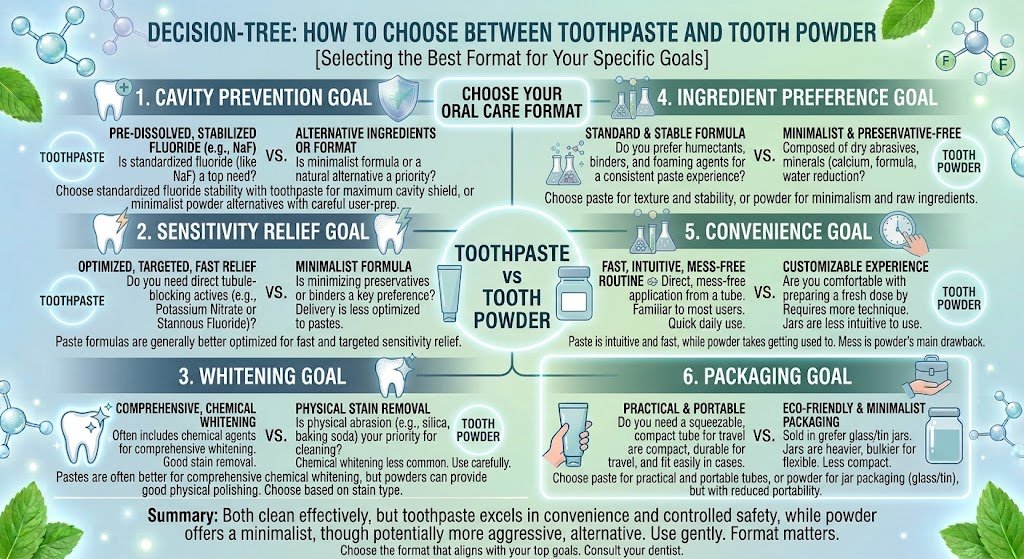
The easiest way to choose is to start with your oral-health goal, rather than starting with the format.
Choose Toothpaste If:
- You want a familiar daily brushing product
- You want an easily identifiable fluoride formula
- You need a product specifically formulated for sensitivity
- You want a product for cavity prevention
- You want a specialized whitening formula
- You prefer the convenience of a ready-to-use paste
Consider Tooth Powder If:
- You specifically prefer a powder format
- You have found a product with a clearly disclosed ingredient list
- You have checked whether it contains fluoride
- Its abrasivity and intended use fit your needs
- You are comfortable with the dispensing method
- Its packaging fits your personal waste-reduction goals
The important word here is consider.
You should not choose tooth powder simply because it is marketed as natural, cleaner, healthier, or more sustainable.
What to Look for in a Tooth Powder
If you decide to try tooth powder, use a simple checklist before buying.
1. Check the Active Ingredient
First determine whether the powder contains fluoride or another active ingredient intended to provide a specific oral-health benefit.
For cavity prevention, fluoride deserves particular attention because fluoride-containing dentifrices are a major part of evidence-based cavity prevention.
2. Check the Fluoride Status
Do not assume every tooth powder is fluoride-free—or that every powder contains fluoride.
Read the product label carefully.
If fluoride is present, check which fluoride compound is used and the stated concentration when provided.
For comparison, many OTC fluoride toothpastes in the United States contain around 1,000–1,500 ppm fluoride.
3. Look at the Abrasives
Abrasives help remove debris and surface stains, but more abrasive does not automatically mean better cleaning.
Common toothpaste abrasives include materials such as silica and calcium carbonate.
If a product provides reliable information about its abrasivity, use that information alongside the manufacturer’s directions rather than treating a single abrasivity number as the only measure of quality.
4. Read the Complete Ingredient List
Look beyond the front of the package.
Check:
- Fluoride compounds
- Abrasives
- Flavoring ingredients
- Essential oils
- Sweeteners
- Detergents
- Botanical ingredients
- Other active ingredients
5. Consider Your Oral-Health Needs
Someone concerned about cavities may prioritize a different formulation from someone mainly concerned about sensitivity or surface stains.
Your personal goal should determine which features matter most.
6. Follow the Product Directions
Even a well-formulated dentifrice needs to be used correctly.
Do not assume that using more powder or brushing harder will produce better results.
Toothpaste vs Tooth Powder for Everyday Brushing
For everyday brushing, the biggest difference is usually the delivery format, not the basic purpose.
Both are used with a toothbrush to help clean teeth. Dentifrices can be formulated as paste, gel, or powder, and their performance depends heavily on their ingredients and intended function.
Your brushing technique still matters.
A good product cannot compensate for consistently poor brushing habits. At the same time, brushing harder is not a good strategy for getting cleaner teeth.
For most people, the better daily product is the one that:
- Fits their oral-health needs
- Has an appropriate formulation
- Is easy to use consistently
- Has clearly disclosed ingredients
- Is suitable for their sensitivity level
- Provides the active ingredient they actually want
Toothpaste vs Tooth Powder for a Non-Toxic Oral-Care Routine
If you are specifically building a non-toxic oral-care routine, it can be tempting to choose a tooth powder simply because it looks more natural or has simpler packaging.
That approach can miss the bigger picture.
A better evaluation separates ingredient preferences, oral-health effectiveness, and packaging goals.
For example, you might prefer:
- A fluoride-free formula because of a personal ingredient preference
- A fluoride formula because cavity prevention is your primary concern
- A low-abrasive product because you are concerned about enamel wear
- A product without SLS because you prefer SLS-free oral care
- A refillable package because reducing packaging waste matters to you
These are different goals, and one product does not necessarily win on all of them.
The key is to decide which characteristics matter most to you before comparing products.
Best Types of Toothpaste and Tooth Powder to Consider
Instead of asking, “What is the best format?” ask:
What type of dentifrice best matches my specific need?
For Cavity Prevention
Look closely at the fluoride status and active ingredient.
A fluoride toothpaste is often the simplest category to evaluate because the fluoride concentration and active ingredient can be checked on the label.
For Sensitive Teeth
Prioritize a formula designed for sensitivity and consider abrasivity and your brushing technique.
For Hydroxyapatite Users
If you specifically want hydroxyapatite, compare the type and formulation rather than choosing a product simply because it is fluoride-free.
For SLS-Free Oral Care
Check the ingredient list rather than relying only on the product’s front-label claims.
For Ingredient-Conscious Buyers
Focus on complete ingredient transparency, active ingredients, abrasives, flavoring, and any ingredients you personally want to avoid.
Toothpaste vs Tooth Powder: Which Should You Buy?
For most people, there is no universal winner.
Toothpaste is usually the simpler choice if you want a convenient, familiar product with clearly defined oral-health benefits.
Tooth powder can be a reasonable alternative if you specifically prefer the format and find a well-formulated product that matches your needs.
The most important factors are:
- Your main oral-health goal
- Fluoride or other active ingredients
- Abrasivity
- Ingredient transparency
- Sensitivity and irritation concerns
- Ease of daily use
- Packaging preferences
If cavity prevention is your main priority, do not choose a fluoride-free powder simply because it is marketed as natural.
If ingredient simplicity or packaging is your priority, do not assume that every tooth powder is automatically better.
A Simple Buying Decision
Choose toothpaste when: you want convenience, specialized formulas, and an easy-to-check daily product.
Choose tooth powder when: you prefer the dry format and have verified that its ingredients, active ingredients, abrasivity, and directions fit your needs.
Choose neither based on marketing alone: compare the actual formulation first.
Frequently Asked Questions
Is tooth powder better than toothpaste?
Not automatically. Tooth powder and toothpaste are different physical forms of dentifrice. The better option depends on the formulation, active ingredients, abrasivity, oral-health goal, and how the product is used.
Does tooth powder clean teeth better than toothpaste?
Not simply because it is a powder. Both formats can contain abrasive ingredients that help with mechanical cleaning. The formulation and brushing technique matter more than the physical format alone.
Is fluoride tooth powder as good as fluoride toothpaste?
A fluoride tooth powder can provide fluoride in a powder formulation, but you should evaluate the specific product’s fluoride compound, concentration, formulation, directions, and intended use. Do not assume that all tooth powders are equivalent.
Is fluoride-free tooth powder good for cavities?
Fluoride-free tooth powder should not automatically be considered equivalent to a fluoride dentifrice for cavity prevention. If preventing cavities is your main concern, pay close attention to the active ingredient and the evidence supporting the particular formulation.
Is tooth powder safe for enamel?
It depends on the formulation and how it is used. Abrasives are common in dentifrices, but more abrasive does not automatically mean better cleaning. Brushing technique also matters.
Can tooth powder whiten teeth?
It may help remove some surface stains, depending on its ingredients. However, stain removal is not the same as changing the natural internal color of a tooth.
Is natural tooth powder better?
Not necessarily. “Natural” does not by itself tell you whether a product is appropriate for cavities, sensitivity, enamel, or daily use. Evaluate the complete formulation.
Can you use tooth powder every day?
Some tooth powders are designed for daily use, but you should follow the manufacturer’s directions and consider the product’s active ingredients and abrasivity.
Can children use tooth powder?
Do not assume that an adult tooth powder is appropriate for children. Children’s oral-care needs, fluoride exposure, and swallowing risk can differ by age. Parents should choose products according to age-appropriate dental guidance and the product’s directions.
Should I switch from toothpaste to tooth powder?
You do not need to switch simply because tooth powder is marketed as more natural or sustainable. Switch only if the specific product better fits your needs and you have evaluated its ingredients, active ingredients, abrasivity, and directions.
Final Verdict: Toothpaste vs Tooth Powder
The toothpaste vs tooth powder debate is less about which format is universally better and more about which formulation fits your needs.
Toothpaste offers convenience and a wide range of specialized formulations. Tooth powder offers a different format that may appeal to people who prefer dry products, alternative packaging, or particular ingredient choices.
But the format itself should not be your main decision factor.
Before buying, ask:
- Does it contain fluoride?
- What active ingredients does it use?
- How abrasive is it?
- Is the ingredient list clearly disclosed?
- Does it match my oral-health goal?
- Is it suitable for daily use?
- Do I actually prefer this format?
For someone focused on cavity prevention, fluoride status deserves serious consideration.
For someone with sensitive teeth, formulation, abrasivity, active ingredients, and brushing technique matter.
For someone focused on whitening, look beyond the powder-versus-paste distinction and consider whether the product is primarily removing surface stains or designed for another whitening mechanism.
And for someone focused on non-toxic or ingredient-conscious oral care, read the complete ingredient list instead of assuming that “natural” or “powder” automatically means safer.
Ultimately, the best choice is the product that combines an appropriate formulation with a brushing routine you can use consistently.