If you are comparing sodium fluoride vs stannous fluoride, the short answer is that both are legitimate fluoride ingredients used to help prevent cavities, but they are not identical.
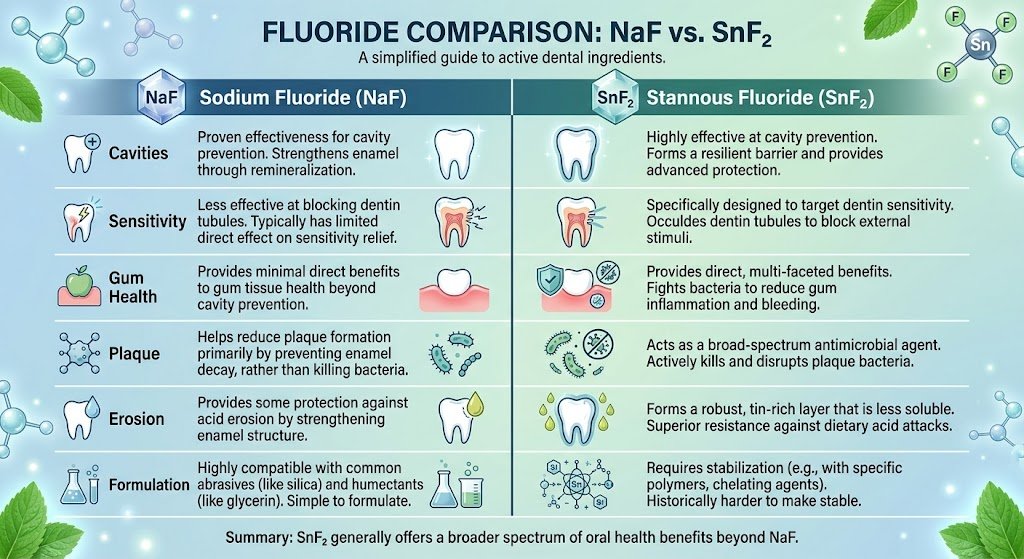
Sodium fluoride (NaF) is a straightforward fluoride source widely used for cavity protection. Stannous fluoride (SnF₂) also provides fluoride for cavity protection, while the stannous component has been studied for additional benefits involving tooth sensitivity, gingival health, plaque, and dental erosion. (ADA)
That does not mean stannous fluoride is automatically better for everyone. Your best choice depends on what you want your toothpaste to do.
In this guide, we will compare sodium fluoride and stannous fluoride for cavities, sensitivity, gums, plaque, enamel, erosion, staining, and everyday use, then explain what to look for when choosing a toothpaste.
Sodium Fluoride vs Stannous Fluoride: Quick Answer
Both sodium fluoride and stannous fluoride are recognized fluoride ingredients used in toothpaste for anticaries protection. The American Dental Association lists sodium fluoride, stannous fluoride, and sodium monofluorophosphate among the fluoride-containing compounds used as anticaries agents in toothpaste. (ADA)
The main difference is what else the formulation may offer beyond basic fluoride protection.
| Feature | Sodium Fluoride | Stannous Fluoride |
| Cavity protection | Yes | Yes |
| Fluoride source | Sodium fluoride | Stannous fluoride |
| Sensitivity benefits | Depends on formula | Strong option to consider |
| Gingival health | Depends on formula | Has evidence for additional benefits |
| Plaque-related benefits | Depends on formula | Has been studied extensively |
| Dental erosion | Fluoride provides protection | Specific SnF₂ evidence supports anti-erosive potential |
| Taste/mouthfeel | Product-dependent | Product-dependent |
| Best fit | Straightforward fluoride protection | People seeking additional benefits from the active ingredient |
The important point is that the fluoride type is only one part of the toothpaste formula. Concentration, other active ingredients, formulation, and your individual dental needs also matter.
What Is Sodium Fluoride?
Sodium fluoride (NaF) is a fluoride compound used in toothpaste to help prevent tooth decay.
When you brush with fluoride toothpaste, fluoride becomes available around the teeth and in dental plaque. It helps strengthen enamel and supports the remineralization of early areas of tooth damage. The ADA identifies sodium fluoride as one of the fluoride compounds used in anticaries toothpastes. (ADA)
This makes sodium fluoride a familiar choice for people whose primary goal is everyday cavity protection.
How Does Sodium Fluoride Work?
Tooth enamel is constantly exposed to acids produced by bacteria and introduced through foods and drinks. These acids can contribute to mineral loss from the enamel.
Fluoride helps shift that balance toward protection. It can be incorporated into and interact with the tooth mineral and helps make enamel more resistant to acid attacks.
That is why the most important question is not whether sodium fluoride is a “strong” or “weak” fluoride. It is whether the toothpaste provides an appropriate fluoride formulation and is used consistently.
For most people, regular brushing with fluoride toothpaste is an important part of preventing tooth decay. The ADA states that U.S. over-the-counter fluoride toothpastes generally contain 1,000 to 1,500 ppm fluoride. (ADA)
What Is Sodium Fluoride Good For?
Sodium fluoride makes sense when your main objective is straightforward fluoride-based cavity protection.
For example, someone who:
- does not have significant tooth sensitivity,
- has no particular gum-health concern,
- tolerates their current toothpaste,
- and mainly wants daily cavity protection
may have no reason to switch away from a sodium fluoride formula simply because another toothpaste contains stannous fluoride.
The complete product formulation still matters. Two toothpastes can contain fluoride but be designed for different purposes because they contain different additional active ingredients.
What Is Stannous Fluoride?
Stannous fluoride (SnF₂) is another fluoride compound used in toothpaste for cavity prevention.
The “stannous” part refers to tin, while fluoride provides the familiar anticaries role associated with fluoride toothpaste.
What makes stannous fluoride particularly interesting is that researchers have studied stabilized SnF₂ formulations for benefits beyond cavity protection, including dentin hypersensitivity, gingivitis, plaque, halitosis, and dental erosion. (PubMed)
That broader potential is why stannous fluoride often appears in toothpaste marketed toward people who want more than basic cavity protection.
How Does Stannous Fluoride Work?
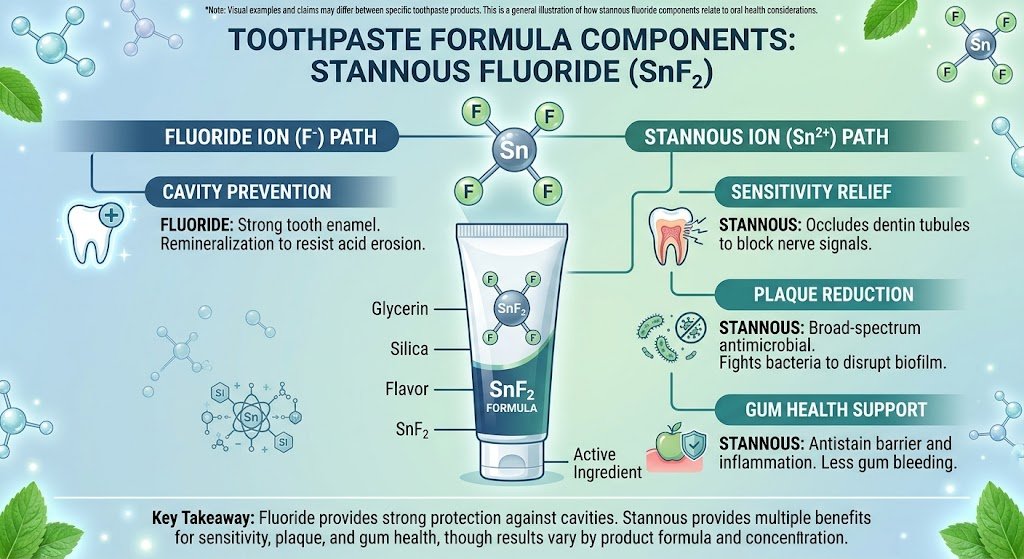
Stannous fluoride provides fluoride for anticaries protection, but the stannous component can also interact with oral surfaces and the tooth environment.
Research has investigated mechanisms involving:
- reduced sensitivity,
- interaction with dentin,
- effects on oral biofilm,
- protection against erosive challenges,
- and effects on gingival health.
A systematic review of stabilized stannous fluoride dentifrices found evidence supporting benefits for dental erosion and dentin hypersensitivity, while noting that the quality and amount of evidence differed between outcomes. (PubMed)
This is an important distinction:
Stannous fluoride is not simply “more fluoride.” It is a different fluoride compound that may provide additional formulation benefits.
Why Does “Stabilized” Stannous Fluoride Matter?
You may see the term stabilized stannous fluoride when comparing toothpaste products.
This matters because the behavior of stannous fluoride depends on how it is formulated. Modern toothpaste formulations are designed to maintain the ingredient’s usefulness in the product rather than treating all SnF₂ formulas as identical.
So when comparing products, do not assume:
“Every toothpaste containing SnF₂ works exactly the same.”
The specific formulation, concentration, and combination of ingredients can affect the product’s performance.
Sodium Fluoride vs Stannous Fluoride: Key Differences
The easiest way to understand the comparison is to stop asking which ingredient is universally “better” and instead ask:
Which fluoride formulation better matches my oral-health needs?
Cavity Protection
Both sodium fluoride and stannous fluoride are used as anticaries ingredients in toothpaste. (ADA)
So if your only concern is preventing cavities, you do not necessarily need stannous fluoride.
A systematic review of stabilized stannous fluoride found similar or slightly higher anticaries activity compared with non-stannous fluoride dentifrices, but the evidence should not be interpreted as meaning every stannous fluoride toothpaste will outperform every sodium fluoride toothpaste. (PubMed)
Your brushing routine, fluoride concentration, formulation, diet, saliva, and individual cavity risk all matter.
Sensitivity
This is one area where stannous fluoride becomes particularly relevant.
Dentin hypersensitivity can occur when exposed dentin reacts to stimuli such as cold drinks, air, touch, or temperature changes.
Research has found stannous fluoride-containing toothpastes to be effective for reducing dentin hypersensitivity in clinical studies. A large network meta-analysis also found beneficial effects for SnF₂-containing formulations against certain sensitivity stimuli. (PubMed)
That does not mean every person with sensitive teeth needs stannous fluoride. Other desensitizing ingredients, including potassium-based formulations and other actives, can also be used.
But if sensitivity is one of your main concerns, stannous fluoride is worth considering.
Gingivitis and Gum Health
Stannous fluoride has also been studied for gingivitis and gingival bleeding.
A systematic review of stabilized SnF₂ dentifrices found positive effects on gingivitis, with the authors also noting substantial variation between studies. (PubMed)
Another meta-analysis of 18 randomized controlled trials involving a specific 0.454% stannous fluoride formulation found reductions in gingival bleeding compared with control dentifrices. Because that evidence involved a specific formulation, it should not automatically be generalized to every stannous fluoride toothpaste. (PubMed)
This makes SnF₂ especially interesting for people who want their toothpaste to address more than cavities.
However, toothpaste should not replace professional dental care when someone has persistent bleeding, swelling, pain, or other signs of gum disease.
Plaque
Plaque is another area where stannous fluoride has been investigated.
Research suggests that stabilized SnF₂ formulations can provide benefits related to plaque and gingival health, although outcomes differ between studies and comparison products. (PubMed)
This is why a toothpaste’s active ingredient should be considered alongside the rest of the formula rather than evaluated in isolation.
Enamel and Dental Erosion
Both fluoride-containing toothpastes can contribute to enamel protection through fluoride.
Stannous fluoride has also been specifically studied for dental erosion. A systematic review found greater anti-erosive potential for stannous fluoride dentifrices in most of the erosion studies included, although the authors noted that risk of bias was high in much of the caries and erosion evidence. (PubMed)
So if erosion is a particular concern, SnF₂ may deserve consideration—but the article should not turn this into a universal claim that every SnF₂ product is better for enamel.
Bad Breath
Stabilized stannous fluoride has also been studied in relation to halitosis.
A systematic review reported reductions in halitosis in some SnF₂ studies, but the authors also noted limitations in the available evidence. (PubMed)
If bad breath is your main concern, however, toothpaste should not be viewed as the only possible solution. Persistent bad breath can have multiple causes and may require professional evaluation.
Staining and Appearance
Staining is one of the concerns people sometimes have when they see stannous fluoride on a toothpaste label.
The evidence is more nuanced than saying simply:
“Stannous fluoride stains teeth.”
A systematic review specifically examining stabilized SnF₂ toothpaste found no differences in stain reduction in the included studies, while also noting that the evidence quality for stain outcomes was limited. (PubMed)
The practical takeaway is that formulation matters.
If whitening or tooth appearance is important to you, evaluate the complete toothpaste rather than rejecting every stannous fluoride product based on the ingredient name alone.
Is Stannous Fluoride Better for Sensitive Teeth?
If sensitive teeth are your main concern, stannous fluoride deserves a closer look.
Dentin sensitivity can make ordinary activities such as drinking something cold or brushing uncomfortable. Desensitizing toothpaste works through active ingredients that can reduce the response of exposed dentin to stimuli.
Stannous fluoride is one of the ingredients with clinical evidence for this purpose. A network meta-analysis covering 125 randomized controlled trials found beneficial effects for SnF₂-containing formulations against certain tactile and air sensitivity measures. (PubMed)
However, there is an important distinction between:
“Stannous fluoride can help sensitivity”
and:
“Every stannous fluoride toothpaste is the best choice for sensitivity.”
The second statement is too broad.
Different products may contain different concentrations, additional desensitizing ingredients, abrasives, flavors, and other formulation components.
If sensitivity is your priority, compare the entire formula and choose a toothpaste specifically intended for sensitivity rather than selecting a product solely because its label says SnF₂.
Is Sodium Fluoride Better for Cavities?
If your main goal is cavity prevention, sodium fluoride is a very solid choice—but that does not mean it is automatically better than stannous fluoride.
Both sodium fluoride and stannous fluoride are recognized fluoride ingredients used in toothpaste for cavity protection. The American Dental Association lists sodium fluoride and stannous fluoride among the fluoride compounds used in anticavity toothpastes. Fluoride helps strengthen teeth and supports remineralization of early areas of tooth decay.
The more useful question is:
Which toothpaste gives you the cavity protection you need while also matching your other oral-health concerns?
For someone who simply wants dependable fluoride protection, a sodium fluoride toothpaste can be an excellent option. For someone who also has sensitivity, gum concerns, plaque buildup, or erosion concerns, a properly formulated stannous fluoride toothpaste may offer additional benefits.
One systematic review found that stabilized stannous fluoride dentifrices had similar or slightly higher anticaries activity compared with non-stannous fluoride dentifrices, although the researchers noted limitations and risk of bias in some of the available evidence.
So, do not choose between NaF and SnF₂ based on the assumption that one is universally stronger. Look at the complete formulation and your specific needs.
Does Stannous Fluoride Help With Gingivitis?
Yes. Stannous fluoride can provide benefits for gum health beyond basic fluoride cavity protection, although the strength of the evidence depends on the specific formulation.
Gingivitis is inflammation of the gums that is commonly associated with plaque buildup. Brushing removes plaque mechanically, while some toothpaste ingredients can provide additional effects against plaque-related problems.
Research on stabilized stannous fluoride toothpastes has reported improvements in gingivitis and plaque-related outcomes. A systematic review found favorable effects for several oral-health outcomes, including plaque and gingivitis, although the researchers also noted differences in study quality and risk of bias.
A separate meta-analysis involving a specific 0.454% stannous fluoride formulation found reductions in gingival bleeding compared with control toothpastes. However, this result should not be interpreted as proof that every toothpaste containing any amount or formulation of stannous fluoride will produce the same result.
What This Means for You
If your main concern is occasional gum irritation or plaque-related gum problems, stannous fluoride may be worth considering.
But toothpaste is not a replacement for good oral hygiene or professional dental care. Persistent bleeding, swelling, pain, or other gum symptoms should be evaluated by a dental professional.
For everyday prevention, focus on:
- Brushing twice a day with fluoride toothpaste
- Cleaning between your teeth regularly
- Using a toothpaste you can comfortably use consistently
- Choosing additional active ingredients based on your oral-health needs
Does Stannous Fluoride Cause Staining?
This is one of the biggest questions people have when comparing sodium fluoride and stannous fluoride.
The answer is not simply yes.
Older concerns about stannous fluoride have been associated with tooth staining, but modern stabilized formulations are different from older formulations. More importantly, the effect of a toothpaste on tooth appearance depends on the complete formula, not simply the words “stannous fluoride” on the label.
A systematic review examining stabilized stannous fluoride toothpaste reported positive effects across several oral-health outcomes, but the evidence for stain-related outcomes had important limitations. The review did not establish that stabilized stannous fluoride universally causes staining.
That means you should avoid two extreme claims:
Incorrect: “Stannous fluoride always stains teeth.”
Also incorrect: “Stannous fluoride can never contribute to staining.”
A better way to think about it is:
The complete toothpaste formulation and your individual response matter.
If tooth appearance is a major concern, look beyond the fluoride type. Consider the toothpaste’s complete ingredient list, its intended benefits, cleaning characteristics, and whether it is designed for your specific needs.
If you notice new or persistent discoloration after changing toothpaste, discuss it with your dentist rather than automatically assuming the fluoride ingredient is responsible.
How to Choose Between Sodium Fluoride and Stannous Fluoride
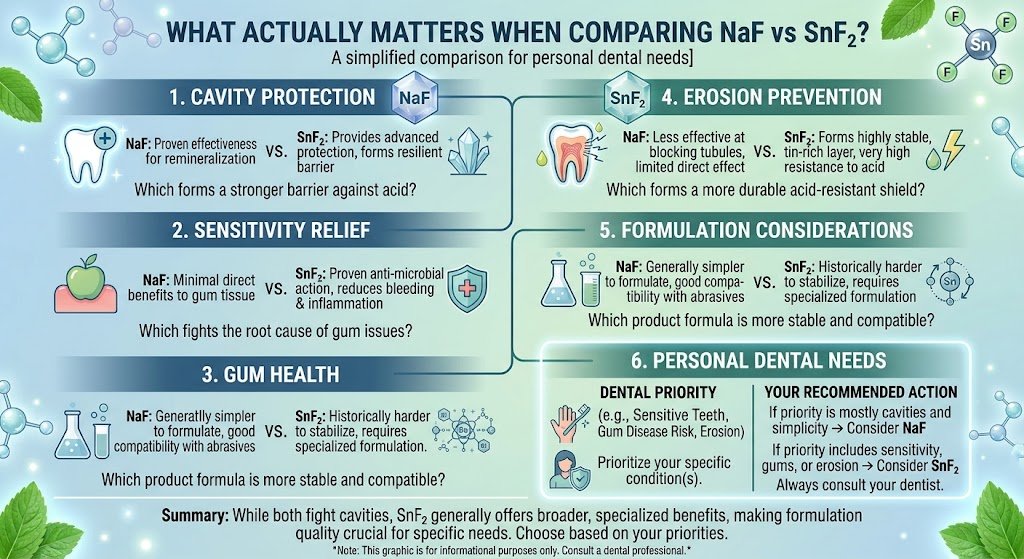
There is no single winner for every person.
Instead, use your main oral-health goal as the starting point.
Choose Sodium Fluoride If…
Sodium fluoride may make sense if:
- Your main priority is straightforward cavity protection.
- You already use a sodium fluoride toothpaste that works well for you.
- You do not have a particular sensitivity or gum-health concern that requires an additional active ingredient.
- You prefer a simple fluoride formulation.
- You want to compare products based on other factors such as flavor, abrasiveness, whitening claims, or price.
If your current sodium fluoride toothpaste is comfortable and effective for your needs, there is usually no reason to switch simply because another toothpaste uses stannous fluoride.
Consider Stannous Fluoride If…
Stannous fluoride may be worth considering if:
- Tooth sensitivity is one of your main concerns.
- You want a fluoride toothpaste that may provide additional gum-health benefits.
- Plaque control is an important consideration for you.
- You are concerned about dental erosion as well as cavities.
- You want a toothpaste with evidence supporting multiple oral-health benefits from its active ingredient.
Research supports potential benefits of stabilized stannous fluoride for sensitivity, gingival health, plaque, and erosion, but the evidence is not equally strong for every outcome or every formulation.
The key is to choose the whole toothpaste, not just the fluoride name.
What to Look for When Buying Fluoride Toothpaste
Once you understand the difference between sodium fluoride and stannous fluoride, the buying decision becomes much easier.
Do not stop at the front of the package. Check the active ingredients and the complete formulation.
1. Check the Fluoride Type
Look for the active ingredient listed on the toothpaste package.
Common fluoride anticaries ingredients include:
- Sodium fluoride
- Stannous fluoride
- Sodium monofluorophosphate
The American Dental Association notes that fluoride toothpastes accepted for cavity protection contain fluoride and that fluoride helps protect against tooth decay.
2. Check the Fluoride Concentration
For typical over-the-counter fluoride toothpaste in the United States, fluoride concentration is commonly around 1,000–1,500 ppm. Prescription-strength products can contain higher concentrations and should be used according to professional guidance.
Do not assume that a higher number automatically means a toothpaste is better for everyone.
Your age, cavity risk, dental history, and professional recommendations can affect what is appropriate.
3. Match the Formula to Your Main Problem
Ask yourself what you actually want the toothpaste to accomplish.
| Main concern | What to consider |
| Cavities | Fluoride toothpaste with appropriate fluoride concentration |
| Sensitivity | Stannous fluoride or another evidence-supported sensitivity active |
| Gum concerns | Formula with evidence for plaque/gingival benefits |
| Erosion | Fluoride plus an appropriate anti-erosion formulation |
| Bad breath | Complete formula and oral-hygiene routine |
| Appearance/staining | Consider the complete formula rather than fluoride type alone |
4. Look at the Other Ingredients
Fluoride is important, but it is not the only ingredient that matters.
A toothpaste can contain:
- Abrasives for cleaning
- Humectants to maintain texture
- Flavoring ingredients
- Surfactants
- Sweeteners
- Thickeners
- Additional active ingredients
If you are specifically trying to avoid certain ingredients, read the ingredient list instead of relying only on front-label claims.
5. Consider the ADA Seal
For U.S. shoppers, the ADA Seal of Acceptance can be a useful additional screening factor.
The ADA explains that products seeking the Seal must provide evidence supporting their safety and effectiveness.
This does not mean that the Seal is the only factor you should consider, but it can provide another useful signal when comparing products.
6. Consider Your Own Dental Needs
The best toothpaste on paper may not be the best toothpaste for you.
For example, a person with frequent sensitivity may value sensitivity protection more than a person whose only concern is cavity prevention.
Likewise, someone with recurring gum problems may want a formulation with evidence for gingival benefits.
This is why “Which is better, sodium fluoride or stannous fluoride?” is ultimately the wrong question by itself.
The better question is:
Which formulation best matches my oral-health needs?
Best Types of Toothpaste to Consider
Instead of choosing a toothpaste solely by brand, think in terms of categories.
Fluoride Toothpaste for General Cavity Protection
If you have no major sensitivity or gum concerns, start with a fluoride toothpaste designed primarily for cavity prevention.
Sodium fluoride can be a straightforward choice, while stannous fluoride can also provide cavity protection.
Stannous Fluoride Toothpaste for Sensitivity
If cold drinks, cold air, sweets, or brushing trigger sensitivity, a stannous fluoride formulation may be worth considering.
Clinical research has found evidence supporting stannous fluoride for dentin sensitivity, although results vary by formulation and study design.
Stannous Fluoride Toothpaste for Gum Health
If plaque and gum health are major concerns, consider a toothpaste with evidence supporting gingival benefits.
Again, do not assume every stannous fluoride toothpaste performs identically. Specific formulations and concentrations matter.
Fluoride Toothpaste for High Cavity Risk
If you frequently develop cavities, fluoride should generally be a major consideration unless your dental professional has advised otherwise.
The right choice may be sodium fluoride or stannous fluoride depending on your other needs.
If you have unusually high cavity risk, ask your dentist whether a prescription-strength fluoride product or another professional recommendation is appropriate.
Toothpaste for Multiple Oral-Health Needs
Some people are not choosing toothpaste for just one reason.
You may want:
- Cavity protection
- Sensitivity relief
- Gum support
- Plaque control
- Erosion protection
- Fresh breath
In that situation, a multifunctional stannous fluoride formulation may be especially worth comparing with simpler fluoride formulations.
The important point is to evaluate the evidence for the actual finished product, not just the ingredient name.
Sodium Fluoride vs Stannous Fluoride: Which Should You Buy?
If you want the simplest answer:
Buy a sodium fluoride toothpaste if your primary need is reliable everyday cavity protection and you have no specific reason to prefer another formulation.
Consider a stannous fluoride toothpaste if you also want to target concerns such as sensitivity, gingival health, plaque, or erosion.
But there is an important final step: compare the entire product.
A good buying decision should consider:
- Fluoride type
- Fluoride concentration
- Your cavity risk
- Sensitivity
- Gum health
- Dental erosion
- Other active ingredients
- Abrasiveness and overall formulation
- Ingredient preferences
- Whether you will actually enjoy using it consistently
For example, if two products both provide appropriate fluoride protection but one has a flavor or texture you dislike, the theoretically better product may not be the better real-world choice if you stop using it.
Your daily routine matters.
FAQs
Is sodium fluoride or stannous fluoride better?
Neither is universally better. Both can provide cavity protection. Stannous fluoride has additional evidence for benefits involving sensitivity, gingival health, plaque, and erosion, while sodium fluoride is a well-established fluoride ingredient for cavity prevention.
Which fluoride is best for cavities?
Both sodium fluoride and stannous fluoride can be effective for cavity prevention. The overall formulation, fluoride concentration, brushing routine, and individual cavity risk also matter.
Is stannous fluoride better for sensitive teeth?
Stannous fluoride is a strong option to consider for sensitivity. Clinical evidence has found beneficial effects compared with controls, although results depend on the formulation and the quality of the evidence.
Does stannous fluoride help gingivitis?
Research suggests that some stabilized stannous fluoride formulations can improve gingival and plaque-related outcomes. However, results should not be generalized to every stannous fluoride toothpaste because formulations differ.
Does stannous fluoride stain teeth?
Stannous fluoride should not automatically be considered a staining ingredient. Modern stabilized formulations and complete toothpaste formulas can differ considerably. Evidence on staining is mixed and has limitations, so the fluoride type alone should not determine your decision.
Can I use stannous fluoride toothpaste every day?
Stannous fluoride is used in everyday fluoride toothpaste formulations. For most people, the important point is to follow the product directions and use fluoride toothpaste consistently. The ADA generally recommends brushing twice daily with fluoride toothpaste for most people.
What does SnF₂ mean?
SnF₂ is the chemical formula for stannous fluoride. “Sn” represents tin, while “F” represents fluoride.
What should I look for when buying sodium fluoride toothpaste?
Look for an appropriate fluoride concentration, a formulation that fits your needs, ingredients you are comfortable using, and a product that you can use consistently.
What should I look for when buying stannous fluoride toothpaste?
Look at the specific stannous fluoride formulation, fluoride concentration, other active ingredients, sensitivity or gum-health claims, overall ingredient list, and whether the product suits your personal needs.
Is 1,000–1,500 ppm fluoride enough?
That range is commonly found in U.S. over-the-counter fluoride toothpaste. The appropriate fluoride strength depends on the individual, and higher-strength prescription products may be recommended for people with particular dental needs.
Conclusion
Sodium fluoride and stannous fluoride are both legitimate fluoride options for protecting teeth against cavities.
Sodium fluoride is a straightforward, established choice for everyday fluoride protection.
Stannous fluoride also provides cavity protection and has evidence supporting additional benefits for concerns such as sensitivity, gingival health, plaque, and dental erosion.
The biggest mistake is choosing a toothpaste based only on the fluoride name.
Instead, consider your:
- Cavity risk
- Tooth sensitivity
- Gum health
- Plaque concerns
- Erosion risk
- Ingredient preferences
- Overall toothpaste formulation
If your main goal is cavity protection, either sodium fluoride or stannous fluoride can be a sensible choice. If you have multiple concerns—especially sensitivity or gum-related concerns—stannous fluoride may deserve closer consideration.
Ultimately, the best toothpaste is not simply the one with the “better” fluoride. It is the one with an appropriate, evidence-supported formulation that matches your needs and that you will use consistently.
