Choosing a toothpaste should be simple, but ingredient labels can make it surprisingly confusing.
One product highlights fluoride. Another promotes hydroxyapatite. Others focus on sensitivity, whitening, natural ingredients, enamel protection, or a “clean” formula.
So what are actually the best toothpaste ingredients?
The answer depends on what you want your toothpaste to do. An ingredient that matters most for cavity prevention may not be the same ingredient you prioritize for sensitive teeth or whitening.
This guide breaks down the most useful toothpaste ingredients, explains what each one does, and shows you how to match ingredients with your specific oral-care goal.
Affiliate disclosure: This article may contain affiliate links. If you purchase through one of these links, we may earn a commission at no additional cost to you.
What Are the Best Ingredients in Toothpaste?
There is no single ingredient that makes a toothpaste the best choice for everyone.
Instead, think about toothpaste ingredients according to their function.
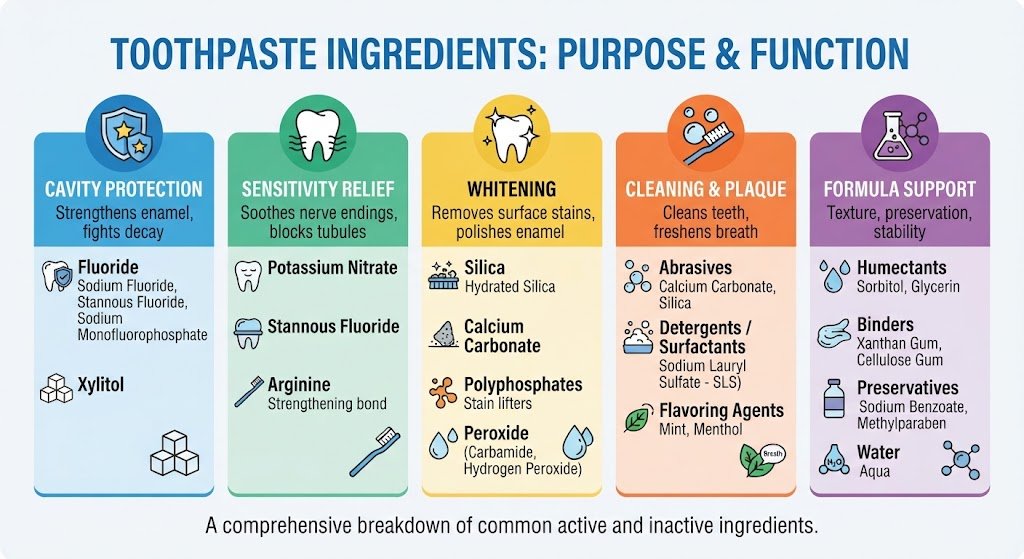
Some ingredients are active ingredients that provide a specific oral-health benefit. Others support the formula by helping clean the teeth, retain moisture, improve texture, control foaming, or improve taste.
The American Dental Association (ADA) identifies several categories of toothpaste ingredients, including anticaries ingredients, desensitizing agents, abrasives, detergents, humectants, flavoring agents, and sweeteners.
Here is a simple starting point:
| Your main goal | Ingredients worth looking for |
| Cavity prevention | Fluoride |
| Sensitive teeth | Potassium, stannous compounds, or arginine |
| Fluoride-free preference | Hydroxyapatite |
| Surface-stain removal | Appropriate abrasives |
| Whitening | Abrasives and, in some formulas, peroxide |
| Moisture and texture | Glycerin and other humectants |
| Ingredient-conscious shopping | Transparent, well-understood formula |
For cavity protection, fluoride compounds such as sodium fluoride, sodium monofluorophosphate, and stannous fluoride are recognized anticaries ingredients used in toothpaste.
Hydroxyapatite is another ingredient worth understanding if you are specifically interested in fluoride-free toothpaste. Recent systematic reviews have evaluated hydroxyapatite-containing toothpaste for caries prevention and remineralization, although the evidence should be interpreted in the context of the individual formulation and study design.
The key idea is simple:
Do not ask only, “Is this ingredient good?” Ask, “What does this ingredient do, and is that function useful for me?”
How to Choose the Right Toothpaste Ingredients
Before comparing individual ingredients, it helps to understand how to evaluate a toothpaste as a complete formula.
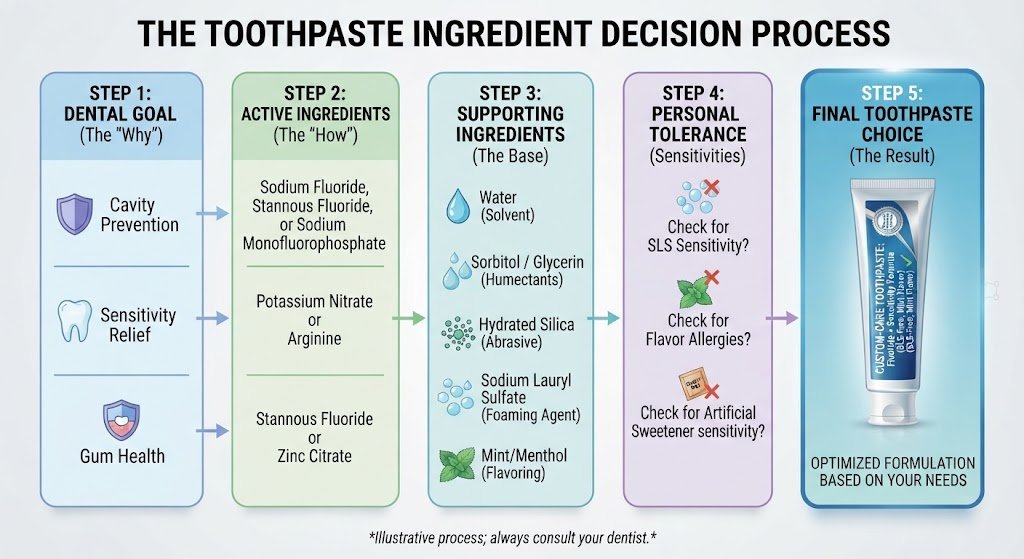
Start With Your Main Dental Goal
First decide what problem you are trying to solve.
Your main goal might be:
- preventing cavities
- managing sensitive teeth
- protecting enamel
- removing surface stains
- improving gum care
- choosing fluoride-free toothpaste
- avoiding specific ingredients
- finding a simpler or more transparent formula
This matters because toothpaste ingredients have different jobs.
For example, someone mainly concerned about cavities may want to start by checking the anticaries active ingredient.
Someone dealing with tooth sensitivity may care more about desensitizing ingredients.
And someone specifically looking for fluoride-free toothpaste may want to compare hydroxyapatite formulas.
This is why simply asking for the “best toothpaste ingredients” can lead to an incomplete answer without knowing the user’s goal.
Understand Active vs. Supporting Ingredients
One of the easiest ways to understand a toothpaste label is to separate active ingredients from supporting ingredients.
Active ingredients are included to provide a specific oral-health effect.
Supporting ingredients help create a usable toothpaste.
For example:
- Fluoride compounds can provide anticaries benefits.
- Desensitizing ingredients can help address tooth sensitivity.
- Abrasives help with physical cleaning and surface-stain removal.
- Humectants help retain moisture.
- Detergents can provide foaming action.
- Flavoring agents improve taste.
- Sweeteners can improve palatability.
The ADA describes these functional categories as common components of toothpaste formulations.
This distinction is useful because not every ingredient needs to be judged by the same standard.
For example, glycerin is not supposed to prevent cavities. Its job is different.
Likewise, an abrasive is not necessarily there to whiten teeth dramatically. Its primary role may be physical cleaning.
Consider the Complete Formula
A single ingredient rarely tells you everything about a toothpaste.
Seeing hydrated silica on an ingredient list, for example, tells you that the formula contains an abrasive. It does not automatically tell you that the toothpaste is too abrasive.
Similarly, seeing glycerin does not tell you whether the entire formula is appropriate for your needs.
The better approach is to look at:
- The toothpaste’s main purpose
- Its active ingredient
- Its supporting ingredients
- Your personal tolerance
- The product’s overall formulation
This approach is more useful than creating a simple list of “good” and “bad” ingredients.
Best Toothpaste Ingredients for Different Needs
The best ingredient depends heavily on what you want from your toothpaste.
Instead of choosing based on marketing claims, match the ingredient to the problem you are trying to solve.
Best Ingredients for Cavity Prevention
If cavity prevention is your main goal, fluoride deserves particular attention.
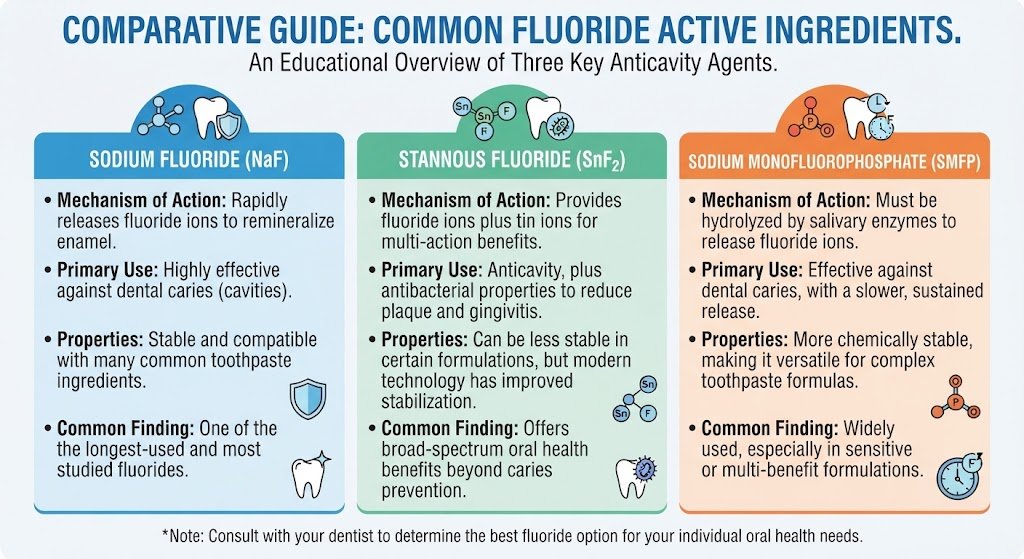
The ADA identifies sodium fluoride, sodium monofluorophosphate, and stannous fluoride as fluoride compounds used as anticaries agents in toothpaste.
The FDA’s OTC anticaries monograph also specifies fluoride active ingredients and permitted formulations for over-the-counter anticaries products.
Fluoride is therefore not simply another ingredient added for texture or flavor. It serves a specific preventive purpose.
The ADA explains that fluoride helps strengthen teeth and supports remineralization of enamel during the early stages of tooth decay.
If cavity prevention is your priority, check the active ingredient before being distracted by front-of-package claims such as “natural,” “clean,” or “fresh.”
Best Ingredients for Sensitive Teeth
Sensitive teeth require a different approach.
If cold drinks, hot foods, sweet foods, or brushing cause a sharp sensation, you may want to look for a toothpaste specifically formulated for sensitivity.
The ADA discusses desensitizing ingredients including stannous compounds, potassium, and arginine. It also cites evidence that twice-daily use of self-applied stannous, potassium with or without stannous, or arginine formulations can reduce dentin hypersensitivity pain.
This gives you a more useful starting point than simply searching for the toothpaste with the fewest ingredients.
When comparing sensitivity toothpastes, consider:
- the desensitizing active ingredient
- whether the toothpaste also contains fluoride
- whether you tolerate the flavoring system
- whether the formula fits your everyday routine
If sensitivity is your main concern, a toothpaste designed specifically around that problem may make more sense than a generic “natural” toothpaste.
Best Ingredients for Enamel Protection
Enamel protection is not about finding one magical ingredient.
Instead, think about the overall toothpaste formula and your brushing routine.
Fluoride is important in cavity-prevention toothpaste and helps strengthen teeth and support enamel remineralization.
Abrasivity can also matter, particularly if you frequently use whitening toothpaste or have concerns about enamel wear.
However, do not automatically reject every toothpaste containing silica or calcium carbonate. Both can serve useful abrasive functions in toothpaste.
The important question is how the finished formula performs, not simply whether one abrasive appears on the label.
Best Ingredients for Whitening
Whitening toothpaste generally works through a different mechanism than professional bleaching.
The ADA explains that whitening toothpastes primarily use abrasives to help remove extrinsic surface stains. Some formulas also contain peroxide.
This means ingredients such as appropriate abrasives can be useful when your main goal is removing surface discoloration from things such as coffee or tea.
But stronger whitening claims do not automatically mean a better everyday toothpaste.
If you have sensitive teeth, consider the complete formula and how your teeth respond to regular use.
The important distinction is:
Surface-stain removal is not the same thing as changing the natural internal color of the tooth.
Best Ingredients for Gum Health
If gum health is your main concern, look beyond words such as “natural” or “fresh” on the front of the package.
Some toothpaste formulas contain active ingredients intended to support plaque control, gingivitis reduction, or other oral-health goals. The ADA notes that toothpaste can contain ingredients intended to improve oral health beyond cavity protection, including ingredients aimed at gingivitis or tartar buildup.
The more useful approach is to identify the specific benefit claimed by the toothpaste and then evaluate the active ingredients supporting that claim.
Persistent bleeding, swelling, pain, or other gum symptoms should not be managed solely by switching toothpaste. Those symptoms can require professional dental evaluation.
Best Ingredients for Ingredient-Conscious Shoppers
If you are mainly interested in a simpler or more transparent toothpaste formula, your priorities may be different.
Look for:
- a clearly listed ingredient panel
- an identifiable active ingredient
- ingredients with understandable functions
- a formula that matches your oral-care goal
- ingredients you personally tolerate
A shorter ingredient list can make a product easier to understand, but shorter does not automatically mean better.
A toothpaste with several functional ingredients can still be a sensible choice if each ingredient serves a useful purpose.
Fluoride: One of the Most Important Ingredients to Understand
Fluoride deserves its own section because it is one of the most important ingredients to understand when comparing toothpaste.
It is sometimes discussed online as though fluoride-free automatically means healthier.
That is too simple.
The ADA identifies fluoride as an anticaries ingredient and states that fluoride helps strengthen teeth and prevent tooth decay.
For U.S. over-the-counter anticaries products, the FDA specifies permitted fluoride active ingredients and conditions for use.
If your main goal is cavity prevention, understanding fluoride should come before evaluating marketing labels such as “natural” or “chemical-free.”
Sodium Fluoride
Sodium fluoride is one of the fluoride compounds used in toothpaste for anticaries protection.
When you see sodium fluoride listed as the active ingredient, the important takeaway is that the toothpaste is using fluoride as part of its cavity-prevention approach.
For consumers, there is usually no need to memorize the chemistry behind the compound. What matters is recognizing its role.
Stannous Fluoride
Stannous fluoride is another fluoride active ingredient used in toothpaste.
It is particularly interesting when comparing formulas designed to address more than one oral-care concern because stannous-containing toothpaste can also be associated with sensitivity-focused formulations. The ADA identifies stannous compounds among desensitizing approaches as well as stannous fluoride among anticaries fluoride compounds.
That makes the ingredient worth understanding when comparing toothpaste for multiple needs.
Sodium Monofluorophosphate
Sodium monofluorophosphate is another fluoride compound used in anticaries toothpaste.
The FDA OTC monograph identifies sodium monofluorophosphate as an anticaries active ingredient under specified conditions.
Again, the important lesson is not to choose toothpaste based solely on which fluoride compound has the most familiar name.
Instead, recognize that several fluoride compounds can serve the anticaries function.
Hydroxyapatite and Nano-Hydroxyapatite
Hydroxyapatite has become an important category for people looking for fluoride-free toothpaste.
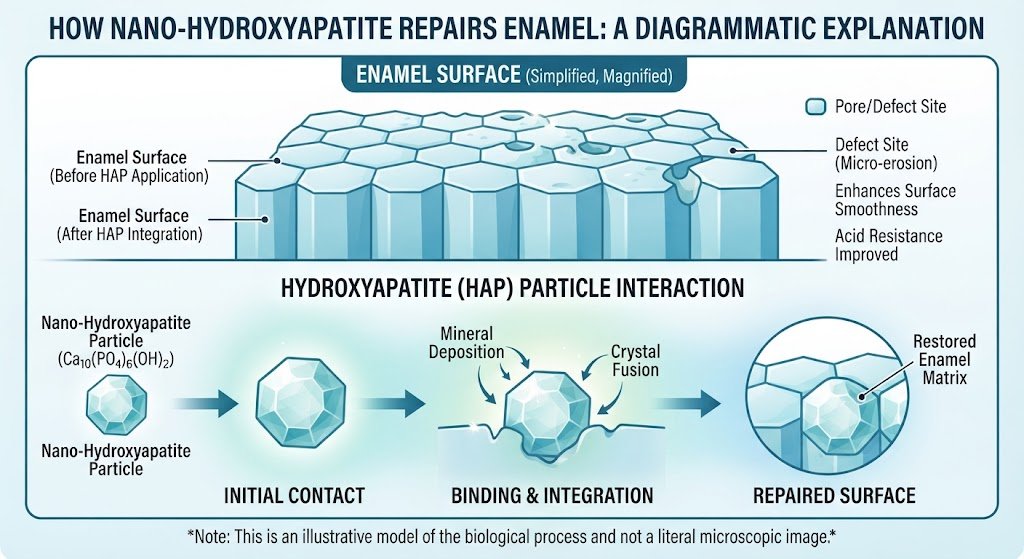
Hydroxyapatite is a calcium-phosphate mineral related to the mineral component of teeth. Toothpaste containing hydroxyapatite has been studied for its potential role in remineralization and caries prevention.
Recent systematic reviews have evaluated clinical evidence for hydroxyapatite toothpaste. A 2024 systematic review and meta-analysis found that the evidence base for fluoride-free hydroxyapatite oral-care products had expanded and included clinical and in-situ studies showing anticaries potential.
A 2025 systematic review specifically comparing fluoride-free hydroxyapatite toothpaste with fluoride toothpaste found no significant difference in several measured caries outcomes, while also noting differences in some lesion-related measures.
That makes hydroxyapatite a meaningful ingredient to investigate, but it does not mean every hydroxyapatite toothpaste is identical.
When comparing these products, look at:
- whether hydroxyapatite is identified as an active ingredient
- the type of hydroxyapatite used
- the rest of the formula
- the product’s intended use
- current manufacturer information
Nano-hydroxyapatite is a specific form of hydroxyapatite that has also been studied in caries-prevention research.
If you are considering a fluoride-free toothpaste, understanding hydroxyapatite is much more useful than simply choosing a product because the front label says “natural.”
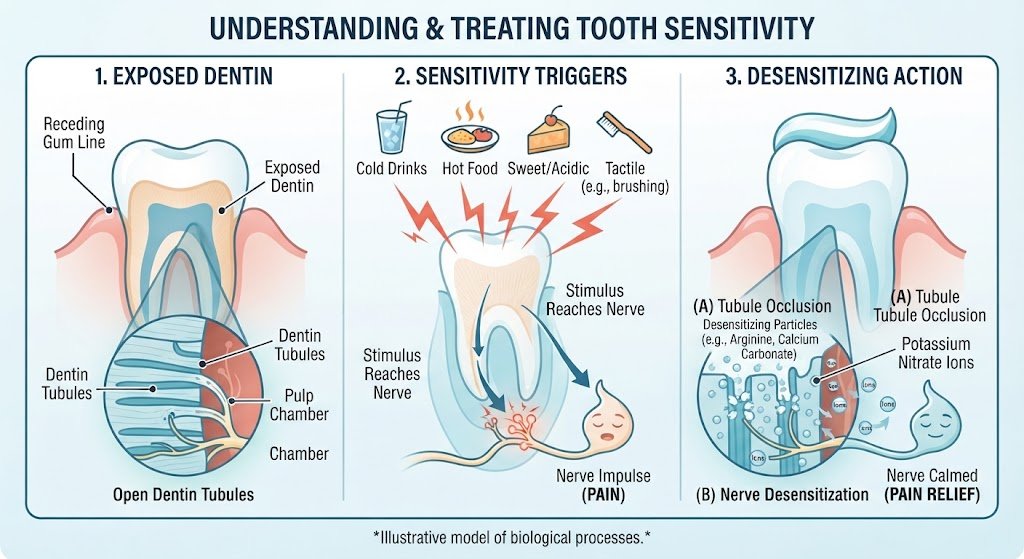
Potassium Nitrate and Arginine for Sensitive Teeth
If tooth sensitivity is one of your main concerns, look beyond the word “sensitive” on the front of the tube and check the active ingredients.
Potassium nitrate and arginine are two ingredients used in toothpaste designed to help manage dentin hypersensitivity. The American Dental Association lists potassium-based ingredients and arginine among desensitizing ingredients, and notes evidence that certain desensitizing toothpastes can reduce sensitivity pain with regular use.
These ingredients serve a different purpose from fluoride or hydroxyapatite. Instead of focusing primarily on cavity protection or enamel remineralization, they are included to address the discomfort that can occur when exposed dentin responds to hot, cold, sweet, or acidic foods and drinks.
Potassium Nitrate
Potassium nitrate is commonly used in sensitivity toothpastes. It is intended to reduce the nerve response associated with dental sensitivity over continued use.
If sensitivity is your primary concern, a toothpaste containing a recognized desensitizing ingredient may make more sense than choosing a formula simply because it is marketed as “natural” or “clean.”
Arginine
Arginine is another ingredient used for sensitivity management. It works through a different formulation approach than potassium-based desensitizing ingredients.
The important point is that the ingredient should match the problem you are trying to solve. If you regularly experience sensitivity, look at the active ingredients and not just marketing claims.
Glycerin, Xylitol, and Other Supporting Ingredients
Not every ingredient in toothpaste is there to prevent cavities or treat a dental condition.
Toothpaste also needs ingredients that give it the right texture, moisture, taste, stability, and brushing experience. These are often called supporting or inactive ingredients.
That does not automatically make them unimportant. A toothpaste needs a complete formula, and the supporting ingredients affect how that formula feels and performs during everyday brushing.
Glycerin
Glycerin is commonly used as a humectant. In simple terms, it helps toothpaste retain moisture and maintain its texture.
When you see glycerin on an ingredient label, its presence does not tell you whether the toothpaste is good or bad overall. It is one part of the formula and should be considered alongside the active ingredients, flavoring system, abrasives, and other components.
Xylitol
Xylitol is a sugar alcohol commonly used as a sweetener in oral-care products.
Its main role in toothpaste can be related to taste and formulation. However, it should not be treated as a replacement for an established anticaries active ingredient simply because a toothpaste contains it.
If cavity protection is your priority, look first at the toothpaste’s active ingredient and the product’s intended use.
Flavoring Ingredients
Flavoring ingredients make toothpaste more pleasant to use. Mint flavors are especially common, but formulas can contain different combinations of flavoring compounds.
This matters because personal tolerance is part of choosing toothpaste. A strong flavor may feel refreshing to one person and irritating to another.
For ingredient-conscious shoppers, a shorter or more transparent ingredient list can also make it easier to identify what you tolerate well.
Other Supporting Ingredients
Depending on the formula, toothpaste may also contain ingredients that:
- help maintain texture
- keep ingredients evenly distributed
- control moisture
- improve consistency
- provide flavor
- support product stability
- create foam during brushing
The key lesson is simple: do not judge a toothpaste from one supporting ingredient alone.
Hydrated Silica and Calcium Carbonate: Useful Abrasives
Abrasives are another important part of toothpaste formulation.
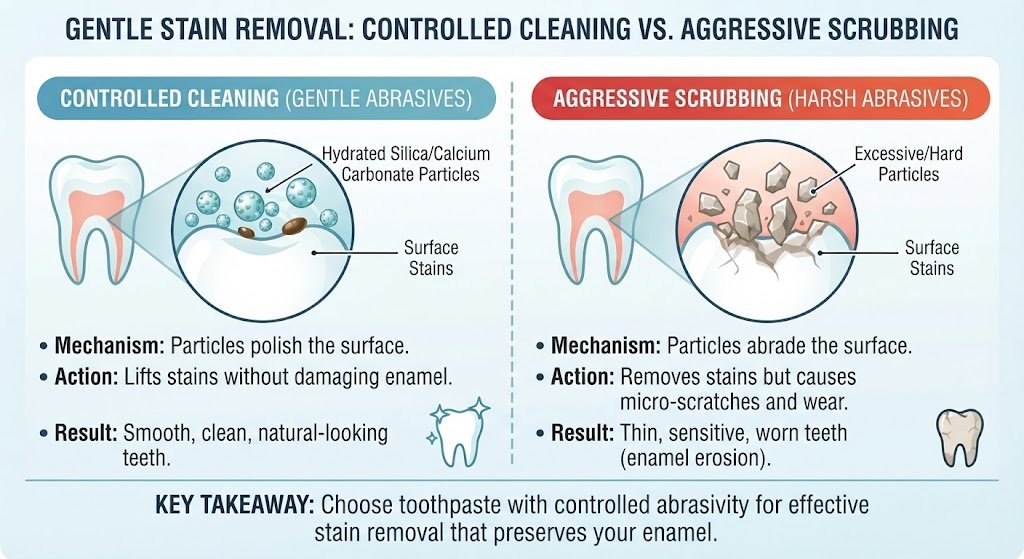
Their job is to help remove surface debris and external stains during brushing. Hydrated silica and calcium carbonate are examples of abrasive ingredients that can be found in toothpaste formulas.
The word “abrasive” can sound negative, but some level of controlled abrasion is useful because brushing needs mechanical cleaning.
The question is not simply:
“Does this toothpaste contain silica or calcium carbonate?”
A better question is:
“Is the overall formula appropriate for how I use it and for my dental needs?”
Why Abrasivity Matters
A toothpaste that is designed for heavy stain removal may have a different cleaning approach from a toothpaste designed for sensitive teeth.
Your brushing technique also matters. Brushing aggressively can increase mechanical wear regardless of which toothpaste you choose.
That is why ingredient-conscious shoppers should avoid assuming that the presence of one abrasive automatically makes a toothpaste too harsh.
For people who specifically want to minimize unnecessary abrasion, a toothpaste’s intended use and overall formulation deserve more attention than a single ingredient name.
SLS and Foaming Ingredients: What Their Presence Means
Sodium lauryl sulfate (SLS) is a detergent and foaming ingredient used in some toothpaste formulas.
Foam can make brushing feel more thorough, but foam itself is not what cleans your teeth. The cleaning action comes from brushing and the toothpaste’s overall formulation.
This is important because SLS is sometimes presented online as an ingredient that everyone should avoid. That is too broad.
Some people prefer SLS-free toothpaste, particularly if they find certain formulas irritating or uncomfortable. For those people, choosing an SLS-free formula can be a reasonable personal preference.
But the presence of SLS by itself does not tell you that the entire toothpaste formula is unsuitable.
Should You Choose SLS-Free Toothpaste?
Consider SLS-free toothpaste if:
- you notice irritation with certain toothpaste formulas
- you prefer a lower-foaming brushing experience
- you are trying to simplify your ingredient choices
- you have already identified that SLS-containing products do not agree with you
At the same time, do not sacrifice an ingredient that matters for your primary dental goal simply to remove one supporting ingredient.
For example, if cavity protection is important to you, first make sure the toothpaste provides the active ingredient and protection you are looking for.
Ingredients for Whitening
Whitening toothpaste usually focuses on removing surface stains rather than changing the natural internal color of the tooth.
Ingredients used for this purpose can include abrasives that help remove external discoloration. Some whitening formulas may also contain peroxide-based ingredients.
Abrasives and Surface Stains
Abrasive ingredients can help polish away external stains caused by things such as coffee, tea, or other strongly colored foods and drinks.
But stronger cleaning is not automatically better.
If you have sensitive teeth or are concerned about enamel wear, it makes sense to consider the toothpaste’s overall formulation and how aggressively you brush.
Peroxide-Based Whitening Ingredients
Some toothpastes use peroxide-containing ingredients as part of their whitening approach.
If whitening is your goal, look beyond the word “whitening” on the packaging and check what the formula is actually designed to do.
A toothpaste can be useful for maintaining a cleaner-looking smile while still needing to be appropriate for your sensitivity level and everyday brushing habits.
What About Charcoal?
Charcoal toothpaste is often marketed around stain removal and a “natural” image. But “natural” does not automatically mean better for your teeth.
If you are considering charcoal toothpaste, evaluate it using the same questions you would use for any other formula:
- What are the active ingredients?
- What is the toothpaste designed to accomplish?
- Is it appropriate for your dental needs?
- Are there reasons to be cautious about repeated abrasive cleaning?
- Does the formula provide benefits you actually need?
This approach is more useful than choosing a toothpaste simply because its marketing sounds clean or natural.
Ingredients for Gum and Plaque Care
Gum health is another area where the active ingredients matter.
Some toothpaste formulas are designed to support plaque control and gum care through specific active ingredients. Stannous fluoride, for example, is one of the fluoride active ingredients recognized for anticaries use in the United States.
When choosing toothpaste for gum-related concerns, do not focus only on whether the product says “gum health” on the package.
Look at:
- the active ingredient
- the intended benefit
- your sensitivity level
- your tolerance of flavoring ingredients
- the overall formula
- whether you need additional professional dental care
Toothpaste can be part of an oral-care routine, but persistent bleeding, swelling, pain, or other concerning symptoms should not be treated as something toothpaste alone needs to solve.
What Ingredients Should You Avoid or Treat With Caution?
There is a big difference between an ingredient that may not suit some people and an ingredient that is automatically unsafe for everyone.
That distinction is especially important when researching “clean,” “natural,” or “non-toxic” toothpaste.
Instead of creating a universal list of ingredients that everyone must avoid, think in terms of personal tolerance, dental needs, and formula quality.
Ingredients That May Need More Attention
You may want to investigate further when a toothpaste contains:
- an ingredient you already know you do not tolerate
- strong flavoring that causes discomfort
- SLS if you personally experience irritation with it
- a whitening or highly abrasive approach that does not suit your needs
- unnecessary complexity when you prefer a simpler formula
- an ingredient that conflicts with your specific dental-care requirements
Do Not Automatically Put Fluoride on an “Avoid” List
Fluoride deserves special attention because online discussions often put it into a simple good-versus-bad category.
That does not reflect how dental organizations and regulatory guidance describe fluoride toothpaste.
The ADA identifies fluoride as an important anticaries active ingredient, and U.S. OTC fluoride toothpastes generally contain 1,000–1,500 ppm fluoride.
Whether you personally want a fluoride or fluoride-free toothpaste is a separate decision. If you are comparing fluoride-free options, hydroxyapatite is one ingredient with a growing body of research behind it, but the evidence should be understood in context rather than presented as a universal replacement for fluoride.
Natural Does Not Automatically Mean Better
A plant-derived or naturally sourced ingredient can still cause irritation or sensitivity in some people.
Likewise, a synthetic ingredient is not automatically harmful simply because it was produced synthetically.
The better approach is to ask:
What does this ingredient do, why is it included, and does the complete formula fit my needs?
How to Read a Toothpaste Ingredient Label
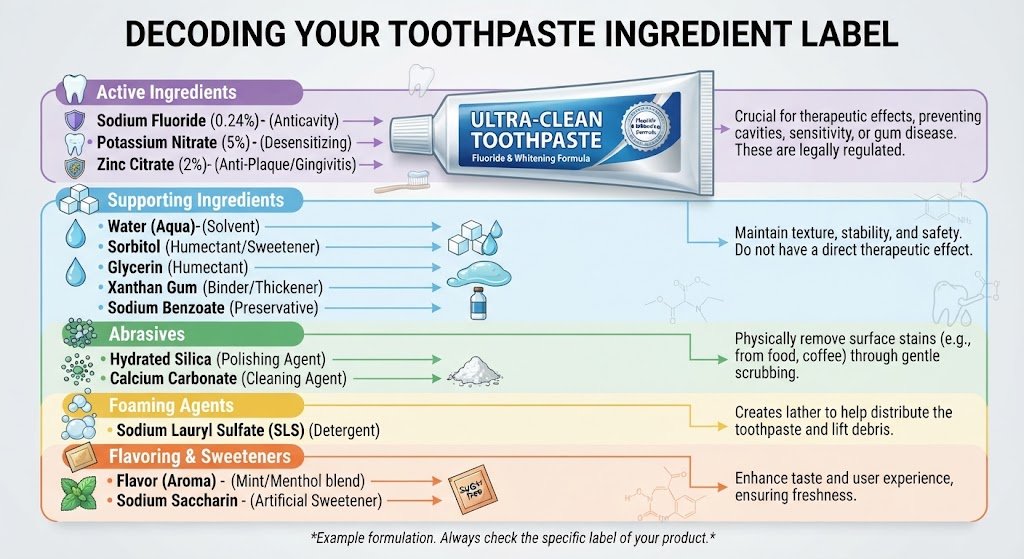
Ingredient labels can look complicated because they combine active ingredients with supporting ingredients.
You do not need to understand every chemical name before choosing a toothpaste.
Use this simple process.
Step 1: Identify Your Main Dental Goal
Start with the problem you actually want the toothpaste to address.
Is it:
- cavity protection?
- sensitivity?
- enamel support?
- whitening?
- gum and plaque care?
- an ingredient preference such as SLS-free or fluoride-free?
Your goal determines which ingredients deserve the most attention.
Step 2: Find the Active Ingredient
Look for the ingredient responsible for the toothpaste’s main therapeutic or preventive purpose.
For cavity protection, this may be a fluoride active ingredient such as:
- sodium fluoride
- stannous fluoride
- sodium monofluorophosphate
These are recognized anticaries fluoride ingredients.
For sensitivity, look for a recognized desensitizing approach such as potassium-based ingredients or arginine.
For fluoride-free formulas, hydroxyapatite may be the ingredient you want to investigate.
Step 3: Check the Supporting Ingredients
Once you understand the active ingredient, look at the rest of the formula.
Check for:
- abrasives
- humectants
- sweeteners
- flavoring ingredients
- detergents
- thickeners
- other formulation ingredients
You are not looking for a label with zero “chemical-sounding” words. You are checking whether the formula makes sense for you.
Step 4: Consider Your Tolerance
If you have experienced irritation, sensitivity, or discomfort from a specific toothpaste before, compare its ingredient list with formulas you tolerate better.
This can help you identify patterns.
Step 5: Ignore Marketing Until You Understand the Formula
Words such as:
- natural
- clean
- whitening
- advanced
- gentle
- mineral
- botanical
can help describe a product, but they do not replace the ingredient list.
The ingredient list gives you a much better starting point for comparison.
Best Toothpaste Ingredient Combinations for Different Needs
There is no single ingredient combination that makes sense for every person.
The better approach is to match the formula to your primary goal.
| Dental goal | Ingredients to investigate | What to consider |
| Cavity protection | Fluoride active ingredients | Look at the specific fluoride active and product purpose |
| Tooth sensitivity | Potassium-based desensitizers, arginine, or stannous fluoride | Consider regular use and personal response |
| Enamel support | Fluoride or hydroxyapatite | Compare the evidence and your fluoride preference |
| Whitening | Suitable abrasives and, in some formulas, peroxide-based ingredients | Consider sensitivity and brushing habits |
| Ingredient-conscious shopping | Transparent formula with clearly identified functions | Avoid judging the formula from one ingredient |
| SLS-free preference | SLS-free formula | Make sure the formula still meets your primary dental goal |
| Fluoride-free preference | Hydroxyapatite-containing formula | Understand how the evidence compares with fluoride |
This is why the phrase “best toothpaste ingredients” should not lead you toward one universal formula.
The better question is:
Which ingredients make the most sense for my specific dental needs?
How to Choose a Toothpaste Without Overthinking the Label
Once you understand the major ingredient groups, choosing toothpaste becomes much easier.
You can reduce the decision to five questions.
1. What Is My Main Goal?
Choose the primary goal before looking at secondary preferences.
If you mainly want cavity protection, start with anticaries ingredients.
If sensitivity is your biggest issue, focus on desensitizing ingredients.
If you want fluoride-free toothpaste, investigate hydroxyapatite formulas.
2. Which Active Ingredient Supports That Goal?
Do not let a long ingredient list distract you from the ingredient doing the main job.
The active ingredient should be the first major checkpoint.
3. Do I Need Any Formula Restrictions?
This is where preferences such as:
- SLS-free
- fluoride-free
- strong-flavor-free
- certain allergen-free
- simpler ingredient lists
can come into the decision.
These preferences matter, but they should be considered alongside your primary dental goal.
4. Is the Formula Comfortable to Use?
A toothpaste can look excellent on paper but still be a poor personal fit if you dislike the flavor, texture, foam, or brushing experience.
The toothpaste you can comfortably use consistently is more practical than a formula you avoid using.
5. Is the Product Claim Supported by the Formula?
If the package emphasizes sensitivity, whitening, cavity protection, or another benefit, check whether the ingredients actually correspond to that purpose.
This habit helps you shop based on formulation rather than advertising language.
Best Toothpaste Types to Consider
Instead of searching for one universal “best” toothpaste, consider the type that matches your needs.
Fluoride Toothpaste
A fluoride toothpaste may be the category to investigate when cavity prevention is your primary concern.
Common fluoride active ingredients in U.S. toothpaste include sodium fluoride, stannous fluoride, and sodium monofluorophosphate.
Hydroxyapatite Toothpaste
Hydroxyapatite toothpaste is an option for people specifically looking for fluoride-free oral-care formulas.
Research on hydroxyapatite toothpaste has expanded, including systematic reviews and clinical trials evaluating its role in caries-related outcomes. However, evidence varies by formulation, population, and study design, so avoid treating every hydroxyapatite product as equivalent.
Sensitive Toothpaste
For sensitivity, focus on formulas containing recognized desensitizing ingredients such as potassium-based ingredients, arginine, or stannous fluoride.
Low-Abrasive Toothpaste
If minimizing abrasion is important to you, investigate formulas designed around gentler cleaning rather than choosing products solely because they promise aggressive whitening.
Non-Toxic or Ingredient-Conscious Toothpaste
If your main priority is avoiding certain ingredients or choosing a more transparent formula, start by defining exactly what “non-toxic” means for your household.
Then check the complete ingredient list instead of relying only on front-of-package claims.
Frequently Asked Questions
What are the best toothpaste ingredients?
The right ingredients depend on your dental goal. Fluoride is an established anticaries active ingredient, while hydroxyapatite is an ingredient used in fluoride-free formulas with an expanding evidence base. Potassium-based ingredients and arginine are used in formulas for tooth sensitivity.
Is fluoride a good toothpaste ingredient?
Fluoride is widely used as an anticaries active ingredient in toothpaste. The ADA identifies sodium fluoride, stannous fluoride, and sodium monofluorophosphate as fluoride active ingredients used for cavity protection.
Is hydroxyapatite better than fluoride?
The evidence does not support reducing this comparison to a universal “better” answer. Hydroxyapatite has been studied as a fluoride-free approach to caries prevention, including systematic reviews comparing outcomes with fluoride toothpaste. The choice depends on the evidence you are comfortable with, your dental needs, and whether you want fluoride-free toothpaste.
What ingredient is best for sensitive teeth?
Potassium-based desensitizing ingredients, arginine, and stannous fluoride are among the ingredients used in sensitivity toothpastes. The ADA summarizes evidence supporting several of these approaches for reducing dentin hypersensitivity pain with regular use.
Is xylitol good in toothpaste?
Xylitol is commonly used as a sweetener in oral-care products. Its presence can contribute to the taste and formulation, but it should not be viewed as a substitute for the toothpaste’s primary anticaries active ingredient.
Is glycerin bad in toothpaste?
Glycerin is commonly used as a humectant to help retain moisture and maintain toothpaste texture. Its presence alone does not determine whether a toothpaste is appropriate for you.
Is silica safe in toothpaste?
Hydrated silica is used as an abrasive in toothpaste. The important consideration is the overall formulation and how the product is intended to be used, rather than assuming that the word “silica” alone makes a toothpaste too abrasive.
Is SLS bad in toothpaste?
SLS is a foaming and detergent ingredient used in some toothpastes. Some people prefer SLS-free formulas because of personal tolerance or irritation concerns, but SLS should not automatically be treated as an ingredient that everyone must avoid.
What ingredients should I look for in whitening toothpaste?
Look for a formula designed for your type of whitening goal. Abrasive ingredients can help remove external stains, while some formulas use peroxide-based ingredients. If you have sensitive teeth, also consider whether the whitening approach is comfortable for regular use.
How do I choose toothpaste ingredients?
Start with your main dental goal, identify the relevant active ingredient, then review supporting ingredients and personal preferences. This is more useful than trying to find a toothpaste with the shortest or most “natural” ingredient list.
Conclusion: Focus on the Formula, Not Just One Ingredient
The best toothpaste ingredients are not necessarily the ingredients with the most impressive marketing claims.
A good toothpaste choice starts with what you need the toothpaste to do.
For cavity protection, understand fluoride and the different fluoride active ingredients used in toothpaste. For sensitivity, look at recognized desensitizing ingredients such as potassium-based ingredients, arginine, or stannous fluoride. For fluoride-free formulas, hydroxyapatite is an ingredient worth understanding and comparing based on the available evidence.
Then look beyond the active ingredient.
Consider abrasives, humectants, sweeteners, flavoring agents, foaming ingredients, your personal tolerance, and the overall purpose of the formula.
Most importantly, do not judge toothpaste by a single ingredient.
The best formula for you is the one that matches your dental needs, fits your ingredient preferences, feels comfortable to use, and provides the type of oral-care benefit you are actually looking for.