Wearing braces makes everyday tooth cleaning more challenging. Brackets and wires create additional areas where plaque and food can collect, so your toothpaste needs to support good oral hygiene without distracting from the most important goal: keeping your teeth and gums healthy during treatment.
For most people with braces, fluoride toothpaste is the best starting point because fluoride helps prevent tooth decay and supports enamel. The American Association of Orthodontists recommends fluoride toothpaste and specifically advises choosing one without whitening when possible.
But there is more to choosing the right toothpaste than simply looking for the word “fluoride.”
This guide explains what to look for, whether whitening toothpaste is a good choice, which ingredients matter, how to compare products, and when a specific toothpaste may make sense for your needs.
What Is the Best Toothpaste for Braces?
There isn’t one toothpaste that is best for every person wearing braces.
The right choice depends on your cavity risk, sensitivity, gum health, ingredient preferences, and any recommendations from your orthodontist or dentist.
For most braces wearers, however, a good everyday toothpaste should provide:
- Fluoride for cavity protection
- A formula you can comfortably use every day
- Support for sensitivity if you need it
- Clear ingredient information
- No unnecessary emphasis on cosmetic whitening
- Reliable evidence behind its oral-health claims
The ADA explains that fluoride toothpastes help prevent tooth decay and that common fluoride compounds include sodium fluoride, stannous fluoride, and sodium monofluorophosphate.
That makes fluoride a more important selection criterion than simply choosing a toothpaste marketed specifically for “braces.”
It is also important to remember that toothpaste is only one part of orthodontic care. Brushing, cleaning between teeth, and removing plaque around brackets all work together.
Why Braces Change Your Toothpaste Needs
Braces don’t necessarily require a completely different type of toothpaste, but they make plaque control more difficult.
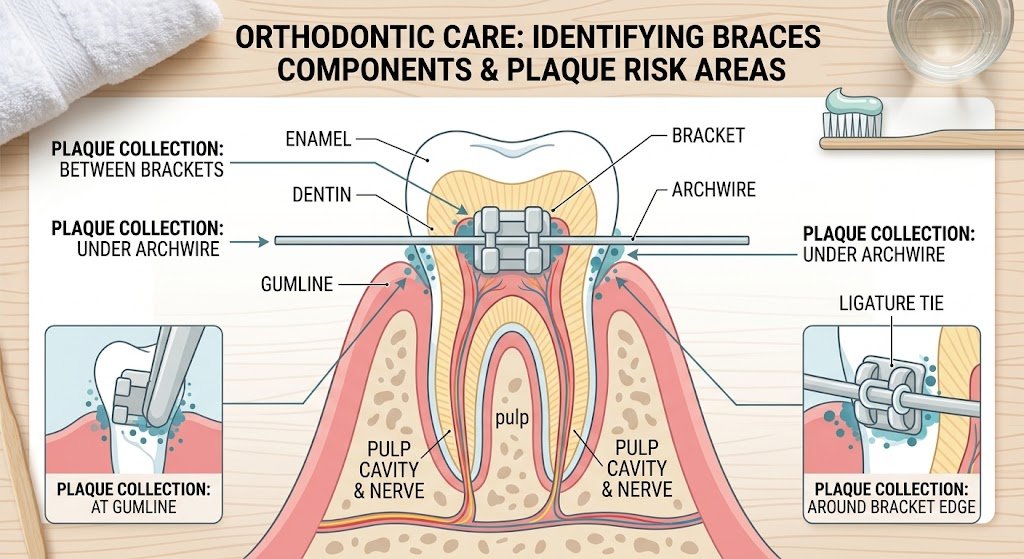
Traditional braces attach brackets to teeth and connect them with wires. These structures can create areas that are harder to clean with a normal toothbrush.
Brackets Create More Places for Plaque
Plaque can collect around:
- The edges of brackets
- Above and below brackets
- The gumline
- Between teeth
- Around orthodontic wires
This is important because plaque contains bacteria that can contribute to tooth decay and gum inflammation.
The AAO recommends using additional cleaning methods, including an interproximal brush and floss, to reach areas that are difficult to clean around orthodontic appliances.
Your toothpaste therefore needs to support the basics of oral health rather than trying to compensate for areas that brushing cannot reach.
White Spots and Cavities Are a Concern
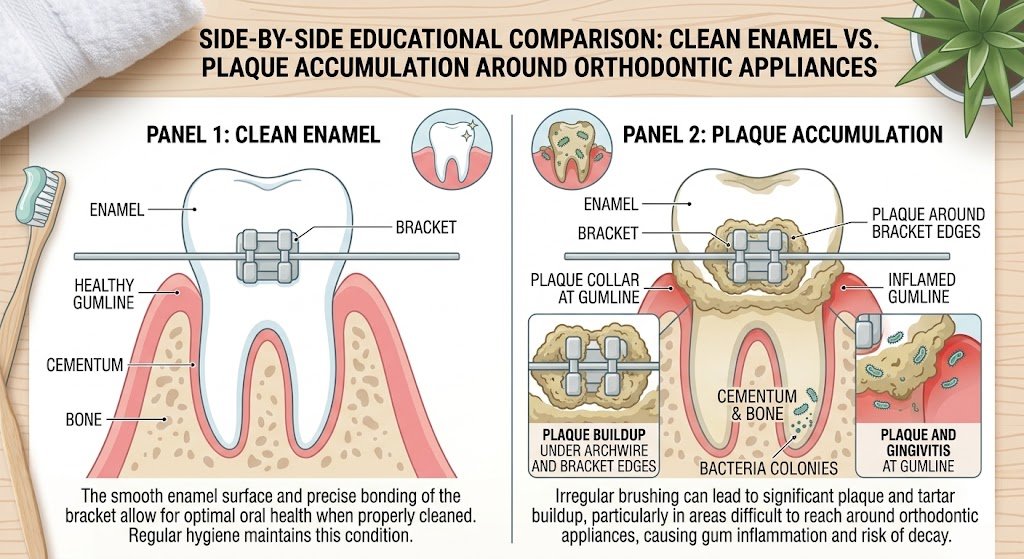
White spots can develop when plaque and acids remain on enamel and cause minerals to be lost from the tooth surface.
NIDCR explains that a white spot can be an early sign of tooth decay and that early decay may be stopped or reversed with fluoride and proper oral care.
Recent AAO guidance also explains that white spots associated with orthodontic treatment are generally related to plaque and acid-driven enamel demineralization rather than braces themselves directly creating the spots.
That makes cavity prevention especially important while you are wearing braces.
Gum Health Matters Too
Brushing around brackets is not only about protecting the visible surface of your teeth.
Plaque can also collect near the gumline, where inadequate cleaning can contribute to gum inflammation.
A toothpaste that you can comfortably use consistently is therefore more useful than a product chosen only because it promises a cosmetic benefit.
What Should You Look for in Toothpaste for Braces?
1. Fluoride
Fluoride should usually be one of the first things you check.
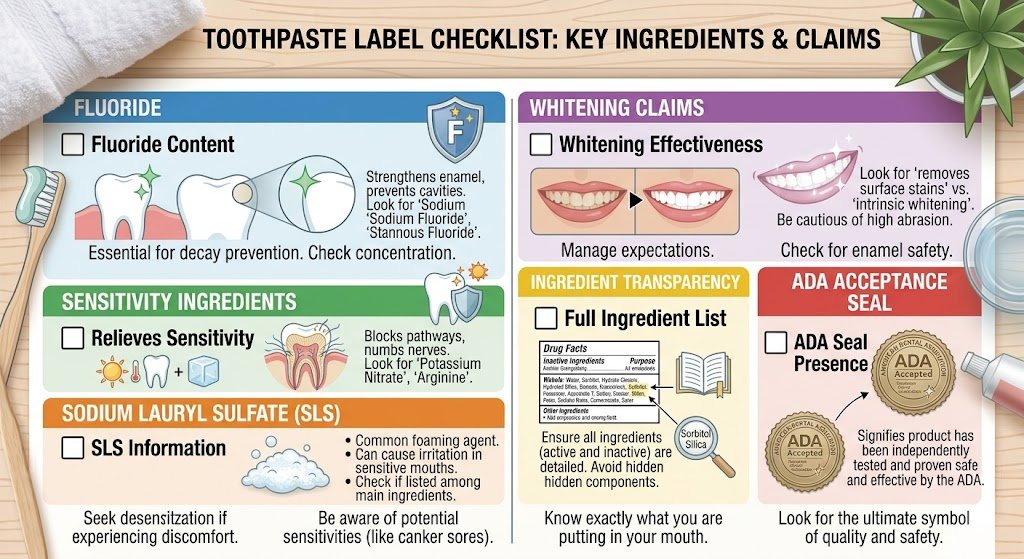
NIDCR explains that fluoride strengthens enamel, helps prevent tooth decay, and can help reverse early decay.
Common fluoride ingredients in U.S. toothpaste include:
- Sodium fluoride
- Stannous fluoride
- Sodium monofluorophosphate
The specific fluoride compound can matter for certain additional benefits, but the more important first question is whether the toothpaste provides fluoride for cavity protection.
For braces wearers, this is particularly relevant because maintaining enamel health around brackets is a major part of successful home care.
2. Cavity Protection
Don’t let cosmetic claims distract you from cavity protection.
A toothpaste can promise whitening, fresh breath, deep cleaning, or a special flavor, but those features do not replace the importance of protecting enamel from decay.
The ADA notes that toothpastes accepted for cavity-protection claims contain fluoride.
If your orthodontist considers you at particularly high risk for cavities, they may recommend additional fluoride treatment or a prescription-strength fluoride toothpaste.
That decision should be based on your individual risk rather than simply choosing the strongest product you can find online.
3. A Formula You Can Use Comfortably
You will use toothpaste frequently during orthodontic treatment.
If a toothpaste causes unpleasant burning, irritation, or an overly strong sensation, you may find it harder to maintain a consistent routine.
A comfortable formula that you actually use properly can be more valuable than one with a long list of marketing claims.
4. Sensitivity Support
Some people experience tooth sensitivity while wearing braces.
If sensitivity is a concern, you can look for toothpaste containing ingredients used for sensitivity management.
The ADA identifies ingredients such as stannous compounds, potassium-based ingredients, and arginine among desensitizing agents used in toothpaste.
This does not mean every sensitive tooth requires a special toothpaste. Persistent or severe sensitivity can have other causes and should be evaluated by a dental professional.
5. Consider SLS Based on Your Own Tolerance
Sodium lauryl sulfate, or SLS, is a detergent commonly used to create foam during brushing.
The ADA lists detergents such as SLS among ingredients used in toothpaste for foaming action.
Some people prefer SLS-free toothpaste because they find it more comfortable.
That does not mean SLS is automatically harmful for everyone. If you tolerate it well, there may be no reason to avoid every toothpaste containing it.
If a particular toothpaste causes irritation, however, comparing an SLS-free alternative can be reasonable.
6. Consider the ADA Seal
The ADA Seal of Acceptance can provide an additional evidence-based quality signal.
Products that receive the Seal must submit information that allows the ADA Council on Scientific Affairs to evaluate whether they meet specified requirements for safety and efficacy.
For toothpaste, the specific claim being evaluated matters.
So the Seal should not be interpreted as meaning that one product is universally better than every other toothpaste. Instead, it can help you identify products whose relevant claims have gone through the ADA’s evaluation process.
Best Toothpaste for Braces by Need
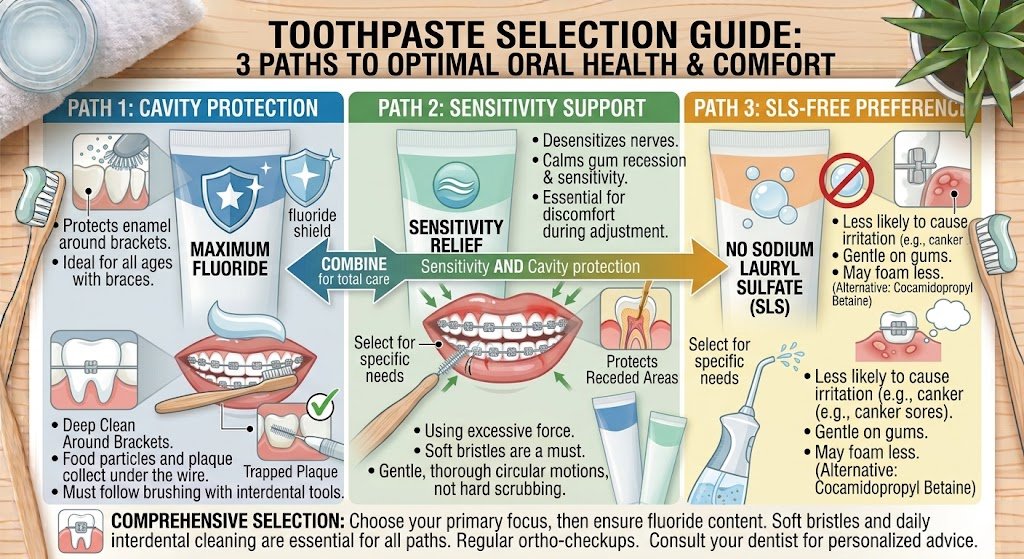
Instead of choosing one universal “best” toothpaste, match the formula to the problem you are trying to solve.
Best for Cavity Protection
If your main concern is protecting your teeth during orthodontic treatment, start with a fluoride toothpaste.
This is especially important if you have difficulty keeping plaque away from the areas surrounding your brackets.
Look for:
- Fluoride
- A cavity-protection claim
- Comfortable everyday use
- Clear ingredient labeling
- Evidence-backed claims
Fluoride is not a special “braces ingredient.” Its importance comes from its ability to help protect enamel against tooth decay.
Best for Sensitive Teeth
If braces are accompanied by sensitivity, a fluoride toothpaste with a recognized sensitivity ingredient may be a better fit.
Potential ingredients include:
- Stannous fluoride
- Potassium-based desensitizing ingredients
- Arginine
The ADA identifies these types of ingredients for reducing dentin hypersensitivity.
However, toothpaste should not be used to mask ongoing dental pain. If sensitivity is severe, persistent, or associated with a particular tooth, speak with your dentist or orthodontist.
Best for People Who Prefer SLS-Free Toothpaste
If you find SLS-containing toothpaste uncomfortable, an SLS-free formula can be a reasonable preference.
But don’t make SLS the only selection criterion.
A toothpaste being SLS-free does not automatically make it better for braces. You should still check whether it provides the cavity protection and other features you actually need.
Best for Everyday Braces Care
For everyday use, a simple combination is often the most practical:
Fluoride + cavity protection + comfortable formula + consistent brushing.
You do not need a toothpaste with the longest ingredient list or the most aggressive marketing claims.
The goal is to protect your teeth while making your daily routine easy enough to maintain throughout orthodontic treatment.
What About Whitening Toothpaste?
This is one area where braces wearers should be cautious.
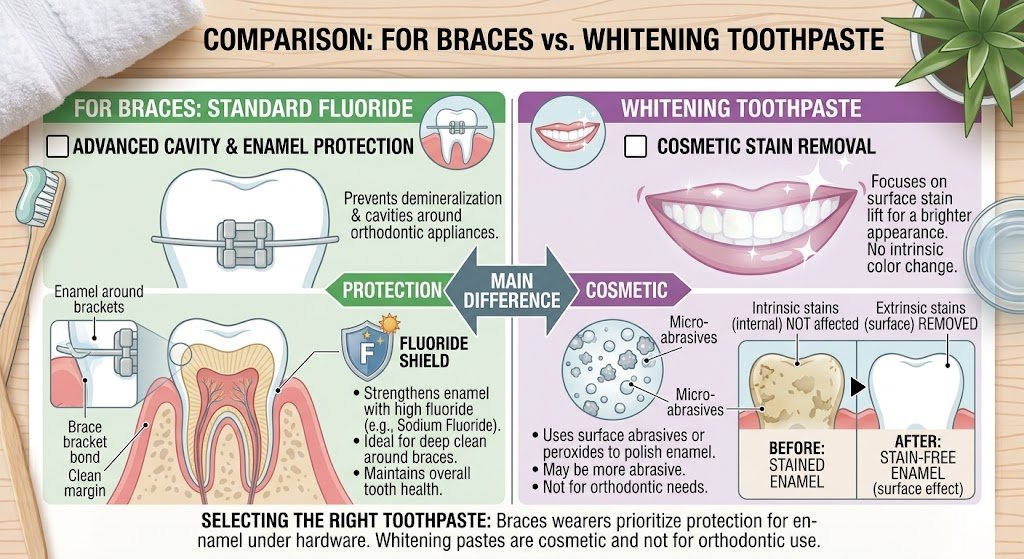
The American Association of Orthodontists recommends fluoride toothpaste and says it is preferably used without whitening during orthodontic treatment.
Whitening toothpaste primarily works by helping remove surface stains through abrasive ingredients. That is different from peroxide-based bleaching, which changes tooth color through a chemical process.
If your primary goal is a whiter smile, talk to your orthodontist about the appropriate timing rather than assuming a whitening toothpaste is the best choice during treatment.
Fluoride vs. Fluoride-Free Toothpaste for Braces
For someone wearing braces, the fluoride-versus-fluoride-free decision deserves careful consideration.
Fluoride helps strengthen enamel, prevent tooth decay, and support the repair of early mineral loss.
Because orthodontic appliances can make plaque control more difficult, cavity protection is an important priority during treatment.
Why Fluoride Is Usually the Practical Starting Point
A fluoride toothpaste can:
- Help prevent cavities
- Strengthen enamel
- Help reverse early stages of decay
- Provide fluoride directly during brushing
NIDCR recommends brushing twice daily with fluoride toothpaste as part of cavity prevention.
What About Fluoride-Free Toothpaste?
Some people choose fluoride-free toothpaste for personal reasons.
But if you are wearing braces, don’t assume that a fluoride-free formula provides the same cavity-prevention benefits simply because it is marketed as “natural,” “clean,” or “gentle.”
If you are considering fluoride-free toothpaste and have a history of cavities or other risk factors, discuss the choice with your dentist or orthodontist.
Is Whitening Toothpaste Good for Braces?
For most people wearing fixed braces, whitening should not be the main reason for choosing toothpaste.
The AAO specifically recommends fluoride toothpaste, preferably without whitening, during orthodontic treatment.
There is also an important difference between removing surface stains and bleaching tooth color.
Whitening toothpastes mainly use abrasives to remove extrinsic surface stains. ADA guidance distinguishes this from peroxide-based bleaching treatments.
Why This Matters During Braces Treatment
Brackets cover portions of the tooth surface.
Trying to change tooth color while brackets are attached may therefore create an uneven cosmetic result once the appliances are removed.
That doesn’t mean whitening toothpaste is inherently dangerous or that every person will experience a problem. It means cosmetic whitening is usually a lower priority than maintaining healthy enamel and controlling plaque during orthodontic treatment.
If whitening is important to you, ask your orthodontist when it makes sense to begin.
For most braces wearers, the better priority is:
Clean teeth → healthy gums → protected enamel → fewer cavities → cosmetic whitening later if appropriate.
Ingredients to Look For and Consider Carefully
You don’t need to memorize every ingredient on a toothpaste label.
Instead, understand the major categories.
Fluoride Compounds
The main fluoride ingredients you may see in U.S. toothpaste include:
- Sodium fluoride
- Stannous fluoride
- Sodium monofluorophosphate
These are recognized anticaries fluoride compounds used in toothpaste.
Desensitizing Ingredients
If sensitivity is an issue, check whether the toothpaste contains an ingredient intended to reduce sensitivity.
Stannous compounds, potassium-based ingredients, and arginine are examples identified by the ADA.
Abrasives
Toothpaste needs some abrasive action to help clean teeth.
The ADA lists ingredients such as silica and calcium carbonate among abrasive materials used in toothpaste.
But stronger abrasive action is not automatically better.
This is another reason to be cautious about choosing toothpaste primarily because its packaging promises an “intensive” or “deep” clean.
SLS
SLS is mainly used for foaming.
If you tolerate it without problems, there may be no need to avoid it simply because it appears on the ingredient list.
If a formula causes irritation, an alternative toothpaste may be worth trying.
Strong Flavoring
Flavor is largely a comfort consideration.
A very strong mint flavor does not mean a toothpaste provides better cavity protection.
Choose a flavor that makes it easy for you to maintain your brushing routine consistently.
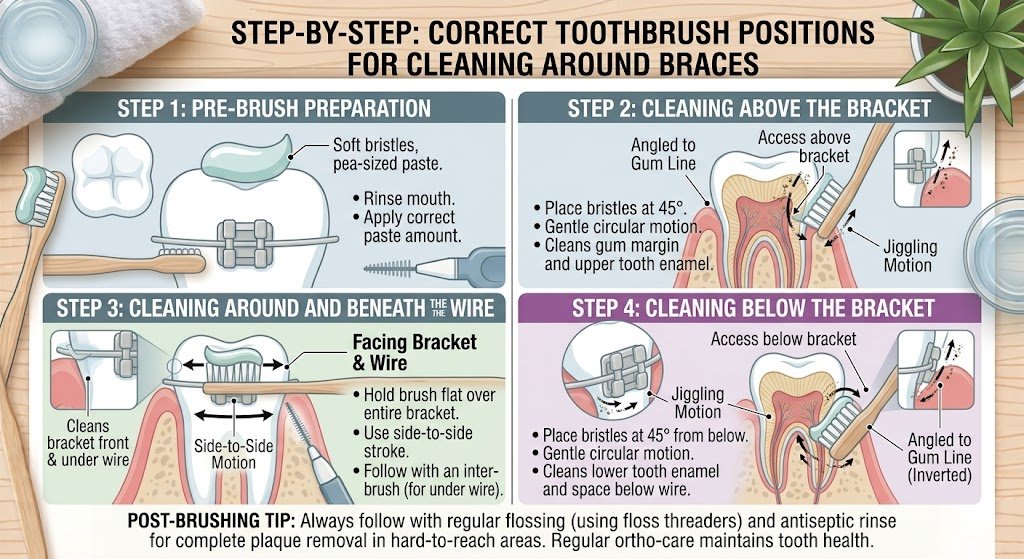
How to Brush Your Teeth With Braces
Choosing a good toothpaste is only half of the job. With braces, how you brush matters because brackets and wires can make plaque harder to remove.
The National Institute of Dental and Craniofacial Research recommends brushing gently with fluoride toothpaste and paying attention to the gumline and all tooth surfaces. [ add a link ]
Start With the Gumline
Hold your toothbrush at an angle toward the gumline and use gentle, small movements.
Avoid pressing the brush aggressively against your teeth or brackets. Harder brushing does not automatically remove plaque better and can make your gums uncomfortable.
Clean Above and Below the Brackets
With traditional braces, don’t focus only on the front of the bracket.
Spend time cleaning:
- Above each bracket
- Around the sides of each bracket
- Below each bracket
- Along the gumline
- Around the orthodontic wire
- The chewing surfaces
- The inside surfaces of your teeth
This helps address the areas where plaque can remain hidden.
Use a Soft-Bristled Toothbrush
A soft-bristled toothbrush is generally a practical choice for routine brushing.
You can use a manual or powered toothbrush depending on your preference and the advice of your dental professional.
The most important factor is that you use it correctly and consistently.
How Often Should You Brush?
Your orthodontist may give you a specific brushing routine based on your treatment.
The AAO recommends brushing after meals when possible and emphasizes regular cleaning around orthodontic appliances. [ add a link ]
If you cannot brush immediately after eating, rinsing your mouth with water can help remove loose food particles until you can brush properly.
Don’t Forget Your Tongue
The tongue can hold bacteria and food debris, so gently cleaning it can be part of your normal oral-hygiene routine.
Avoid turning tongue cleaning into aggressive scraping.
Toothpaste Alone Isn’t Enough
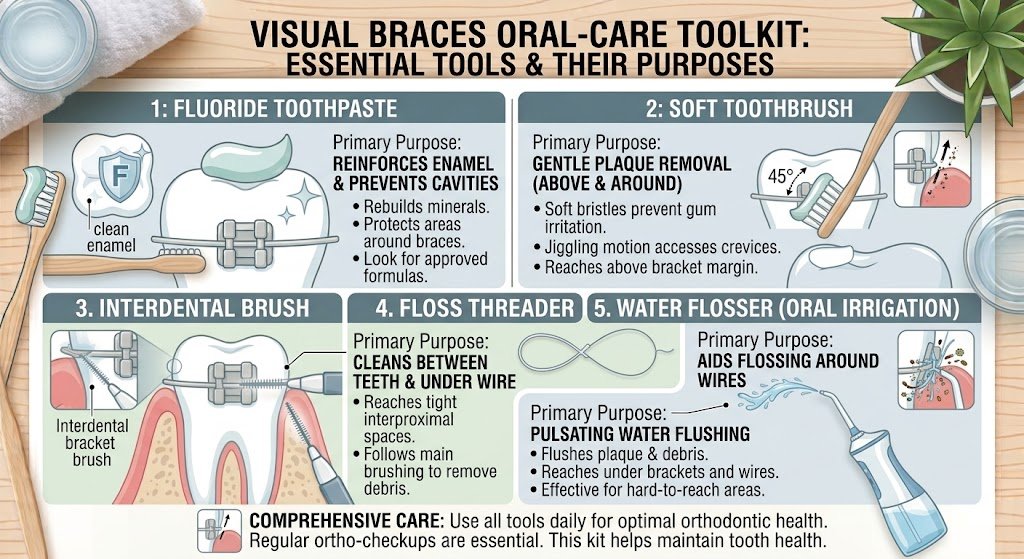
One of the biggest mistakes braces wearers can make is assuming that a good toothpaste will handle everything.
It won’t.
Toothpaste delivers ingredients such as fluoride during brushing, but the physical movement of a toothbrush and additional cleaning tools are what help remove plaque and food debris.
Braces create areas that can be difficult to reach with ordinary brushing alone.
Interdental Brushes
An interdental or interproximal brush is a small brush designed to clean between teeth and around orthodontic appliances.
The AAO recommends interproximal brushes as part of cleaning around braces. [ add a link ]
They can be particularly useful around bracket edges and beneath wires where a standard toothbrush may struggle.
Floss Threaders
Flossing with braces can take more time because the floss needs to pass around the orthodontic wire.
A floss threader can help guide floss underneath the wire so you can clean between your teeth.
The exact flossing method may depend on your braces and orthodontic setup, so follow the instructions from your orthodontist.
Water Flossers
A water flosser can be a convenient addition to a braces-care routine.
It can help flush food particles and debris from areas around brackets and wires.
However, it should not automatically be treated as a complete replacement for every other form of interdental cleaning.
Fluoride Mouthwash
Some people with braces may benefit from fluoride mouthwash as an additional source of fluoride.
The AAO notes that fluoride rinses may be recommended for additional enamel protection in some orthodontic situations. [ add a link ]
If your orthodontist recommends one, follow the product directions and their specific instructions.
The Simple Braces-Care Routine
A practical routine looks something like this:
Brush → clean between teeth → clean around brackets → follow your orthodontist’s recommendations.
The exact tools can vary from person to person.
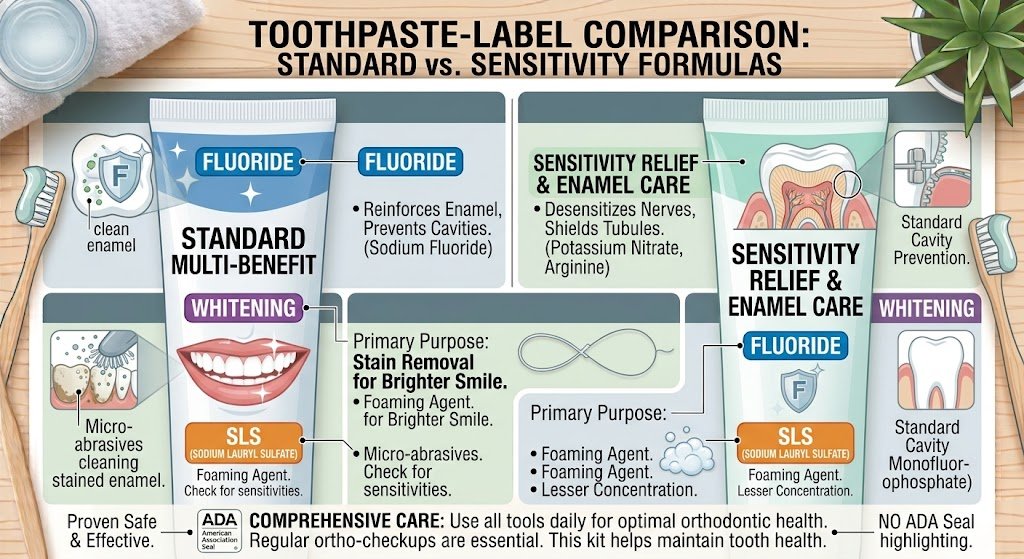
How to Compare Toothpaste for Braces Before Buying
Once you know what matters, comparing products becomes much easier.
Don’t start with the product’s flavor or packaging. Start with the features that affect your oral-health needs.
| Feature | What to Check | Why It Matters |
| Fluoride | Fluoride active ingredient | Helps prevent cavities |
| Cavity protection | Product claim and evidence | Important during orthodontic treatment |
| Sensitivity support | Desensitizing ingredients | Useful if teeth are sensitive |
| Whitening | Whether the formula emphasizes whitening | Usually a lower priority during braces |
| SLS | Present or absent | May matter for personal comfort |
| Flavor | Mild or strong | Affects everyday comfort |
| ADA Seal | Whether the relevant claim has been evaluated | Additional evidence signal |
| Ingredients | Clear, current label | Helps you compare formulas |
| Price | Cost relative to size | Helps assess value |
| Product format | Paste, gel, etc. | Personal preference and usability |
The ADA explains that toothpaste formulas can contain ingredients for cavity prevention, sensitivity, gingivitis, tartar, whitening, and other purposes. [ add a link ]
The important question is not “Which toothpaste has the most features?”
Instead ask:
Which features solve my actual braces-care needs?
A Simple Label-Reading Checklist
Before purchasing, check these five things:
1. Does it contain fluoride?
If cavity prevention is important, this should be one of your first checks.
2. Does it contain a sensitivity ingredient if you need one?
Don’t pay extra for a sensitivity claim if sensitivity isn’t a concern.
3. Is whitening a major focus?
For braces, cosmetic whitening is usually less important than cavity and enamel protection.
4. Are the ingredients clearly listed?
A transparent label makes comparison easier.
5. Is the product information current?
Formulas and packaging can change. Always verify the current label before purchasing.
What Features Matter Most When Buying Toothpaste for Braces?
Not every toothpaste feature deserves equal weight.
A useful way to prioritize your decision is:
Priority 1: Cavity Protection
Start with fluoride and the product’s cavity-protection purpose.
Priority 2: Your Specific Dental Needs
If you have sensitivity, choose accordingly.
If your mouth is easily irritated, comfort may influence your choice.
If your dentist has identified a higher cavity risk, professional recommendations should take priority over generic product advice.
Priority 3: Comfort
A toothpaste that you dislike using is not useful if it causes you to shorten or skip brushing.
Priority 4: Cosmetic Features
Whitening, unusual flavors, and other cosmetic features can be considered after the fundamentals are covered.
This order keeps the buying decision focused on oral health rather than marketing.
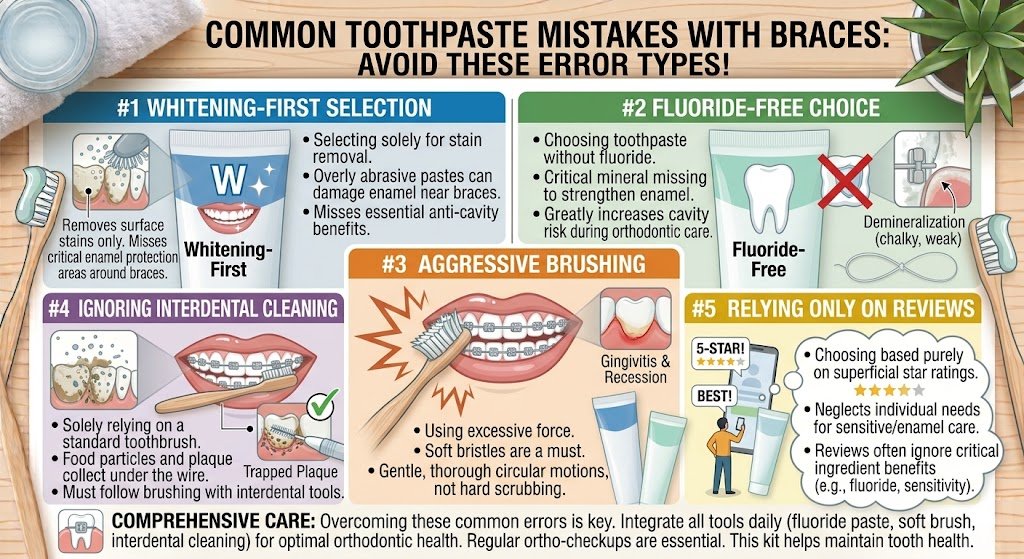
Common Mistakes When Choosing Toothpaste for Braces
Choosing Whitening Over Fluoride Protection
A brighter smile may sound attractive, but during braces treatment, enamel protection and plaque control should come first.
The AAO recommends fluoride toothpaste without whitening when possible. [ add a link ]
Assuming You Need “Special” Braces Toothpaste
Many people search for a toothpaste made specifically for braces.
But the important question is not whether the packaging says “braces toothpaste.”
Look at what the product actually provides.
A standard fluoride toothpaste may meet your needs if it is comfortable and appropriate for your oral-health situation.
Choosing Fluoride-Free Because It Sounds Natural
“Natural” and “fluoride-free” are marketing or formulation characteristics, not automatic proof of better cavity protection.
If you are wearing braces, think carefully about your cavity-prevention needs before removing fluoride from your routine.
Ignoring Sensitivity
If your teeth are sensitive, don’t assume you simply have to tolerate it.
A toothpaste containing a desensitizing ingredient may be worth considering, although persistent sensitivity should be evaluated professionally.
Brushing Too Hard
More pressure does not mean better cleaning.
With braces, you want thorough cleaning around brackets and the gumline without aggressive scrubbing.
Relying Only on Toothpaste
This is perhaps the biggest mistake.
Even an excellent toothpaste cannot replace interdental cleaning.
Food and plaque can remain around wires, brackets, and between teeth unless those areas are specifically cleaned.
Buying Based Only on Amazon Reviews
Amazon reviews can help you understand practical experiences with:
- Taste
- Texture
- Packaging
- Tube design
- Personal preferences
But reviews are not clinical evidence.
A toothpaste with thousands of reviews is not automatically more effective for braces than another product.
Use reviews for consumer experience and product information, while relying on dental organizations and product documentation for health claims.
Assuming Expensive Means Better
Price alone doesn’t establish effectiveness.
A more expensive toothpaste may contain additional features, but those features may not be relevant to your needs.
Compare the actual formula and purpose instead.
When to Ask Your Orthodontist or Dentist
Online buying guides can help you compare products, but some situations require individualized dental advice.
Talk with your orthodontist or dentist if you have:
- Frequent cavities
- Persistent tooth sensitivity
- Significant gum bleeding or swelling
- White spots developing around brackets
- Persistent mouth irritation
- Tooth pain
- A damaged bracket or wire
- Difficulty keeping specific areas clean
- Questions about prescription fluoride
- Questions about whitening during treatment
Your orthodontist can also tell you whether your current brushing routine is adequately cleaning around your particular braces.
If You Already Have White Spots
Don’t assume that changing toothpaste alone will remove them.
White spots can indicate mineral loss associated with the tooth-decay process. Early enamel changes may be manageable with appropriate preventive care, but the correct approach depends on their severity and cause.
Professional evaluation is particularly important if you notice new or worsening changes around your brackets.
[ add a link ]
If You Have Persistent Pain
Toothpaste is not a substitute for diagnosis.
Persistent pain can have several possible causes, and the appropriate treatment depends on the underlying problem.
If something feels abnormal, contact your dental professional rather than repeatedly switching toothpaste.
Frequently Asked Questions
What is the best toothpaste for braces?
The best toothpaste for braces is usually one that provides reliable cavity protection while fitting your individual oral-care needs. For most people wearing braces, fluoride toothpaste is an important starting point because braces can make it easier for plaque and food debris to collect around brackets and wires.
If you also have sensitive teeth, gum irritation, or another specific concern, you can choose a fluoride toothpaste designed to address that need. The goal is not to find a toothpaste simply labeled “for braces,” but to choose a formula that supports your overall braces-care routine.
Is fluoride toothpaste good for braces?
Yes. Fluoride toothpaste is commonly recommended for people with braces because fluoride helps strengthen enamel and prevent cavities. Braces can create additional areas where plaque can remain, making consistent cavity prevention particularly important.
The American Dental Association and dental organizations generally recommend fluoride toothpaste for routine cavity prevention. Your orthodontist may recommend additional fluoride products if your individual cavity risk is higher.
Should you use whitening toothpaste with braces?
Whitening toothpaste is not usually the main priority during orthodontic treatment.
Many whitening toothpastes work mainly by removing surface stains with mild abrasives. They do not whiten the entire tooth in the same way as professional or peroxide-based bleaching.
With braces, the more important goal is keeping the teeth and areas around brackets clean and protected. The American Association of Orthodontists advises patients to avoid whitening during treatment because whitening can create uneven-looking results when brackets cover parts of the tooth.
If cosmetic whitening is important to you, ask your dentist or orthodontist about the appropriate time to whiten after treatment.
Can toothpaste prevent white spots from braces?
Toothpaste can help reduce the risk of problems that contribute to white spots, but toothpaste alone cannot guarantee that white spots will not develop.
White spots around brackets are commonly associated with enamel demineralization caused by plaque and acids. Good brushing with fluoride toothpaste, daily cleaning between teeth, and limiting frequent exposure to sugary foods and drinks can help protect enamel.
The key is the entire oral-care routine rather than a special toothpaste alone.
Is SLS-free toothpaste better for braces?
Not necessarily.
Sodium lauryl sulfate, or SLS, is mainly used as a detergent and foaming ingredient in toothpaste. Some people prefer SLS-free formulas because they find them more comfortable, particularly if certain toothpaste formulas irritate their mouth.
However, being SLS-free does not automatically make a toothpaste better for someone with braces. Compare the complete formula, especially fluoride, cavity protection, sensitivity support, and your own tolerance.
If you regularly experience mouth irritation, discuss it with your dentist or orthodontist rather than assuming SLS is always the cause.
Can I use sensitive toothpaste with braces?
Yes. A sensitivity-focused toothpaste can be useful if your teeth become sensitive while wearing braces.
Look for a product that also provides appropriate cavity protection. Sensitivity support should complement, not replace, the basic protection you need from your toothpaste.
If sensitivity is severe, persistent, or limited to one particular tooth, talk with your dentist because sensitivity can sometimes have causes that require professional evaluation.
How often should I brush with braces?
A consistent brushing routine is especially important when you have braces. Dental and orthodontic guidance commonly recommends brushing at least twice a day with fluoride toothpaste, while brushing after meals can be useful when practical because food can become trapped around brackets and wires.
The exact routine may depend on your orthodontist’s instructions and your individual oral-health needs.
Use a soft-bristled toothbrush and clean carefully around the gumline, brackets, and the spaces between teeth.
Do I need special toothpaste for braces?
Usually, you do not need a toothpaste specifically marketed as “braces toothpaste.”
What matters more is what the toothpaste actually contains and what it is designed to do. A regular fluoride toothpaste can be suitable for someone with braces if it provides the cavity protection and comfort they need.
Specialized marketing should not be the main reason you choose a product. Read the label and compare the ingredients and claims.
Is fluoride-free toothpaste safe with braces?
A fluoride-free toothpaste may be acceptable for certain people depending on their dental circumstances, but it is not generally the first choice when cavity prevention is the main concern.
Because braces can make plaque control more challenging, maintaining enamel and cavity protection becomes particularly important. Fluoride has strong evidence for helping prevent tooth decay.
If you prefer fluoride-free toothpaste, discuss that choice with your dentist or orthodontist, especially if you have a history of cavities.
Should I use mouthwash with braces?
Mouthwash can be an additional part of a braces-care routine, but it should not replace brushing or cleaning between teeth.
Some people may benefit from a fluoride mouth rinse, particularly when recommended by a dental professional. Your dentist or orthodontist can tell you whether an additional fluoride product is appropriate based on your cavity risk.
The basic routine remains brushing with fluoride toothpaste and cleaning between the teeth.
How We Would Choose the Best Toothpaste for Braces
Choosing toothpaste for braces becomes much easier when you focus on the features that actually affect oral health instead of marketing language.
Step 1: Start With Cavity Protection
First, check whether the toothpaste contains fluoride and is intended for cavity protection.
This is especially important because brackets and wires can create areas where plaque is harder to remove. Fluoride helps strengthen enamel and reduce the risk of tooth decay.
Step 2: Consider Your Specific Dental Need
After cavity protection, think about what you personally need.
For example:
- Sensitive teeth → consider a sensitivity toothpaste.
- Frequent cavities → prioritize strong cavity-prevention guidance from your dentist.
- Gum concerns → focus on plaque control and professional advice.
- Mouth irritation → consider a gentler formula or discuss possible triggers with your dentist.
- Cosmetic concerns → treat whitening as a secondary feature during braces treatment.
This approach is more useful than choosing a toothpaste simply because it has the highest number of positive reviews.
Step 3: Choose a Formula You Can Use Consistently
The best toothpaste on paper is not useful if you dislike the taste, experience irritation, or avoid using it.
Flavor, foam, texture, and overall comfort can therefore matter. If a particular formula makes brushing unpleasant, another suitable toothpaste may be easier to use consistently.
Step 4: Treat Whitening as a Secondary Feature
If you are comparing several products, do not automatically choose the one with the strongest whitening claim.
During braces treatment, plaque control and enamel protection should generally receive more attention than cosmetic whitening. Whitening can also create uneven-looking results when brackets cover portions of the teeth.
Step 5: Look for Evidence and Clear Product Information
Look beyond packaging.
Check:
- Active fluoride ingredient
- Fluoride concentration where disclosed
- Cavity-protection claim
- Sensitivity ingredients if needed
- Whitening claims
- SLS status if this matters to you
- ADA Seal of Acceptance when available
- Complete ingredient list
- Current manufacturer information
The ADA Seal can provide useful information because accepted products undergo evaluation for specified safety and effectiveness requirements. However, an ADA Seal does not mean a product is automatically the right choice for every person.
Step 6: Check the Current Product Label Before Buying
Product formulas can change. Packaging, sizes, flavors, and availability can also change.
Before purchasing through Amazon or another retailer, check the current product listing and, when possible, compare it with the manufacturer’s current information.
This is particularly important if you are looking for a specific fluoride type, SLS-free formula, sensitivity ingredient, or other feature.
What Makes a Braces Toothpaste Worth Buying?
A toothpaste does not need to have a complicated formula or a special “orthodontic” label to be useful.
For most people, a practical braces toothpaste should provide:
Fluoride + cavity protection + comfortable daily use + support for your specific dental needs.
That combination matters more than packaging claims.
For example, someone with sensitive teeth may choose a fluoride toothpaste that also supports sensitivity. Someone who has no sensitivity may not need that extra feature. Someone who strongly prefers an SLS-free formula can consider that preference after checking the toothpaste still provides the protection they need.
This creates a simple decision process:
First protect the teeth → then address your specific need → then consider personal preferences.
Final Buying Checklist for Toothpaste With Braces
Before buying toothpaste, use this checklist:
| Feature | What to Check |
| Fluoride | Does it contain fluoride for cavity protection? |
| Cavity protection | Is cavity prevention a clear product purpose? |
| Sensitivity | Do you need a sensitivity-focused formula? |
| Whitening | Is whitening actually necessary during treatment? |
| SLS | Do you personally prefer or tolerate SLS-free toothpaste? |
| Ingredients | Is the ingredient information clear? |
| ADA Seal | Is an ADA Seal available and relevant to the product? |
| Flavor | Will you comfortably use it twice daily? |
| Price | Is the cost reasonable for regular use? |
| Availability | Is the current product actually available from a reliable seller? |
A Simple Way to Compare Products
If two toothpastes both provide fluoride and cavity protection, the deciding factor can be your individual needs.
For example:
Toothpaste A: fluoride + cavity protection + standard formula
Toothpaste B: fluoride + cavity protection + sensitivity support
Toothpaste C: fluoride + cavity protection + SLS-free formula
Someone with no sensitivity may prefer A. Someone with sensitive teeth may find B more relevant. Someone who specifically avoids SLS may consider C.
There is no need to declare one formula universally best when the appropriate choice depends on the person’s dental needs and preferences.
Conclusion
The best toothpaste for braces is not necessarily the one with the most marketing claims or the most expensive price tag.
For most people wearing braces, the starting point should be effective cavity protection, fluoride, comfortable daily use, and a formula that fits their individual dental needs.
Whitening is usually less important during treatment, while careful brushing around brackets and daily cleaning between teeth remain essential. Toothpaste also cannot replace interdental brushes, flossing tools, or other cleaning methods recommended by your orthodontist.
When comparing products, read the current ingredient list and product claims rather than relying only on the words “orthodontic,” “natural,” “whitening,” or “professional.”
If you are shopping for toothpaste for braces, you can compare current products based on the features that matter most to you: fluoride and cavity protection first, followed by sensitivity support, comfort, ingredient preferences, and other personal requirements.
Affiliate disclosure: This article may contain affiliate links. If you purchase a product through one of these links, we may earn a commission at no additional cost to you. Product information, formulas, prices, and availability can change, so always check the current product label and retailer information before purchasing.
