If you want a brighter smile but also pay close attention to toothpaste ingredients, choosing a whitening toothpaste can be confusing. Labels such as natural, clean, SLS-free, fluoride-free, and non-toxic describe different preferences, not one standardized dental category.
The better approach is to evaluate the actual formula and ask what it is designed to accomplish.
For most whitening toothpastes, the main benefit is removing extrinsic or surface stains caused by things such as coffee, tea, tobacco, and other pigmented foods and drinks. Whitening toothpaste is different from peroxide-based bleaching treatments that can change the color of teeth more substantially. The American Dental Association (ADA) makes this distinction in its current guidance on tooth whitening.
In this guide, we’ll look at what “non-toxic” really means, how whitening toothpaste works, which ingredients matter, how fluoride fits into the decision, and how to choose a formula based on your specific needs.
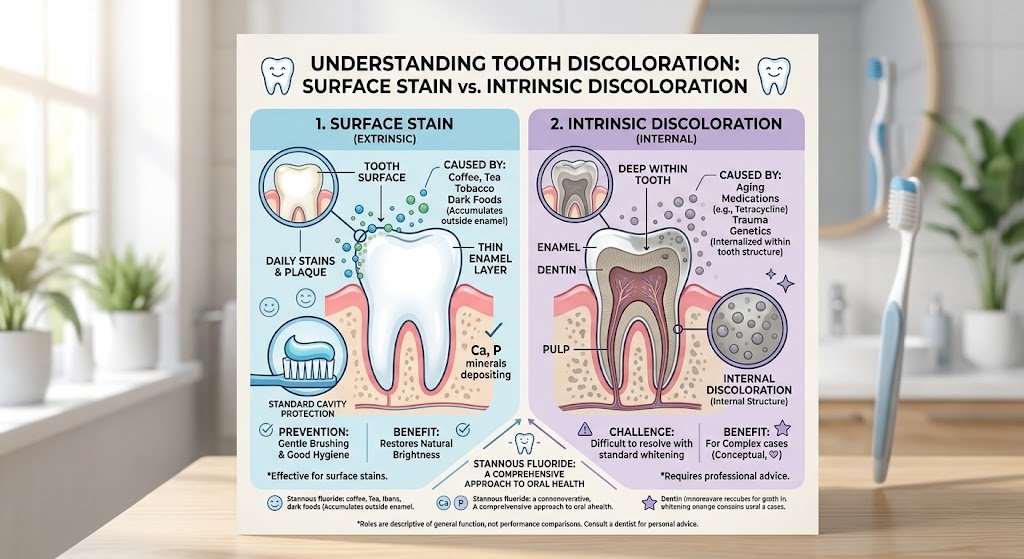
What Does “Non-Toxic” Mean in Toothpaste?
The first thing to understand is that “non-toxic toothpaste” is not a standardized clinical category.
A toothpaste marketed as natural, clean, or non-toxic may reflect a manufacturer’s formulation philosophy, but those terms alone do not establish that one toothpaste is objectively safer or more effective than another.
For an ingredient-conscious shopper, a more useful evaluation considers:
- The active ingredients
- The complete ingredient list
- The product’s intended purpose
- Fluoride status
- Whitening mechanism
- Sensitivity considerations
- Available evidence
- Manufacturer transparency
- Relevant third-party evaluation, such as the ADA Seal where applicable
This distinction matters because avoiding an ingredient and choosing an effective oral-care product are not always the same thing.
For example, some shoppers specifically prefer SLS-free toothpaste, while others prioritize fluoride because of its established role in cavity prevention. The ADA identifies fluoride as an anticaries ingredient and notes that U.S. over-the-counter fluoride toothpastes generally contain 1,000–1,500 ppm fluoride.
So rather than asking:
“Which toothpaste has the fewest chemicals?”
a more useful question is:
“Which formula provides the oral-health benefits I need while fitting my ingredient preferences?”
How Does Whitening Toothpaste Work?
Whitening toothpaste generally works through mechanical removal of surface stains.
The ADA explains that whitening toothpastes primarily rely on abrasives to remove extrinsic stains from the tooth surface. Some formulas also contain low levels of peroxide that can contribute to lightening tooth color.
This means whitening toothpaste is particularly relevant if your discoloration comes from regular exposure to:
- Coffee
- Tea
- Red wine
- Tobacco
- Dark-colored foods and beverages
- Accumulated surface staining
Surface stains vs. intrinsic discoloration
This is one of the most important distinctions to understand before buying a whitening toothpaste.
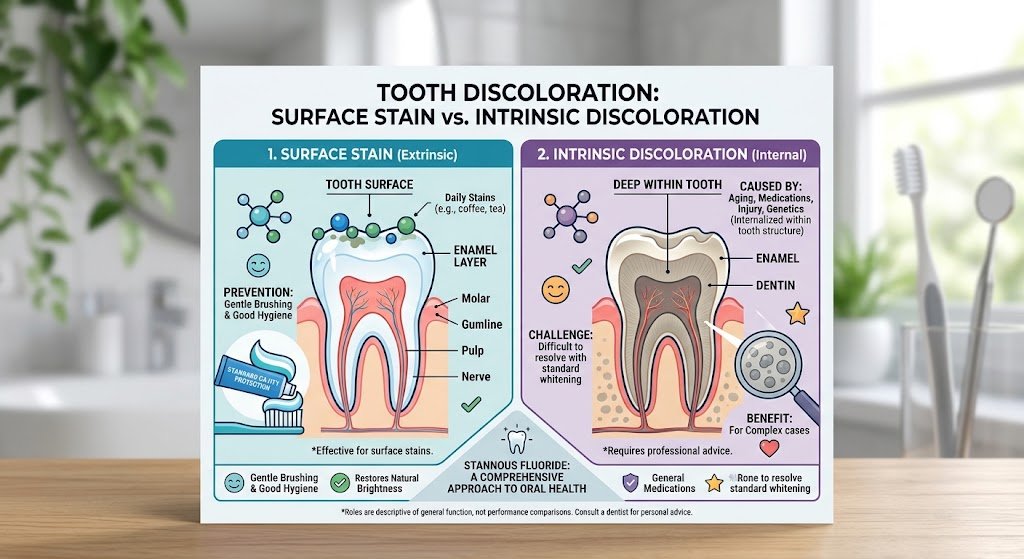
Extrinsic stains develop on or near the outer surface of the tooth. These can often be reduced through mechanical cleaning and professional cleaning procedures. Whitening toothpaste can be useful for this type of discoloration.
Intrinsic discoloration occurs within the tooth structure. Causes can include aging, certain medications or developmental conditions, fluorosis, dental disease, and other factors. Ordinary whitening toothpaste generally should not be expected to dramatically change this underlying tooth color.
That is why someone with heavy coffee staining may notice a useful cosmetic improvement from a whitening toothpaste, while someone with deep intrinsic discoloration may need a different approach.
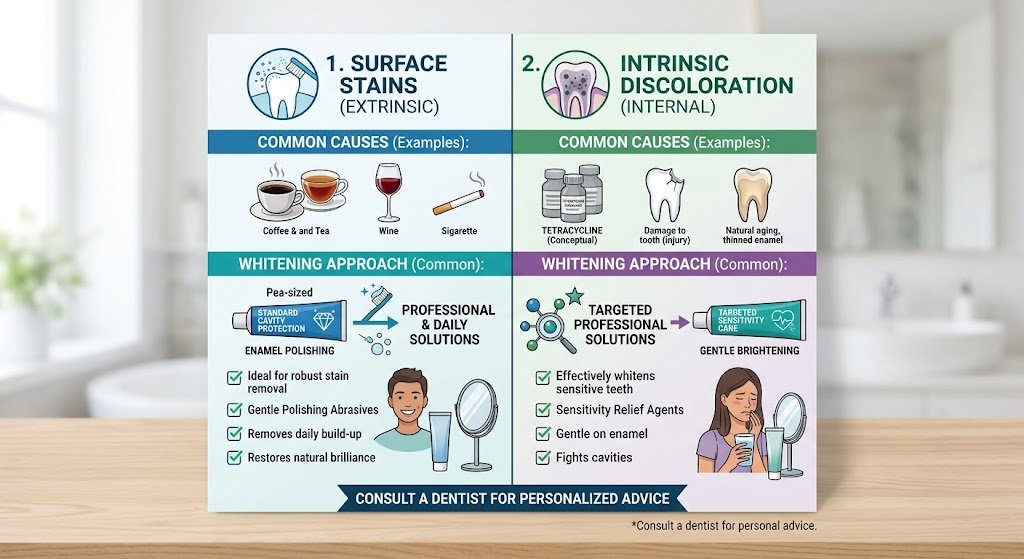
Whitening toothpaste is not the same as bleaching
This distinction is also important when evaluating Amazon product claims.
Peroxide-based bleaching treatments can chemically alter colored compounds within the tooth. Hydrogen peroxide and carbamide peroxide are commonly used for this purpose.
Whitening toothpaste, by comparison, is generally focused on cleaning and removing external stains.
So if your goal is simply to remove coffee or tea staining, a whitening toothpaste may be a reasonable everyday option.
If your goal is a substantial change in your natural tooth shade, toothpaste alone may not provide the result you expect.
What Should You Look for in a Non-Toxic Whitening Toothpaste?
Once you understand what whitening toothpaste can realistically do, the next step is evaluating the formula.
There is no single ingredient checklist that makes a toothpaste universally “non-toxic.” Instead, look at the attributes that actually affect your oral-health needs.
1. Fluoride
Fluoride deserves special attention because whitening and cavity prevention are separate considerations.
The ADA identifies sodium fluoride, sodium monofluorophosphate, and stannous fluoride as fluoride compounds used as anticaries agents in toothpaste. Fluoride toothpaste is also the most commonly used form of self-applied fluoride.
For U.S. consumers, over-the-counter fluoride toothpastes generally contain 1,000–1,500 ppm fluoride.
That does not mean every person must choose the same toothpaste. It means fluoride should be considered separately from marketing terms such as “natural” or “non-toxic.”
If preventing cavities is one of your priorities, don’t assume that a fluoride-free product is automatically a better choice simply because its ingredient list appears simpler.
If you specifically want to compare the two approaches, see:
2. Whitening ingredients
Look at how the product claims to whiten.
Whitening toothpastes commonly use abrasive ingredients to help physically remove surface discoloration. The ADA lists examples of toothpaste abrasives including modified silica abrasives, calcium carbonate, and other abrasive materials.
Some whitening products also contain peroxide.
The important point is that the ingredient should have a logical relationship to the product’s stated purpose.
A product does not become a better whitening toothpaste simply because its ingredient list is longer.
3. SLS
Sodium lauryl sulfate, or SLS, is a detergent used in some toothpaste formulas. It contributes to foaming and helps with the cleaning formulation.
Some consumers prefer to avoid SLS because of personal formulation preferences or because certain toothpaste ingredients can contribute to irritation in susceptible individuals.
The ADA notes that toothpaste ingredients, including SLS and various flavoring substances, can occasionally cause irritation or allergic reactions in some people.
If you specifically want to avoid SLS, check the ingredient list rather than relying on the front of the package.
4. Sensitivity-supporting ingredients
Whitening is not always comfortable for people with sensitive teeth.
If you already experience discomfort from cold drinks, hot foods, or brushing, an aggressive focus on whitening may not be your best starting point.
Some toothpaste formulations use ingredients intended to reduce dentin sensitivity. The ADA identifies potassium-containing and stannous-fluoride formulations among toothpaste approaches supported by evidence for reducing sensitivity.
This creates an important product-selection trade-off:
If whitening and sensitivity are both concerns, look for a product specifically formulated to address both rather than simply choosing the strongest whitening claim.
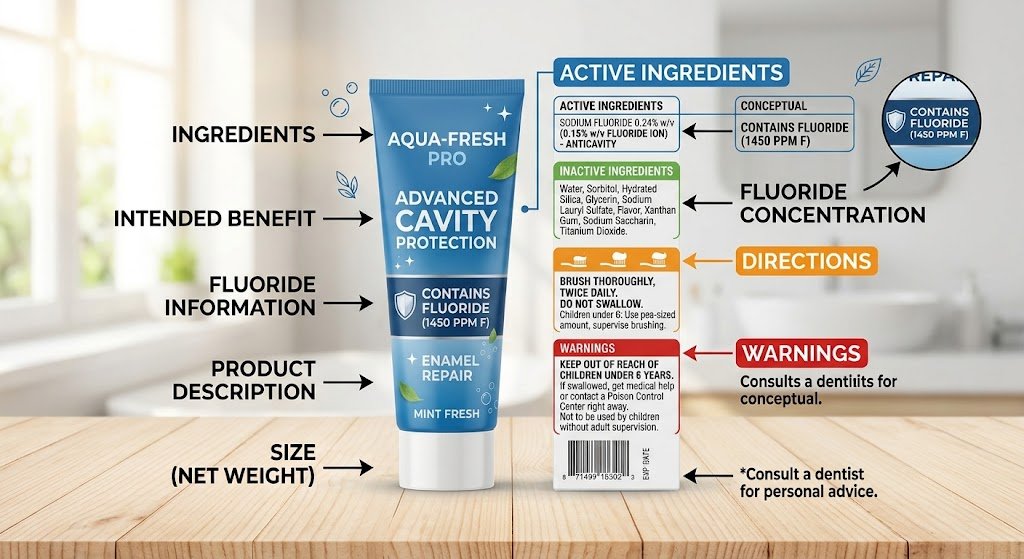
5. Ingredient transparency
A product should make it reasonably easy to determine what you are buying.
Look for:
- Active ingredients
- Inactive ingredients
- Fluoride concentration where applicable
- Directions
- Warnings
- Manufacturer information
- Specific claims supported by the product labeling
This is more useful than choosing a product solely because its packaging uses words such as “clean,” “pure,” or “natural.”
Best Types of Non-Toxic Whitening Toothpaste
There isn’t one formula that makes sense for every shopper.
Instead, think about the product according to the problem you’re trying to solve.
Best for ingredient-conscious shoppers who still want fluoride
If you want to pay attention to ingredients while retaining fluoride-based cavity protection, a fluoride-containing whitening toothpaste may fit your priorities.
One product worth investigating in this category is Tom’s of Maine Simply White, depending on the exact current formulation and variant.
Tom’s of Maine states that its Simply White product has received the ADA Seal of Acceptance. However, product variants can differ, so verify the exact package and formulation before making a purchase.
The important selection principle is not simply the brand name. Check the specific product variant, its active ingredient, whitening claims, and current ingredient list.
Best for people who prioritize sensitivity
If you have sensitive teeth and still want help with surface stains, look for a product that combines whitening with sensitivity-focused ingredients.
Sensodyne Extra Whitening is one example of this product category. The manufacturer’s U.S. product information describes it as a whitening toothpaste intended to remove stains while providing sensitivity protection and containing fluoride. Verify the current formulation and label before publication or purchase.
This type of recommendation is more useful than simply choosing the product with the strongest whitening language.
Best for shoppers who specifically want fluoride-free
Some consumers intentionally choose fluoride-free toothpaste.
Fluoride-free whitening products are available, including formulations that use ingredients such as hydrated silica, calcium carbonate, xylitol, glycerin, and other components.
One example is HELLO Antiplaque + Whitening Fluoride-Free Toothpaste, whose listed ingredients can be checked against the exact current product variant before publication.
However, fluoride-free should be treated as a personal formulation preference, not automatically as a synonym for safer.
If cavity prevention is a major concern, discuss the choice with your dentist.
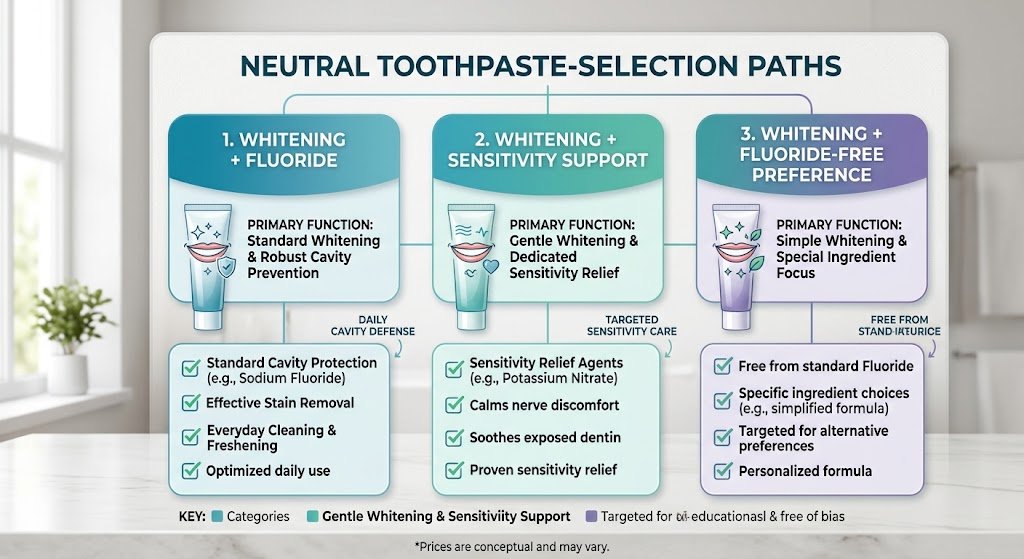
Quick Comparison: Which Type Fits You?
| Your priority | What to look for |
| Coffee or tea stains | Whitening formula designed for surface-stain removal |
| Cavity prevention | Fluoride toothpaste |
| SLS avoidance | Clearly labeled SLS-free formula |
| Sensitive teeth | Whitening toothpaste with sensitivity-focused ingredients |
| Ingredient-conscious shopping | Transparent ingredient list |
| Fluoride-free preference | Clearly labeled fluoride-free formula |
| Major shade change | Consider dedicated peroxide-based whitening rather than toothpaste alone |
| Deep or unusual discoloration | Dental evaluation may be more appropriate |
The goal is not to find the toothpaste with the most marketing claims.
The goal is to find the formula whose function, ingredients, and intended use match your needs.
Does a Natural Toothpaste Whiten Teeth?
It can, but the word natural does not itself describe a whitening mechanism.
A natural or ingredient-conscious toothpaste may contain abrasive ingredients capable of helping remove surface stains. Whether it actually performs well depends on the formulation.
That means two products can both be marketed as natural while having very different approaches to:
- Whitening
- Fluoride
- Sensitivity
- SLS
- Flavoring
- Abrasivity
- Cavity protection
For that reason, compare the actual product attributes rather than assuming that “natural” means better whitening.
What About Charcoal Whitening Toothpaste?
Charcoal is one of the most recognizable ingredients in “natural” or alternative whitening marketing.
But popularity is not the same as evidence.
The ADA currently states that there is insufficient evidence demonstrating that charcoal-based oral-care products provide measurable whitening benefits with adequate safety and effectiveness. The ADA also discusses concerns around abrasive DIY charcoal approaches.
So if your goal is whitening, don’t choose charcoal solely because the product looks more natural or powerful.
Evaluate the actual whitening mechanism and available evidence.
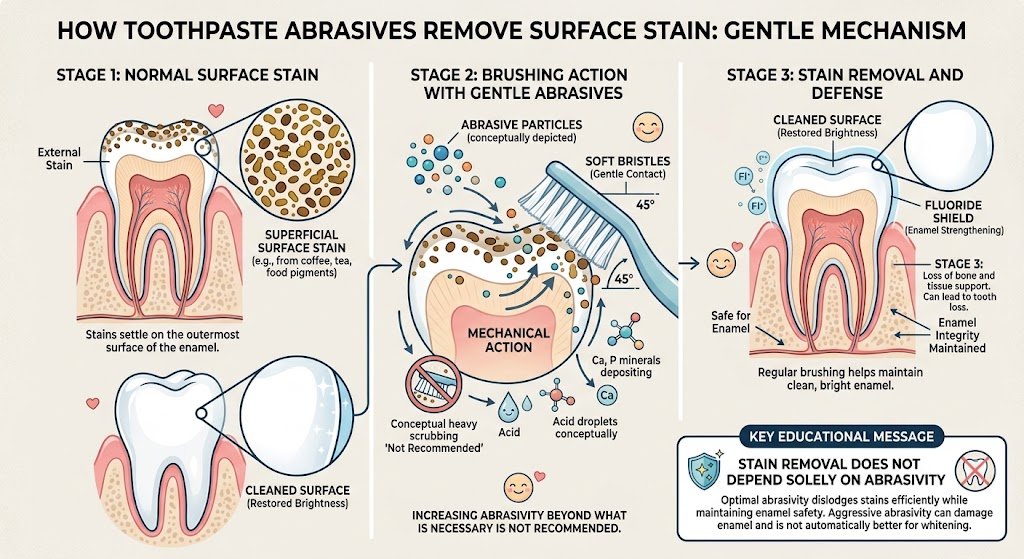
Is More Abrasive Toothpaste Better for Whitening?
No.
Abrasives can help remove external stains, but increasing abrasivity does not mean a toothpaste will provide unlimited whitening.
The ADA explains that Relative Dentin Abrasivity, or RDA, is a standardized measure used to quantify dentifrice abrasivity. It also notes that dentifrices at or below an RDA of 250 are considered safe and effective and that RDA should not simply be used to rank toothpaste safety.
This is important because shoppers sometimes assume:
More abrasive = more whitening = better product.
That is too simplistic.
The useful question is whether the toothpaste can help remove surface stains while remaining appropriate for your teeth and brushing habits.
If you have concerns about enamel wear, exposed dentin, or gum recession, product selection should take those factors into account.
How to Choose the Right Whitening Toothpaste
Use this simple process before buying.
Step 1: Identify the type of discoloration
Ask what you actually want to improve.
Is it:
- Coffee staining?
- Tea staining?
- Tobacco staining?
- General surface discoloration?
- A naturally darker tooth shade?
- A single unusually dark tooth?
Whitening toothpaste makes the most sense when the problem is primarily surface staining.
A single tooth that changes color unexpectedly is a different situation and deserves professional evaluation.
Step 2: Decide whether fluoride matters to you
If cavity prevention is important, consider fluoride-containing toothpaste.
If you specifically prefer fluoride-free toothpaste, understand that this is a separate decision from whether the formula is “clean.”
The ADA identifies fluoride toothpaste as an important self-applied source of topical fluoride and notes that common U.S. OTC fluoride toothpastes contain 1,000–1,500 ppm fluoride.
Step 3: Consider sensitivity
If your teeth are already sensitive, don’t assume that a more aggressive whitening formula will produce a better overall result.
A sensitivity-focused whitening toothpaste may be more appropriate.
Step 4: Read the actual ingredient list
Don’t make your decision from the front label alone.
Check:
- Active ingredients
- Fluoride status
- Whitening ingredients
- SLS
- Flavoring ingredients
- Other ingredients you personally prefer to avoid
Step 5: Set realistic whitening expectations
This may be the most important step.
Whitening toothpaste is mainly a surface-stain management product.
If you expect it to transform the natural color of your teeth several shades, you may be disappointed.
The ADA explains that whitening toothpastes primarily remove extrinsic surface stains, while peroxide-based bleaching products are used to chemically lighten tooth color.
Best Non-Toxic Whitening Toothpaste: What to Look For and How to Choose
If you want whiter teeth without choosing a toothpaste simply because it says “natural,” “clean,” or “non-toxic” on the package, the better approach is to look at how the toothpaste removes stains, what active ingredients it uses, how abrasive it is, and whether it still supports everyday oral health.
The important thing to understand is that “non-toxic toothpaste” is not a standardized dental category or certification. In this guide, we use the term as a practical shopping preference: a toothpaste with transparent labeling, sensible ingredient choices, appropriate oral-health protection, and a formula that fits your individual tolerance and whitening goals.
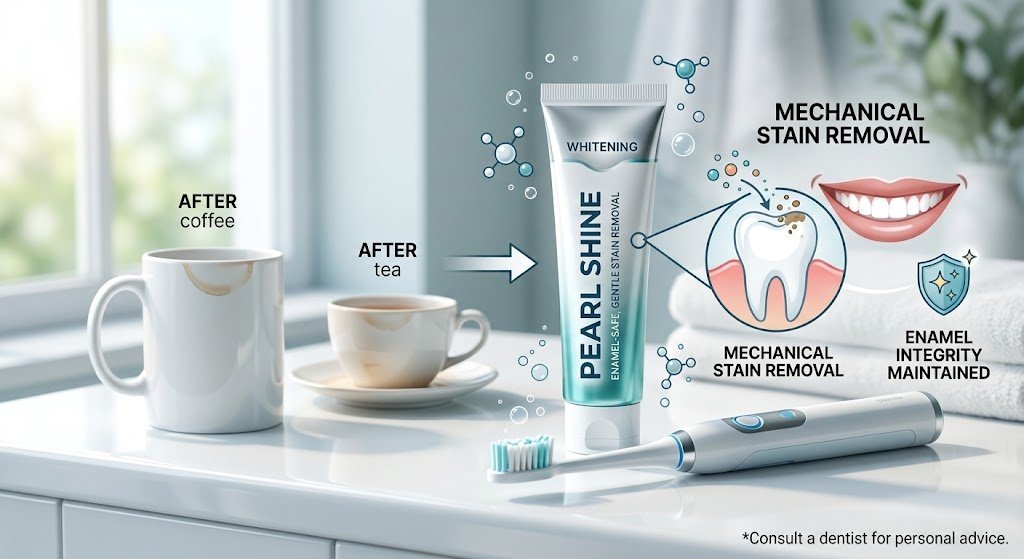
For most people, the right whitening toothpaste should focus on removing surface stains while protecting teeth and gums during normal brushing. Whitening toothpaste generally works mainly on extrinsic, or surface, stains rather than dramatically changing the natural color of the tooth.
What Does “Non-Toxic Whitening Toothpaste” Actually Mean?
The phrase “non-toxic” sounds straightforward, but toothpaste does not have one universally recognized definition of “non-toxic.”
Instead of judging a toothpaste by marketing language alone, consider several separate questions:
- Does it contain an evidence-supported cavity-protection active?
- How does it remove surface stains?
- Is the formula unnecessarily abrasive?
- Does it contain ingredients that personally irritate your mouth?
- Is the complete ingredient list easy to find?
- Does the manufacturer make specific, supportable claims?
- Does the product have credible third-party or professional evidence where applicable?
This approach is more useful than assuming that an ingredient is automatically unsafe simply because it sounds synthetic—or automatically safe because it is plant-derived.
“Natural,” “Clean,” “Fluoride-Free,” and “SLS-Free” Are Not the Same
These terms are often grouped together in toothpaste marketing, but they describe different characteristics.
Natural usually refers to the source or marketing positioning of ingredients.
Clean is generally a marketing term rather than a standardized dental safety classification.
Fluoride-free tells you that the toothpaste does not use fluoride as its anticaries active. It does not automatically tell you that every other ingredient is safer or more effective.
SLS-free means the formula does not contain sodium lauryl sulfate. SLS can be an irritant for some people, but that is different from saying that SLS-containing toothpaste is inherently toxic. Toothpaste formulas can contain detergents such as SLS, and individual tolerance varies.
How Does Whitening Toothpaste Actually Whiten Teeth?
Before choosing a product, it helps to understand what “whitening” means in the context of toothpaste.
There are two broad types of tooth discoloration: extrinsic stains and intrinsic discoloration.
Surface Stains: Where Whitening Toothpaste Can Help
Extrinsic stains develop on the outside of the tooth and can be associated with things such as coffee, tea, tobacco, and other staining substances.
Whitening toothpastes primarily work by helping remove these surface stains, usually through their abrasive ingredients. Some whitening toothpastes may also contain low levels of peroxide.
That means a whitening toothpaste can make teeth look cleaner and brighter by reducing surface staining, but it should not be confused with professional bleaching.
Intrinsic Discoloration Is Different
Intrinsic discoloration occurs within the tooth structure.
Whitening toothpaste is generally less effective against this type of discoloration because simply removing surface deposits does not substantially change the internal color of the tooth. Deeper discoloration may require a different whitening approach, such as peroxide-based bleaching products or professional dental treatment.
What Should You Look for in a Non-Toxic Whitening Toothpaste?
There is no single ingredient combination that makes a toothpaste the best choice for everyone. Instead, compare products using several criteria.
1. Look at the Fluoride Status
For people who want everyday cavity protection, fluoride deserves serious consideration.
The American Dental Association states that fluoride toothpaste is the most commonly used form of self-applied fluoride. Common fluoride actives in US toothpaste include sodium fluoride, sodium monofluorophosphate, and stannous fluoride.
So if your main goal is:
Whitening + cavity protection, look for a toothpaste with an appropriate fluoride active.
If your priority is specifically:
Fluoride-free + whitening, you can compare fluoride-free formulas, but don’t assume that “fluoride-free” automatically means better for cavity prevention.
2. Check How the Toothpaste Removes Stains
A whitening toothpaste may rely primarily on abrasives to remove surface stains. Common toothpaste formulations use abrasive ingredients to help clean teeth and physically remove deposits.
The important question isn’t simply:
“Is it abrasive?”
Instead, ask:
“Is the level of abrasivity appropriate for regular use?”
More aggressive cleaning isn’t automatically better whitening.
If you drink coffee or tea regularly and mainly have surface staining, a toothpaste designed for stain removal may make sense. But repeatedly choosing an unnecessarily abrasive product isn’t a good substitute for good brushing technique.
3. Consider Abrasivity and RDA
RDA stands for Relative Dentin Abrasivity and is a standardized way of describing the abrasivity of dentifrices.
The ADA explains that dentifrices at or below 250 RDA are considered safe and effective, and that proper lifelong use of products at 250 RDA or below produces limited dentin wear and virtually no enamel wear.
However, RDA should not be treated as a simple “higher number = toxic” scale.
It is specifically a measure related to abrasivity—not an overall score for toothpaste safety.
4. Pay Attention to Your Sensitivity
Whitening products can be uncomfortable for people who already experience tooth sensitivity.
If sensitivity is one of your concerns, don’t automatically choose the strongest-looking whitening formula. Instead, look for a product that balances stain removal with ingredients and a formulation appropriate for sensitive teeth.
For example, potassium nitrate is an ingredient used in some sensitivity toothpastes, while stannous fluoride can also be used in toothpaste formulations with oral-health benefits.
5. Decide Whether You Want SLS-Free
Sodium lauryl sulfate, or SLS, is a detergent used in some toothpaste formulations.
If you personally experience irritation with certain toothpaste formulas, an SLS-free product may be worth considering.
But there is an important distinction:
SLS-free does not automatically mean non-toxic, and SLS-containing toothpaste should not automatically be described as toxic.
The better buying decision is based on your individual tolerance and the complete formulation.
6. Consider Hydroxyapatite If You Prefer a Fluoride Alternative
Hydroxyapatite is another active ingredient found in some modern toothpaste formulas.
Consumers interested in “non-toxic,” mineral-based, or fluoride-free toothpaste sometimes specifically look for hydroxyapatite.
However, don’t assume that every hydroxyapatite toothpaste provides identical benefits. Look at the actual formula, concentration where disclosed, intended use, evidence supporting the specific product or ingredient, and whether the toothpaste fits your cavity-prevention priorities.
Best Non-Toxic Whitening Toothpaste by Need
Rather than claiming that one toothpaste is universally “the best,” it is more useful to match the formula to the reason you are buying it.
Best Overall Type: Whitening + Evidence-Based Oral Protection
For a general-purpose choice, look for a formula that combines:
- Effective surface-stain removal
- An appropriate anticaries active
- A reasonable abrasivity level
- A transparent ingredient list
- Clear directions for use
- Claims that can be independently evaluated
For people who want fluoride protection, a fluoride whitening toothpaste can combine everyday cavity protection with surface-stain removal.
[ AMAZON PRODUCT SLOT — Insert a currently verified US Amazon product that matches these criteria. Verify the current formulation, active ingredient, directions, and product listing before publishing. ]
Best Type for Sensitive Teeth
If your teeth are sensitive, prioritize comfort over aggressive whitening.
Look for:
- A formula intended for sensitive teeth
- Appropriate sensitivity-focused ingredients
- Reasonable stain-removal performance
- Instructions that support normal use
- Avoiding unnecessarily aggressive whitening routines
If whitening consistently causes significant discomfort, continuing to increase whitening intensity isn’t necessarily the right solution.
[ AMAZON PRODUCT SLOT — Insert a currently verified sensitivity-focused whitening toothpaste. Verify current ingredients and claims. ]
Best SLS-Free Whitening Type
For people who specifically want to avoid SLS, compare SLS-free whitening formulas.
The key is to evaluate the whole formulation, rather than treating the absence of SLS as proof that the product is safer in every respect.
[ AMAZON PRODUCT SLOT — Insert a currently verified SLS-free whitening toothpaste. Verify current ingredient list. ]
Best Fluoride-Free Whitening Type
Some shoppers specifically prefer fluoride-free toothpaste.
If that’s your preference, focus on ingredient transparency and understand what the product is intended to provide.
If cavity prevention is an important priority, discuss fluoride alternatives and your individual oral-health needs with a dental professional rather than assuming that all fluoride-free products provide equivalent anticaries protection.
[ AMAZON PRODUCT SLOT — Insert a currently verified fluoride-free whitening toothpaste. Verify current formula and product claims. ]
Best Hydroxyapatite Whitening Type
Hydroxyapatite-based whitening toothpaste may appeal to shoppers who want a mineral-based alternative to conventional fluoride toothpaste.
When comparing these products, examine:
- Hydroxyapatite type
- Whether the product is fluoride-free
- Stain-removal ingredients
- Abrasivity information when available
- Full ingredient list
- Manufacturer claims
- Directions for use
[ AMAZON PRODUCT SLOT — Insert a currently verified hydroxyapatite whitening toothpaste. Verify current formulation and claims. ]
Ingredients and Claims to Be Careful With
“Non-toxic” shopping should not become an exercise in avoiding every unfamiliar ingredient.
Instead, pay attention to what the ingredient does, why it is included, and whether the complete formula makes sense for your needs.
Charcoal Whitening Claims
Charcoal toothpaste is often marketed around whitening or “detox” concepts.
The ADA notes that there is insufficient evidence that charcoal toothpaste provides adequate safety and effectiveness, and charcoal products may be abrasive.
That makes charcoal a category where marketing claims deserve particularly careful scrutiny.
Vague “Detox” or “Chemical-Free” Claims
Be cautious when a product relies heavily on broad phrases such as:
- “Chemical-free”
- “Toxin-free”
- “Detoxifying”
- “100% safe”
- “Zero chemicals”
Toothpaste is made of chemicals in the scientific sense—including water and naturally occurring substances.
A better question is:
What are the actual ingredients, what function does each serve, and what evidence supports the product’s specific claims?
Essential Oils and Strong Flavoring
Some toothpaste formulas contain essential oils or flavoring agents.
These ingredients are not automatically harmful, but the ADA notes that some toothpaste ingredients—including essential oils and flavoring ingredients—can cause irritation or allergic reactions in some people.
If a particular toothpaste repeatedly causes burning, irritation, or another uncomfortable reaction, changing formulas may be appropriate and persistent symptoms should be discussed with a dental professional.
How to Compare Non-Toxic Whitening Toothpaste on Amazon
Once you have narrowed your choices to a few products, don’t choose based only on the product title or star rating. Toothpaste listings can use similar marketing language while having very different active ingredients and formulations.
Use this checklist before adding a product to your shortlist.
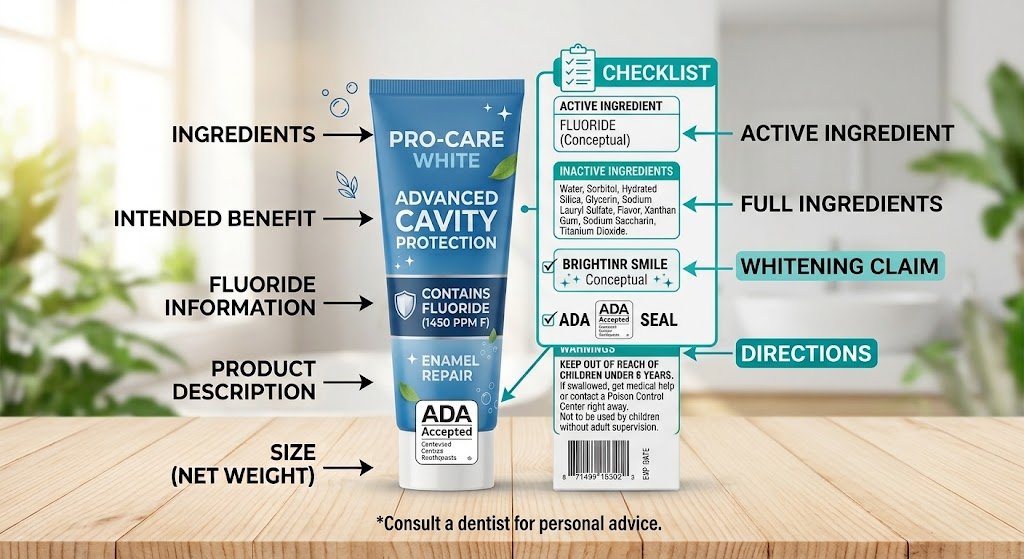
1. Verify the Active Ingredient
Start by checking the Drug Facts panel or product information.
If cavity protection matters to you, identify whether the toothpaste contains a fluoride active such as sodium fluoride, sodium monofluorophosphate, or stannous fluoride. These are among the fluoride actives used in US toothpaste.
If the product is fluoride-free, identify what active ingredient or ingredients the manufacturer uses instead and what claims the product actually makes.
2. Read the Full Ingredient List
Don’t stop at phrases such as “natural whitening” or “clean formula.”
Look at the complete ingredient list and consider:
- Whitening or stain-removal ingredients
- Fluoride or fluoride-free status
- Hydroxyapatite, if used
- Detergents such as SLS
- Flavoring ingredients
- Essential oils
- Sweeteners
- Abrasive ingredients
- Other ingredients relevant to your personal sensitivities
The ADA notes that toothpaste formulations commonly contain several functional ingredient groups, including abrasives, detergents, humectants, binders, sweeteners, and—in some products—peroxide.
3. Look for the ADA Seal When Relevant
The ADA Seal of Acceptance is voluntary. Products that receive the Seal are evaluated against requirements related to their claimed benefits, safety, and effectiveness.
For whitening products, the ADA has categories covering stain removal and tooth bleaching claims.
However, the Seal should not be interpreted as meaning that one product is universally better than every other toothpaste. It indicates that the product has met the ADA’s requirements for its intended claims.
If a product displays an ADA Seal claim, verify the current product information rather than relying on an old image or third-party description.
4. Check Abrasivity Information When Available
If whitening is your main reason for buying the toothpaste, abrasivity is worth considering.
Abrasives can help physically remove surface stains, but more aggressive abrasion isn’t automatically equivalent to better whitening. The ADA explains that RDA is a standardized abrasivity measure and should not be interpreted as an overall toothpaste safety score.
If a manufacturer provides reliable abrasivity information, use it as one factor in your comparison rather than the only deciding factor.
5. Read the Directions
Even a suitable toothpaste should be used according to its directions.
Pay attention to:
- Recommended brushing frequency
- Amount to use
- Age restrictions
- Warnings
- Whether the product is intended for everyday use
- Any instructions related to sensitivity
Don’t assume that using more toothpaste or brushing harder will produce faster whitening.
6. Treat Customer Reviews as Experience Data, Not Clinical Evidence
Amazon reviews can help identify practical issues such as:
- Strong flavor
- Texture
- Packaging problems
- Irritation reported by some users
- Whether people noticed changes in surface staining
But reviews are not a substitute for controlled evidence.
A product with thousands of reviews isn’t automatically more effective at whitening than a product with fewer reviews.
7. Verify the Current Formulation
Product formulations and packaging can change.
Before publishing an affiliate recommendation, verify the current listing, current ingredient information, active ingredients, size, directions, and claims.
This is particularly important for affiliate content because an article can become inaccurate when an old product formulation remains in the content after the manufacturer changes it.
When Whitening Toothpaste Isn’t Enough
Whitening toothpaste is most useful when your concern is primarily surface staining.
It may not provide the result you expect if the discoloration is deeper or has another cause.
Intrinsic Tooth Discoloration
Because whitening toothpaste primarily removes surface stains, it is not equivalent to bleaching treatment for deeper discoloration.
If your goal is to noticeably change the underlying shade of natural teeth, a different whitening approach may be more appropriate.
Crowns, Veneers, and Other Restorations
Whitening toothpaste is designed for natural tooth surfaces and surface stains. Dental restorations such as crowns and veneers do not necessarily respond to whitening in the same way as natural teeth.
If you have visible restorations and are considering a significant whitening treatment, ask your dentist how the treatment could affect the overall shade match.
Persistent Sensitivity or Pain
Temporary sensitivity can occur with tooth-whitening treatments, and gingival irritation is also a recognized adverse effect of vital tooth whitening.
But persistent or significant pain shouldn’t simply be treated as a normal whitening problem.
If you experience unexplained tooth pain, persistent sensitivity, gum problems, or a sudden change in tooth color, consider getting professional dental advice before continuing a whitening routine.
Non-Toxic Whitening Toothpaste Buying Checklist
Before purchasing, run through this quick checklist:
☐ Whitening goal: Are you trying to remove surface stains or change your underlying tooth color?
☐ Fluoride: Do you want fluoride for cavity protection, or are you intentionally choosing a fluoride-free formula?
☐ Active ingredients: Have you checked the actual active ingredient rather than relying on marketing language?
☐ Abrasivity: Is the formula appropriate for regular use?
☐ Sensitivity: Do you need a formula designed around sensitivity?
☐ SLS: Are you avoiding SLS because of a personal preference or because you have experienced irritation?
☐ Hydroxyapatite: Is this an ingredient you specifically want?
☐ Ingredient transparency: Can you easily find the complete ingredient list?
☐ Evidence: Are the product’s specific claims supported by credible evidence?
☐ Directions: Have you checked how the manufacturer says to use it?
☐ Current listing: Are the product details and formulation current?
This checklist is more reliable than choosing a toothpaste simply because its package uses the words “natural,” “clean,” or “non-toxic.”
FAQ: Best Non-Toxic Whitening Toothpaste
Is non-toxic whitening toothpaste safe?
“Non-toxic” is not a standardized toothpaste safety category, so the phrase alone cannot establish whether a product is safe or effective.
Instead, evaluate the complete formulation, active ingredients, intended use, evidence behind its claims, and your individual tolerance.
If you experience persistent irritation or other concerning symptoms, consult a dental professional.
Does whitening toothpaste actually whiten teeth?
Yes, but its whitening effect is mainly associated with removing extrinsic surface stains.
Whitening toothpaste generally does not provide the same type of deeper color change as peroxide-based bleaching treatments.
Is fluoride toothpaste toxic?
Fluoride is an established anticaries active used in toothpaste.
In the US, common fluoride toothpaste actives include sodium fluoride, sodium monofluorophosphate, and stannous fluoride.
The word “non-toxic” should therefore not be used as a shortcut for “fluoride-free.” A more useful comparison is whether the product’s active ingredients and formulation match your oral-health needs.
Is SLS bad for your teeth?
SLS is a detergent used in some toothpaste formulas.
The ADA notes that some toothpaste ingredients, including SLS and certain flavoring ingredients, can cause irritation or allergic reactions in some individuals.
That does not mean SLS-containing toothpaste is automatically unsafe for everyone.
If you personally have problems with a particular formula, an SLS-free toothpaste may be worth trying.
Is hydroxyapatite better than fluoride?
These are different approaches to toothpaste formulation, and “better” depends on what you’re trying to achieve.
Fluoride has an established role in cavity prevention and is widely used in toothpaste.
Hydroxyapatite is used in some toothpaste formulas, including products positioned as fluoride alternatives.
Rather than choosing based on the word “natural,” compare the evidence, intended benefit, formulation, and your individual oral-health priorities.
Can whitening toothpaste damage enamel?
Whitening toothpastes commonly use abrasives to help remove surface stains.
Abrasivity therefore matters, particularly when a product is used regularly. The ADA describes RDA as a standardized measure of dentifrice abrasivity and states that dentifrices at or below 250 RDA are considered safe and effective when properly used.
Don’t assume that a toothpaste marketed as “extra whitening” is automatically better simply because it provides stronger stain removal.
What is the best whitening toothpaste for sensitive teeth?
There is no single formula that is best for every person with sensitivity.
A practical approach is to look for a toothpaste designed for sensitivity, avoid unnecessarily aggressive whitening routines, and consider ingredients used for sensitivity management.
If sensitivity is persistent, severe, or unexplained, professional dental evaluation is more appropriate than continually switching whitening products.
Does charcoal toothpaste whiten teeth?
Charcoal toothpaste is often marketed for whitening, but the ADA states that there is insufficient evidence to establish adequate safety and effectiveness for charcoal toothpaste, and charcoal products may be abrasive.
For that reason, charcoal should not be treated as automatically superior simply because it is marketed as a natural whitening ingredient.
How often should I use whitening toothpaste?
Follow the product’s directions rather than assuming that more frequent or harder brushing will produce faster results.
Your ideal routine also depends on the particular formulation, your oral-health needs, and whether you experience sensitivity or irritation.
Can whitening toothpaste whiten crowns or veneers?
Whitening toothpaste can help remove surface stains from teeth, but dental restorations do not necessarily whiten in the same way as natural teeth.
If you have crowns, veneers, bonding, or other visible restorations and want to change your overall smile shade, discuss the options with your dentist first.
Final Verdict: How to Choose a Non-Toxic Whitening Toothpaste
The best way to shop for a non-toxic whitening toothpaste is to move beyond the marketing label.
Start with your actual goal.
If you mainly want to remove coffee, tea, or other surface stains, look for a toothpaste with appropriate stain-removal characteristics and a formulation suitable for regular brushing.
If cavity prevention is important, consider an evidence-backed fluoride toothpaste.
If you have sensitivity, prioritize a comfortable formulation rather than simply choosing the most aggressive whitening product.
If you prefer SLS-free or fluoride-free toothpaste, treat those as specific formulation preferences—not automatic proof that a product is safer or more effective for everyone.
And if you are considering hydroxyapatite, charcoal, essential oils, or other “natural” ingredients, evaluate the actual evidence and complete formulation instead of relying on broad marketing claims.
Ultimately, a good non-toxic whitening toothpaste should be judged by what it contains, what it is designed to do, how it fits your oral-health needs, and how transparent the manufacturer is about its claims.
