If your gums are red, swollen, tender, or bleed when you brush, choosing the right toothpaste can feel confusing. There are products marketed for gum health, plaque control, sensitivity, tartar, whitening, and general oral care—but not all of them are designed for the same purpose.
The best toothpaste for gingivitis is generally one that fits your specific oral-health needs while supporting effective plaque control and daily brushing. Ingredients matter, especially the active ingredient, but toothpaste is only one part of gum care. Brushing properly and cleaning between your teeth are also important.
For many people looking for a toothpaste specifically aimed at gum health, stannous fluoride is worth considering because it combines fluoride’s cavity-protection role with evidence supporting benefits related to plaque and gingivitis. However, it is not automatically the right choice for everyone.
In this guide, we’ll explain what to look for, compare important toothpaste ingredients, show how to choose based on your situation, and explain when changing toothpaste is not enough and you should see a dental professional.
What Is Gingivitis?
Gingivitis is inflammation of the gums, commonly associated with the buildup of dental plaque around the gumline. Plaque is a sticky film containing bacteria that develops on teeth. If it is not removed regularly, it can irritate the gums and contribute to inflammation.
Common signs can include:
- Red or swollen gums
- Gums that bleed during brushing or flossing
- Tender or irritated gums
- Persistent bad breath
- Changes in how the gums look around the teeth
Gingivitis is important to address because it can affect the health of the tissues surrounding your teeth. The good news is that plaque-related gingivitis is generally considered an early form of gum disease and can often be improved with better daily oral hygiene.
However, not every case of bleeding or swollen gums is simply a toothpaste problem.
Common Signs of Gingivitis
The most recognizable sign is often bleeding gums, especially when brushing or cleaning between teeth. But bleeding alone does not tell you exactly why your gums are bleeding.
Other signs can include:
- Red rather than healthy-looking pink gum tissue
- Swelling around the teeth
- Gum tenderness
- Bad breath
- Increased plaque around the gumline
If these symptoms continue despite improving your oral-hygiene routine, it is worth getting professional advice rather than repeatedly switching toothpaste.
Gingivitis vs. Periodontitis
Gingivitis and periodontitis are not the same condition.
Gingivitis involves inflammation of the gums and is commonly associated with plaque. Periodontitis is a more advanced form of gum disease that can affect the tissues and bone supporting the teeth.
This distinction matters when choosing toothpaste.
A toothpaste can be a useful part of an oral-hygiene routine, but it should not be presented as a replacement for professional treatment of established periodontal disease.
If you have persistent bleeding, gum recession, loose teeth, significant swelling, pain, or other concerning symptoms, a dental examination is more important than finding a different toothpaste.
Can Toothpaste Actually Help Gingivitis?
Yes, the right toothpaste can support gum health, but it is important to understand what “help” means.
Toothpaste works alongside brushing to help remove plaque and deliver active ingredients to the mouth. Some formulations are designed specifically around plaque control or gum-health benefits.
But toothpaste does not replace the mechanical removal of plaque.
If plaque remains around the gumline or between the teeth, simply choosing a more expensive toothpaste will not solve the underlying problem.
Toothpaste is one part of plaque control
A useful gum-care routine generally involves:
- Brushing your teeth regularly with an appropriate toothpaste.
- Cleaning between your teeth.
- Using a toothbrush with an appropriate technique and pressure.
- Paying attention to areas around the gumline.
- Having professional dental care when necessary.
The National Institute of Dental and Craniofacial Research explains that plaque buildup can contribute to gingivitis and emphasizes daily brushing and cleaning between the teeth as part of oral hygiene. [ add a link ]
What toothpaste can contribute
Depending on the formulation, toothpaste may provide:
- Fluoride for cavity protection
- Ingredients designed to help with plaque control
- Ingredients associated with gum-health benefits
- Tartar-control benefits
- Sensitivity relief
- Whitening or surface-stain removal
These benefits are not interchangeable.
For example, a toothpaste can be excellent for whitening without being the most appropriate choice for someone whose main concern is inflamed or bleeding gums.
What toothpaste cannot do
Toothpaste cannot simply brush away hardened tartar once it has formed.
Tartar, also called calculus, is hardened dental plaque that cannot normally be removed through ordinary brushing and flossing. Professional dental cleaning may be necessary.
That distinction is important because someone with significant tartar buildup may think they need a stronger toothpaste when the more appropriate solution is professional cleaning.
What Ingredients Should You Look for in Toothpaste for Gingivitis?
When shopping for toothpaste for gingivitis, the ingredient list deserves more attention than the front of the package.
The most useful starting point is the active ingredient.
A toothpaste may advertise itself as “gum care,” “complete care,” “deep clean,” or “healthy gums,” but these marketing terms do not tell you everything about how the formula works.
Stannous Fluoride
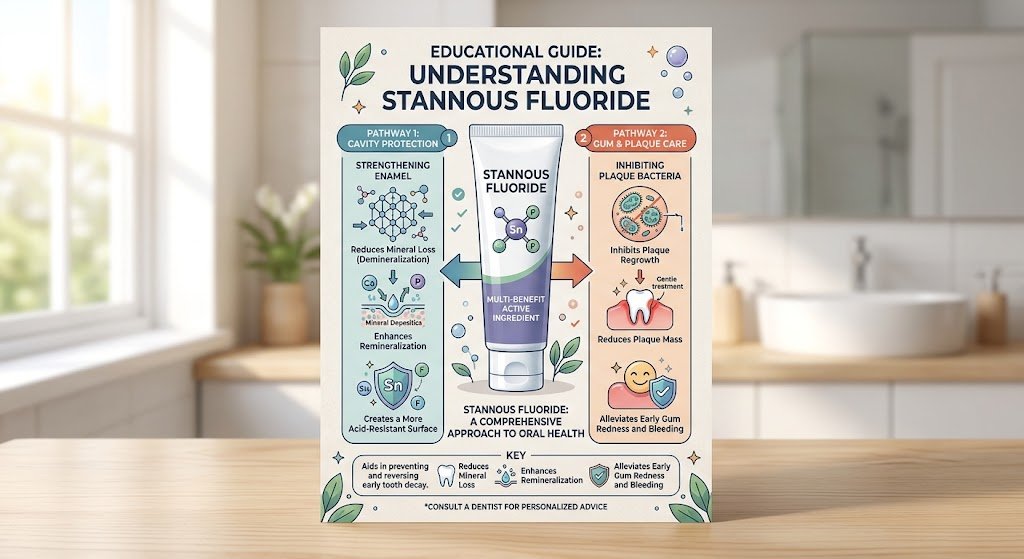
Stannous fluoride is one of the most relevant ingredients to consider when your priorities include both cavity protection and gum health.
It is a fluoride compound used in toothpaste and provides fluoride for anticaries protection. It has also been studied for effects related to plaque and gingivitis.
The American Dental Association recognizes stannous fluoride among fluoride ingredients used in toothpaste and discusses evidence for certain antimicrobial toothpaste ingredients in oral care. [ add a link ]
A systematic review of stabilized stannous fluoride dentifrice also found evidence supporting reductions in plaque and gingivitis compared with non-antimicrobial fluoride dentifrices. [ add a link ]
That does not mean every toothpaste containing stannous fluoride will produce identical results for every person. Formulation, brushing habits, frequency of use, and individual oral health still matter.
Why stannous fluoride can be attractive for gum care
It can potentially address more than one common toothpaste goal:
- Cavity protection
- Daily plaque control
- Gum-health support
That combination makes it particularly relevant to people who want one everyday toothpaste rather than separate products for every concern.
Other Fluoride Ingredients
Stannous fluoride is not the only fluoride used in toothpaste.
Other common fluoride compounds include:
- Sodium fluoride
- Sodium monofluorophosphate
The important point is that fluoride type and gum-health positioning are separate considerations.
Fluoride is primarily important because of its role in cavity prevention. A toothpaste can contain fluoride without being specifically positioned as a gingivitis-focused product.
So if you are comparing two toothpastes, ask two different questions:
Does this toothpaste provide appropriate cavity protection?
and:
Does its formulation also address my gum-health concerns?
Those questions can lead you toward different products depending on your needs.
Best Toothpaste for Gingivitis: What We Look For
Before recommending a toothpaste for gingivitis, it helps to define what “best” actually means.
There is no single toothpaste that is automatically best for every person with gum inflammation.
Instead, a useful evaluation should consider several factors.
1. Active ingredients
The active ingredient should match the primary goal of the toothpaste.
For gum-health-focused shoppers, stannous fluoride may deserve particular attention.
For cavity prevention, an appropriate fluoride active is important.
For sensitivity, a product containing a recognized sensitivity-focused ingredient may be more appropriate.
2. Plaque-control purpose
Because plaque is closely connected with gingivitis, a toothpaste intended to support plaque control makes more sense for this search intent than choosing a product based only on whitening claims.
3. Cavity protection
Gum health should not be considered separately from overall oral health.
A toothpaste can be selected for gingivitis while still providing daily cavity protection.
4. Your other dental concerns
The best choice may change if you also have:
- Sensitive teeth
- Frequent surface staining
- Bad breath
- High cavity risk
- Tartar buildup
- Ingredient preferences
This is why a “best for everyone” ranking can be less useful than recommendations based on different situations.
5. Evidence and transparency
A strong recommendation should be based on identifiable product characteristics rather than marketing language alone.
Where applicable, the ADA Seal of Acceptance can provide an additional point of reference because products carrying the Seal are evaluated against specific requirements for safety and efficacy. [ add a link ]
6. Product limitations
Every product recommendation should have a reason not to choose it.
For example:
- A gum-focused toothpaste may not be your first choice if sensitivity is your biggest issue.
- A whitening-focused toothpaste may not be ideal if gum irritation is your primary concern.
- A fluoride-free product may not match your cavity-prevention needs.
- A heavily flavored formula may be unsuitable if you are sensitive to certain ingredients.
The goal is not to find a universally perfect toothpaste.
The goal is to find the best fit for your oral-health needs.
Best Toothpaste for Gingivitis: Our Top Picks
The product section should be based on current product formulations and availability, rather than assuming that a product remains unchanged over time.
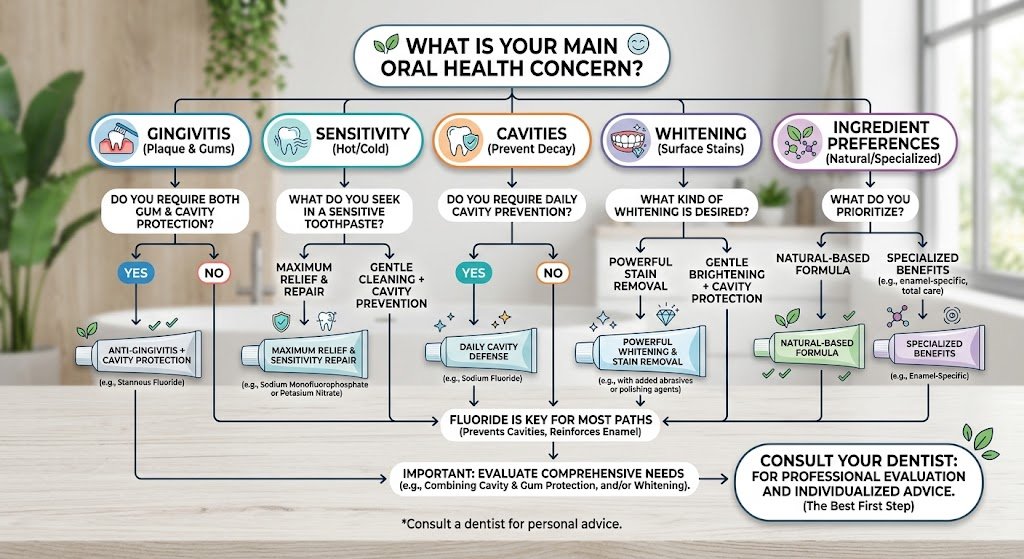
For that reason, the most useful way to structure recommendations is by use case.
Best Overall for Gingivitis
Look for a toothpaste that combines:
- An appropriate fluoride active
- Strong cavity-protection positioning
- Gum-health or plaque-control relevance
- A formulation suitable for everyday use
A stannous fluoride toothpaste is a strong category to investigate for this use case because stannous fluoride combines fluoride-based cavity protection with evidence related to plaque and gingivitis.
The specific product should be selected after checking its current ingredient list, current claims, and any applicable ADA acceptance information.
Best for: Someone whose main goal is everyday gum and cavity care.
Why consider it: It can address multiple everyday oral-health priorities in one toothpaste.
Watch out for: Individual formulas differ, so do not assume every stannous fluoride toothpaste has identical characteristics.
Amazon opportunity: This is the strongest point for a primary product recommendation.
Best for Bleeding Gums
If bleeding is your main concern, do not choose toothpaste based only on the words “bleeding gums” on the package.
Instead, prioritize a product that supports:
- Plaque control
- Gum-health care
- Daily fluoride protection where appropriate
But there is an important warning here.
If your gums continue to bleed regularly, especially without an obvious improvement after improving your oral-hygiene routine, a dentist should evaluate the cause.
A toothpaste can support your routine, but it should not be used to hide a persistent dental problem.
Best for: Readers experiencing mild gum bleeding who are also improving their overall oral-hygiene routine.
Watch out for: Persistent or heavy bleeding should not be treated as a simple toothpaste-selection problem.
Best for Gingivitis and Sensitive Teeth
If you have both gum inflammation and tooth sensitivity, the decision becomes more complicated.
You want a toothpaste that supports gum health without making your teeth uncomfortable during everyday brushing.
In this situation, compare:
- Active ingredient
- Sensitivity positioning
- Fluoride status
- Plaque-control benefits
- Overall formulation
Avoid assuming that the most aggressive “deep cleaning” or whitening toothpaste is automatically better.
Best for: People who experience both gum concerns and sensitivity.
Best for Gingivitis and Whitening
If you want whiter-looking teeth while also caring for your gums, gum health should remain the first priority.
Whitening toothpaste typically focuses on removing surface stains or improving the appearance of the teeth. That is different from treating the underlying inflammation associated with gingivitis.
A reasonable approach is to find a toothpaste that addresses your gum-health needs first and then consider whether its whitening benefits are appropriate for you.
Best for: Someone who has mild surface staining but does not want whitening to replace gum-focused care.
Watch out for: Do not assume that stronger whitening claims mean stronger gum-health benefits.
Best Ingredient-Conscious Option
If you prefer a toothpaste with a particular ingredient profile, start by identifying what you actually want to avoid or include.
For example, you may care about:
- SLS-free formulations
- Specific flavoring ingredients
- Fluoride status
- Hydroxyapatite
- Minimal ingredient lists
- Specific abrasive ingredients
But ingredient-conscious shopping should not mean ignoring the toothpaste’s primary dental function.
A toothpaste can have a simple-looking ingredient list and still fail to match your cavity or gum-health needs.
Best Budget-Friendly Option
Price should be considered alongside function rather than treated as a quality score.
A more expensive toothpaste is not automatically better for gingivitis.
For a budget-focused choice, look for:
- An appropriate active ingredient
- Fluoride where appropriate
- A formula that matches your primary concern
- Reasonable cost per use
- Availability in a size you are comfortable purchasing regularly
The best budget toothpaste is one you can use consistently and that meets your actual oral-health needs.
[ ARTICLE CONTINUES — NEXT PART STARTS WITH: H2: Stannous Fluoride vs. Sodium Fluoride for Gingivitis ]
Stannous Fluoride vs. Sodium Fluoride for Gingivitis
If gingivitis is your main concern, the type of fluoride in your toothpaste can matter. Both stannous fluoride and sodium fluoride provide fluoride for cavity protection, but they are not identical in how they are positioned for gum health.
Stannous Fluoride
Stannous fluoride is a particularly useful ingredient to consider when you want toothpaste that addresses both cavity prevention and gum health.
In addition to supplying fluoride, stannous fluoride has properties that can help with plaque-related oral concerns. Research has evaluated stannous fluoride formulations for their effects on gingivitis, plaque, and other oral-health outcomes.
[ add a link — External Source: ADA or peer-reviewed evidence on stannous fluoride and gingivitis ]
This makes stannous fluoride a practical option for people whose main goal is to maintain healthy gums while also getting the cavity protection expected from fluoride toothpaste.
Sodium Fluoride
Sodium fluoride is another established fluoride ingredient used to prevent cavities. It is widely used in toothpaste and is an effective source of fluoride when formulated and used correctly.
However, you should not assume that every toothpaste containing sodium fluoride is specifically designed for gingivitis. The complete formula, brushing habits, plaque control, and other ingredients still matter.
Which One Should You Choose?
If your priority is gingivitis and plaque-related gum concerns, a toothpaste containing stannous fluoride may be worth considering.
If your main priority is general cavity protection, sodium fluoride can also be an appropriate choice.
The important point is that the fluoride type is only one part of the decision. Look at the complete active-ingredient profile and choose a toothpaste that fits your other needs, such as sensitivity, whitening, dry mouth, or ingredient preferences.
What About Fluoride-Free Toothpaste for Gingivitis?
Fluoride-free toothpaste can be appealing if you prefer a different approach to oral care, but it is important to separate gum-health goals from cavity-protection goals.
A toothpaste may help clean the teeth and support plaque removal without containing fluoride. However, fluoride has an established role in preventing dental caries, so removing fluoride means giving up that particular cavity-protection benefit.
This is especially important if you are choosing toothpaste primarily because you have gingivitis. Treating or managing gingivitis does not mean you should automatically ignore cavity prevention.
Can Fluoride-Free Toothpaste Help With Gingivitis?
Potentially, depending on the formula and your brushing routine.
The mechanical action of brushing is a major part of plaque removal. A fluoride-free toothpaste can still provide cleaning agents and other ingredients that may support oral hygiene.
But there is a difference between:
- Cleaning teeth
- Reducing plaque
- Supporting gum health
- Preventing cavities
- Treating established gum disease
One toothpaste does not automatically accomplish all five.
If you are considering fluoride-free toothpaste because of personal preferences, ask your dentist whether it makes sense for your cavity risk and overall oral-health needs.
Hydroxyapatite vs. Fluoride for Gingivitis
Hydroxyapatite has become increasingly popular in toothpaste, especially among people looking for alternatives to traditional fluoride formulas.
Hydroxyapatite is a calcium-phosphate mineral related to the mineral naturally found in teeth and bones. Toothpaste containing hydroxyapatite is commonly marketed for enamel support and remineralization.
But if your specific search is for the best toothpaste for gingivitis, you should not choose between hydroxyapatite and fluoride based only on which ingredient sounds more natural.
The more useful question is:
Which formula gives you the right combination of cavity protection, plaque control, gum support, and compatibility with your dental needs?
When Hydroxyapatite May Be Appealing
Hydroxyapatite may be worth considering if you are particularly interested in:
- Enamel support
- Remineralization
- Fluoride alternatives
- Ingredient-conscious oral care
- Toothpaste formulations without traditional fluoride
When Fluoride May Be the More Familiar Choice
Fluoride has a long-established role in cavity prevention and remains a common recommendation for people who need stronger caries protection.
For someone with gingivitis and a higher risk of cavities, choosing toothpaste should therefore involve more than simply asking whether the product is “natural” or “non-toxic.”
[ add a link — External Source: ADA guidance on fluoride toothpaste and cavity prevention ]
How to Choose the Best Toothpaste for Gingivitis
There is no single toothpaste that is perfect for every person with gingivitis. The best choice depends on what is happening in your mouth and what other dental concerns you have.
Use the following checklist before buying.
1. Start With Your Main Oral-Health Problem
Ask yourself what you are trying to improve.
Is it:
- Bleeding gums?
- Red or swollen gums?
- Plaque buildup?
- Sensitive teeth?
- Cavities?
- Bad breath?
- Surface stains?
- Dry mouth?
- Several problems at once?
If gingivitis is the main issue, prioritize a formula designed around effective daily plaque control rather than choosing a toothpaste only because of whitening claims or attractive packaging.
2. Check the Active Ingredient
Look beyond words such as “natural,” “clean,” “gum care,” or “healthy.”
Check the actual active ingredient.
For many people, this means looking for a fluoride toothpaste and considering whether stannous fluoride is a good fit for their needs.
3. Consider Your Cavity Risk
Gingivitis and cavities are different problems, but they can occur at the same time.
If you are prone to cavities, do not choose a toothpaste solely because it is marketed for gum health.
A toothpaste that supports gum care while also providing cavity protection may make more sense for your overall oral-health routine.
4. Think About Tooth Sensitivity
If your teeth hurt when you drink something cold, eat something hot, or consume sweet foods, sensitivity should be part of your toothpaste decision.
You may need to balance:
Gum care + cavity protection + sensitivity relief
rather than focusing on gingivitis alone.
5. Do Not Overvalue “Natural”
Natural does not automatically mean better for gingivitis.
Likewise, a toothpaste does not have to contain a long list of ingredients to be effective.
Instead, evaluate:
- Active ingredients
- Fluoride status
- Plaque-control purpose
- Ingredient transparency
- Your dental needs
- Your dentist’s recommendations
This is particularly important when comparing “natural,” “clean,” “non-toxic,” and conventional toothpaste.
Ingredients and Features to Look For in a Gingivitis Toothpaste
When comparing products, focus on the formula rather than the marketing headline.
Fluoride
Fluoride is important for cavity prevention. If you want a toothpaste that supports both gum health and cavity protection, fluoride status should be one of your first checks.
Stannous Fluoride
Stannous fluoride deserves particular attention when gum health is a priority because it combines fluoride protection with evidence around plaque and gingivitis.
It can therefore be a logical ingredient to investigate when comparing toothpaste for gum concerns.
A Formula Designed for Plaque Control
Gingivitis develops when plaque accumulates around the gumline and triggers inflammation.
That means your toothpaste should be considered as part of a larger plaque-control routine.
A product cannot compensate for brushing poorly or failing to clean between your teeth.
Ingredients That Match Your Other Needs
You may also want ingredients or formulation characteristics that address:
- Tooth sensitivity
- Enamel support
- Dry mouth
- Bad breath
- Surface staining
- Ingredient preferences
The best product is often the one that solves several relevant problems without creating a new one.
What Ingredients Should You Be Careful About?
There is no universal list of “toxic” toothpaste ingredients that every person must avoid. Ingredient tolerance varies, and some ingredients are used for specific formulation purposes.
However, people with sensitive mouths may want to pay closer attention to ingredients that can cause irritation or that they personally do not tolerate well.
SLS
Sodium lauryl sulfate, or SLS, is a foaming ingredient found in many personal-care products, including some toothpastes.
Some people prefer SLS-free toothpaste because they experience irritation or simply prefer formulas without it.
If you regularly develop mouth irritation or ulcers, discuss your toothpaste ingredients with your dentist or healthcare professional.
Strong Flavoring
Mint and other flavoring ingredients can make toothpaste feel fresh, but very strong flavoring may not be comfortable for everyone.
If a toothpaste causes burning, irritation, or discomfort, changing formulas may be reasonable.
Abrasive Ingredients
Some abrasives help remove surface stains and clean the teeth. However, more aggressive cleaning is not necessarily better.
If you have sensitivity, enamel concerns, or gum recession, consider the overall formulation rather than choosing a toothpaste simply because it promises intense whitening.
Whitening Ingredients
Whitening toothpaste can help with certain types of surface staining, but whitening should not be the first priority when active gingivitis is present.
Healthy gums and effective plaque control come first.
Best Toothpaste for Gingivitis and Bleeding Gums
Bleeding during brushing is one of the signs that can occur with gingivitis.
If your gums bleed occasionally because of plaque-related inflammation, improving your daily oral-hygiene routine may help.
A toothpaste designed for gum health can be part of that routine.
However, persistent or heavy bleeding should not be treated as a toothpaste-selection problem alone.
Bleeding gums can have different causes, including gum disease, irritation, trauma from brushing, certain medications, and other health factors.
If your gums continue to bleed despite improving your oral hygiene, schedule a dental examination.
[ add a link — External Source: NIDCR information on gum disease symptoms and treatment ]
Best Toothpaste for Gingivitis and Sensitive Teeth
Gingivitis and sensitive teeth can occur together, which makes toothpaste selection slightly more complicated.
You may want a toothpaste that supports:
- Plaque control
- Gum health
- Cavity prevention
- Sensitivity management
Do not automatically choose a toothpaste that promises the strongest sensation of freshness or whitening.
Instead, compare the active ingredients and determine whether the formula is suitable for your sensitivity.
If sensitivity is severe, new, or concentrated around one tooth, toothpaste alone may not solve the underlying problem.
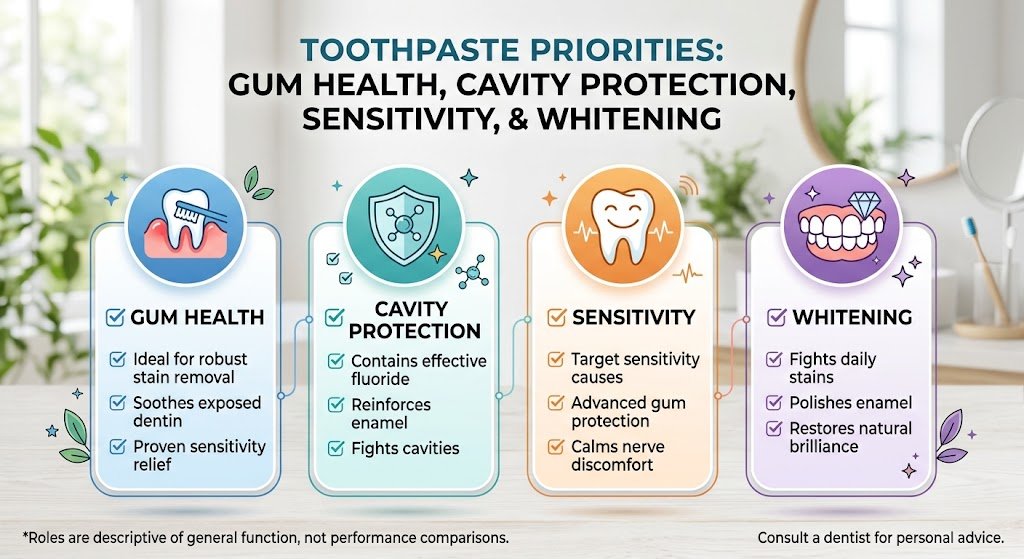
[ IMAGE SUGGESTION — A comparison chart showing the four priorities: gum health, cavity protection, sensitivity, and whitening ]
Best Toothpaste for Gingivitis and Whitening
Whitening is one of the most common reasons people switch toothpaste, but it should not replace proper gum care.
Whitening toothpastes generally focus on removing or reducing surface stains rather than changing the natural internal color of the teeth.
If you have gingivitis, prioritize:
Gum health → plaque control → cavity protection → whitening
rather than choosing a highly abrasive formula simply because it promises a brighter smile.
If your gums are inflamed or bleeding, improving the condition of your gums should be more important than chasing faster whitening results.
How to Use Toothpaste Properly When You Have Gingivitis
Even an excellent toothpaste will have limited value if you use it incorrectly.
Brush Twice a Day
A consistent brushing routine is one of the foundations of plaque control.
For fluoride toothpaste, commonly recommended brushing guidance involves brushing twice daily for about two minutes.
[ add a link — External Source: ADA brushing guidance ]
Focus on the Gumline
Plaque can collect where the teeth and gums meet.
Use gentle, controlled movements and make sure the brush reaches the gumline without aggressive scrubbing.
Do Not Brush Harder to Remove Plaque
More pressure does not necessarily mean cleaner teeth.
Aggressive brushing can irritate the gums and may contribute to gum recession or tooth sensitivity.
A soft-bristled toothbrush and gentle technique are generally preferable.
Clean Between Your Teeth
A toothbrush cannot effectively clean every area between the teeth.
Depending on your needs, this may mean floss, interdental brushes, or another professionally recommended method.
For gingivitis, cleaning between the teeth is particularly important because plaque can remain in areas that brushing misses.
Give Your Routine Time
Gum inflammation does not necessarily disappear after one or two brushing sessions.
Consistency matters.
If your symptoms are not improving, or if they are becoming worse, do not keep changing toothpaste indefinitely. Get your gums evaluated by a dental professional.
Common Mistakes People Make When Choosing Toothpaste for Gingivitis
Mistake 1: Choosing Based Only on “Gum Care” on the Label
A product can use attractive marketing language without being the best match for your specific needs.
Read the active ingredients.
Mistake 2: Assuming Natural Means More Effective
A natural ingredient is not automatically more effective for plaque or gingivitis.
Evaluate the complete formula and evidence behind its intended use.
Mistake 3: Ignoring Cavities
If you have gingivitis, cavities do not stop being a concern.
Your toothpaste should fit your complete oral-health situation.
Mistake 4: Focusing Only on Toothpaste
Gingivitis is strongly connected with plaque accumulation.
Changing toothpaste while continuing poor brushing or skipping between-teeth cleaning is unlikely to solve the entire problem.
Mistake 5: Using Whitening as the Main Goal
A brighter smile is useful, but active gum inflammation deserves attention first.
Mistake 6: Ignoring Persistent Symptoms
If bleeding, swelling, pain, bad breath, or gum changes continue, toothpaste may not be enough.
When Toothpaste Is Not Enough for Gingivitis
Toothpaste is a supporting part of an oral-hygiene routine. It is not a substitute for professional dental care.
You should consider seeing a dentist if you have:
- Persistent gum bleeding
- Swollen or painful gums
- Receding gums
- Persistent bad breath
- Loose teeth
- Pus around the gums
- Significant tooth sensitivity
- Pain when chewing
- Symptoms that continue despite improving your oral hygiene
These symptoms can indicate a problem that requires professional evaluation.
Gingivitis can sometimes progress to periodontitis, a more serious form of gum disease that can damage the tissues and bone supporting the teeth.
[ add a link — External Source: CDC or NIDCR information on periodontal disease ]
How We Would Compare Toothpaste for Gingivitis
If you are comparing several toothpaste options, use a simple scoring system instead of relying on marketing claims.
| Factor | What to Check |
| Gum-health focus | Does the formula make sense for plaque and gum care? |
| Active ingredient | What is the actual active ingredient? |
| Fluoride | Does it provide cavity protection? |
| Stannous fluoride | Is this included if gum health is a priority? |
| Sensitivity | Does it fit your sensitivity needs? |
| Ingredients | Are the ingredients clearly disclosed? |
| Flavor | Is it comfortable for daily use? |
| Abrasiveness | Is it appropriate for your teeth and gums? |
| Personal fit | Does it address your other oral-health concerns? |
| Professional advice | Does it fit your dentist’s recommendations? |
The goal is not to find a toothpaste with the longest ingredient list or the most impressive marketing claims. The goal is to find a formula that fits your oral-health needs and that you can use consistently.
Frequently Asked Questions
What is the best toothpaste for gingivitis?
For people primarily concerned about gingivitis, a fluoride toothpaste with a formula designed for plaque and gum health can be a strong starting point. Stannous fluoride is especially worth considering because it provides fluoride for cavity protection and has evidence related to plaque and gingivitis.
Your individual dental needs may change the best choice.
Is stannous fluoride good for gingivitis?
Stannous fluoride is a useful ingredient to consider for gingivitis because it provides fluoride for cavity prevention and has been studied for plaque and gingival health.
It should still be combined with proper brushing and cleaning between the teeth.
Does toothpaste cure gingivitis?
Toothpaste does not independently cure every case of gingivitis.
It can support daily plaque control, but effective gum care also depends on brushing technique, cleaning between the teeth, and professional dental care when needed.
Is fluoride toothpaste better for gingivitis?
Fluoride toothpaste is particularly useful when you need cavity protection in addition to gum care. Some fluoride formulations, especially those containing stannous fluoride, have also been studied for gingival health.
The best choice depends on your complete oral-health needs.
Can I use fluoride-free toothpaste if I have gingivitis?
You can use fluoride-free toothpaste, but you should consider what you are giving up in terms of cavity protection. If you are at risk for cavities, discuss fluoride-free toothpaste with your dentist before making the switch.
Is SLS bad for gingivitis?
SLS is primarily a foaming ingredient, not a treatment for gingivitis. Some people prefer SLS-free toothpaste because they find certain formulas irritating.
If toothpaste repeatedly causes mouth irritation, consider discussing the ingredients with a dental professional.
Why do my gums bleed when I brush my teeth?
Bleeding gums can be associated with gingivitis and plaque-related inflammation, but there are other possible causes.
If bleeding is persistent, heavy, or accompanied by swelling, pain, or other symptoms, see a dentist rather than relying on a toothpaste change alone.
How long does gingivitis take to improve?
The time required can vary depending on the severity and cause. Mild plaque-related gingivitis may improve with consistent oral hygiene, but persistent symptoms should be professionally evaluated.
Do not assume that continued bleeding is normal simply because you have recently changed toothpaste.
Can whitening toothpaste make gingivitis worse?
Whitening toothpaste does not automatically cause gingivitis, but some formulas may be less comfortable for people with sensitive teeth or irritated gums.
If your gums are inflamed, prioritize gentle, effective oral hygiene over aggressive whitening.
Should I use toothpaste for gingivitis every day?
Yes, toothpaste is generally intended to be part of your regular brushing routine rather than an occasional treatment.
The important factor is choosing an appropriate formula and using it consistently with proper brushing and between-teeth cleaning.
Final Verdict: What Is the Best Toothpaste for Gingivitis?
The best toothpaste for gingivitis is not necessarily the one with the most “natural,” “clean,” or “gum care” claims on the package.
A better approach is to look at the complete formula and your individual needs.
For many people, a fluoride toothpaste with stannous fluoride is an option worth considering because it combines cavity protection with ingredients that have been studied for plaque and gingival health.
But toothpaste is only one part of the solution.
A strong gingivitis-care routine includes:
- Brushing twice a day
- Using gentle brushing pressure
- Cleaning along the gumline
- Cleaning between the teeth
- Choosing toothpaste that fits your dental needs
- Getting professional dental care when symptoms persist
If your gums continue to bleed, swell, hurt, or change despite improving your routine, do not simply keep trying different toothpastes. A dentist can determine whether you have gingivitis or a more advanced gum condition that requires professional treatment.
The right toothpaste should support your routine—not replace it.
