If your main goal is protecting tooth enamel, the best toothpaste is not necessarily the one with the most impressive marketing claims. What matters more is the combination of active ingredients, enamel-protection evidence, abrasivity, your sensitivity or cavity risk, and the reason your enamel is being challenged in the first place.
For most people, a fluoride toothpaste is the evidence-based starting point because fluoride helps prevent tooth decay and supports remineralization of enamel during the early stages of tooth decay. Some formulations containing stannous fluoride may be particularly relevant when enamel erosion and sensitivity are concerns. Hydroxyapatite and nano-hydroxyapatite toothpastes are another option, especially for people specifically looking for fluoride-free formulations, but the evidence base is not equivalent to the long-established evidence for fluoride.
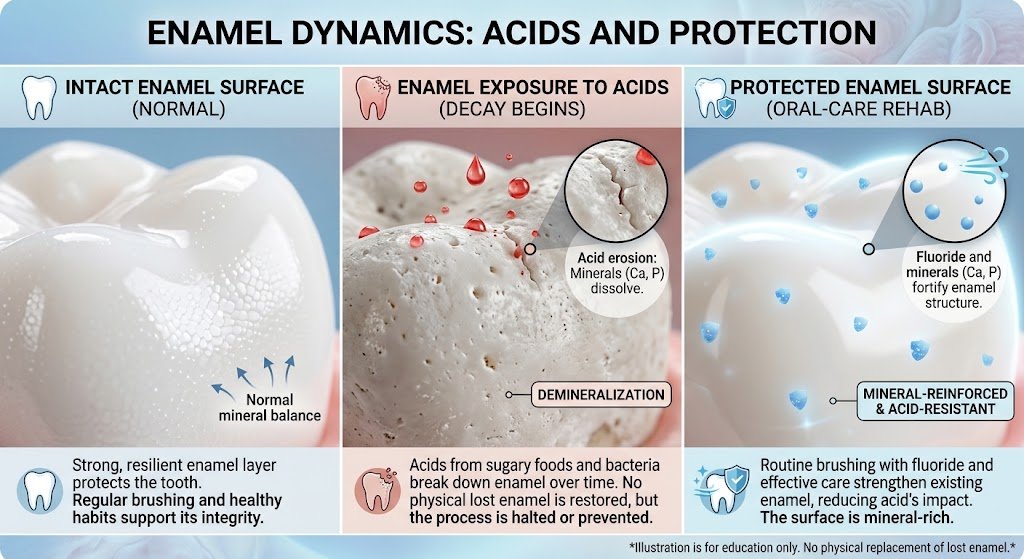
The important distinction is that toothpaste can help protect and strengthen the enamel you still have; it cannot simply grow back substantial enamel that has already been physically lost.
In this guide, we’ll look at the toothpaste ingredients and product characteristics that matter most for enamel, compare fluoride, stannous fluoride, and hydroxyapatite approaches, explain what to look for when shopping, and identify which type of toothpaste makes sense for different enamel-related concerns.
Affiliate disclosure: This article may contain affiliate links. If you purchase through one of these links, we may earn a commission at no additional cost to you. Our recommendations are based on the product characteristics and evidence discussed in this guide, not on the size of a potential commission.
Quick Answer: What Is the Best Toothpaste for Enamel?
For most adults, look first for a toothpaste that provides fluoride for cavity protection, is appropriate for your sensitivity level, and does not encourage unnecessarily aggressive brushing.
If enamel erosion is a major concern, a toothpaste containing stannous fluoride can be worth considering. Research has found protective effects from fluoride-containing dentifrices against experimental erosive tooth wear, with some evidence suggesting stannous-containing formulations may offer greater protection under certain erosion and abrasion conditions. However, much of this evidence comes from laboratory or in-situ models, so it should not be interpreted as proof that one toothpaste will stop clinical enamel loss in every person.
If you specifically want a fluoride-free toothpaste, hydroxyapatite or nano-hydroxyapatite is a category worth investigating. But fluoride-free should not automatically be interpreted as better for enamel. For cavity prevention in particular, fluoride remains the established active ingredient in U.S. anticaries toothpastes, and the American Dental Association states that ADA-Accepted toothpastes making a cavity-protection claim must contain fluoride.
A practical starting point
| Your main concern | What to look for |
| General enamel and cavity protection | Fluoride toothpaste |
| Enamel erosion from acidic foods or drinks | Fluoride toothpaste; consider stannous fluoride |
| Enamel-related sensitivity | A toothpaste formulated for sensitivity, often with a desensitizing active ingredient |
| Fluoride-free preference | Hydroxyapatite/nano-hydroxyapatite formulation |
| Concern about tooth wear | Low-abrasion formulation + gentle brushing technique |
| Whitening while protecting enamel | Avoid assuming “whitening” means enamel-friendly; consider the formulation and how aggressively you brush |
One more factor is easy to overlook: how you brush can matter as much as which toothpaste you buy. The ADA recommends a soft-bristle toothbrush for dental erosion concerns and notes that normal brushing with a soft-bristle brush and low-abrasion fluoride toothpaste is unlikely to cause erosive enamel wear.
How We Chose the Toothpastes
There is no single toothpaste ingredient that makes a product universally “best” for every enamel problem.
Someone with frequent acidic drinks and tooth sensitivity may have a different priority from someone whose primary concern is cavity prevention. Someone who wants fluoride-free toothpaste may also make a different choice from someone who wants the most established anticaries evidence.
For that reason, this guide evaluates products according to use case and formulation, rather than pretending that every reader should buy the same toothpaste.
1. Enamel-protection ingredients
The first question is what active ingredient is doing the important work.
For conventional fluoride toothpastes in the United States, common anticaries active ingredients include sodium fluoride, sodium monofluorophosphate, and stannous fluoride. Fluoride helps prevent tooth decay and supports remineralization of enamel in the early stages of decay.
Stannous fluoride deserves additional attention when erosion and sensitivity are part of the problem. Systematic reviews have reported protective effects from stannous-containing formulations under experimental erosion and erosion/abrasion conditions, although the certainty and clinical relevance vary between studies.
Hydroxyapatite and nano-hydroxyapatite are considered separately because they represent a different approach to enamel care and are particularly relevant to people seeking fluoride-free products.
The key is not to turn this into a simplistic ingredient contest. Different ingredients can be useful for different objectives.
2. Evidence for the specific benefit
A toothpaste may say that it “strengthens enamel,” “protects enamel,” or “restores” teeth, but those phrases can mean different things.
For example:
- Cavity prevention is not the same as preventing acid erosion.
- Remineralization of an early lesion is not the same as rebuilding lost enamel.
- Reducing sensitivity is not the same as reversing enamel erosion.
- Removing surface stains is not the same as improving enamel health.
The ADA’s Seal of Acceptance is useful here because products are evaluated against specific safety and efficacy requirements. The ADA has separate categories for fluoride toothpaste, dentinal hypersensitivity, and enamel erosion, among others.
That does not mean the ADA Seal identifies one universal “best toothpaste.” Instead, it provides evidence that a particular product has met the requirements for the specific claims associated with its Seal.
3. Abrasivity and brushing behavior
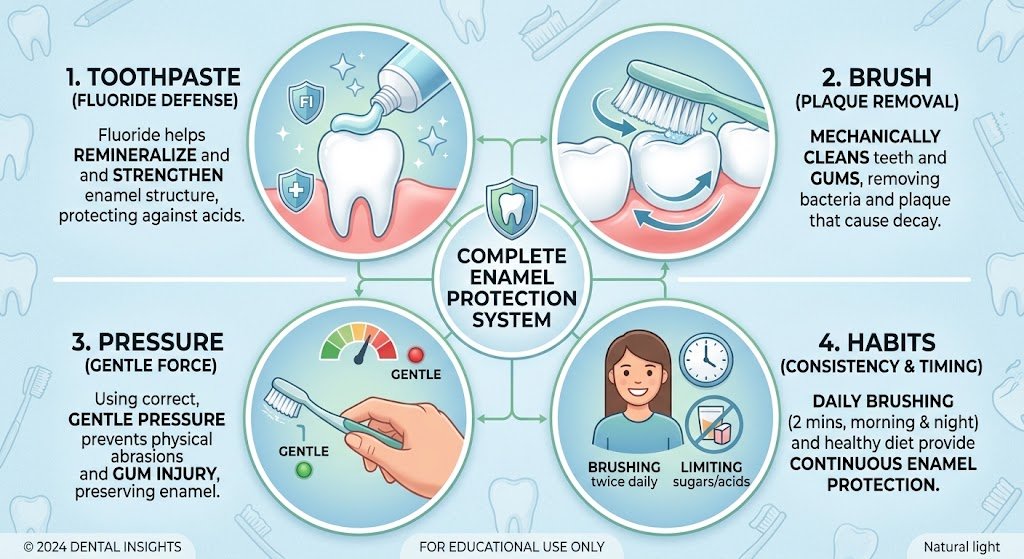
Toothpaste needs some degree of abrasivity to help clean teeth and remove external stains. More abrasive does not automatically mean more effective for enamel.
This is particularly important if you already have enamel erosion or tooth wear.
The ADA notes that excessive or aggressive brushing can contribute to physical tooth wear and recommends a soft-bristle brush. It also states that normal brushing with a soft-bristle brush and a low-abrasion fluoride toothpaste is considered unlikely to cause erosive wear of enamel.
This is why we would not evaluate an enamel toothpaste solely by its active ingredient. The entire brushing system matters: toothpaste + toothbrush + pressure + frequency + timing.
4. Sensitivity and other symptoms
Enamel concerns frequently overlap with sensitivity.
When enamel becomes thinner or tooth surfaces become exposed, changes in the tooth structure can contribute to sensitivity. But sensitivity can also have other causes, including exposed root surfaces and dental problems that require professional evaluation.
Therefore, a person searching for an enamel toothpaste because cold drinks hurt their teeth may need a different product strategy from someone who simply wants better cavity protection.
For people with dentin hypersensitivity, the ADA recognizes toothpaste containing specific desensitizing ingredients as a category of oral-care products, and a 2023 systematic review and network meta-analysis found evidence supporting twice-daily use of certain self-applied dentifrices for reducing sensitivity pain.
Best Toothpastes for Enamel: Our Use-Case Approach
Rather than assigning an arbitrary score to every toothpaste, the more useful question is:
Which toothpaste characteristics fit your particular enamel concern?
The categories below are designed to make that decision easier.
Best for General Enamel Protection: A Fluoride Toothpaste
If your main objective is everyday protection against cavities while supporting enamel health, a conventional fluoride toothpaste is the most straightforward starting point.
Fluoride is not merely an ingredient added for marketing purposes. It is an established anticaries active ingredient, and the ADA identifies sodium fluoride, sodium monofluorophosphate, and stannous fluoride as the fluoride compounds used as anticaries agents in U.S. toothpastes. Fluoride helps prevent tooth decay and remineralizes enamel during the early stages of tooth decay.
For a typical adult shopper, the practical checklist is relatively simple:
- Look for fluoride as an active ingredient.
- Consider an ADA-Accepted product when available and appropriate.
- Choose a formulation you can comfortably use twice daily.
- Don’t compensate for a good toothpaste with aggressive brushing.
- If you have significant sensitivity, choose a formulation that addresses that concern too.
The important point is that fluoride toothpaste is primarily an enamel-protection and cavity-prevention tool—not a product that physically replaces missing enamel.
For shoppers comparing conventional fluoride products, this category includes everyday formulations from major oral-care brands as well as sensitivity-oriented and enamel-focused products.
Product opportunity: A current fluoride toothpaste with an appropriate active ingredient, relevant enamel/erosion claims, and verifiable product information can be introduced here.
[ Amazon product link placeholder — verify exact product variant, current formulation, and ASIN before publication. ]
Best for Enamel Erosion Concerns: Consider Stannous Fluoride
If your concern is specifically acid-related enamel erosion, stannous fluoride deserves a closer look.
Research comparing fluoride formulations has found evidence that fluoride dentifrices can reduce enamel loss under experimental erosive conditions. Some systematic reviews have found particularly promising results for stannous-containing formulations.
However, there is an important evidence-quality distinction.
A systematic review and meta-analysis comparing sodium fluoride and stannous fluoride dentifrices found a significant difference favoring stannous fluoride in in-vitro studies, but the authors concluded that the evidence was insufficient for definitive conclusions and called for clinical trials.
So the responsible takeaway is:
Stannous fluoride is a reasonable ingredient to consider when enamel erosion and sensitivity are concerns, but it should not be presented as a guaranteed way to stop enamel loss.
This distinction matters because real-world enamel wear depends on much more than toothpaste. Acid exposure, brushing behavior, saliva, diet, reflux, oral hygiene, and individual dental conditions can all contribute.
Product opportunity: A stannous-fluoride toothpaste positioned around sensitivity, enamel erosion, or comprehensive oral care can be introduced at this point.
[ Amazon product link placeholder — verify exact current formulation and product variant before publication. ]
Best Fluoride-Free Option: Hydroxyapatite or Nano-Hydroxyapatite
Some readers specifically want a toothpaste without fluoride.
In that situation, hydroxyapatite—and particularly nano-hydroxyapatite—is a relevant category to investigate.
Hydroxyapatite is a calcium-phosphate mineral closely associated with the mineral component of teeth and bone. Nano-hydroxyapatite formulations are designed around very small hydroxyapatite particles and are marketed for applications including enamel and sensitivity care.
But there is an important distinction between saying “there is evidence for hydroxyapatite” and saying “hydroxyapatite is better than fluoride.”
Those are not equivalent claims.
Fluoride has a much longer-established evidence base for preventing dental caries. The ADA specifically identifies fluoride as the active ingredient required for an ADA-Accepted toothpaste making a cavity-protection claim.
Therefore, if someone chooses a fluoride-free hydroxyapatite toothpaste, that choice should be understood as a preference for a different formulation strategy—not as proof that fluoride is unnecessary for everyone.
Product opportunity: This is the natural place to introduce a carefully selected fluoride-free hydroxyapatite or nano-hydroxyapatite product for readers who have already decided that this category fits their preferences.
[ Amazon product link placeholder — verify current ingredient list, concentration claims, product variant, and ASIN before publication. ]
Best for Enamel Concerns Plus Sensitivity
If your enamel concern comes with sharp pain from cold water, air, sweets, or touch, don’t choose a toothpaste based only on the word “enamel.”
Sensitivity should become part of the selection criteria.
A sensitivity toothpaste may use an active ingredient specifically intended to reduce dentin hypersensitivity. The ADA recognizes dentinal hypersensitivity as a specific product category, and evidence reviews support some self-applied dentifrice approaches for reducing sensitivity pain.
This is also a situation where the cause matters.
Sensitivity can occur alongside enamel wear, but persistent or severe sensitivity can have other causes. A toothpaste may help manage symptoms without addressing the underlying dental problem.
Product opportunity: A sensitivity-focused fluoride toothpaste can be presented here for readers whose enamel concerns overlap with sensitivity.
[ Amazon product link placeholder — verify exact product variant and active ingredient before publication. ]
What Ingredients Actually Help Protect Enamel?
When shopping for enamel toothpaste, it is easy to become distracted by a long ingredient list.
Instead, start with the ingredients that have a clear relationship to your actual goal.
Fluoride
Fluoride is the most important ingredient to understand if cavity prevention is part of your enamel-protection strategy.
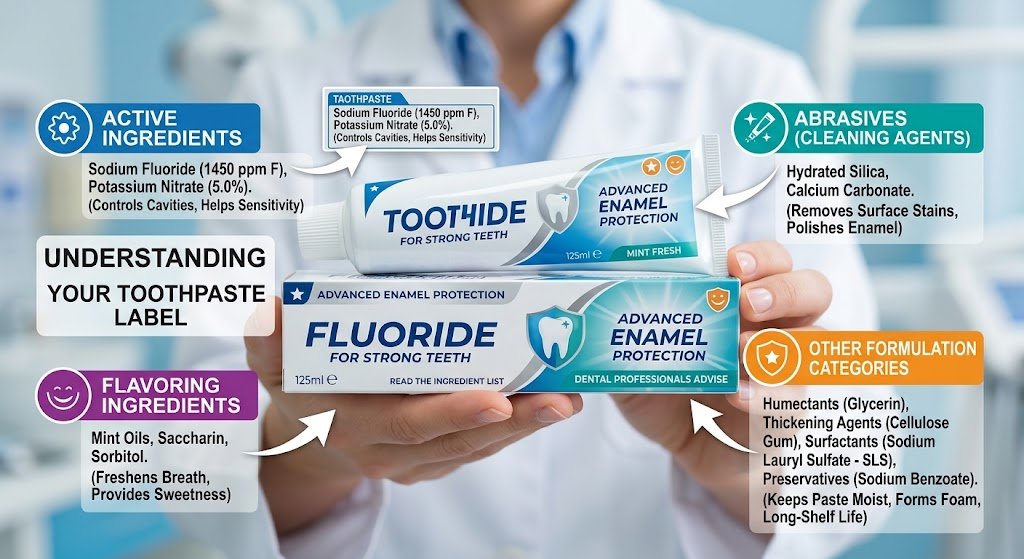
According to the ADA, fluoride strengthens teeth to help prevent tooth decay and can remineralize enamel in the early stages of tooth decay. U.S. over-the-counter fluoride toothpastes generally contain fluoride in concentrations around 1,000–1,500 ppm, while prescription-strength products can contain higher concentrations and are used under professional guidance.
For a consumer choosing an everyday toothpaste, the important question isn’t simply:
“Does this toothpaste strengthen enamel?”
A better question is:
“What active ingredient provides the claimed protection, and what problem is that protection intended to address?”
That distinction makes toothpaste labels much easier to evaluate.
Stannous Fluoride
Stannous fluoride is a form of fluoride that provides anticaries activity while also being particularly relevant to products targeting sensitivity, gingivitis, and enamel erosion.
Experimental and systematic-review evidence suggests stannous-containing formulations can provide protection against erosive and erosive/abrasive enamel wear. However, the strength of evidence differs between study types, and laboratory findings should not automatically be treated as proof of a specific clinical outcome for every user.
That makes stannous fluoride an interesting ingredient for shoppers with multiple concerns—but not a reason to assume that every stannous fluoride toothpaste will be identical.
Formulation matters.
Hydroxyapatite and Nano-Hydroxyapatite
Hydroxyapatite toothpastes take a different approach from conventional fluoride toothpastes.
The underlying concept is based on using a calcium-phosphate mineral associated with tooth structure. Nano-hydroxyapatite products use particles engineered at the nanoscale and are commonly marketed toward enamel and sensitivity concerns.
This category can be especially relevant when a consumer has decided to avoid fluoride.
But the evidence should be interpreted proportionally. Emerging biomimetic or calcium-based technologies should not be presented as automatically superior to fluoride simply because they sound more “natural” or more technologically advanced.
Abrasives
Abrasives are not automatically bad for enamel.
They help toothpaste clean the tooth surface and remove external deposits and stains. The issue is how abrasive the overall formulation is and how the toothpaste is used.
The ADA notes that RDA values below 250 cannot be used to quantitatively rank the safety of toothpastes because those values do not directly correspond to clinical changes in enamel. ADA-Accepted dentifrices have an RDA of 250 or less.
That means consumers should be cautious about simplistic claims such as:
“Lower RDA always means this is the safest toothpaste.”
Abrasivity is one factor—not the entire enamel-protection picture.
More importantly, brushing technique matters. Excessive pressure, an unsuitable toothbrush, and frequent aggressive brushing can undermine otherwise sensible toothpaste selection.
Fluoride vs Stannous Fluoride vs Hydroxyapatite for Enamel
These three approaches are often presented as competing technologies, but they do not answer exactly the same question.
Fluoride has the strongest established role in everyday cavity prevention and early enamel remineralization. Stannous fluoride is a fluoride formulation that may offer additional benefits relevant to sensitivity and erosive tooth wear. Hydroxyapatite and nano-hydroxyapatite are alternatives that are particularly relevant to people seeking fluoride-free toothpaste.
The right choice therefore depends on what you are trying to accomplish.
| Ingredient/category | Main reason to consider it | Particularly relevant for | Important limitation |
| Fluoride | Cavity prevention and early remineralization | Everyday enamel and cavity protection | Does not regenerate substantial lost enamel |
| Stannous fluoride | Fluoride protection plus potential erosion/sensitivity benefits | Enamel erosion, sensitivity, comprehensive protection | Anti-erosion evidence includes substantial laboratory/experimental research |
| Hydroxyapatite | Calcium-phosphate mineral approach | Fluoride-free preference, enamel-focused care | Evidence base is less established than fluoride for caries prevention |
| Nano-hydroxyapatite | Nanoscale hydroxyapatite formulation | Fluoride-free enamel/sensitivity products | Product formulations and evidence vary |
Fluoride: The Established Starting Point
Fluoride works through several mechanisms that make it important for enamel health.
When tooth enamel is exposed to acids produced by plaque bacteria or introduced through acidic foods and drinks, minerals can be lost from the tooth surface. Fluoride can promote remineralization and make the tooth structure more resistant to subsequent acid attacks.
This is why the question “Does fluoride rebuild enamel?” needs a careful answer.
It can help remineralize early, non-cavitated enamel lesions and strengthen the tooth surface, but that does not mean fluoride can reconstruct a large section of enamel that has already been worn away.
The ADA identifies fluoride as the active ingredient used for anticaries protection in accepted toothpastes and notes its role in preventing decay and remineralizing early lesions. (ada.org)
For someone whose primary objective is minimizing future cavity risk while maintaining existing enamel, fluoride remains an important benchmark.
Stannous Fluoride: Particularly Interesting for Erosion and Sensitivity
Stannous fluoride contains fluoride, so it should not be treated as a completely separate alternative to fluoride.
It is better understood as one particular fluoride formulation with properties that can make it useful for additional oral-care concerns.
Research has investigated stannous fluoride for erosion, erosion combined with abrasion, dentin hypersensitivity, plaque, and gingivitis. A 2026 umbrella review found that fluoridated dentifrices generally reduced enamel and dentin tissue loss compared with non-fluoridated controls in experimental models, while stannous-containing formulations showed some of the most consistent protective effects. The review also emphasized that much of the evidence came from in-vitro or in-situ models and that evidence for emerging technologies was less certain. (pubmed.ncbi.nlm.nih.gov)
Earlier systematic reviews similarly found promising anti-erosive effects from stabilized stannous fluoride formulations, while noting limitations in the available clinical evidence. (pubmed.ncbi.nlm.nih.gov)
So if your main concern is acid erosion plus sensitivity, a stannous fluoride formulation is a logical category to investigate.
Hydroxyapatite: A Different Approach
Hydroxyapatite is chemically related to the mineral component of teeth.
The appeal of hydroxyapatite toothpaste is therefore intuitive: instead of relying on fluoride as the primary enamel-focused technology, the toothpaste uses a calcium-phosphate mineral that is closely related to dental mineral.
Nano-hydroxyapatite takes this concept further by using very small particles.
There is growing research into hydroxyapatite dentifrices for caries prevention, remineralization, and sensitivity. However, the evidence is heterogeneous, and comparisons with fluoride depend heavily on the study design, formulation, concentration, and outcome being measured.
That is why this guide treats hydroxyapatite as a legitimate fluoride-free option, rather than declaring it universally superior.
Which One Should You Choose?
A simple decision framework can make the comparison easier:
Choose a fluoride toothpaste when:
- Cavity prevention is a major priority.
- You want the longest-established evidence base for anticaries toothpaste.
- You have no particular reason to avoid fluoride.
- You want a conventional everyday toothpaste.
Consider stannous fluoride when:
- You want fluoride-based cavity protection.
- Sensitivity is also an issue.
- Acid erosion or enamel wear is a concern.
- You are interested in a formulation with evidence for additional protective effects.
Consider hydroxyapatite or nano-hydroxyapatite when:
- You specifically want a fluoride-free toothpaste.
- You understand that fluoride-free does not automatically mean more effective.
- You are interested in calcium-phosphate-based enamel-care formulations.
- You have evaluated the product’s formulation rather than relying only on “natural” or “mineral” marketing.
Can Toothpaste Actually Rebuild Enamel?
This is one of the most important questions to answer correctly because toothpaste marketing can make “rebuild,” “repair,” and “strengthen” sound interchangeable.
They are not.
Enamel Cannot Simply Grow Back Like Skin
Once a substantial amount of mature tooth enamel has been physically lost, the body does not regenerate it in the same way skin can heal after an injury.
That is why preventing additional mineral loss is so important.
Toothpaste can help create conditions that favor remineralization of early mineral loss, but this should not be confused with manufacturing a brand-new layer of natural enamel over an area that has already been worn away.
This distinction is particularly important for people with dental erosion.
If acidic exposure has gradually reduced the thickness of enamel, switching toothpaste may help reduce future risk, but it cannot independently restore the original tooth geometry.
Remineralization Is Different From Regeneration
Imagine an early enamel lesion as a tooth surface that has lost some mineral but has not yet developed a cavity.
That situation is very different from a tooth surface where a significant amount of enamel has physically disappeared.
Remineralization refers to mineral being deposited back into areas where mineral loss has occurred.
Regeneration would imply the creation of new biological tissue comparable to the original structure.
For everyday toothpaste decisions, this distinction matters because a product can support remineralization without actually regenerating substantial lost enamel.
Fluoride is particularly important in the remineralization context because of its established anticaries effects. (ada.org)
What About Hydroxyapatite?
Hydroxyapatite toothpaste is often described as helping “rebuild” or “repair” enamel because hydroxyapatite is chemically related to tooth mineral.
There is a reasonable scientific basis for studying hydroxyapatite as a remineralizing material. But the wording still needs to be precise.
A toothpaste containing hydroxyapatite should not be interpreted as a way to regrow a large quantity of enamel that has already been lost.
When evaluating a product, look for evidence related to the specific formulation and specific outcome, rather than assuming that the chemical identity of an ingredient proves every marketing claim.
When Toothpaste Is Not Enough
If you can see obvious changes in the shape of a tooth, have progressively worsening sensitivity, notice significant wear, or have persistent pain, toothpaste should not be treated as a substitute for a dental examination.
A dentist can determine whether the problem is related to erosion, abrasion, attrition, decay, exposed dentin, gum recession, a cracked tooth, or another condition.
That distinction matters because the treatment for each problem can be different.
Is Whitening Toothpaste Bad for Enamel?
Whitening toothpaste is one of the areas where consumers can easily get conflicting advice.
One extreme says whitening toothpaste destroys enamel.
The other suggests that whitening toothpaste is completely harmless under all circumstances.
Neither statement is useful.
How Whitening Toothpaste Usually Works
Most conventional whitening toothpastes primarily help remove extrinsic or surface stains.
These are stains sitting on or near the external tooth surface, often associated with foods, beverages, tobacco, or other staining exposures.
Removing a surface stain can make teeth appear whiter without changing the natural internal color of the tooth.
Some whitening products may also contain additional ingredients designed to alter tooth color, but the formulation varies substantially between products.
Abrasivity Matters
Abrasives are useful because they help physically remove deposits and surface stains.
The concern arises when someone combines an abrasive toothpaste with excessive brushing pressure, a hard-bristle brush, frequent brushing, or an already compromised tooth surface.
The ADA notes that excessive brushing can contribute to physical tooth wear and recommends soft-bristle brushing, particularly in the context of dental erosion. (ada.org)
So the question should not simply be:
“Is whitening toothpaste bad for enamel?”
Instead ask:
“Is this whitening product appropriate for my enamel condition and brushing habits?”
If you have significant erosion, sensitivity, or visible tooth wear, a dentist can help determine whether whitening is appropriate and which approach is least likely to aggravate the problem.
Don’t Confuse Whitening With Enamel Damage
Surface stain removal does not necessarily mean that enamel is being damaged.
Likewise, a toothpaste marketed as “gentle whitening” is not automatically appropriate for every person with enamel erosion.
Look at the complete formulation and consider how you use it.
For readers whose primary goal is enamel protection, whitening should generally be a secondary feature, not the main selection criterion.
What Causes Enamel to Wear Down?
Choosing the right toothpaste becomes much easier once you understand what is actually damaging the enamel.
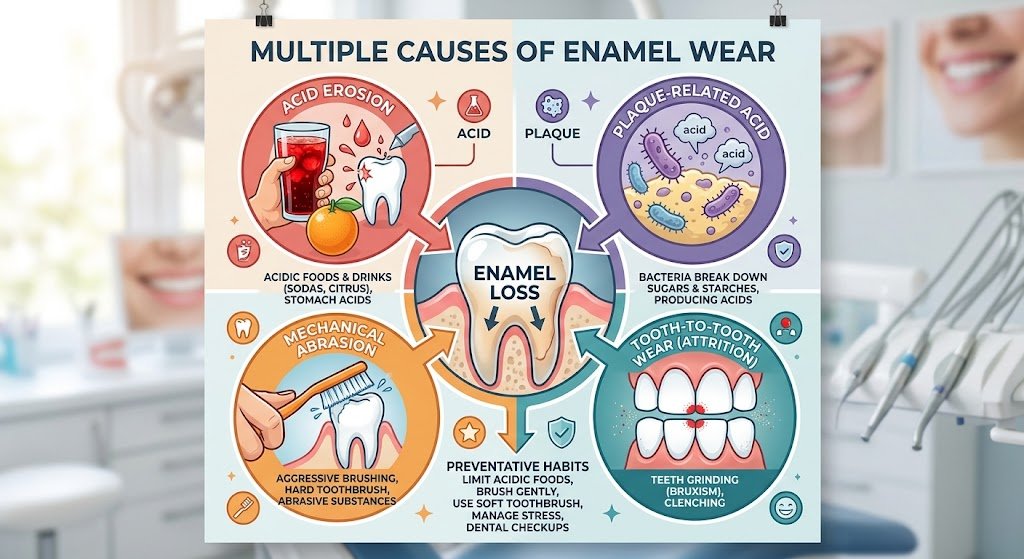
Enamel wear is not caused by one single mechanism.
Acid Erosion
Dental erosion is the chemical loss of tooth structure caused by acids that are not produced by bacteria.
Dietary acids can come from foods and drinks such as acidic beverages, citrus products, and other acidic foods. Stomach acid can also contribute in some circumstances.
Repeated acid exposure can soften the tooth surface temporarily, making it more vulnerable to mechanical wear.
The important practical point is that toothpaste cannot compensate for unlimited acid exposure.
If someone drinks acidic beverages repeatedly throughout the day, changing toothpaste while leaving the exposure pattern unchanged may have limited benefit.
Plaque and Dental Caries
Dental caries is a different process.
Bacteria in dental plaque metabolize fermentable carbohydrates and produce acids. Repeated acid attacks can cause mineral loss from enamel.
Fluoride is particularly relevant here because of its established role in preventing and managing the early stages of tooth decay.
Mechanical Wear
Tooth structure can also be affected by physical forces.
Examples include:
- Brushing too aggressively
- Using excessive pressure
- Using an inappropriate toothbrush
- Repeated abrasive habits
- Tooth-to-tooth contact associated with grinding or clenching
This is why choosing an enamel-friendly toothpaste is only one part of the equation.
If you are brushing aggressively for two or three minutes with a hard-bristle toothbrush, simply switching to a different toothpaste may not solve the underlying problem.
Enamel Demineralization
Demineralization occurs when mineral is lost from tooth structure.
The balance between mineral loss and mineral gain is influenced by factors including acid exposure, saliva, plaque activity, fluoride exposure, and oral hygiene.
Early mineral loss can sometimes be reversed or arrested through remineralization-focused preventive care.
More advanced structural loss is different.
A Combination of Causes
Real-world enamel wear can involve more than one process.
For example, someone might:
- Frequently consume acidic drinks.
- Have plaque-related acid exposure.
- Brush aggressively afterward.
- Develop sensitivity.
- Switch to a highly whitening-focused toothpaste.
- Continue the same brushing pattern.
In that scenario, the toothpaste is only one variable.
A better approach would address acid exposure, timing, brushing technique, sensitivity, and professional assessment where necessary.
How to Choose the Right Toothpaste for Your Enamel
Once you understand the different mechanisms, choosing a toothpaste becomes much less about marketing terminology.
Start with your primary problem.
If Your Main Goal Is Cavity Prevention
Look for a fluoride toothpaste.
This is the simplest decision for most adults who do not have a reason to avoid fluoride.
You do not need an exotic ingredient simply because your search query includes the word “enamel.”
A conventional fluoride toothpaste can support enamel by helping prevent and remineralize early stages of tooth decay. (ada.org)
If Your Main Goal Is Acid-Erosion Protection
Consider a fluoride toothpaste, with particular interest in stannous fluoride formulations.
But also examine the cause of the acid exposure.
Ask:
- How frequently do I consume acidic drinks?
- Do I sip them over long periods?
- Do I have frequent acid reflux or vomiting?
- Do I brush immediately after acidic exposure?
- Am I using excessive brushing pressure?
A toothpaste choice can help, but reducing the underlying acid challenge may be equally or more important.
If Your Main Goal Is Sensitivity
Choose a toothpaste specifically formulated for sensitivity rather than relying on an “enamel strengthening” claim alone.
Persistent sensitivity deserves attention because toothpaste may reduce symptoms while leaving an underlying dental problem untreated.
If You Want Fluoride-Free Toothpaste
Hydroxyapatite or nano-hydroxyapatite is a logical category to research.
Before buying, check:
- Which hydroxyapatite ingredient is actually used?
- Is the product explicitly fluoride-free?
- What does the manufacturer claim?
- What evidence supports the particular formulation?
- Is sensitivity one of your concerns?
- Are you comfortable choosing a fluoride-free product given your individual cavity risk?
If Your Main Goal Is “Stronger Enamel”
Be careful with the wording.
A toothpaste may help maintain mineral balance, reduce cavity risk, or support remineralization.
That does not mean it can rebuild a visibly worn tooth.
If your teeth appear shorter, thinner, chipped, translucent at the edges, or increasingly sensitive, consider getting a dental assessment rather than relying entirely on a toothpaste change.
Ingredients and Features to Consider
Once you have identified the primary problem, these are the characteristics worth comparing.
Active Ingredient
Start here.
For cavity protection, determine whether the toothpaste contains fluoride and identify the fluoride compound.
For sensitivity, look for an active ingredient specifically intended for that purpose.
For fluoride-free preferences, identify whether the toothpaste contains hydroxyapatite or nano-hydroxyapatite.
ADA Seal
The ADA Seal of Acceptance can be a useful independent signal when comparing products in the U.S.
Products submitted for the Seal are evaluated against requirements relating to safety and efficacy for their relevant claims. The ADA maintains different product categories, including cavity-protection toothpastes, sensitivity products, and enamel-erosion-related products. (ada.org)
However, don’t interpret the Seal as an overall ranking.
A toothpaste can be appropriate for one goal and less relevant for another.
Abrasivity
If enamel wear is a concern, avoid treating high-powered stain removal as automatically desirable.
The ADA’s guidance emphasizes low-abrasion toothpaste and appropriate brushing behavior in the context of erosion. (ada.org)
Flavor and Texture
This sounds trivial compared with active ingredients, but it is not.
The best toothpaste for you is partly the toothpaste you will actually use consistently.
If a formulation has a flavor or texture you strongly dislike, adherence may suffer.
That is especially relevant because toothpaste benefits depend on regular use.
Your Overall Oral-Care Routine
Finally, toothpaste should be evaluated as part of the whole routine.
Consider:
- Toothbrush type
- Brushing pressure
- Brushing frequency
- Flossing/interdental cleaning
- Fluoride exposure
- Diet and acidic beverages
- Sugar frequency
- Dry mouth
- Existing sensitivity
- Dental visits
No toothpaste can compensate for every risk factor.
Common Mistakes When Choosing Toothpaste for Enamel
A good enamel toothpaste can support a strong oral-care routine, but several common shopping mistakes can make the decision harder than it needs to be.
Mistake 1: Assuming “Enamel Repair” Means Regrowing Enamel
Words such as repair, rebuild, restore, strengthen, and remineralize can sound interchangeable on a toothpaste package.
They are not.
A toothpaste may help protect enamel, support remineralization, reduce sensitivity, or help prevent further mineral loss. None of those statements should automatically be interpreted as meaning that substantial enamel loss will grow back.
When comparing products, look for the actual mechanism behind the claim.
If the problem is significant structural tooth wear, professional dental treatment may be necessary.
Mistake 2: Choosing Fluoride-Free Because It Sounds More Natural
“Natural” and “effective for your particular goal” are different questions.
Some consumers prefer fluoride-free toothpaste for personal reasons, and hydroxyapatite products provide an option worth considering.
But if cavity prevention is a major priority, fluoride has a much longer-established evidence base.
The ADA states that ADA-Accepted toothpastes making a cavity-protection claim must contain fluoride. (ada.org)
So don’t assume that removing fluoride automatically makes a toothpaste safer or better for enamel.
Mistake 3: Focusing Only on Whitening
If enamel protection is your primary objective, whitening should not automatically be the deciding factor.
Whitening toothpaste can be useful for removing external stains, but aggressively chasing a whiter appearance can encourage frequent use of highly stain-focused products or overly vigorous brushing.
If you already have enamel erosion or significant sensitivity, discuss whitening with your dentist rather than assuming that any whitening toothpaste is appropriate.
Mistake 4: Brushing Harder Because Your Teeth Feel “Dirty”
More pressure does not necessarily mean cleaner teeth.
Aggressive brushing can contribute to physical tooth wear, particularly when combined with other risk factors.
A soft-bristle toothbrush and gentle technique are more sensible choices when enamel wear is a concern. The ADA specifically recommends soft-bristle brushing and appropriate technique for people concerned about dental erosion. (ada.org)
Mistake 5: Treating One Ingredient as the Whole Story
It’s tempting to search for the single “best” enamel ingredient.
But a toothpaste is a formulation.
Two products can contain the same broad active ingredient while differing in:
- Concentration
- Abrasive system
- Flavoring
- Desensitizing ingredients
- Fluoride compound
- Intended use
- Supporting ingredients
- Product claims
This is why product selection should be based on the complete formulation and your specific need.
Mistake 6: Ignoring the Cause of Enamel Wear
If acidic beverages are causing repeated acid exposure, changing toothpaste without changing the exposure pattern may leave the main risk factor untouched.
Likewise, if grinding is contributing to tooth wear, toothpaste alone is not a complete solution.
The same applies to untreated reflux, persistent dry mouth, or dental decay.
The right toothpaste is useful, but the cause of the enamel problem still matters.
Mistake 7: Assuming a Product Claim Is the Same as Independent Evidence
A manufacturer can make claims about its own formulation.
That information can be useful, particularly for identifying ingredients and intended use.
But manufacturer claims and independent clinical evidence are not interchangeable.
For important claims, look for:
- Peer-reviewed research
- Systematic reviews
- Professional dental organizations
- Product-specific evidence
- Relevant regulatory or professional standards
This distinction is especially important for newer ingredients and technologies.
When to See a Dentist Instead of Simply Changing Toothpaste
A toothpaste change is reasonable for many routine oral-care decisions.
But certain symptoms deserve professional evaluation.
Consider seeing a dentist if you have:
- Persistent or worsening tooth sensitivity
- Significant pain
- A visible change in tooth shape
- Chipped or fractured teeth
- Increasingly translucent or worn tooth edges
- Pain when biting
- A suspected cavity
- Gum recession accompanied by sensitivity
- Severe or unexplained enamel wear
- Symptoms that continue despite changing your oral-care routine
The reason is simple: tooth sensitivity and tooth wear have multiple possible causes.
A sensitivity toothpaste may help with symptoms, but it cannot diagnose why the tooth hurts.
Similarly, a toothpaste marketed for enamel protection cannot repair every type of structural damage.
A dental professional can distinguish among erosion, abrasion, attrition, decay, exposed dentin, cracks, and other conditions and recommend treatment appropriate to the cause.
Frequently Asked Questions
What is the best toothpaste for enamel?
For most adults, a fluoride toothpaste is a sensible starting point when the goal includes cavity prevention and maintaining enamel health.
If acid erosion and sensitivity are major concerns, a stannous fluoride formulation may be worth considering. If you specifically want fluoride-free toothpaste, hydroxyapatite or nano-hydroxyapatite products are an alternative category.
There is no single toothpaste that is objectively best for every enamel concern.
Does fluoride toothpaste rebuild enamel?
Fluoride can support remineralization of early enamel lesions and helps prevent tooth decay, but it does not regenerate substantial enamel that has already been physically lost.
That distinction between remineralization and regeneration is important when interpreting toothpaste marketing claims. (ada.org)
Is stannous fluoride good for enamel?
Stannous fluoride is a fluoride compound with established anticaries activity and evidence suggesting additional protective effects under certain experimental erosion and abrasion conditions.
It can therefore be an interesting option for people concerned about enamel erosion and sensitivity. However, experimental evidence should not be interpreted as a guarantee that a specific product will prevent clinical enamel loss. (pubmed.ncbi.nlm.nih.gov)
Is hydroxyapatite toothpaste good for enamel?
Hydroxyapatite toothpaste is a reasonable fluoride-free category to consider, particularly for people interested in calcium-phosphate-based formulations.
Research into hydroxyapatite and nano-hydroxyapatite is growing, but the evidence base is not identical to the established fluoride evidence for cavity prevention.
If you choose hydroxyapatite toothpaste, evaluate the specific product and its evidence rather than assuming that every hydroxyapatite formulation performs identically.
Is nano-hydroxyapatite better than fluoride?
There is not a sound basis for making a universal “better” claim.
Fluoride has a well-established role in preventing dental caries and supporting remineralization. Nano-hydroxyapatite is an increasingly studied fluoride-free approach with evidence for enamel and sensitivity-related applications.
The appropriate choice depends partly on your priorities, cavity risk, preferences, and the specific product formulation.
Can toothpaste repair damaged enamel?
It depends on what “damaged” means.
If the enamel has experienced early mineral loss, preventive care and remineralization can help strengthen the affected tooth structure.
If a significant amount of enamel has already been physically worn away, toothpaste cannot simply regenerate the missing structure.
A dentist should evaluate substantial tooth wear or visible structural changes.
Is whitening toothpaste bad for enamel?
Not necessarily.
Whitening toothpastes can help remove external stains, and their effects depend on the formulation and how the toothpaste is used.
The bigger concern for someone with enamel wear is the combination of toothpaste abrasivity, brushing pressure, brush type, frequency, and existing tooth condition.
If you have significant erosion or sensitivity, prioritize enamel protection and gentle brushing over aggressive stain removal.
What toothpaste is best for enamel erosion?
A fluoride toothpaste is an evidence-based starting point. A stannous fluoride formulation may be particularly worth considering because research has found protective effects against experimental erosive tooth wear.
However, toothpaste is only one part of erosion management.
Reducing repeated acid exposure and avoiding aggressive brushing are also important.
Does toothpaste make enamel stronger?
Some toothpaste ingredients can support enamel protection and remineralization, particularly fluoride in the context of early mineral loss.
But “stronger enamel” should not be interpreted as meaning that toothpaste can rebuild large amounts of enamel that have already disappeared.
Should I use fluoride-free toothpaste for enamel?
You can choose fluoride-free toothpaste if that is your preference, and hydroxyapatite/nano-hydroxyapatite products are one category to consider.
However, fluoride-free does not automatically mean better for enamel.
If you are at elevated risk of cavities, discuss your toothpaste choice with a dental professional.
What should I look for in an enamel toothpaste?
Start with your primary concern.
For general cavity protection, look for fluoride.
For erosion and sensitivity concerns, a stannous fluoride formulation may be useful to consider.
For a fluoride-free preference, investigate hydroxyapatite or nano-hydroxyapatite.
Also consider abrasivity, sensitivity ingredients, product-specific evidence, and whether the toothpaste is suitable for your normal brushing habits.
Can toothpaste stop enamel erosion?
Toothpaste can contribute to an enamel-protection strategy, but it cannot eliminate every cause of erosion.
Acid exposure, brushing behavior, saliva, diet, reflux, and other factors can contribute to enamel wear.
If erosion is already significant, identifying and controlling the underlying cause is essential.
Final Buying Checklist
Before buying an enamel-focused toothpaste, ask these questions:
1. What is my actual problem?
Is it cavity prevention, sensitivity, acid erosion, whitening, or a preference for fluoride-free toothpaste?
2. What is the active ingredient?
Don’t rely on the front of the package. Check the active ingredients.
3. Do I want fluoride?
If yes, conventional fluoride toothpaste is the established starting point for cavity prevention.
4. Is sensitivity part of the problem?
If so, consider a toothpaste specifically formulated for sensitivity.
5. Am I concerned about acid erosion?
If yes, consider a fluoride formulation—particularly stannous fluoride—and address the source of repeated acid exposure.
6. Am I choosing fluoride-free?
If so, hydroxyapatite or nano-hydroxyapatite may be relevant, but don’t interpret fluoride-free as automatically superior.
7. Am I brushing too aggressively?
A good toothpaste cannot compensate for excessive pressure.
8. Do I have symptoms that need professional attention?
Persistent pain, significant sensitivity, visible tooth wear, or suspected decay should be evaluated by a dentist.
Conclusion: Choosing the Right Toothpaste for Your Enamel
The best toothpaste for enamel depends on what you are actually trying to protect against.
For general cavity prevention and everyday enamel protection, fluoride toothpaste remains the most established starting point.
For people concerned about enamel erosion and sensitivity, stannous fluoride is particularly worth considering because research has found protective effects in experimental erosion models, although the clinical evidence has limitations.
For people who specifically want fluoride-free toothpaste, hydroxyapatite and nano-hydroxyapatite offer alternative formulations worth investigating—but they should not automatically be described as superior to fluoride.
Just as importantly, toothpaste is only one piece of enamel protection.
A soft-bristle toothbrush, gentle brushing, appropriate oral hygiene, sensible management of acidic foods and drinks, and regular dental care all matter.
If your teeth are already showing substantial wear, the most useful next step may not be finding a more advanced toothpaste. It may be finding out why the enamel is being lost in the first place.
