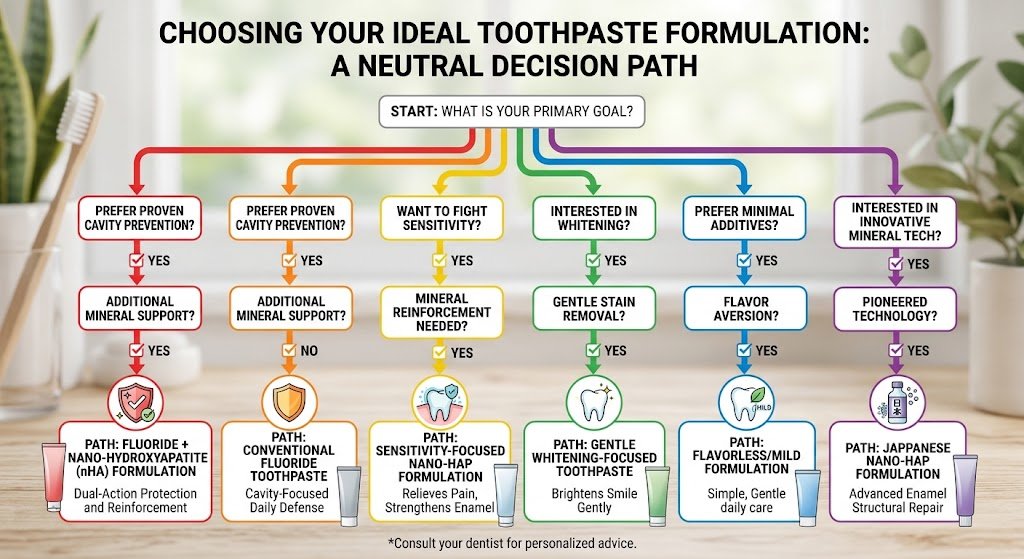
If you’re looking for the best nano-hydroxyapatite toothpaste, the important question is not simply which tube contains nano-hydroxyapatite. You also need to consider whether it is fluoride-free or contains fluoride, the formulation, ingredient transparency, abrasivity, sensitivity needs, flavor, and the evidence behind the claims.
Nano-hydroxyapatite (nHA or n-HAp) is a very fine form of hydroxyapatite, a calcium-phosphate mineral related to the mineral structure of teeth. Research has investigated hydroxyapatite toothpastes for enamel remineralization and caries prevention, but the evidence is not identical to the much longer-established evidence base for fluoride toothpaste. A 2024 systematic review found an expanding body of clinical evidence for hydroxyapatite, while also noting that the available studies vary in design and quality. (PubMed)
That distinction matters when choosing a product.
This guide focuses on how to evaluate nano-hydroxyapatite toothpaste for everyday adult oral care, which formulations make sense for different needs, and what to check before buying.
Affiliate disclosure: This article may contain affiliate links. If you purchase through one of these links, we may earn a commission at no additional cost to you. Our recommendations are based on product attributes, available evidence, formulation, and intended use—not on the commission earned.
Our Quick Take
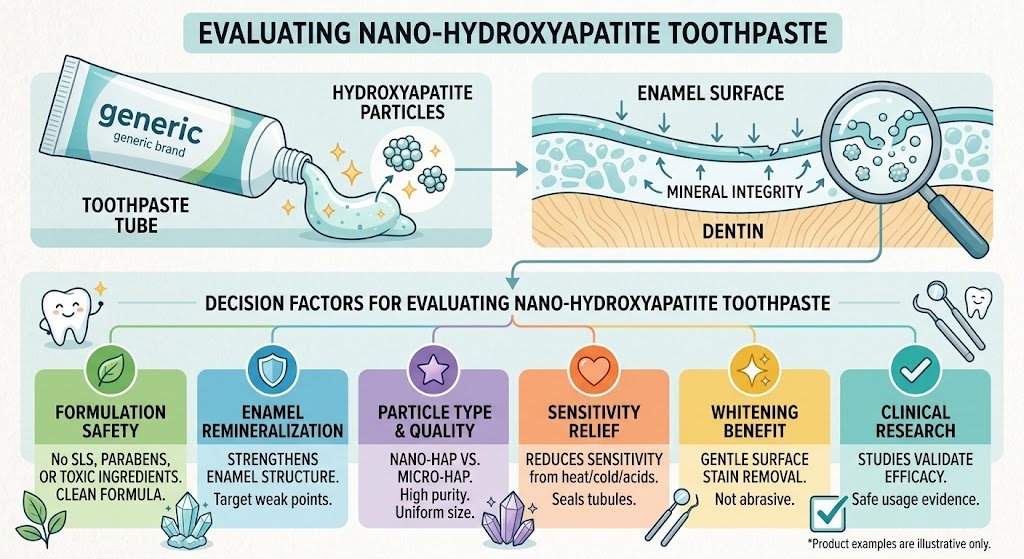
For most shoppers, the best nano-hydroxyapatite toothpaste is one that has clearly identified nano-hydroxyapatite, a formulation appropriate for your oral-health needs, transparent ingredients, and claims that don’t go beyond the available evidence.
Among currently available products, several formulations are worth considering for different priorities:
| Best for | Product to consider | Why it stands out |
| Simple everyday nHA formula | Boka Ela Mint Nano-Hydroxyapatite Toothpaste | Fluoride-free, SLS-free formula with nano-hydroxyapatite and xylitol |
| Nano + micro-hydroxyapatite | RiseWell PRO Hydroxyapatite Toothpaste | Combines nano- and micro-hydroxyapatite |
| Flavor-sensitive users | RiseWell PRO Flavorless | Flavorless formulation with nano- and micro-hydroxyapatite |
| Higher-concentration nHA formula | Dr. Jen Natural 10% Premium nHA Toothpaste | Manufacturer lists 10% nano-hydroxyapatite |
| Japanese nano-hydroxyapatite option | APAGARD PREMIO | Japanese fluoride-free toothpaste using nano-hydroxyapatite technology |
These are different formulations for different preferences, not five interchangeable products. Manufacturer-reported ingredients and formulations should be checked again before purchase because formulas can change. (Boka)
What Is Nano-Hydroxyapatite Toothpaste?
Nano-hydroxyapatite toothpaste contains hydroxyapatite particles engineered at a very small scale.
Hydroxyapatite is a calcium-phosphate mineral associated with the hard tissues of teeth and bone. The reason it has attracted attention in toothpaste research is that its chemical composition is related to the mineral phase of enamel.
The “nano” part refers to particle size rather than a completely different mineral.
That distinction is useful because shoppers will encounter several terms:
- Hydroxyapatite
- Micro-hydroxyapatite
- Nano-hydroxyapatite
- nHA
- n-HAp
- Biomimetic hydroxyapatite
These terms are related, but they should not automatically be treated as identical products. A toothpaste can contain hydroxyapatite without necessarily using a nano-sized form.
Research on nano-hydroxyapatite has examined several potential oral-care applications, including remineralization of early enamel lesions and reduction of mineral loss. A scoping review of nHA dentifrices found that published studies have investigated remineralization, caries prevention, demineralization, sensitivity and other outcomes, while also concluding that additional standardized long-term research is needed. (PubMed)
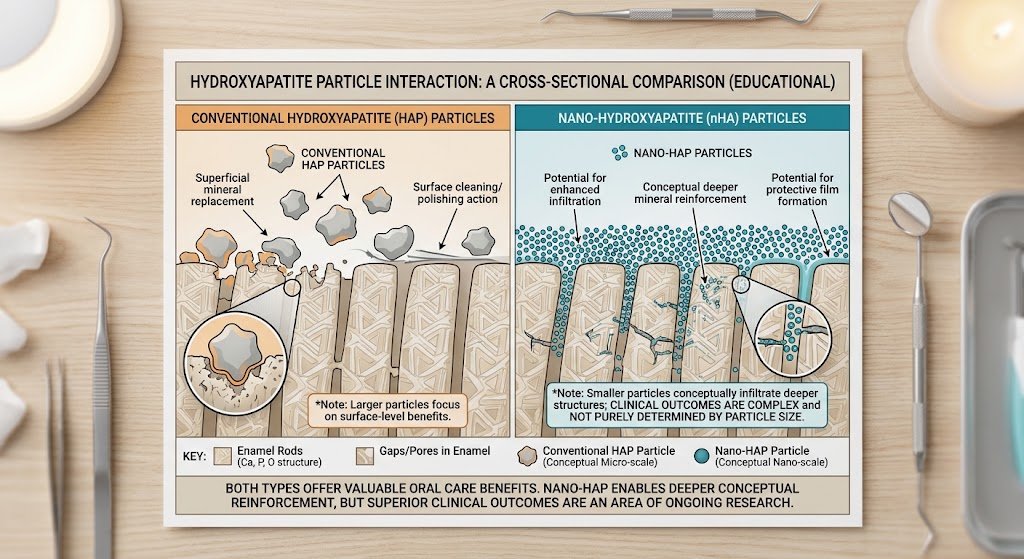
Why particle size matters
The appeal of nano-hydroxyapatite is partly related to its ability to interact closely with the tooth surface.
However, you should avoid interpreting “nano” as meaning automatically more effective.
The quality of the finished toothpaste depends on much more than particle size. Concentration, particle characteristics, formulation, brushing behavior, frequency of use and the patient’s oral-health situation all matter.
This is one reason a product should not be selected solely because its label prominently says “nano.”
Does Nano-Hydroxyapatite Actually Work?
The short answer is: there is promising evidence, but the evidence should be interpreted carefully.
Several systematic reviews have investigated hydroxyapatite as an active ingredient in toothpaste.
An earlier systematic review and meta-analysis of nano-hydroxyapatite found evidence suggesting remineralization potential, but concluded that the available clinical evidence was not strong enough for a definitive conclusion because of the limited number of studies, short follow-up periods, heterogeneity and risk of bias. (PubMed)
More recent evidence is encouraging.
A 2024 updated systematic review and meta-analysis examined clinical studies of hydroxyapatite-containing oral-care products and concluded that the evidence base supporting fluoride-free hydroxyapatite products had expanded. (PubMed)
A 2025 systematic review focused specifically on fluoride-free hydroxyapatite toothpaste and initial caries lesions. It found no statistically significant difference between hydroxyapatite and fluoride toothpaste for some caries-progression outcomes, while other measures showed differences after six months. The authors described hydroxyapatite toothpaste as a potentially effective alternative but based their conclusions on a relatively small eligible evidence base. (PubMed)
So the responsible interpretation is:
Nano-hydroxyapatite is a legitimate area of dental research with encouraging evidence, but it should not be marketed as a universally proven replacement for fluoride.
That distinction becomes particularly important for people who have a high risk of cavities.
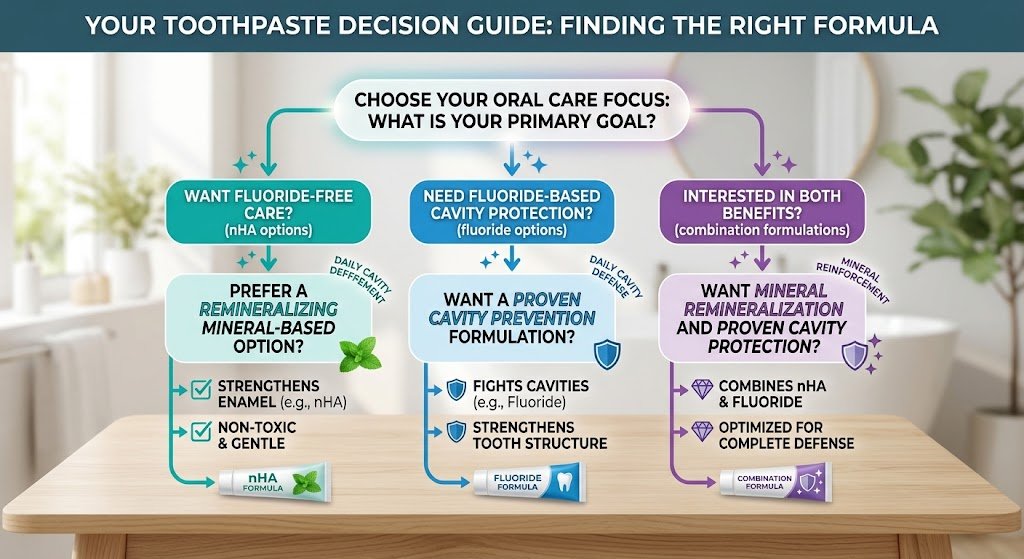
Nano-Hydroxyapatite vs Fluoride: Which Should You Choose?
This is one of the most important decisions you’ll make when buying an nHA toothpaste.
Nano-hydroxyapatite and fluoride are not simply two flavors of the same ingredient.
Fluoride has a long-established role in cavity prevention, and the American Dental Association states that toothpastes carrying the ADA Seal for cavity protection must contain fluoride. The ADA also maintains a specific category for fluoride toothpastes that have demonstrated safety and efficacy for helping prevent cavities. (ADA)
Hydroxyapatite has a different evidence base and is particularly attractive to people who specifically want fluoride-free oral care.
Choose fluoride when cavity prevention is your overriding priority
If you have a history of frequent cavities, elevated caries risk, dry mouth, significant dietary acid or sugar exposure, or have been advised by your dentist to use a fluoride toothpaste, don’t switch simply because a product is marketed as “natural” or “non-toxic.”
Your dentist can also recommend higher-fluoride products or other preventive measures when appropriate.
Consider nano-hydroxyapatite when fluoride-free care is your priority
A fluoride-free nHA toothpaste can make sense for someone who specifically wants a hydroxyapatite-based formulation and understands the trade-offs.
For this shopper, the decision is less about finding the product with the loudest “natural” marketing and more about finding a well-formulated product with transparent ingredients and realistic claims.
There is also a third possibility
Some products combine fluoride with nano-hydroxyapatite.
For example, Dr. Jen Natural currently lists a toothpaste containing 0.22% sodium fluoride and 10% nano-hydroxyapatite. That makes it fundamentally different from the many fluoride-free nHA products on the market. (Dr. Jen Natural)
This type of formulation is worth considering if you want to investigate hydroxyapatite while retaining fluoride.
What Should You Look for in the Best Nano-Hydroxyapatite Toothpaste?
The active ingredient is only the starting point.
1. Clearly identified nano-hydroxyapatite
Look at the actual ingredient list rather than relying only on the front label.
For example, Boka’s Ela Mint formula lists Hydroxyapatite in the ingredients and identifies it as nano-hydroxyapatite in the manufacturer’s documentation. (Boka)
RiseWell’s PRO formula separately lists both hydroxyapatite and nano-hydroxyapatite. (RiseWell)
That type of transparency makes it easier to understand what you’re actually buying.
2. Fluoride status
Don’t assume every hydroxyapatite toothpaste is fluoride-free.
Check the ingredient list and product description.
If you specifically want fluoride-free toothpaste, confirm that before purchasing. Conversely, if you want fluoride, make sure the formula actually contains a fluoride active ingredient.
3. Concentration
When manufacturers disclose concentration, it can provide useful information for comparison.
For example, Dr. Jen Natural currently lists 10% nano-hydroxyapatite in several of its formulas. (Dr. Jen Natural)
However, don’t turn concentration into a simplistic ranking system.
A toothpaste with a higher stated percentage isn’t automatically clinically superior. The formulation, particle characteristics, supporting ingredients and available evidence still matter.
4. Abrasivity
A toothpaste needs enough cleaning ability to remove plaque and surface deposits, but “more abrasive” does not mean “better.”
The ADA notes that RDA values should not be used as a simple numerical ranking of toothpaste safety and states that ADA-Seal toothpastes have an RDA of 250 or less. (ADA)
For shoppers concerned about enamel wear, sensitivity or frequent brushing, the better approach is to consider the complete formulation rather than chasing an arbitrary abrasivity number.
5. Ingredients you personally want to avoid
Some shoppers specifically seek formulas without:
- SLS
- Artificial colors
- Certain flavoring agents
- Essential oils
- Parabens
- Strong flavor compounds
- Specific allergens
But “free from” lists should be personalized.
For example, Boka’s Ela Mint formula is marketed as fluoride-free and SLS-free, but it still contains multiple flavoring oils, including peppermint, spearmint, anise and wintergreen oils. (Boka)
Someone looking for an especially simple or flavor-neutral formula may therefore prefer a different product.
6. Flavor and sensory experience
This sounds minor until you use the toothpaste twice every day.
A toothpaste that you dislike is unlikely to become a sustainable part of your routine.
Look for a flavor that you can comfortably use long-term. Some brands now offer conventional mint, stronger mint, cinnamon, fruit flavors and even flavorless formulas.
RiseWell’s PRO Flavorless toothpaste, for example, is specifically marketed without essential oils or extracts and uses a flavorless formulation. (RiseWell)
Best Nano-Hydroxyapatite Toothpaste Options to Consider
Rather than pretending there is one universally superior formula, it is more useful to match products to different priorities.
Boka Ela Mint Nano-Hydroxyapatite Toothpaste — Best for a straightforward everyday formula
Boka’s Ela Mint toothpaste is a fluoride-free, SLS-free nano-hydroxyapatite formula. The manufacturer lists hydroxyapatite, xylitol, hydrated silica and other ingredients in the formulation and recommends twice-daily brushing. (Boka)
It is a sensible option for shoppers who want:
- Nano-hydroxyapatite
- Fluoride-free formulation
- SLS-free formulation
- A conventional mint experience
- A relatively simple everyday toothpaste format
The main consideration is that it isn’t a minimal-ingredient flavorless formula; it contains several flavoring oils and botanical ingredients.
Best fit: adults who want an accessible, everyday fluoride-free nHA toothpaste.
Check current Amazon availability: [ add a link ]
RiseWell PRO Hydroxyapatite Toothpaste — Best for nano + micro hydroxyapatite
RiseWell’s PRO formula uses both micro- and nano-hydroxyapatite. The manufacturer lists the product as fluoride-free and provides a full ingredient list. (RiseWell)
That makes it interesting for shoppers who specifically want a formulation combining the two particle scales rather than a product marketed around nano-hydroxyapatite alone.
The flavorless version is particularly relevant for people who dislike strong flavors or want to minimize flavoring ingredients.
Best fit: shoppers prioritizing a nano + micro-hydroxyapatite formulation or those who want a flavorless option.
Check current Amazon availability: [ add a link ]
Dr. Jen Natural 10% Premium Nano-Hydroxyapatite Toothpaste — Best for a disclosed 10% nHA formulation
Dr. Jen Natural lists 10% nano-hydroxyapatite as a key active in its fluoride-free toothpaste. The brand also offers a separate formula combining 10% nHA with 0.22% sodium fluoride. (Dr. Jen Natural)
This distinction is useful because shoppers sometimes assume all nHA products are fluoride-free.
They aren’t.
Best fit: shoppers who specifically want a product with a disclosed 10% nHA concentration, including people interested in either fluoride-free or combined fluoride/nHA formulations.
Check current Amazon availability: [ add a link ]
APAGARD PREMIO — Best for shoppers interested in Japanese nHA toothpaste
APAGARD’s PREMIO line is a Japanese nano-hydroxyapatite toothpaste marketed as fluoride-free and focused on whitening and enamel care. The manufacturer’s site lists PREMIO products using its nano-hydroxyapatite technology. (Apagard)
This option is particularly relevant if you’re interested in Japanese oral-care formulations or want to explore a long-established hydroxyapatite-focused product category.
Best fit: shoppers interested in Japanese nano-hydroxyapatite toothpaste and fluoride-free formulas.
Check current Amazon availability: [ add a link ]
How We Would Compare Nano-Hydroxyapatite Toothpastes
A good nano-hydroxyapatite toothpaste is not simply the one with “nano” printed largest on the label. The more useful comparison is based on the complete formula, the role of hydroxyapatite in that formula, the intended use, and how transparent the manufacturer is about its ingredients.
For this guide, the most important factors are:
1. Is nano-hydroxyapatite clearly identified?
Look for hydroxyapatite or nano-hydroxyapatite in the ingredient information rather than relying only on front-label marketing.
Some manufacturers disclose a specific concentration, while others identify hydroxyapatite as an ingredient without stating a percentage. A disclosed concentration can make products easier to compare, but a missing percentage does not automatically mean the product is ineffective.
For example, Dr. Jen’s products explicitly market a 10% premium nano-hydroxyapatite formula, while other products identify nano-hydroxyapatite without providing the same concentration information.
2. Is it fluoride-free or does it contain fluoride?
This is one of the most important distinctions.
Some nano-hydroxyapatite toothpastes are completely fluoride-free. Others combine hydroxyapatite with fluoride.
For example, Boka Ela Mint is marketed as fluoride-free, while Dr. Jen’s Super Paste combines 10% nano-hydroxyapatite with sodium fluoride.
Neither formula should be treated as automatically appropriate for every person.
For people at elevated risk of cavities, fluoride remains an important consideration because fluoride toothpaste has a long-established role in cavity prevention. The American Dental Association’s accepted toothpaste category for cavity protection is based on fluoride-containing toothpaste.
3. Is the formula suitable for your specific needs?
A toothpaste can contain nano-hydroxyapatite and still be a poor personal fit.
Consider other ingredients and product characteristics if you have:
- tooth sensitivity
- a preference for fluoride-free products
- sensitivity to strong flavors
- a preference to avoid SLS
- a preference for minimal ingredients
- a desire for surface-stain removal
- difficulty tolerating strong mint or essential oils
For example, RiseWell PRO Flavorless is specifically formulated without essential oils or extracts and combines nano- and micro-hydroxyapatite.
4. Does the toothpaste clean effectively without making unrealistic claims?
Nano-hydroxyapatite is primarily interesting because of its interaction with tooth mineral and its potential remineralization-related effects. That does not mean the toothpaste should be expected to whiten teeth dramatically, remove tartar, or replace professional dental care.
Cleaning performance also depends on the rest of the formula.
Boka’s whitening formula, for example, uses nano-hydroxyapatite alongside cleaning ingredients intended to help remove everyday surface stains. That is different from claiming that nano-hydroxyapatite itself is a powerful bleaching agent.
5. Can you actually use it consistently?
This sounds obvious, but it matters.
A toothpaste that has an appealing ingredient profile but an unpleasant flavor, texture, or foaming level may end up being used inconsistently.
Flavor, texture, foaming, tube design, and availability are therefore legitimate practical considerations. They are not measures of clinical superiority.
Best Nano-Hydroxyapatite Toothpaste by Use Case
Rather than declaring one toothpaste universally “best,” it is more useful to match the formula to the reason you are considering nano-hydroxyapatite in the first place.
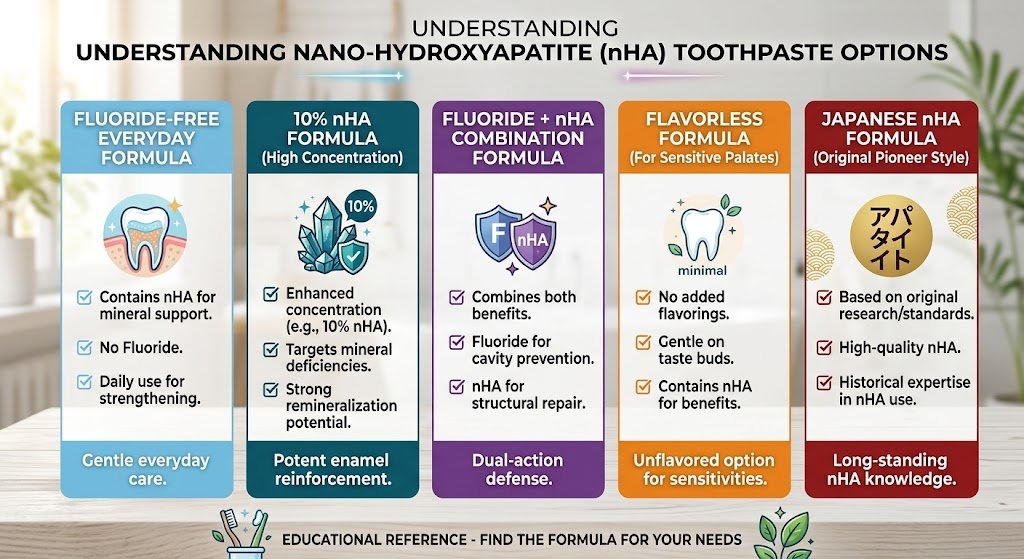
Best Everyday Fluoride-Free Option: Boka Ela Mint
Boka’s Ela Mint toothpaste is one of the more recognizable nano-hydroxyapatite options in the U.S. market.
Its formula is fluoride-free and contains nano-hydroxyapatite along with xylitol and other formulation ingredients. Boka also markets it as SLS-free and recommends brushing with a pea-sized amount for two minutes twice daily.
Why it stands out: It provides a relatively straightforward entry point for someone specifically looking for a conventional fluoride-free toothpaste containing nano-hydroxyapatite.
Best suited to: Adults who specifically want a fluoride-free nHA toothpaste and prefer a conventional mint toothpaste format.
Important consideration: If you have a high risk of dental caries, do not choose a fluoride-free toothpaste solely because it contains nano-hydroxyapatite. Discuss your cavity-prevention strategy with your dentist.
Best for a Higher-Disclosure nHA Formula: Dr. Jen 10% Premium nHA
Dr. Jen Natural offers formulas that explicitly state a 10% premium nano-hydroxyapatite concentration.
Its fluoride-free 10% formula is designed for consumers who specifically want a fluoride-free toothpaste with a clearly disclosed nHA concentration.
The brand also offers a different Super Paste containing both 10% nHA and sodium fluoride.
Why it stands out: The stated nHA concentration makes the product easier to evaluate from an ingredient-transparency perspective.
Best suited to: Readers who specifically want a disclosed 10% nHA formulation.
Important consideration: A higher disclosed concentration should not automatically be interpreted as proof that one toothpaste will produce better clinical outcomes than another. The clinical evidence does not establish a simple “more nHA = better toothpaste” rule.
Best for a Fluoride + nHA Combination: Dr. Jen Super Paste
If you want to explore nano-hydroxyapatite without eliminating fluoride from your toothpaste routine, Dr. Jen’s Super Paste is a particularly relevant formula to examine.
The manufacturer lists 10% premium nano-hydroxyapatite together with 0.22% sodium fluoride.
This type of formula is worth distinguishing from fluoride-free nHA toothpaste because it does not require the consumer to choose between the two active ingredients.
Best suited to: People interested in a toothpaste containing both fluoride and nano-hydroxyapatite.
Why this category matters: The evidence base for fluoride-containing toothpaste is much more established for caries prevention than the evidence base for fluoride-free nHA toothpaste. Combining the ingredients is therefore a fundamentally different proposition from replacing fluoride with nHA.
Best for a Flavorless Formula: RiseWell PRO Flavorless
RiseWell’s PRO Flavorless formula combines nano- and micro-hydroxyapatite and is designed without essential oils or extracts.
This makes it particularly interesting for people who dislike strong mint flavors or who prefer a less aromatic toothpaste.
Best suited to: Adults who want a fluoride-free nHA formula but prefer to minimize flavoring ingredients.
Best Japanese nHA Option to Consider: APAGARD PREMIO
APAGARD is a long-established Japanese hydroxyapatite toothpaste line, with PREMIO among its products.
The manufacturer’s product information identifies nano-hydroxyapatite as part of the formulation and positions the toothpaste around its hydroxyapatite technology.
Best suited to: Readers specifically interested in Japanese nano-hydroxyapatite toothpaste products.
Important consideration: Imported products can differ in labeling, availability, package size, and seller information depending on where you purchase them. Verify the current product listing and ingredient information before buying.
Nano-Hydroxyapatite vs Fluoride: Which Should You Choose?
This is probably the most important question behind the search for nano-hydroxyapatite toothpaste.
The answer depends partly on what you are trying to accomplish and your individual cavity risk.
Fluoride has a substantially longer clinical evidence history in caries prevention. The ADA states that toothpaste carrying its cavity-protection claim must contain fluoride, and its Seal program evaluates toothpaste against established safety and efficacy requirements.
Hydroxyapatite research has also expanded.
A 2024 systematic review and meta-analysis reported that the clinical evidence surrounding hydroxyapatite-based, fluoride-free oral care had expanded, although the authors disclosed conflicts of interest involving some researchers and the manufacturer of certain hydroxyapatite products.
A separate 2025 systematic review focused on fluoride-free hydroxyapatite toothpaste in children, adolescents, and young adults. The included studies did not show statistically significant differences in lesion development or progression compared with fluoride toothpaste, but the evidence base was limited.
Earlier systematic evidence was more cautious. A 2022 systematic review and meta-analysis concluded that there was insufficient evidence at that time to make a definitive conclusion about nano-hydroxyapatite’s caries-prevention effect, citing factors such as heterogeneity, risk of bias, and manufacturer funding in some studies.
The practical takeaway is not that one ingredient has made the other obsolete.
Instead:
- Fluoride: the more established caries-prevention active.
- Nano-hydroxyapatite: a biomimetic mineral ingredient with growing clinical evidence.
- Fluoride + nHA: an option for people interested in using both ingredients.
- Fluoride-free nHA: an option for people specifically seeking fluoride-free oral care, but the decision should consider individual cavity risk.
If you have frequent cavities, dry mouth, extensive restorations, orthodontic appliances, or another reason your dentist considers you higher-risk, ask your dental professional before replacing fluoride toothpaste with a fluoride-free product.
Is Nano-Hydroxyapatite Safe?
Nano-hydroxyapatite has been investigated in dental research for remineralization, demineralization control, caries prevention, and related applications.
A 2022 scoping review identified 28 studies investigating nano-hydroxyapatite in the remineralization of early dental caries. Many reported potentially beneficial effects, but the authors also noted limitations including a lack of sufficient evidence for primary teeth and a need for longer-term, standardized research.
That distinction is important.
“Studied” does not mean “proven superior,” and “generally considered safe in a particular formulation” does not mean every nano-material is interchangeable.
The exact particle characteristics, concentration, formulation, exposure, and intended use all matter.
For consumers, the sensible approach is to look at the complete toothpaste formula and the manufacturer’s ingredient disclosure rather than treating the word “nano” itself as either a benefit or a warning sign.
How to Use Nano-Hydroxyapatite Toothpaste
For normal daily brushing, follow the instructions provided by the manufacturer.
Boka, for example, recommends using a pea-sized amount and brushing for two minutes twice daily.
A practical routine is:
- Use the amount recommended on the product label.
- Brush all tooth surfaces gently for approximately two minutes.
- Pay attention to the gumline and areas that commonly collect plaque.
- Avoid aggressive scrubbing.
- Follow any rinsing instructions supplied with the product.
- Maintain regular dental examinations and professional preventive care.
More toothpaste is not necessarily better.
Likewise, brushing harder is not a shortcut to better remineralization. Excessive brushing pressure can contribute to mechanical wear and gum irritation.
If your dentist has given you a specific brushing or fluoride-use recommendation, follow that individualized advice over a generic product guide.
Common Mistakes When Buying Nano-Hydroxyapatite Toothpaste
Mistake 1: Assuming “nano” automatically means better
Nano-hydroxyapatite is a specific material format, but the word “nano” does not establish clinical superiority.
Look at the whole formula and the evidence supporting the intended claim.
Mistake 2: Choosing fluoride-free toothpaste without considering cavity risk
A fluoride-free toothpaste may be appropriate for some consumers, but fluoride remains an important evidence-based tool for cavity prevention.
The decision to switch should be based on your circumstances rather than marketing alone.
Mistake 3: Comparing products only by nHA percentage
A 10% label may look impressive, but concentration alone does not tell you everything about the final product.
Particle characteristics, formulation, brushing behavior, frequency of use, and the rest of the ingredient system can all matter.
Mistake 4: Expecting nHA toothpaste to whiten like a bleaching treatment
A toothpaste may help remove surface stains through its cleaning system, but that is different from chemically bleaching the underlying tooth color.
If whitening is your primary goal, distinguish between:
- surface-stain removal
- optical brightening
- peroxide bleaching
- professional whitening
Do not assume that nano-hydroxyapatite itself provides all four.
Mistake 5: Treating toothpaste as a replacement for dental care
Toothpaste is one component of oral hygiene.
It does not replace professional evaluation, treatment of cavities, periodontal care, or individualized preventive recommendations.
Frequently Asked Questions
Is nano-hydroxyapatite toothpaste better than fluoride toothpaste?
There is no single answer that applies to every person.
Fluoride has a much longer-established evidence base for caries prevention. Nano-hydroxyapatite has growing evidence supporting its potential as a remineralizing and caries-prevention ingredient, but systematic reviews continue to identify limitations in the available evidence.
Does nano-hydroxyapatite toothpaste contain fluoride?
Not necessarily.
Some products are fluoride-free, while others combine hydroxyapatite with fluoride. Always check the current ingredient list.
Can you use nano-hydroxyapatite toothpaste every day?
Many products are designed for routine daily brushing, but follow the manufacturer’s directions. Boka, for example, recommends twice-daily brushing.
Is 10% nano-hydroxyapatite better?
There is not enough evidence to make a general rule that a toothpaste containing 10% nHA will outperform every lower-concentration product.
A disclosed concentration is useful for transparency, but it should not be treated as a standalone measure of clinical effectiveness.
Does nano-hydroxyapatite rebuild enamel?
Hydroxyapatite is chemically related to the mineral component of teeth, and laboratory and clinical research has investigated its ability to support remineralization and reduce demineralization.
However, “rebuilds enamel” can be misleading if interpreted as completely regenerating lost natural tooth structure. Toothpaste should not be expected to restore substantial amounts of physically lost enamel.
Can nano-hydroxyapatite help sensitive teeth?
Hydroxyapatite has been investigated for dentin hypersensitivity and may be relevant to people looking for sensitivity-focused toothpaste.
If sensitivity is persistent, severe, localized to one tooth, or associated with pain, a dental examination is more important than simply changing toothpaste.
Is nano-hydroxyapatite toothpaste safe to swallow?
Toothpaste is generally intended to be brushed onto the teeth and then expectorated, not intentionally swallowed.
Children require particular care because toothpaste ingredients and appropriate amounts depend on age. Follow the product’s age-specific instructions and dental guidance.
Does nano-hydroxyapatite toothpaste have an ADA Seal?
Do not assume that a toothpaste has the ADA Seal simply because it contains hydroxyapatite.
The ADA’s cavity-protection toothpaste category is based on fluoride-containing toothpaste, and products seeking the Seal undergo an evaluation process. Check the ADA’s current accepted-product information rather than relying on marketing language.
What is the best nano-hydroxyapatite toothpaste for cavities?
For cavity prevention, the most important question is not simply which nHA toothpaste has the highest percentage.
Consider your cavity risk, whether the product contains fluoride, the evidence supporting the active ingredients, and your dentist’s recommendation.
A fluoride-containing nHA formula may be particularly relevant for someone who wants both ingredients, while a fluoride-free formula represents a different choice that warrants more consideration of individual cavity risk.
Bottom Line
Nano-hydroxyapatite toothpaste is no longer just a niche ingredient concept. It has a growing body of research behind it, and multiple manufacturers now offer fluoride-free and fluoride-containing formulations.
The evidence, however, is more nuanced than the marketing sometimes suggests.
If you specifically want a fluoride-free everyday nHA toothpaste, Boka Ela Mint is a straightforward option to investigate.
If ingredient concentration disclosure is important to you, Dr. Jen’s 10% premium nHA products provide a clearly stated concentration.
If you want fluoride and nano-hydroxyapatite together, Dr. Jen’s Super Paste is an example of that formulation approach.
If you prefer a flavorless formula, RiseWell PRO Flavorless is worth considering.
And if you are interested in Japanese nano-hydroxyapatite toothpaste, APAGARD PREMIO is an established product line to investigate.
The most important point is that “best” depends on what you need from the toothpaste.
For someone with a high risk of dental caries, a fluoride-free toothpaste should not be selected merely because nano-hydroxyapatite is fashionable. For someone specifically seeking fluoride-free oral care, meanwhile, nHA provides a research-backed ingredient worth considering while recognizing that the evidence continues to develop.