If regular toothpaste leaves your mouth feeling irritated—or you simply dislike the heavy foaming sensation—an SLS-free toothpaste may be worth trying. SLS, or sodium lauryl sulfate, is a common toothpaste surfactant that helps create foam, but the American Dental Association notes that it can cause contact irritation or allergic reactions in some people.
The important catch is that SLS-free does not automatically mean fluoride-free, fluoride-containing, better for cavities, or better for everyone. The most useful way to choose is to start with your oral-health priority, then check the active ingredients and the complete ingredient list.
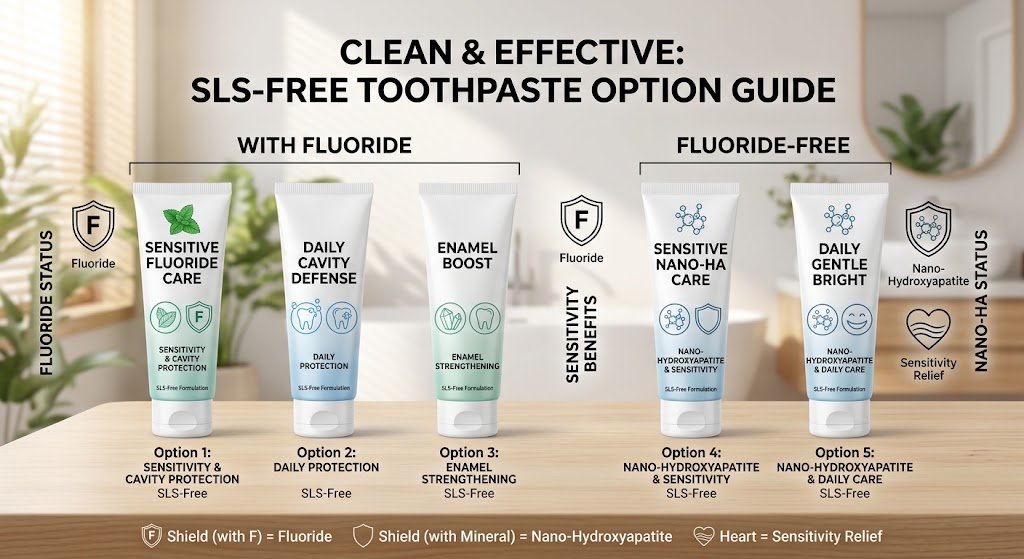
This guide compares SLS-free options for sensitive mouths, recurrent canker sores, tooth sensitivity, fluoride-based cavity prevention, and people specifically looking for fluoride-free nano-hydroxyapatite formulas.
Affiliate disclosure: If you purchase through qualifying links on this page, we may earn a commission at no additional cost to you.
Quick Picks: SLS-Free Toothpaste by Use Case
| Toothpaste | Best suited for | Fluoride? | SLS-free? | Notable feature |
| ClōSYS Sensitive Fluoride Toothpaste | SLS-free daily toothpaste with fluoride | Yes | Yes* | Sodium fluoride + ADA Seal |
| Sensodyne Fresh Mint | SLS-free toothpaste for sensitive teeth | Yes | Yes | Potassium nitrate + fluoride |
| Sensodyne Extra Whitening | Sensitivity + surface-stain removal | Yes | Yes | Whitening-focused formula |
| Boka Ela Mint n-Ha | Fluoride-free SLS-free shoppers | No | Yes | Nano-hydroxyapatite |
| Boka Mint Coconut Cream Sensitive | Fluoride-free SLS-free sensitivity formula | No | Yes | 5% potassium nitrate + n-Ha |
*The ADA listing describes ClōSYS Sensitive Fluoride Toothpaste as “Sulphate-Free” and lists sodium fluoride as its active ingredient. Always verify the current package and ingredient list before purchase.
What Is SLS-Free Toothpaste?
SLS-free toothpaste is simply toothpaste formulated without sodium lauryl sulfate.
SLS is a surfactant, or detergent, used in many toothpastes to create foam and help distribute the paste during brushing. The foaming effect can make a toothpaste feel like it is cleaning more aggressively, but foam itself is not what prevents cavities.
Toothpaste contains a mixture of active and inactive ingredients. Depending on the formula, active ingredients can include fluoride compounds for cavity prevention or desensitizing ingredients for tooth sensitivity.
That distinction matters because removing SLS does not remove the ingredients responsible for a toothpaste’s main oral-health benefit.
For example:
- An SLS-free toothpaste can contain sodium fluoride.
- An SLS-free toothpaste can contain another fluoride such as stannous fluoride.
- An SLS-free toothpaste can be fluoride-free.
- An SLS-free toothpaste can use another surfactant instead of SLS.
- An SLS-free toothpaste can contain additional ingredients aimed at sensitivity, whitening, or other cosmetic benefits.
So when comparing the best SLS-free toothpaste options, don’t stop at the front of the tube.
SLS vs. Other Surfactants
“SLS-free” does not necessarily mean “surfactant-free.”
Manufacturers can replace SLS with other surfactants or detergents. For example, Sensodyne says many of its SLS-free toothpastes use alternatives such as sodium methyl cocoyl taurate or cocamidopropyl betaine.
Boka’s SLS-free formulas similarly use sodium lauroyl sarcosinate in at least some formulations.
These ingredients are chemically different from sodium lauryl sulfate. Therefore, someone specifically trying to avoid SLS should not automatically assume that a product containing another surfactant fails the requirement.
If your dentist has advised you to avoid a broader group of detergents or if you have experienced a suspected contact reaction, ask about the specific ingredients rather than relying on the phrase “SLS-free.”
Why Choose an SLS-Free Toothpaste?
There are several reasons people look for SLS-free toothpaste, but they are not equally well supported by evidence.
Mouth irritation
The ADA identifies SLS among toothpaste ingredients that can cause contact irritation or allergic reactions in susceptible individuals. Reported oral reactions can include redness, swelling, peeling or ulceration of the oral tissues.
That does not mean SLS irritates everyone’s mouth. Millions of people use SLS-containing toothpaste without an obvious problem.
The practical question is whether your mouth feels better with an SLS-free formula.
Recurrent canker sores
This is one of the more interesting reasons to consider an SLS-free toothpaste.
A 2019 systematic review examined four double-blind randomized crossover trials involving 124 participants with recurrent aphthous stomatitis. The review found that SLS-free dentifrice was associated with reductions in ulcer number, duration, episodes, and pain, while also noting that additional well-designed research is needed.
However, individual trials have produced less consistent results. For example, one randomized crossover trial involving 90 people found reductions in ulcer duration and pain but not in the number of ulcers or episodes.
So the evidence supports a reasonable trial of SLS-free toothpaste for people who experience recurrent canker sores, but it does not establish that SLS causes every canker sore or that removing SLS will prevent them.
If mouth ulcers are frequent, severe, unusually persistent, or changing in appearance, discuss them with a dental or medical professional rather than assuming toothpaste is the cause.
You dislike excessive foam
Some people simply prefer the mouthfeel of a lower-foaming toothpaste.
That’s a legitimate product preference. SLS contributes to foaming, although an SLS-free formula can still contain another surfactant and produce some foam.
The important point is that more foam does not automatically mean better cleaning. What matters for everyday oral care is the complete formulation and, especially for cavity prevention, the active ingredient.
What to Look for in an SLS-Free Toothpaste
Once you know you want to avoid SLS, use these criteria to narrow the choices.
1. Check the fluoride status first
For most adults who want conventional cavity prevention, this is the first major decision.
The ADA identifies sodium fluoride, sodium monofluorophosphate, and stannous fluoride as fluoride active ingredients used in toothpaste. Over-the-counter fluoride toothpastes in the U.S. generally contain about 1,000–1,500 ppm fluoride.
The FDA’s OTC anticaries monograph also specifies permitted fluoride ingredients and concentrations for dentifrices.
This means an SLS-free toothpaste should not automatically be treated as an alternative to fluoride toothpaste.
If your priority is cavity prevention, look for an SLS-free product that also contains an appropriate fluoride active ingredient.
2. Look for a sensitivity active if sensitivity is your main problem
If cold drinks, hot foods, sweets, or brushing trigger sharp tooth pain, SLS-free status is only part of the decision.
Sensitivity toothpastes may contain active ingredients such as potassium nitrate or stannous fluoride. The ADA’s toothpaste guidance identifies desensitizing agents as a separate category from SLS and other inactive ingredients.
Sensodyne, for example, says its products use potassium nitrate or stannous fluoride for sensitivity depending on the formula.
Therefore, an SLS-free toothpaste without a sensitivity active may be suitable for someone who simply wants to avoid SLS, but it isn’t necessarily the right choice for someone specifically seeking sensitivity relief.
3. Don’t confuse SLS-free with fluoride-free
This is one of the easiest mistakes to make.
Some popular SLS-free toothpastes are also fluoride-free. Boka’s Ela Mint toothpaste, for example, is marketed as fluoride-free and SLS-free and uses nano-hydroxyapatite instead.
That may appeal to shoppers who specifically want a fluoride-free formulation.
But if you were searching for SLS-free toothpaste because of mouth irritation while still wanting conventional fluoride protection, a fluoride-free formula solves a different problem.
4. Consider the rest of the ingredient list
If you’re reacting to toothpaste, SLS may not be the only possible trigger.
The ADA lists other ingredients that can produce contact reactions in susceptible people, including certain flavoring agents, essential oils, menthol, propylene glycol and PEGs.
That is why switching to an SLS-free product may not solve the problem if another ingredient is responsible.
If symptoms continue after changing toothpaste, speak with a dentist or other qualified clinician about whether a broader ingredient review is appropriate.
5. Use the ADA Seal as one verification signal
The ADA Seal of Acceptance indicates that a product has been evaluated against specific safety and efficacy requirements. The ADA says consumers can verify accepted products through its Product Search database rather than relying only on packaging claims.
For fluoride dentifrices, the relevant ADA Seal category claim is helping prevent cavities.
The Seal does not mean every accepted toothpaste is interchangeable or that one accepted product is universally superior to another. It tells you that the product has met the requirements for the specific claim or category for which it was accepted.
Best SLS-Free Toothpaste by Use Case
Rather than choosing one universal winner, it makes more sense to match the formula to the reason you’re shopping.
Best SLS-free fluoride toothpaste: ClōSYS Sensitive Fluoride Toothpaste
ClōSYS Sensitive Fluoride Toothpaste is a particularly relevant option for readers who want SLS-free toothpaste without giving up fluoride.
The ADA’s current product listing identifies sodium fluoride as the active ingredient and says the product is accepted for helping prevent tooth decay when used as directed. The ADA listing also describes it as “Sulphate-Free.”
This makes the formula particularly interesting for someone whose priority is:
- Avoiding SLS or sulfates
- Keeping fluoride in the routine
- Choosing a product with current ADA Seal acceptance
- Avoiding a fluoride-free formula by accident
The key limitation is that “sulfate-free” and “SLS-free” should still be checked against the current package and ingredient list when you buy.
Consider it if: your main requirement is an SLS-free daily toothpaste with fluoride.
Look elsewhere if: you specifically want fluoride-free nano-hydroxyapatite or a dedicated whitening formulation.
Best SLS-free option for sensitive teeth: Sensodyne Fresh Mint
Sensodyne’s U.S. product page identifies Fresh Mint as SLS-free, fluoride-containing, and designed for sensitivity relief.
Sensodyne’s broader product information says its sensitivity formulas use active ingredients such as potassium nitrate or stannous fluoride depending on the product.
The advantage here is that you’re not choosing an SLS-free toothpaste solely because it lacks SLS; you’re also selecting a formula designed around tooth sensitivity.
Consider it if: you have sensitive teeth and want a mainstream fluoride toothpaste that does not contain SLS.
Check before buying: Sensodyne has many different formulas, and not every Sensodyne toothpaste is SLS-free. The manufacturer specifically lists which products contain SLS and which do not.
Best SLS-free option for whitening: Sensodyne Extra Whitening
For someone who wants an SLS-free toothpaste but also wants a whitening-oriented formula, Sensodyne Extra Whitening is another option to investigate.
The current manufacturer page describes it as SLS-free, fluoride-containing, sensitivity-focused, and designed to help remove surface stains.
That makes it different from a basic SLS-free toothpaste: the formulation is intended to address both sensitivity and surface-stain concerns.
Remember that toothpaste whitening generally concerns surface stains, not the same type of color change produced by professional bleaching.
Consider it if: sensitivity and surface-stain removal are both priorities.
Look elsewhere if: your only concern is avoiding SLS and you don’t need a whitening-oriented formula.
Best fluoride-free SLS-free n-Ha option: Boka Ela Mint
Boka Ela Mint takes a different approach.
The current Boka product page describes it as fluoride-free, SLS-free and based on nano-hydroxyapatite (n-Ha).
This makes it relevant to a very specific shopper: someone deliberately looking for an SLS-free and fluoride-free toothpaste using n-Ha.
It should not, however, be presented as simply interchangeable with a conventional fluoride toothpaste. If your goal is specifically to use fluoride toothpaste for cavity prevention, choose an appropriate fluoride-containing formula instead.
Consider it if: you specifically want a fluoride-free n-Ha formula.
Look elsewhere if: you want a conventional fluoride toothpaste.
Best fluoride-free SLS-free sensitivity formula: Boka Mint Coconut Cream Sensitive
Boka’s Mint Coconut Cream Sensitive formula is another specialized option. The manufacturer describes it as fluoride-free and SLS-free, with 5% potassium nitrate and nano-hydroxyapatite.
That combination makes it different from a basic fluoride-free toothpaste.
The important trade-off is again fluoride status. Someone choosing it should understand that they are selecting a fluoride-free formula with potassium nitrate and n-Ha—not simply a conventional fluoride toothpaste without SLS.
Consider it if: you specifically want a fluoride-free SLS-free formula and sensitivity is an important consideration.
Look elsewhere if: your priority is a conventional fluoride anticavity toothpaste.
SLS-Free vs. Fluoride-Free: What’s the Difference?
These terms describe two completely different characteristics.
SLS-free tells you something about an inactive ingredient: sodium lauryl sulfate is absent from the formulation.
Fluoride-free tells you that the toothpaste does not use fluoride as its anticaries active ingredient.
A toothpaste can therefore be:
- SLS-free + fluoride-containing
- SLS-free + fluoride-free
- SLS-containing + fluoride-containing
- SLS-containing + fluoride-free
For many shoppers, the first combination is the one that is easiest to overlook.
If you want to avoid SLS because of irritation but still want conventional fluoride toothpaste, read the active ingredient section rather than relying on marketing language on the front of the package.
SLS-Free vs. SLS-Containing Toothpaste
There is no universal requirement that everyone should avoid SLS.
SLS is widely used because it provides foaming and surfactant properties. The ADA recognizes it as an ingredient that can cause contact irritation in some individuals, but that does not establish that it is harmful for every toothpaste user.
The practical distinction is therefore about individual tolerance and formulation preference, not simply whether a toothpaste contains a chemical with a concerning-sounding name.
If your current toothpaste works well, causes no irritation, and meets your oral-health needs, there may be no compelling reason to switch solely because it contains SLS.
On the other hand, if you repeatedly experience irritation or recurrent aphthous ulcers and want to test whether SLS is contributing, an SLS-free toothpaste is a reasonable formulation change to discuss with your dentist.
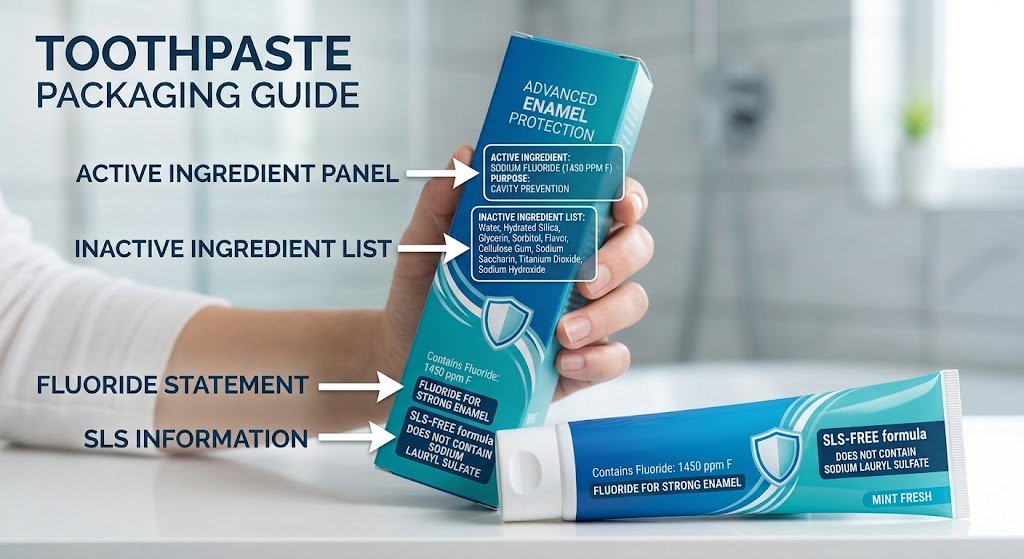
How to Read a Toothpaste Label for SLS
When shopping, don’t rely only on the words “natural,” “gentle,” “clean,” or “sensitive.”
Instead:
- Look for the active ingredient section.
Identify whether the toothpaste contains sodium fluoride, stannous fluoride, sodium monofluorophosphate, or another active ingredient relevant to your goal. - Search the ingredient list for sodium lauryl sulfate.
If you specifically want SLS-free toothpaste, this is the ingredient you’re trying to exclude. - Don’t automatically reject every ingredient containing “sodium” or “sulfate-like” language.
Different ingredients can have very different functions and chemical structures. - Check whether the product is fluoride-free.
This matters especially with n-Ha toothpastes. - Check the exact product variant.
A brand can sell both SLS-free and SLS-containing formulas. - Verify the current manufacturer’s ingredient list.
Formulations can change. - If relevant, verify ADA Seal acceptance independently.
The ADA recommends checking its Product Search rather than relying solely on a marketplace listing.
Who Should Use SLS-Free Toothpaste—and Who May Not Need It?
An SLS-free formula may be particularly worth considering if:
- Your toothpaste seems to irritate your mouth.
- You experience recurrent canker sores and want to test an SLS-free routine.
- You dislike strong foaming.
- You want a particular SLS-free sensitivity or whitening formula.
- You have been advised by a dental professional to avoid SLS.
You may not need to switch simply because SLS appears on an ingredient list if your current toothpaste is comfortable and meets your oral-health needs.
And if you have persistent mouth irritation, don’t assume SLS is responsible. Toothpaste contains numerous ingredients, including flavoring compounds and other additives that can cause reactions in susceptible people.
Common SLS-Free Toothpaste Mistakes
Choosing fluoride-free when you actually wanted fluoride
This is probably the most important mistake.
Some SLS-free toothpastes are fluoride-free. Always check the active ingredient.
Assuming SLS-free means “more natural”
SLS-free describes the absence of one ingredient. It does not tell you whether the rest of the formulation is natural, synthetic, minimalist, botanical, fluoride-free, or fragrance-free.
Assuming no foam means better cleaning
Foam is a sensory characteristic. It should not be used as a proxy for cavity prevention or overall oral-health effectiveness.
Buying based only on the brand name
Even within the same brand, formulas can differ.
Sensodyne is a good example: the manufacturer currently identifies several SLS-free products but also lists other Sensodyne formulas that contain SLS.
Ignoring your actual oral-health problem
If your main concern is sensitivity, choose based on sensitivity-active ingredients as well as SLS status.
If your concern is cavities, prioritize an appropriate fluoride toothpaste.
If your concern is fluoride avoidance, compare fluoride-free alternatives separately.
How to Choose an SLS-Free Toothpaste in 60 Seconds
Use this simple decision process:
Step 1: Do you want fluoride?
- Yes: Focus on SLS-free fluoride toothpaste.
- No: Explore fluoride-free formulas such as n-Ha options.
Step 2: Do you have tooth sensitivity?
- Yes: Look for a documented sensitivity active such as potassium nitrate or an appropriate fluoride-based sensitivity formula.
- No: A standard SLS-free fluoride toothpaste may be enough.
Step 3: Are recurrent canker sores part of the reason you’re switching?
- Yes: An SLS-free trial may be reasonable, but evidence is not definitive.
- No: Treat SLS-free status as a preference or irritation-related consideration.
Step 4: Do you want whitening?
- Yes: Look for an SLS-free whitening formula and distinguish surface-stain removal from bleaching.
- No: Don’t pay extra for whitening features you don’t need.
Step 5: Do you want an extra verification signal?
Check whether the exact product appears in the current ADA Seal Product Search.
This approach keeps the purchase decision focused on your actual need instead of treating “SLS-free” as the only characteristic that matters.
FAQ
Is SLS-free toothpaste better?
Not universally. SLS-free toothpaste can be useful for people who experience irritation, prefer less foaming, or want to test whether SLS contributes to recurrent oral ulcers. Evidence regarding recurrent aphthous stomatitis suggests potential benefit, but studies are limited and not completely consistent.
For other people, an SLS-containing toothpaste may be perfectly suitable.
Is SLS bad for your teeth?
SLS is not considered an ingredient that automatically makes a toothpaste unsuitable. Its primary toothpaste role is as a surfactant and foaming agent. The ADA notes that SLS can cause contact irritation or allergic reactions in some people.
Does SLS-free toothpaste still contain fluoride?
Yes. SLS-free and fluoride-free are separate characteristics. ClōSYS Sensitive Fluoride Toothpaste and several Sensodyne products are examples of SLS-free formulas that contain fluoride.
Is SLS-free toothpaste good for canker sores?
It may help some people with recurrent aphthous stomatitis. A systematic review found reductions in several ulcer outcomes with SLS-free dentifrice, although the authors called for additional high-quality trials.
What is the difference between SLS and sodium lauroyl sarcosinate?
They are different surfactants. A toothpaste can be SLS-free while containing another surfactant such as sodium lauroyl sarcosinate. Boka, for example, lists sodium lauroyl sarcosinate in its Mint Coconut Cream Sensitive formula.
Does Sensodyne toothpaste contain SLS?
Some Sensodyne products do and some do not. The manufacturer’s current FAQ lists Extra Whitening, Fresh Mint, Tartar Control, Fresh Impact, White Mint, and White Extra Fresh as SLS-free, while several other Sensodyne products contain SLS.
Always verify the exact variant you are purchasing.
Is Boka toothpaste SLS-free?
Boka has SLS-free formulas. Ela Mint is currently described by Boka as both SLS-free and fluoride-free, while its Mint Coconut Cream Sensitive formula is also SLS-free and fluoride-free.
Should I use fluoride or hydroxyapatite toothpaste?
That depends on your priorities and the advice of your dental professional. Fluoride toothpaste is the established conventional choice for cavity prevention, while some consumers specifically seek nano-hydroxyapatite formulas. If you’re deciding between the two, compare their intended benefits rather than assuming that SLS-free status settles the question.
Bottom Line
The best SLS-free toothpaste depends on why you want to avoid SLS.
If you want SLS-free toothpaste while retaining conventional fluoride protection, options such as ClōSYS Sensitive Fluoride and qualifying SLS-free Sensodyne formulas are worth investigating. If tooth sensitivity is your main concern, pay attention to the sensitivity active as well as SLS status.
If you specifically want a fluoride-free, SLS-free nano-hydroxyapatite toothpaste, Boka’s Ela Mint is a different category of choice. Its sensitive Mint Coconut Cream formula adds 5% potassium nitrate for people who want a fluoride-free sensitivity-oriented formulation.
The most important shopping rule is simple: check both the active ingredient and the complete ingredient list. SLS-free tells you what the toothpaste leaves out; it does not tell you everything the toothpaste does.
Editorial note: Product formulas can change. Verify the current package, ingredient list, active ingredient, and any ADA Seal status before publishing or purchasing.
