If you’re looking for the best hydroxyapatite toothpaste, the first question isn’t simply which tube has the highest number of reviews. It’s whether hydroxyapatite fits your oral-care needs—and which formulation makes the most sense for you.
Hydroxyapatite (HAP) is a calcium-phosphate mineral closely related to the mineral found in teeth and bone. Research on HAP-containing oral-care products has expanded substantially, including clinical studies examining caries prevention and dentin sensitivity. At the same time, the evidence does not justify saying that every fluoride-free hydroxyapatite toothpaste is universally better than fluoride toothpaste.
This guide compares hydroxyapatite toothpaste by use case rather than an arbitrary overall ranking. You’ll learn what HAP does, how nano-hydroxyapatite differs from conventional HAP, what the research says about cavities and sensitivity, how HAP compares with fluoride, and what to check before buying.
Affiliate disclosure: [ Affiliate Disclosure — insert your current Amazon Associates-compliant disclosure here. ]
Quick Picks: Hydroxyapatite Toothpaste by Use Case
The products below are examples of formulations that match specific shopping needs. They are not presented as a universal ranking, and manufacturer claims should be distinguished from independent clinical evidence.
| Product | Best suited to | Notable formulation details |
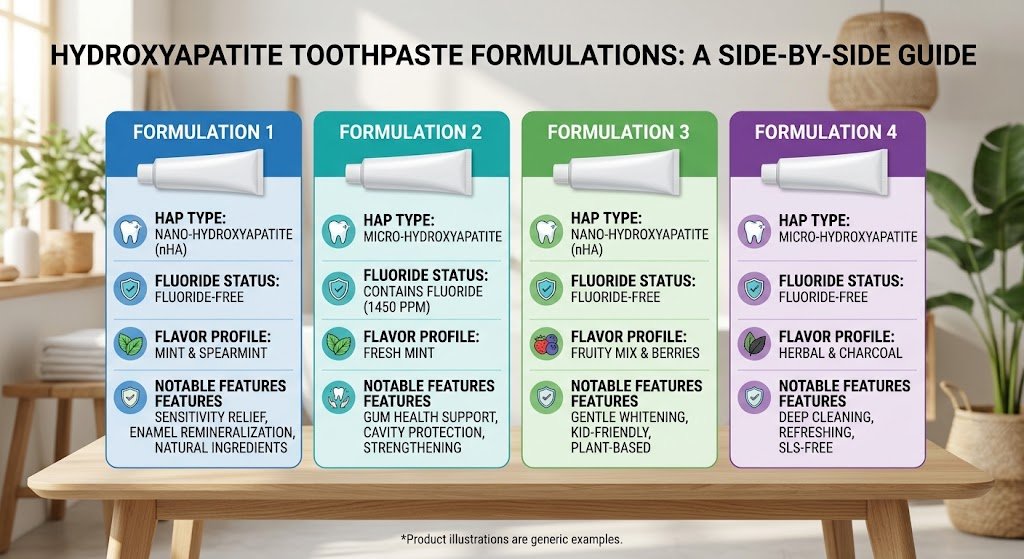
| RiseWell Hydroxyapatite Toothpaste | Everyday fluoride-free HAP care | Micro-hydroxyapatite; fluoride-free; manufacturer lists a 3.4-oz tube |
| Boka Ela Mint n-HAP Toothpaste | Shoppers specifically seeking nano-HAP and an SLS-free formula | Nano-hydroxyapatite; fluoride-free; SLS-free |
| RiseWell Flavorless Hydroxyapatite Toothpaste | People who want a flavor-minimal formulation | Hydroxyapatite; fluoride-free; no essential oils or extracts according to the manufacturer |
| RiseWell PRO Flavorless | Shoppers interested in a micro + nano-HAP formulation | Micro- and nano-hydroxyapatite; no added fluoride |
RiseWell currently lists its standard and flavorless hydroxyapatite toothpastes at $12 and its PRO Flavorless formulation at $22 on its own website; Boka currently lists Ela Mint at $11.62. Prices and formulas can change, so verify the exact product and variant before publication or purchase.
What Is Hydroxyapatite Toothpaste?
Hydroxyapatite is a calcium-phosphate mineral. In dentistry, it has attracted attention because tooth enamel and dentin contain mineral phases closely related to hydroxyapatite.
The basic idea behind HAP toothpaste is different from simply polishing the tooth surface. HAP particles can interact with the tooth surface and may contribute to mineral deposition and protection of enamel. Researchers have investigated HAP-containing products for remineralization, caries prevention, and dentin hypersensitivity.
That does not mean hydroxyapatite toothpaste literally “regrows” a damaged tooth. Early enamel mineral loss is different from a cavity that has progressed to a structural hole. Toothpaste cannot replace the need for professional treatment when a cavity or other dental disease requires treatment.
Nano-hydroxyapatite vs. micro-hydroxyapatite
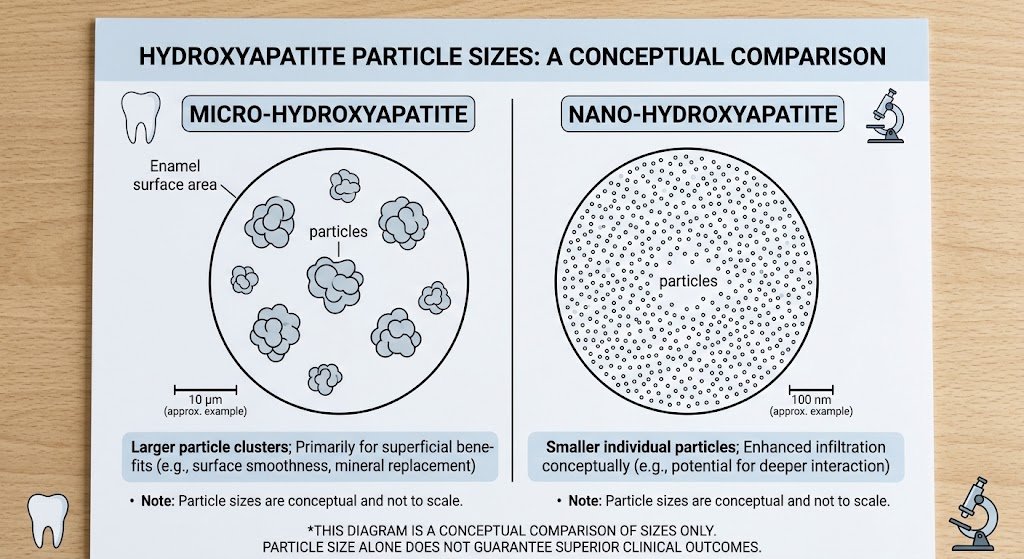
You’ll often see hydroxyapatite toothpaste divided into nano-hydroxyapatite (n-HAP) and larger or micro-sized hydroxyapatite formulations.
The distinction primarily concerns particle size. Nano-hydroxyapatite formulations use much smaller particles, while other products use micro-sized HAP or simply identify hydroxyapatite without prominently specifying a particle-size category.
Nano does not automatically mean better.
A product’s effectiveness depends on the complete formulation, concentration, particle characteristics, brushing routine, study population, and outcome being measured. Marketing language sometimes makes particle size sound like the only important variable, but it isn’t.
For example, RiseWell identifies its original formulation as micro-hydroxyapatite and its PRO formulation as containing both micro- and nano-hydroxyapatite. Boka’s Ela Mint formulation identifies nano-hydroxyapatite as its active HAP ingredient.
Does Hydroxyapatite Toothpaste Actually Work?
The short answer is promising, but the evidence needs to be interpreted carefully.
A 2024 updated systematic review and meta-analysis examined clinical evidence involving hydroxyapatite oral-care products and caries prevention. The review included clinical and in-situ evidence and concluded that the evidence base supporting HAP’s potential as an anticaries active had expanded.
However, evidence that HAP can work is not the same thing as proof that every HAP toothpaste performs identically—or that HAP has definitively replaced fluoride as the standard anticaries ingredient in the United States.
A 2025 systematic review specifically compared fluoride-free HAP toothpaste with conventional fluoride toothpaste in children, adolescents, and young adults under 25. Only four eligible in-situ randomized controlled trials were included. The meta-analysis did not find significant differences in several measures of lesion development, although some secondary measurements differed.
That’s useful information for consumers because it puts the popular “HAP vs. fluoride” discussion into perspective: the research is encouraging, but it is not a simple case of one ingredient universally winning.
There is also an important transparency point. Some HAP research has involved authors affiliated with manufacturers or companies associated with HAP products. That does not automatically invalidate the findings, but it is a reason to look at the entire evidence base rather than relying on a single study or manufacturer’s interpretation of research.
What about sensitive teeth?
Hydroxyapatite has also been studied for dentin hypersensitivity.
A systematic review and meta-analysis covering 44 human clinical trials found that HAP-containing oral-care products reduced dentin hypersensitivity compared with placebo and, in the included analysis, also showed a benefit compared with fluoride-containing comparators. The researchers nevertheless called for continued evaluation of the evidence and study methods.
This makes HAP particularly interesting for people whose main goal is sensitivity management. But sensitivity has multiple possible causes. Persistent, severe, localized, or worsening sensitivity can also be associated with issues such as decay, gum recession, cracks, or other dental problems.
Hydroxyapatite vs. Fluoride Toothpaste
This is the most important comparison to understand before choosing a fluoride-free toothpaste.
In the United States, fluoride remains the mainstream evidence-based anticaries ingredient in toothpaste. The American Dental Association says fluoride toothpaste is the general recommendation for brushing twice daily, and its toothpaste guidance identifies sodium fluoride, sodium monofluorophosphate, and stannous fluoride as anticaries fluoride compounds used in toothpaste.
The ADA also states that toothpastes carrying its Seal of Acceptance for cavity-protection claims must contain fluoride.
That creates an important distinction:
A fluoride-free hydroxyapatite toothpaste can be a legitimate product category without being an ADA-accepted fluoride cavity-protection toothpaste.
The ADA Seal is not a statement that every non-Seal toothpaste is ineffective. The ADA explains that companies voluntarily submit products and supporting evidence for scientific review, and products that complete that process can carry the Seal for specific evaluated claims.
Which approach makes sense?
Think of the choice as a risk-and-preference decision, rather than a universal winner.
| If your priority is… | What to consider |
| Established U.S. cavity-prevention standard | Fluoride toothpaste |
| Deliberately avoiding fluoride | Fluoride-free HAP toothpaste |
| Interest in HAP research | HAP toothpaste |
| Tooth sensitivity | HAP may be worth considering, alongside other evidence-based desensitizing ingredients |
| Higher personal cavity risk | Discuss fluoride and your overall prevention plan with your dentist |
| Ingredient or sensory preferences | Compare the complete ingredient list and formulation |
The right choice also depends on your individual caries risk. The ADA’s home-care guidance specifically emphasizes personalized recommendations for people at increased risk of caries or gum disease rather than assuming that one routine fits everyone.
What to Look For in the Best Hydroxyapatite Toothpaste
Once you’ve decided that HAP fits your needs, don’t stop at the words “hydroxyapatite” or “nano.”
1. Confirm that hydroxyapatite is actually in the formula
Check the ingredient list rather than relying only on the front of the package.
If a product is marketed as hydroxyapatite toothpaste, HAP should be identifiable in the ingredients. Boka’s Ela Mint formula, for example, lists hydroxyapatite and identifies it as nano-hydroxyapatite. RiseWell’s formulations likewise list hydroxyapatite, with the PRO Flavorless formula additionally listing nano-hydroxyapatite.
2. Check whether it contains fluoride
“Hydroxyapatite toothpaste” and “fluoride-free toothpaste” are not synonymous.
Some consumers specifically want a fluoride-free formulation, while others may be looking for a toothpaste that contains both HAP and fluoride. Always check the current ingredient list and active-ingredient information for the exact product.
3. Don’t assume nano-HAP is automatically superior
Nano-hydroxyapatite is an interesting formulation category, but particle size alone isn’t enough to establish that one product will provide better real-world outcomes for every user.
Look at the entire formulation and the evidence supporting the intended benefit.
4. Consider sensitivity-related ingredients
If sensitivity is your main reason for shopping for HAP toothpaste, look beyond the HAP label.
For example, Boka’s separate Sensitive n-Ha toothpaste is described by the manufacturer as containing 5% potassium nitrate, an established desensitizing active.
That distinction matters: a toothpaste can contain HAP without being specifically formulated around sensitivity.
5. Check surfactants, flavors, and other ingredients
SLS-free formulas may appeal to people who dislike the sensation associated with certain conventional toothpastes or have specific ingredient preferences.
Boka’s Ela Mint is marketed as SLS-free, while RiseWell’s Flavorless formulation is marketed without essential oils or extracts.
These are formulation characteristics, not proof that one product is medically superior to another.
6. Look at the complete label, not just marketing terms
Terms such as “natural,” “clean,” “mineral,” or “non-toxic” can describe a brand’s positioning, but they do not substitute for evidence of a toothpaste’s clinical performance.
A better shopping checklist is:
- HAP type disclosed?
- Fluoride present or absent?
- Intended use clearly stated?
- Full ingredient list available?
- Sensitivity active included if needed?
- Flavor and essential-oil profile acceptable?
- Current formulation verified?
- Appropriate for your age and dental needs?
- Evidence available for the specific benefit being claimed?
Best Hydroxyapatite Toothpaste by Use Case
Instead of declaring one product “the best,” the following categories match documented formulation characteristics with common shopping needs.
Best for straightforward fluoride-free HAP care: RiseWell Hydroxyapatite Toothpaste
RiseWell’s standard Hydroxyapatite Toothpaste is a 3.4-ounce fluoride-free formulation that lists hydroxyapatite among its ingredients. The manufacturer identifies its HAP as micro-hydroxyapatite.
This makes it a straightforward option for shoppers who specifically want a conventional HAP formulation without fluoride.
Consider it if: you want a fluoride-free daily toothpaste centered on micro-HAP.
Check before buying: the current ingredient list and exact variant, since manufacturers can update formulations.
Best for SLS-free nano-HAP: Boka Ela Mint
Boka Ela Mint uses nano-hydroxyapatite and is marketed as fluoride-free and SLS-free. Its current ingredient list also includes flavoring oils and other botanical ingredients, so it is worth checking the full label if you have particular flavor or ingredient sensitivities.
Consider it if: you specifically want nano-HAP and an SLS-free formulation.
Check before buying: whether the flavor profile and full ingredient list suit you.
Best for a flavor-minimal formula: RiseWell Flavorless
RiseWell’s Flavorless Hydroxyapatite Toothpaste is marketed as fluoride-free and without essential oils or extracts. The manufacturer positions it for people who want a particularly gentle, flavor-minimal formulation.
Consider it if: strong mint, essential oils, or complex flavor profiles are a reason you avoid certain toothpastes.
Check before buying: “flavorless” does not necessarily mean completely tasteless; the manufacturer describes the product as having a light, sweet flavor.
Best for shoppers interested in micro + nano-HAP: RiseWell PRO Flavorless
RiseWell’s PRO Flavorless formulation lists both micro- and nano-hydroxyapatite and states that it contains no added fluoride. The manufacturer currently lists the 3.4-ounce product at $22, compared with $12 for its standard and Flavorless formulations.
Consider it if: you specifically want a formulation combining micro- and nano-HAP.
Check before buying: whether the additional cost is worthwhile for your particular priorities. A higher-priced formulation is not automatically proven to deliver better clinical outcomes.
Who Should Choose Hydroxyapatite Toothpaste?
Hydroxyapatite toothpaste may make sense for consumers who:
- Specifically want a fluoride-free toothpaste.
- Are interested in calcium-phosphate or biomimetic oral-care formulations.
- Want to explore HAP for enamel-care or sensitivity-related goals.
- Prefer particular ingredient characteristics such as SLS-free or flavor-minimal formulas.
- Have compared the evidence and understand the tradeoff between a fluoride-free choice and the established U.S. fluoride toothpaste standard.
The key is to choose it intentionally rather than assuming “natural” or “mineral” automatically means more effective.
If you’re already seeing a dentist regularly, your caries history is one of the most useful pieces of information for deciding whether a fluoride-free routine is appropriate for you.
Who May Prefer Fluoride Toothpaste Instead?
For many people, fluoride toothpaste remains the straightforward evidence-based choice for cavity prevention.
The ADA recommends brushing twice daily with fluoride toothpaste for two minutes as a general home-care recommendation. It also notes that people at increased risk of caries may need personalized preventive recommendations.
You may want to discuss fluoride toothpaste with your dentist if you:
- Have frequent or recurrent cavities.
- Have been told you have elevated caries risk.
- Have a history of significant enamel demineralization.
- Are using prescription-strength fluoride.
- Have a dental condition requiring a personalized prevention plan.
This doesn’t mean HAP toothpaste has no value. It means the decision should account for your actual cavity risk, not just ingredient preferences.
Common Hydroxyapatite Toothpaste Mistakes
Mistake 1: Assuming “fluoride-free” means “cavity-proof”
No toothpaste makes someone immune to cavities.
Caries prevention depends on multiple factors, including oral biofilm, diet, saliva, fluoride exposure, brushing habits, and individual risk.
Mistake 2: Treating nano-HAP as a guarantee of superior performance
Nano-HAP is a formulation characteristic—not a guarantee that a specific toothpaste will outperform every other HAP or fluoride toothpaste.
Mistake 3: Ignoring the rest of the ingredient list
If you have strong preferences around SLS, essential oils, flavors, sweeteners, or other ingredients, read the full ingredient list.
Mistake 4: Confusing the ADA Seal with a general “approval”
The ADA Seal applies to products that have gone through the ADA’s voluntary review process for specific claims. The ADA specifically lists fluoride toothpaste under its cavity-prevention Seal category.
Don’t describe a fluoride-free HAP toothpaste as “ADA approved” unless you have verified a specific ADA Seal and claim for that exact product.
Mistake 5: Assuming a product’s formula never changes
Manufacturers can change ingredients, sizes, packaging, and variants. Always verify the current product page and package before publishing product-specific information.
How to Choose Hydroxyapatite Toothpaste in 60 Seconds
Use this quick decision process:
1. Do you specifically want fluoride-free toothpaste?
- Yes: Continue to HAP options.
- No: Compare HAP and fluoride formulations based on your oral-health priorities.
2. Is cavity prevention your highest priority?
- Higher risk: Discuss your toothpaste choice with your dentist; fluoride remains the established U.S. anticaries standard.
- Lower risk / preference-driven: Continue comparing HAP formulations.
3. Is sensitivity your main concern?
Look for HAP plus an appropriate desensitizing formulation rather than assuming every HAP toothpaste is equivalent.
4. Do you care about SLS or flavor ingredients?
Read the complete ingredient list.
5. Do you specifically want nano-HAP?
Choose a product that clearly identifies nano-hydroxyapatite in its current formulation.
6. Are you comparing price?
Compare the tube size, purchase price, refill/subscription terms, and amount used per brushing—not just the sticker price.
7. Before ordering
Verify the exact formulation and current availability. If you’re buying through Amazon, compare the product title, size, seller, and current ingredient information with the manufacturer’s product page where possible.
FAQ: Hydroxyapatite Toothpaste
Does hydroxyapatite really remineralize teeth?
Research supports the potential of hydroxyapatite-containing oral-care products to contribute to remineralization and caries prevention, but “remineralization” should not be interpreted as regenerating a tooth that has been structurally destroyed by a cavity. Recent systematic reviews have found promising evidence while also identifying limitations in the available research.
Is hydroxyapatite better than fluoride?
The evidence does not support a blanket statement that hydroxyapatite is better than fluoride for everyone. Fluoride remains the established anticaries ingredient in U.S. toothpaste recommendations, while research on fluoride-free HAP continues to develop.
Is nano-hydroxyapatite safe?
Nano-hydroxyapatite has been studied extensively in oral-care research, including human clinical research. However, safety and effectiveness are properties of a particular formulation and use—not simply consequences of the word “nano.” Review the product’s current labeling and discuss individual concerns with a dental professional.
Can hydroxyapatite toothpaste prevent cavities?
Clinical research suggests HAP-containing oral-care products can help reduce caries risk, and recent systematic reviews have expanded the evidence base. However, the evidence is not a reason to claim that all HAP toothpaste prevents cavities equally or that it is universally equivalent to fluoride.
Is hydroxyapatite good for sensitive teeth?
Hydroxyapatite has evidence supporting a potential role in reducing dentin hypersensitivity. A systematic review of 44 human clinical trials found significant reductions compared with placebo and fluoride in its included analyses.
For persistent or severe sensitivity, however, toothpaste should not substitute for determining the underlying cause.
Can I use hydroxyapatite toothpaste every day?
Many commercial HAP toothpastes are formulated for daily use. For example, Boka describes its Ela Mint toothpaste as designed for daily care, while RiseWell describes its Flavorless formulation as suitable for everyday brushing.
Follow the directions for the specific product you purchase.
Is hydroxyapatite toothpaste ADA approved?
Do not use “ADA approved” as a generic description for hydroxyapatite toothpaste.
The ADA Seal of Acceptance is awarded through a specific voluntary review process, and the ADA’s cavity-protection toothpaste category is based on fluoride dentifrices.
If an article claims that a particular HAP product has an ADA Seal, verify the exact product in the ADA’s current database before publishing.
What should I look for on a hydroxyapatite toothpaste label?
At minimum, check:
- Whether hydroxyapatite is listed as an ingredient.
- Whether the formula contains fluoride.
- Whether nano-HAP or another HAP type is identified.
- The complete ingredient list.
- Any sensitivity-specific active ingredient.
- Flavoring, essential oils, or surfactants that matter to you.
- Directions and age recommendations.
- The exact product variant.
The Bottom Line
The best hydroxyapatite toothpaste is not necessarily the one with the most aggressive marketing or the most reviews. A better approach is to match the formulation to your actual priorities.
For straightforward fluoride-free HAP care, RiseWell’s standard formulation is one example of a micro-HAP product. For shoppers specifically interested in nano-HAP and an SLS-free formula, Boka Ela Mint is another option. RiseWell’s Flavorless formulation focuses on a minimal flavor profile, while its PRO Flavorless formulation combines micro- and nano-HAP. These distinctions are useful for shopping, but they should not be confused with proof that one product is clinically superior to all others.
Most importantly, understand the fluoride tradeoff. Fluoride toothpaste remains the American Dental Association’s general recommendation for twice-daily brushing and is the basis for ADA cavity-protection toothpaste claims. Hydroxyapatite is a promising alternative area of research, particularly for consumers who intentionally prefer fluoride-free care, but the evidence should be interpreted without turning manufacturer claims into universal conclusions.
If you’ve identified the formulation that fits your needs, the next step is simply to verify the current ingredients, size, price, seller, and product variant before purchasing.
